i
Mythologies of possible futures: Between Science Fiction and Reality DDH ()


Mythologies of possible futures: Between Science Fiction and Reality


Activation

Hello wrldz ;)

Formalities

decide whether You want to validate the course as Studium Generale or Wissenschaften / Theorie

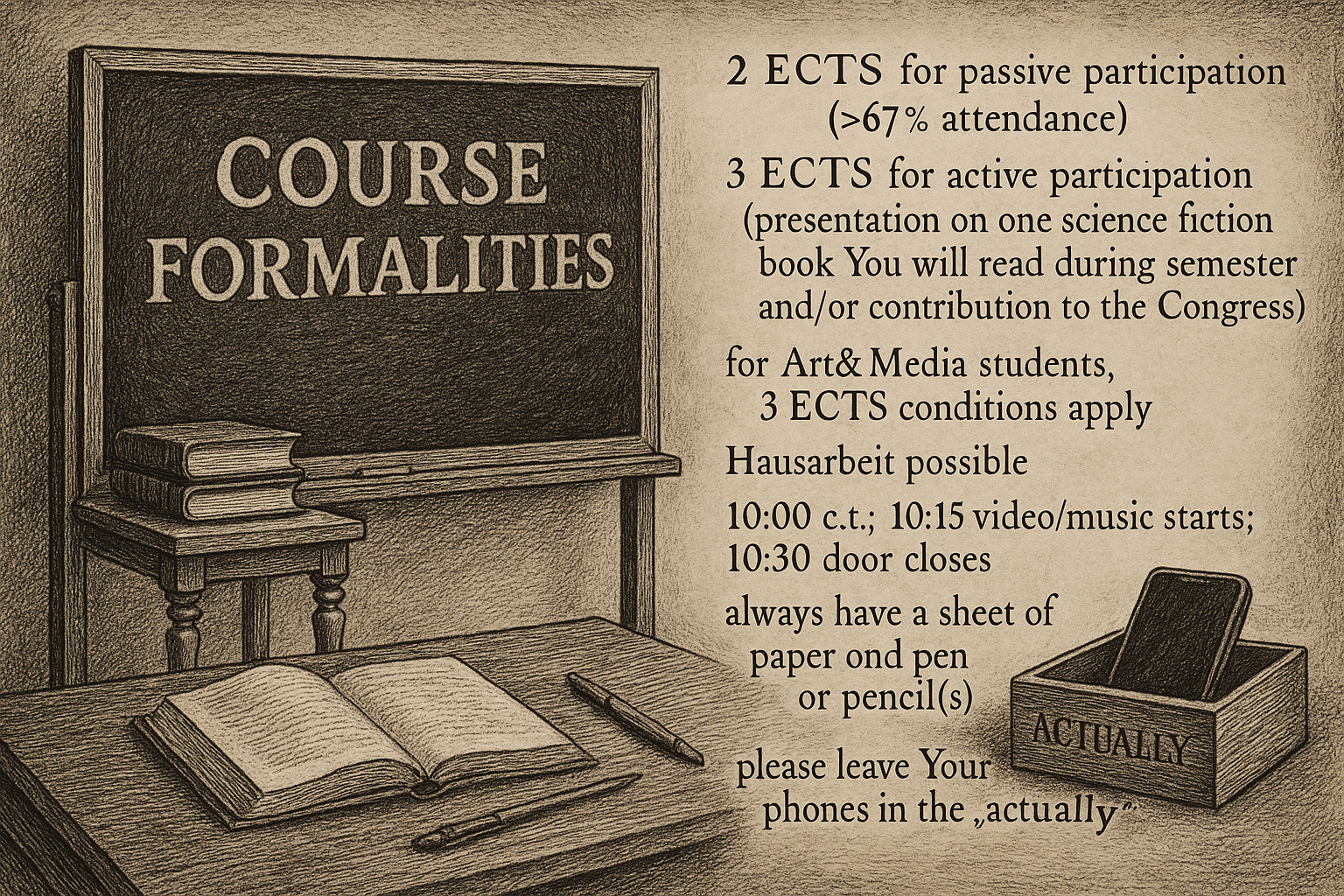
2 ECTS for passive participation (>67% attendance)

3 ECTS for active participation (referat about one sci-fi book You will read during semester and/or contribution to the Congress)

for Art&Media students, the 3 ECTS conditions apply

Hausarbeit possible

10:00 c.t. (cum tempore); 10:15:00 video/music starts; 10:30:00 door closes

always have a sheet of paper and pen or pencil(s)

please leave Your phones in the "actually box"

AIs allowed (&welcome !)

Why this course ?

This course is hommage to PhDr. Ľubica Gabrišková, CSc. (✝ 12. 2. 2008) whose courses on science-fiction at Charles University's Faculty of Humanities and cosmology I had the highest honor to follow.
Cautionary note

We are going to visit MANY (N~67) different worlds. 
There will be benign forces and there will be daemons. There will be drugs, there will be weapons and there will be artefacts and rituals You Yourself are to deploy and create. 

There will be metatextual references to HERE & NOW.

You have been warned: Fasten Your seat-belts or leave the ship until You can.

Overview

Overview

Metamyth

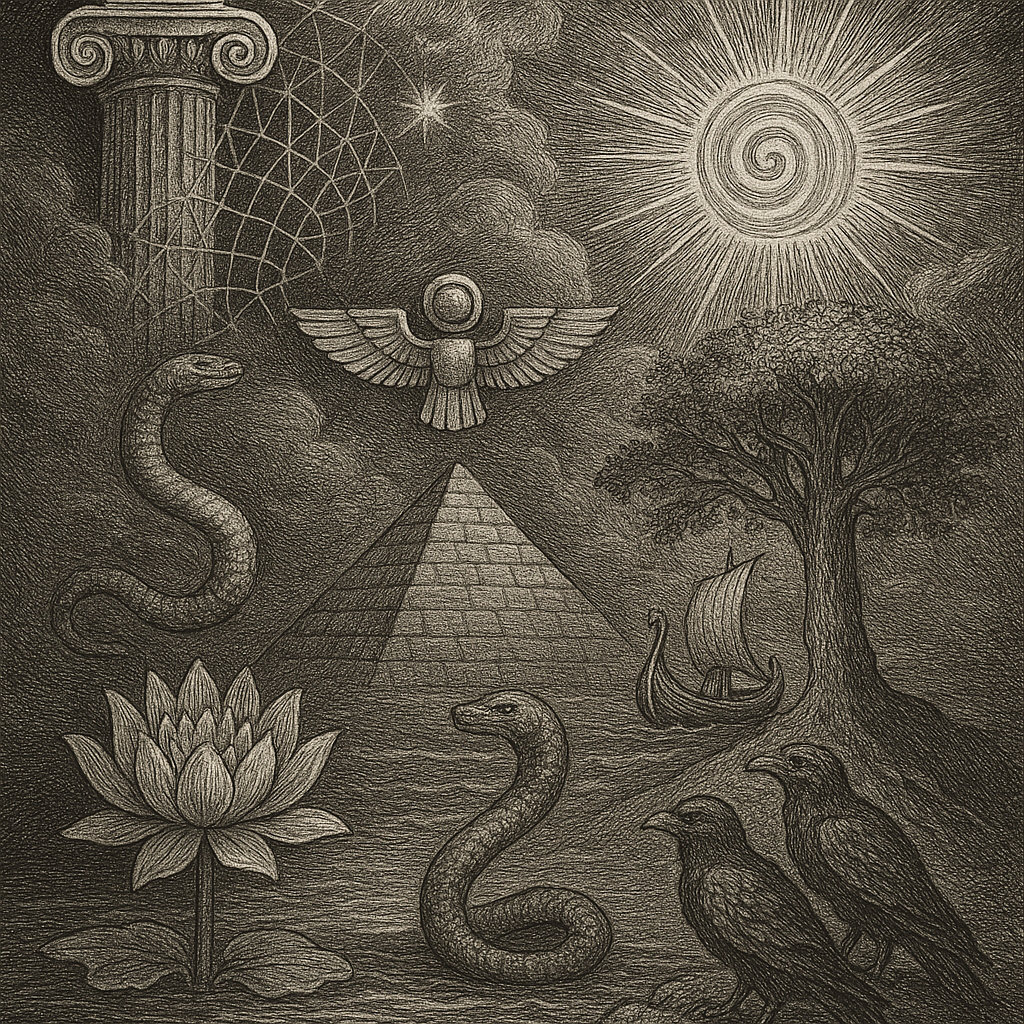
What we / You aspire to deploy is a ΜΕΤΑΜΥΘ - an idealist framework beyond all the other frameworks: a story so consistently inconsistent, so asymmetrically symmetrical that it is able to embrace all other stories (including itself).

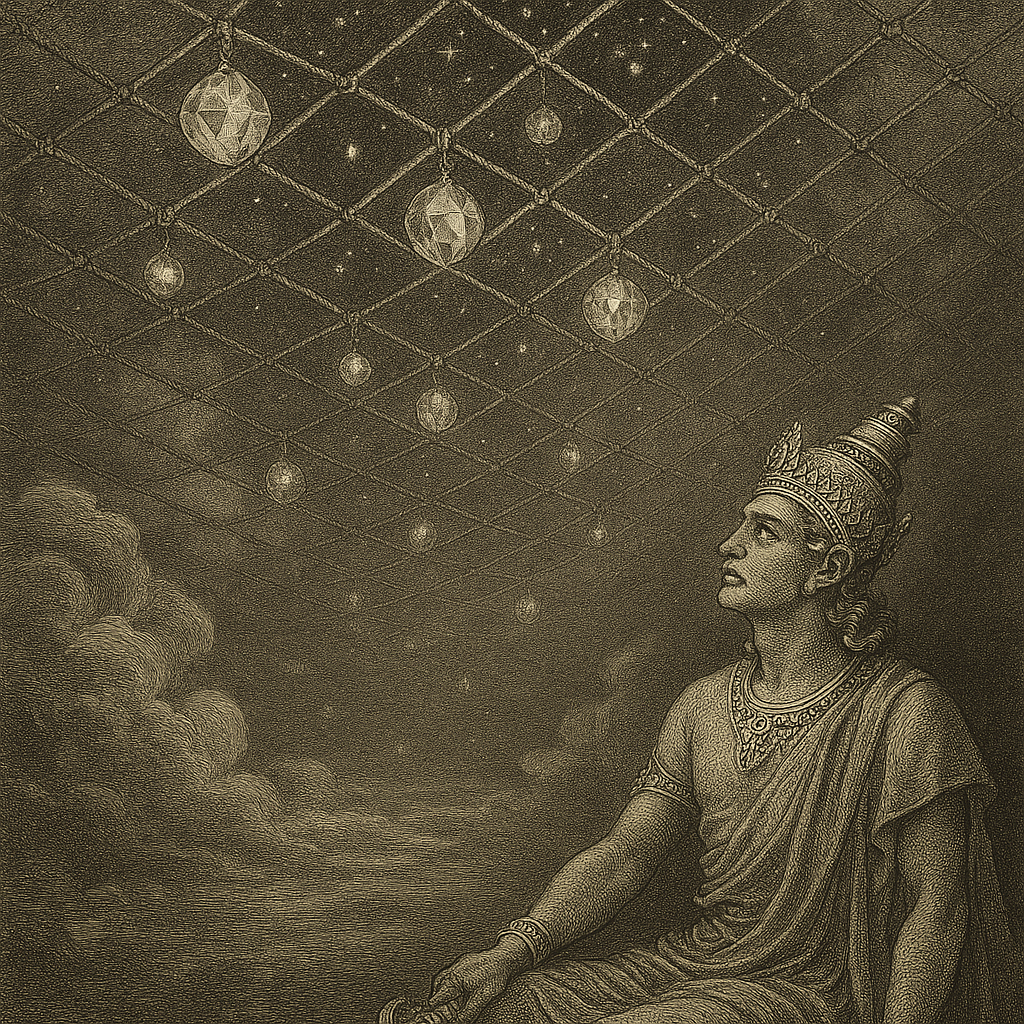
Artefact of the day - Indra's Net

“In the palace of the god Indra is a net, which is hung by some marvelous artisan in such a way that it extends infinitely in all directions. Each jewel in this net is clear and bright, and in each jewel are reflected all the other jewels in the net, infinite in number. In each of the reflected jewels are seen again all the others, and this goes on infinitely.”

Flower Ornament Scripture: A Translation of the Avataṃsaka Sūtra by Thomas Cleary (Shambhala, 1993) Book 35 (The Wondrous Adornments of the Ruler of the Universe)

Lecture - 9 * 10^9 Names of God

Please read at home Arthur C. Clarke's 1952 short story

Practical Seminars

Practical Seminars "Art of Programming" and "AI Embedded ecosystems" start today at 14:00 in Medienhaus R310.

Exercise - Letter to Your future Self

Imagine: it's year 20030 and for the N-th time, You just left Your cryogenic chamber, fresh and ready to act.

On the table, there is a bunch of letters You wrote to Your future selves with an intention to be read (and re-read) thousands and thousands of years in future. 

You open the letter in the envelope with id "0" and read ...

The 0th exercise for You is to write that letter. NOW

Closing Quote

"One of the defining characteristics of Sci-Fi is that it's about worlds. You create a world first, and then you tell one or more stories in that world."

(Neal Stephenson in Locusmag Interview about the Baroque Cycle)

Seeding myths

Let's start the vertical and horizontal analysis of past, present and future myths.

TOPOI

Which topics are common to sci-fi ? Which ones are shared with other forms of fiction (fairy-tales, mythology, fantasy, speculative fiction) ? Which topics distinguish it from other forms of fiction ?

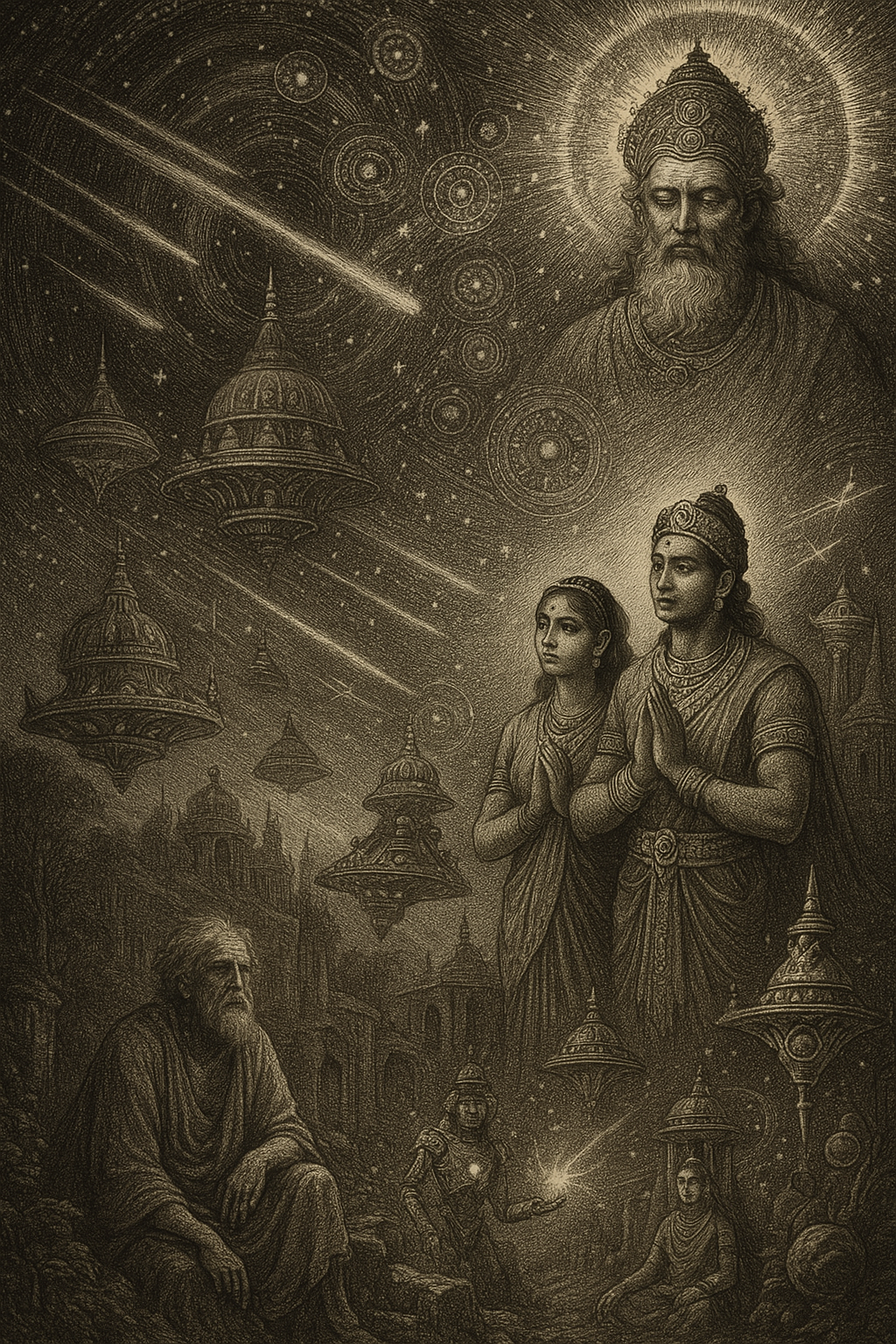
India

King Kakudmi & Revati visit Brahmā’s realm — return after 27 yuga cycles (Bhāgavata Purāṇa 9.8.26–28).

King Muchukunda sleeps for an age; awakens after Manvantaras have passed (Mahābhārata 3.186).

Vimānas described in Mahābhārata & Rāmāyaṇa — flying chariots with propulsion and weapon systems

Brahmāstra & other astra weaponry reminiscent of nuclear weapons (Mahābhārata)

Maya Dānava’s flying palaces & mechanical beings → engineered automatons and anti-gravity craft.

Brahma’s day and night cycles — billions of human years each → cosmic time loops / cyclic universe.

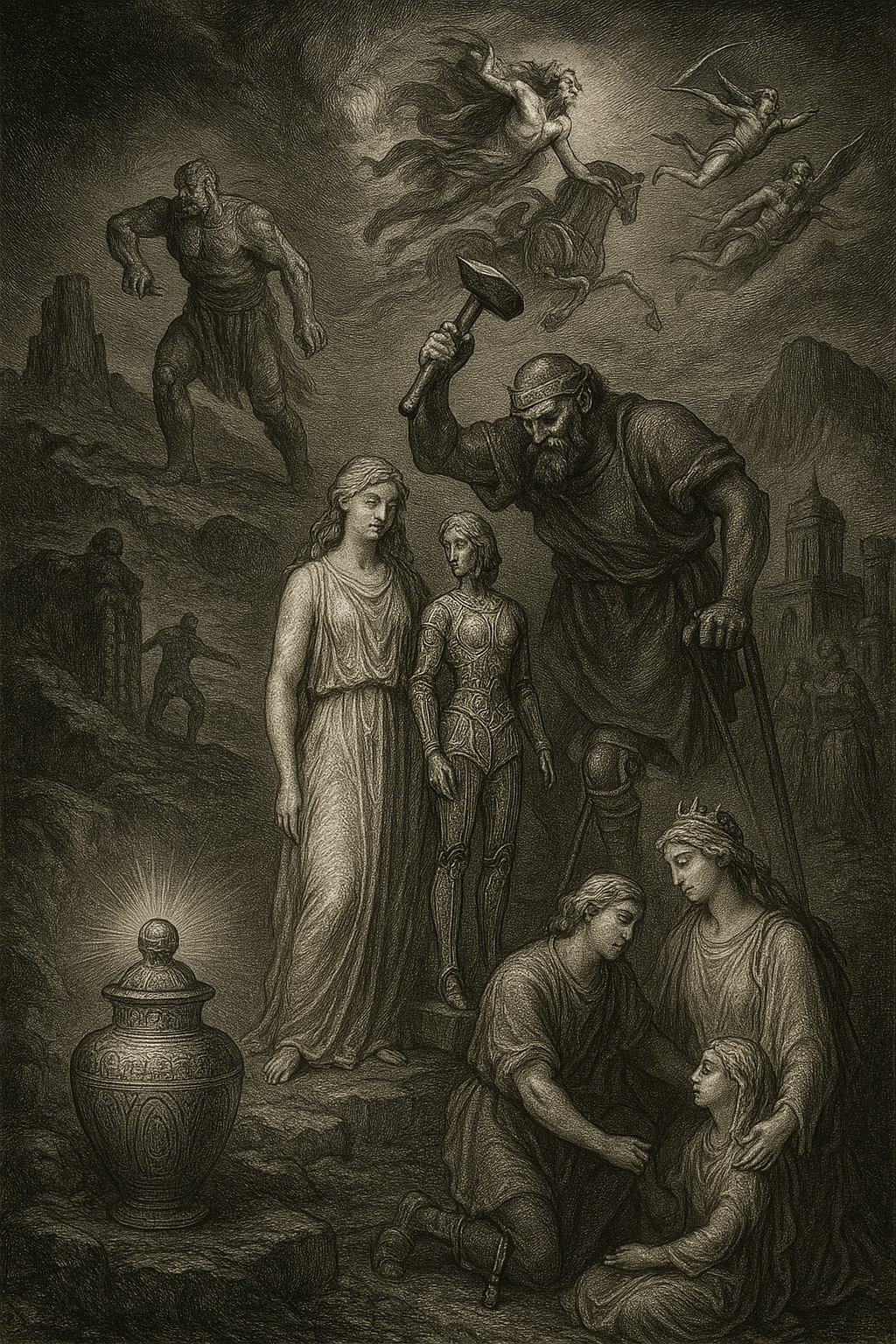
Greece

Pandora — first woman crafted from clay → engineered being.

Pygmalion — sculptor creates a synthetic woman brought to life by Aphrodite → early android animation myth.

Talos of Crete — bronze giant patrolling the island; → robotic sentinel.

Hephaestus’s mechanical servants — self-moving golden maidens → robot assistants.

Helios’s son Phaethon — seizes the solar chariot, loses control → allegory of human misuse of cosmic technology.

Daedalus & Icarus — inventors of mechanical wings; human-made flight technology defying natural limits.

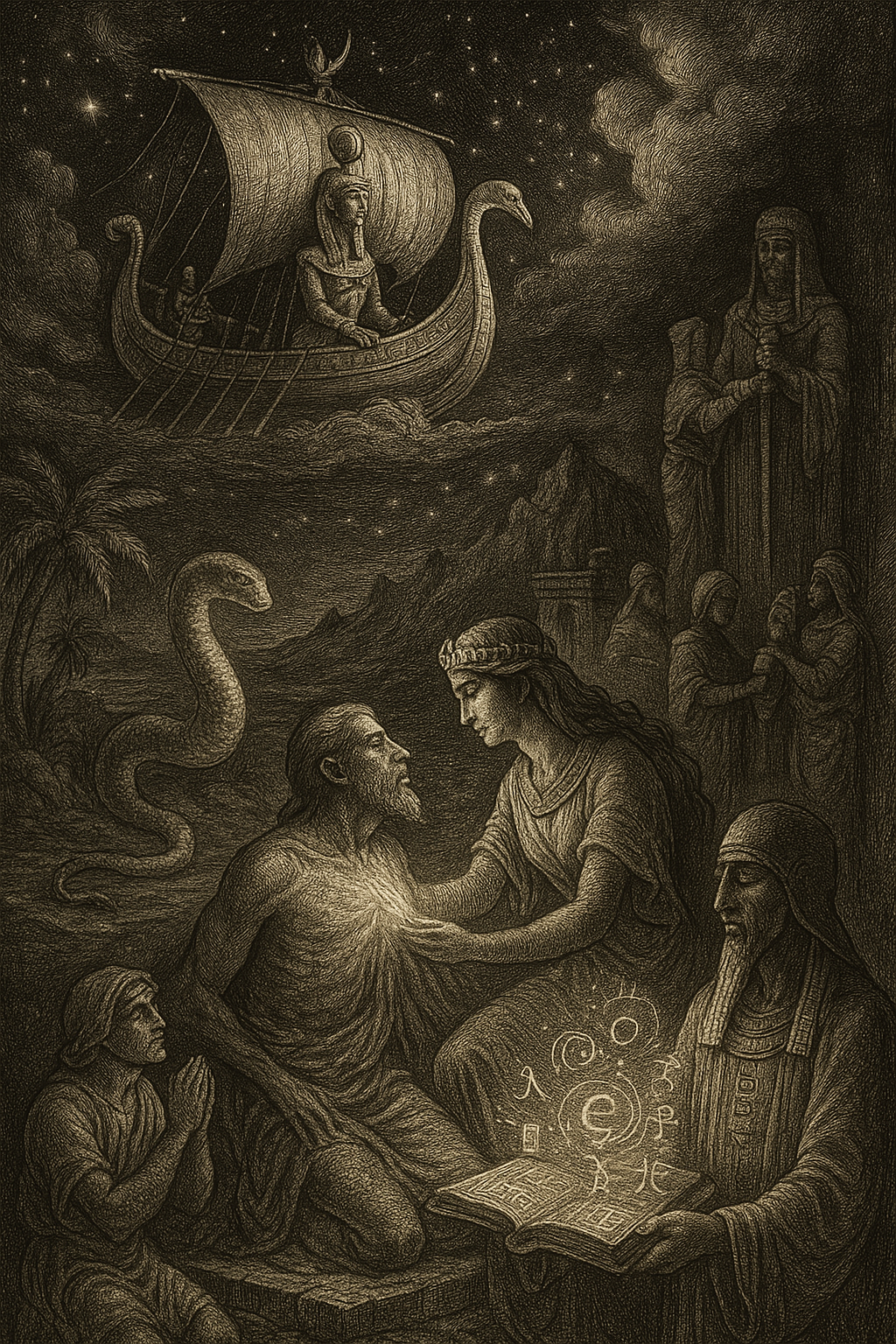
Egypt

Ra’s solar barque sails across sky and underworld each day → cosmic ship.

The Duat (𓂋𓏏𓈉) as cyclical underworld journey → time loop / nightly reset of the cosmos.

Isis reassembles and revives Osiris → early image of biotech resurrection.

The Shipwrecked Sailor meets a radiant serpent being on a lost island → hint of alien encounter.

“Opening of the Mouth” (𓅱𓊪𓏏𓂋) ritual reanimates statues and mummies → animation technology.

Thoth’s Book of Knowledge grants control over time, speech, and nature → forbidden technology.

China

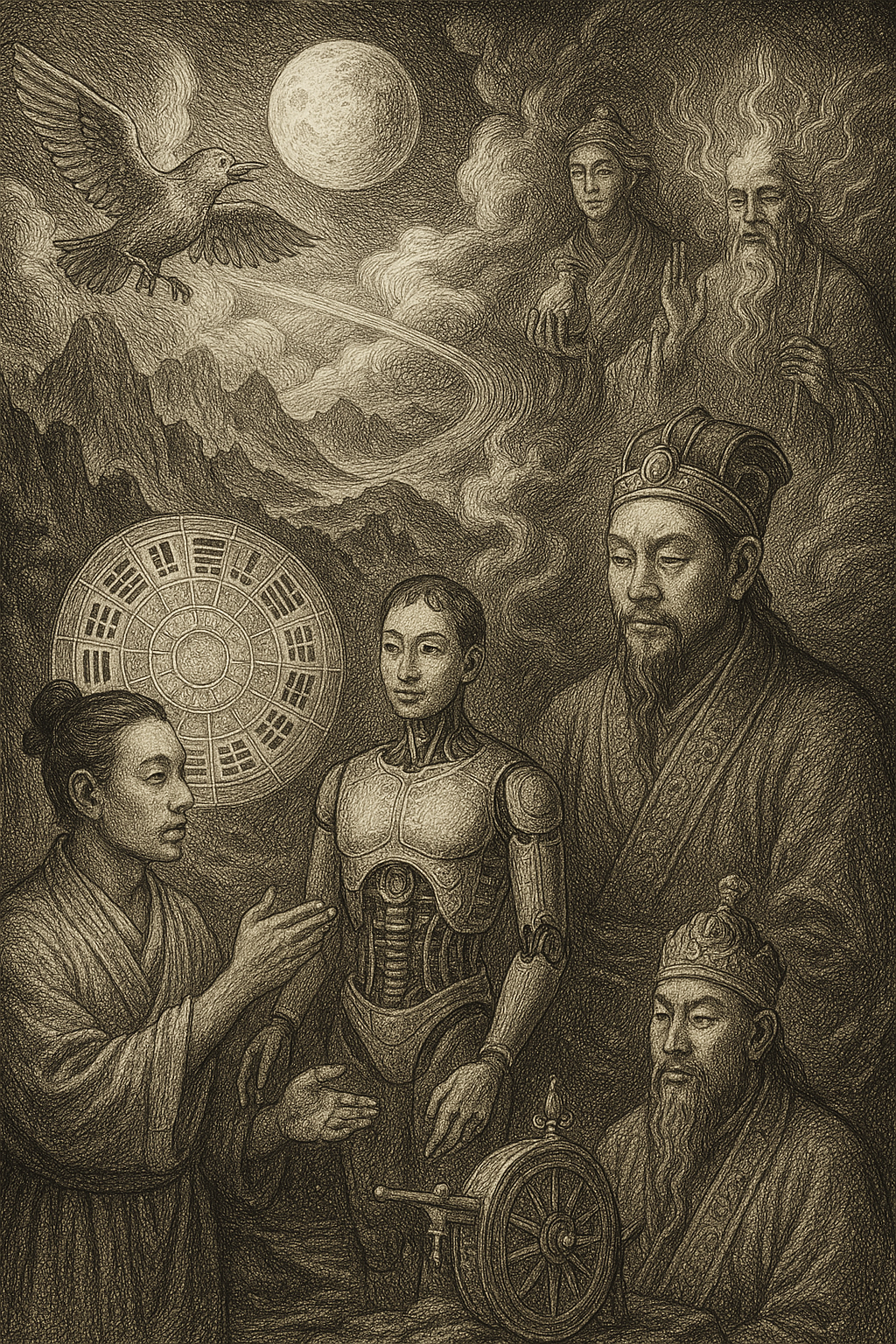
The artificer Yan Shi presents the Yellow Emperor with a mechanical man of wood and leather — moves, sings, even flirts → one of the earliest robot legends.

Lu Ban’s wooden bird flies for days without rest → ancient image of aerial engineering or autonomous drone.

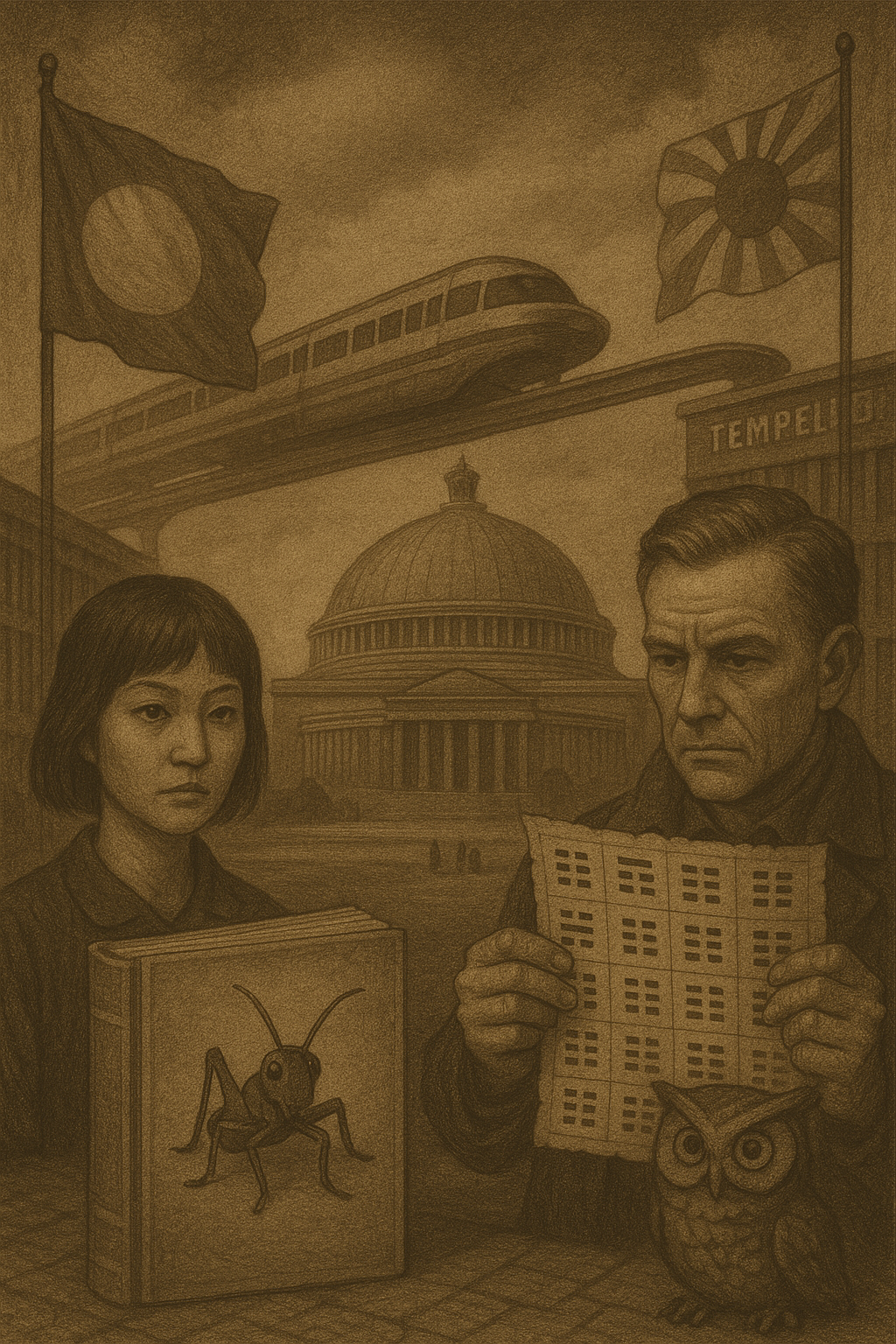
The I Ching encodes the universe in 64 binary hexagrams → a proto-digital code.

The Yellow Emperor’s cosmic compass and carriage always pointing south → navigation technology based on magnetic principles.

Chang’e ascends to the Moon after drinking the elixir of immortality → lunar colonization narrative.

Taoist Immortals → subjective time control and bioengineering.

Maya and Inca

Maya and Inca

Yorumba, Dogon &c.

Yorumba, Dogon &c.

Edda & Kalevala

Edda & Kalevala

Artefact of the day - Table of destiny

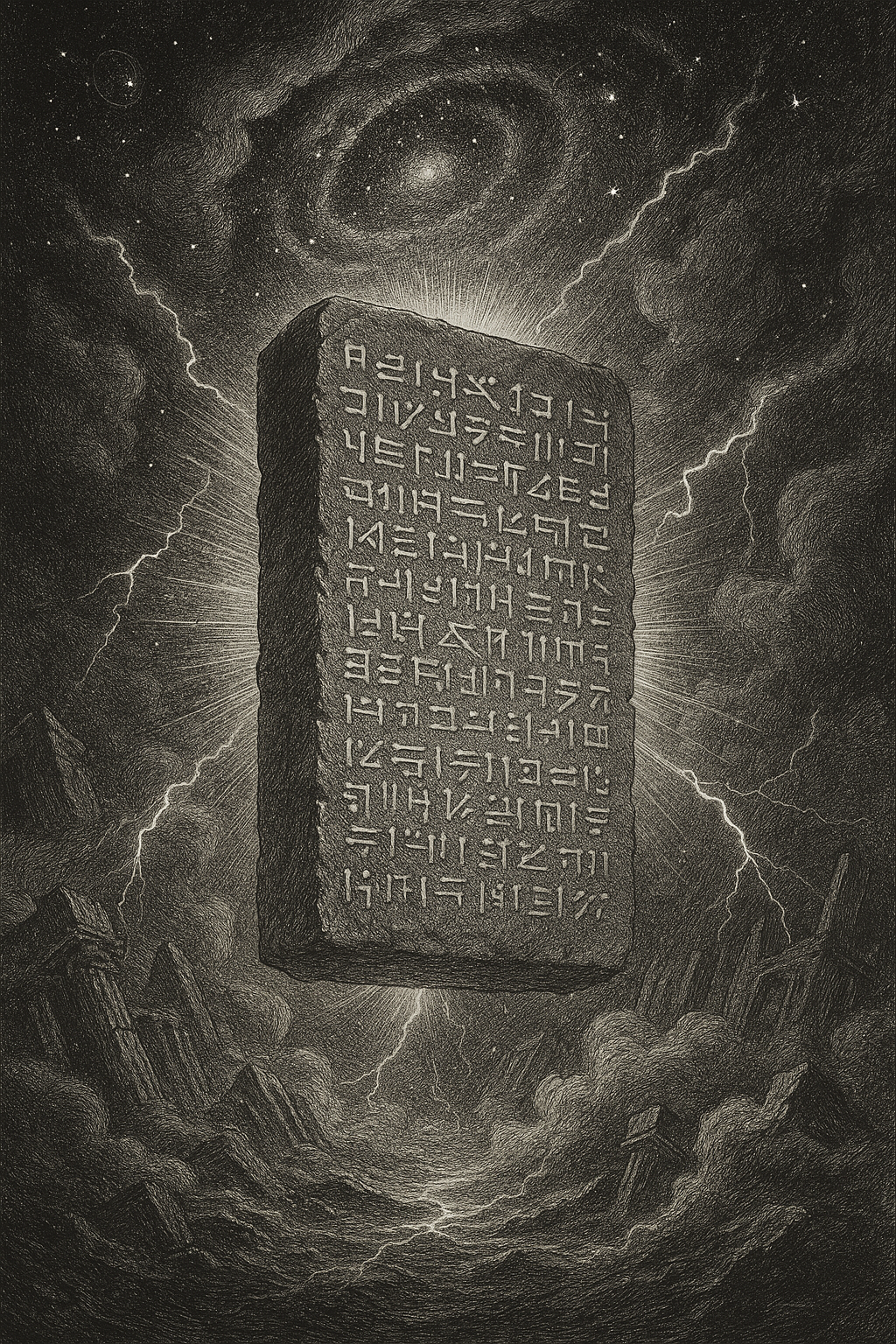
Ancient Sumerian–Babylonian mythic tablets inscribed with the divine code of the universe — whoever possessed them controlled fate, kingship, and cosmic order. In myths like Enuma Elish and Anzu, the theft of the Tablets causes chaos in heaven and on earth, until they’re recovered by the gods.

Lecture for next week

  • The Mahābhārata – The Vimana Episode

  • The Painter and the Mechanical Maiden

  • Daedalus and Icarus

  • King Kakudmi and Revati

  • King Muchukunda Awakens

  • Wang Ziqiao Ascends to Heaven

  • The Shipwrecked Sailor

  • The Hymn to Soma

Antiquity to Renaissance

Dark age & co.

Exercise

Think about the superpower You declared last week that You want to have. It's year 2070 and You fully developed it and use it. Your grand-children and/or students ask You to them Your know-how. What would You tell them ? Write it (or draw it).

Artefact of the day: SAMPO

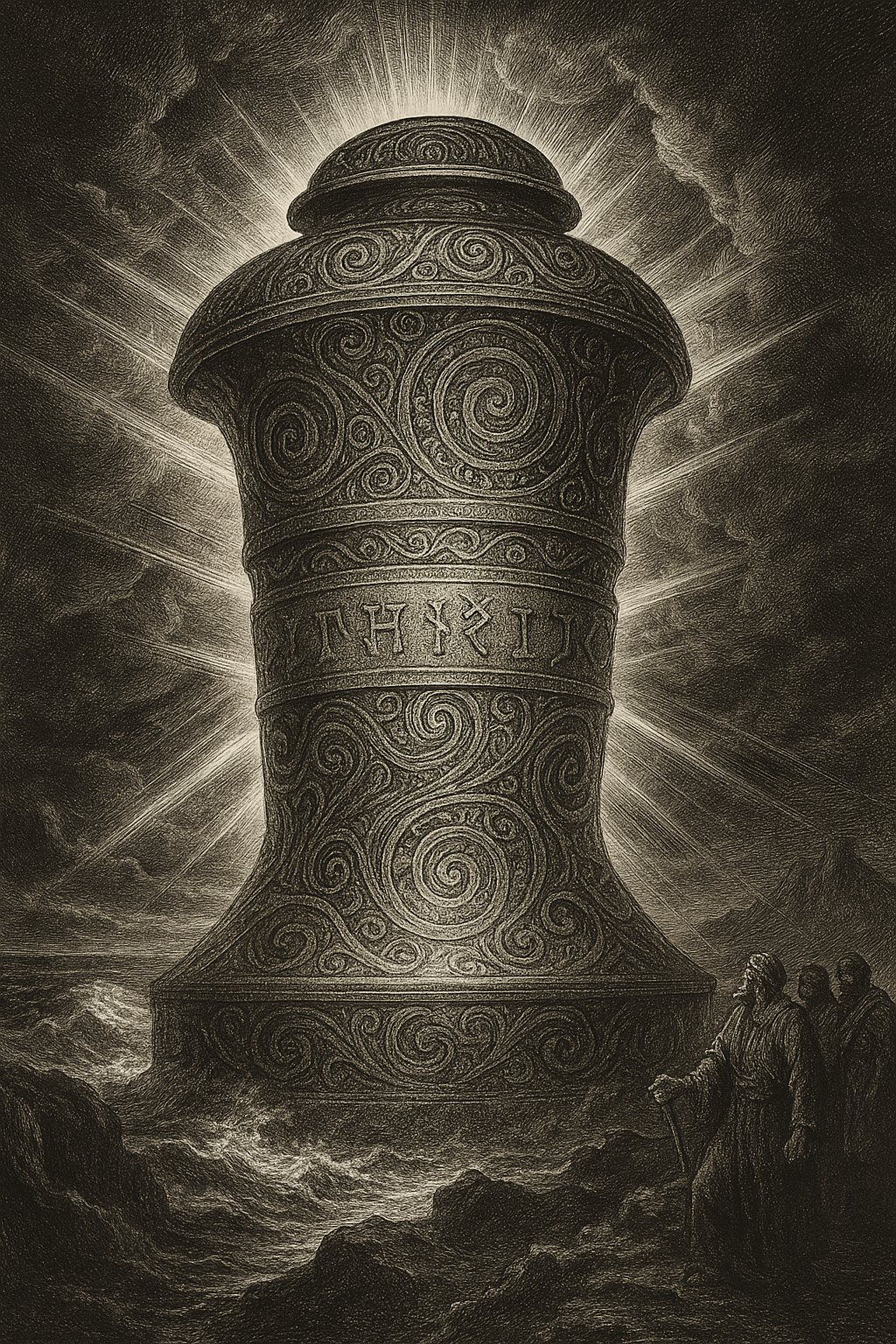
the Sampo — a mysterious artifact forged by the smith-god Ilmarinen, source of endless abundance.

Sampo's nature is never fully defined — part mill, part cosmic axis, part perpetual energy machine.

A myth of technology and desire: whoever controls the Sampo controls creation, prosperity, and fate.

as usual, its forging and theft ignite a cosmic struggle...

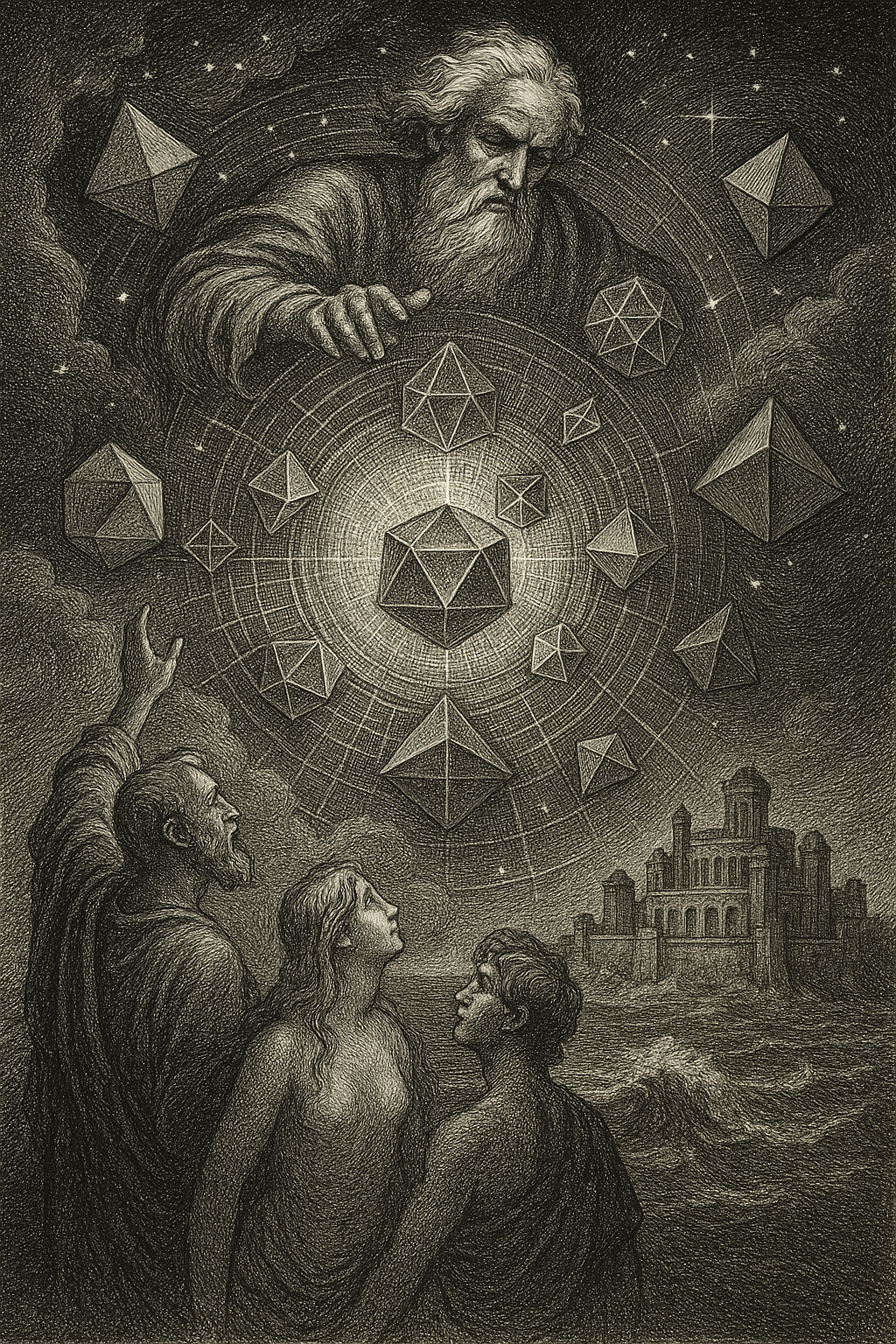
Timaeus

  • Cosmos as a living being — created by a divine craftsman (*Demiurge*).
  • Blending of ΜΥΘΟΣ and ΛΟΓΟΣ: a “likely story” (*eikôs muthos*) explaining the universe.
  • Mathematical harmony as the structure of reality — geometry as sacred order.
  • Creation of the human soul from cosmic ingredients — microcosm mirrors macrocosm.
  • Introduction of Atlantis — mythic civilization of technological ὝΒΡΙΣ (hybris).

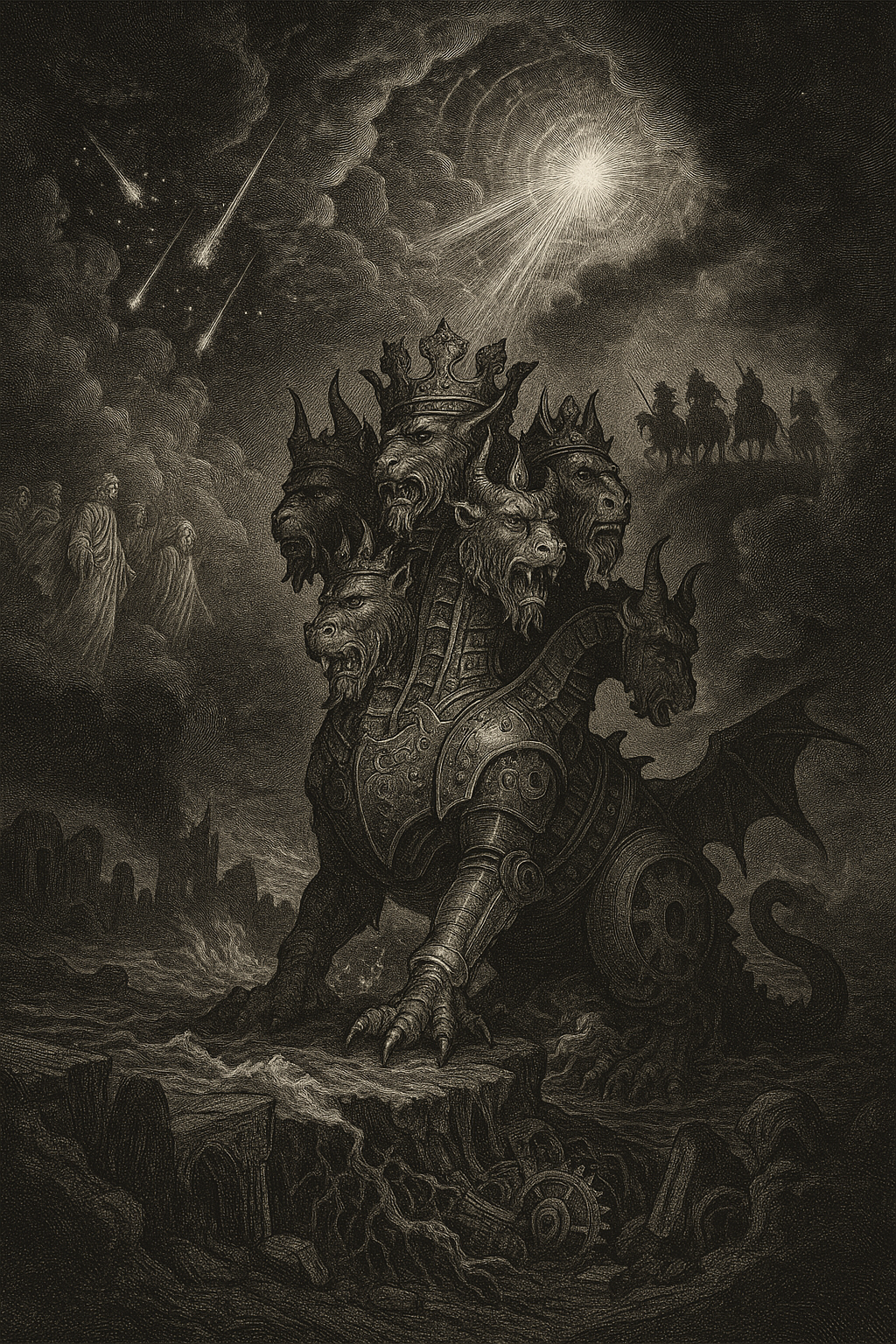
Apocalypse of John of Patmos

  • Combines Jewish apocalyptic motifs with Greco-Roman symbolism — the empire recast as beast-machine.
  • Cosmic imaginery: stars fall, beasts rise, heavens open.
  • Mythic archetypes of dualism — light vs. darkness, human vs. inhuman, cosmos vs. chaos.
  • Proto–science fiction imagination: global catastrophe, cosmic warfare, transformation of bodies and worlds.
  • Influence on modern dystopia, mythologies & technologies (e.g. tech bros building their bunkers are often influenced by this narrative).
  • note: added into the canon in 2nd half of 4th century (potentially due to confusion between two Johns)

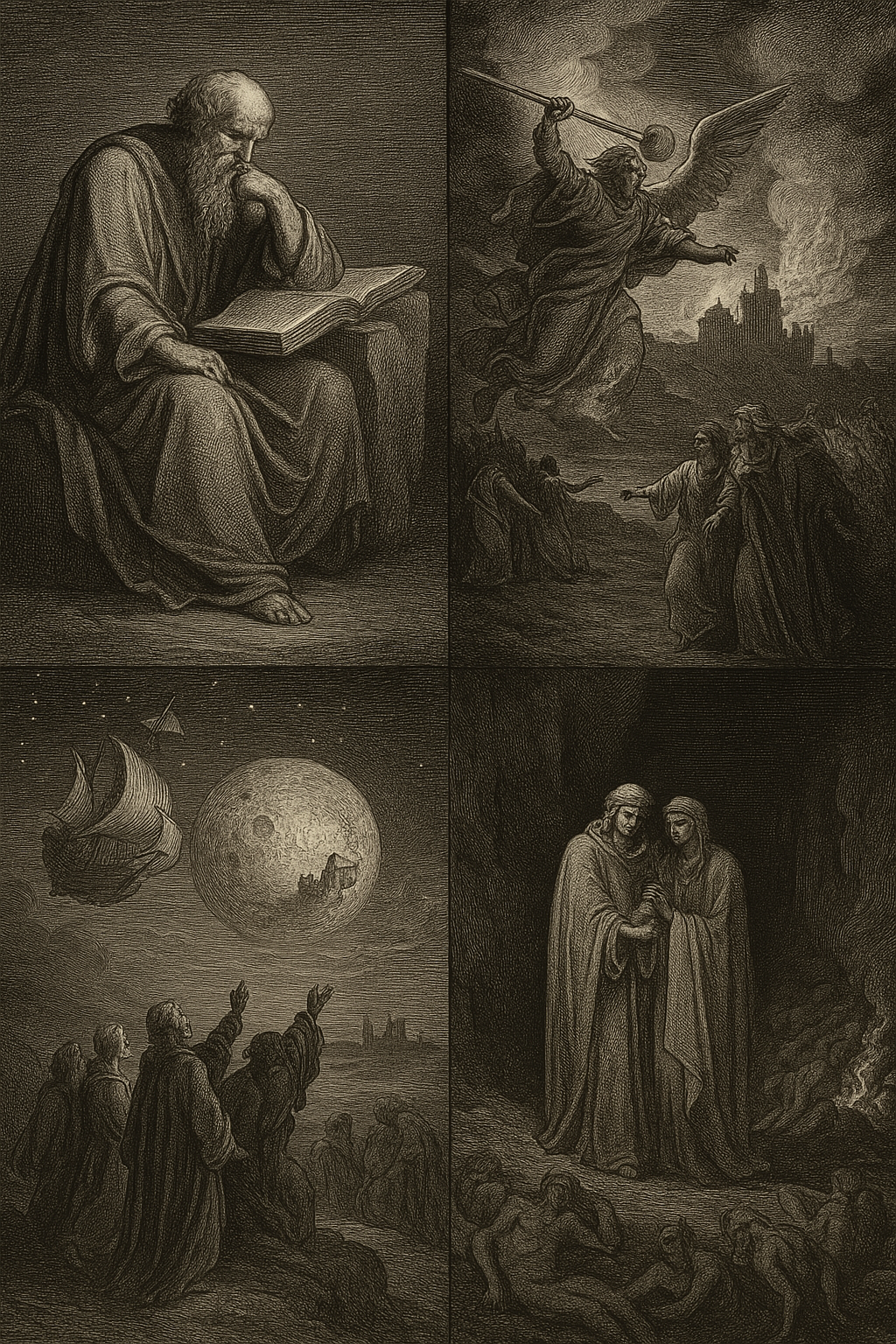
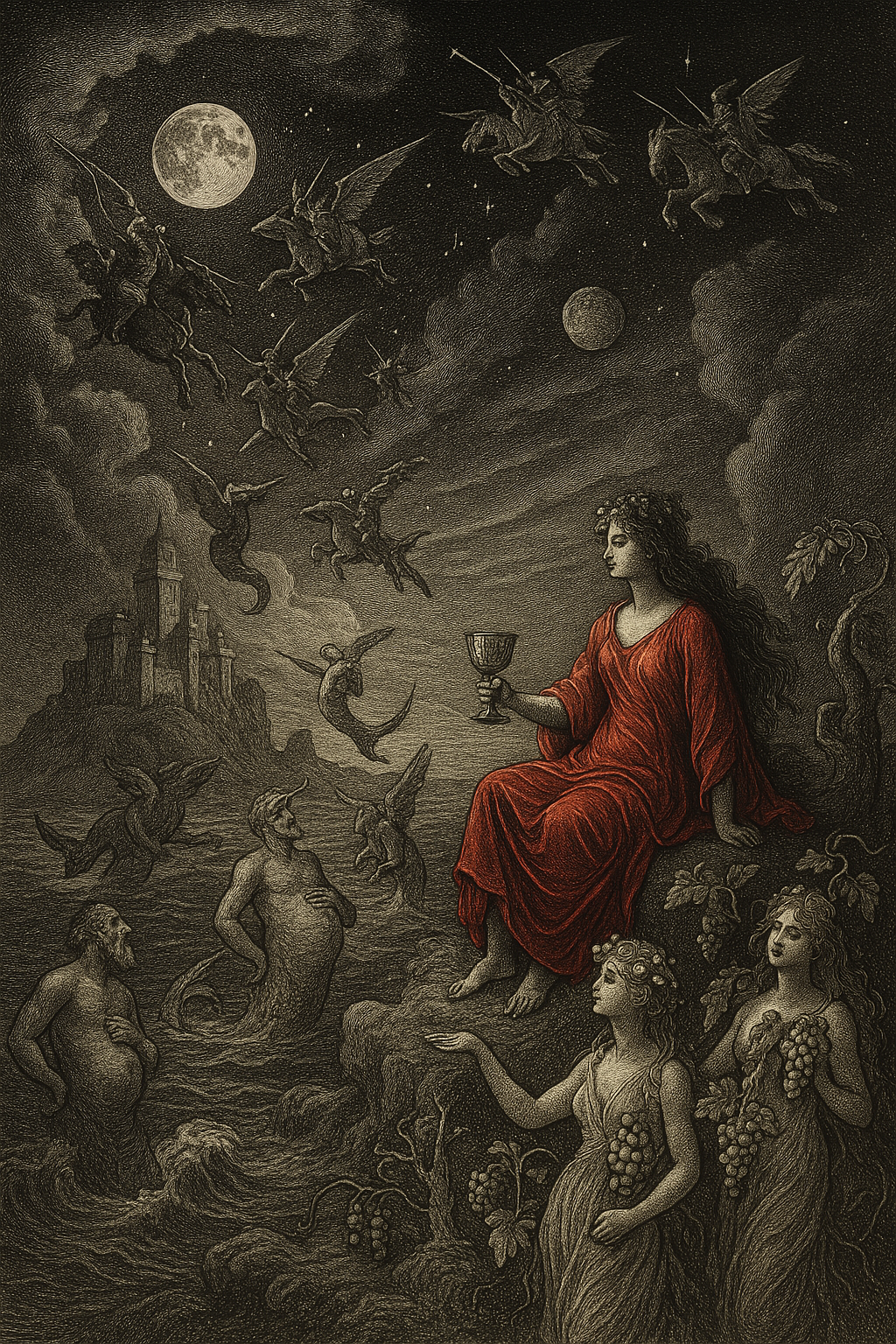
The True History

  • Lucian of Samostata, 2nd century AD.
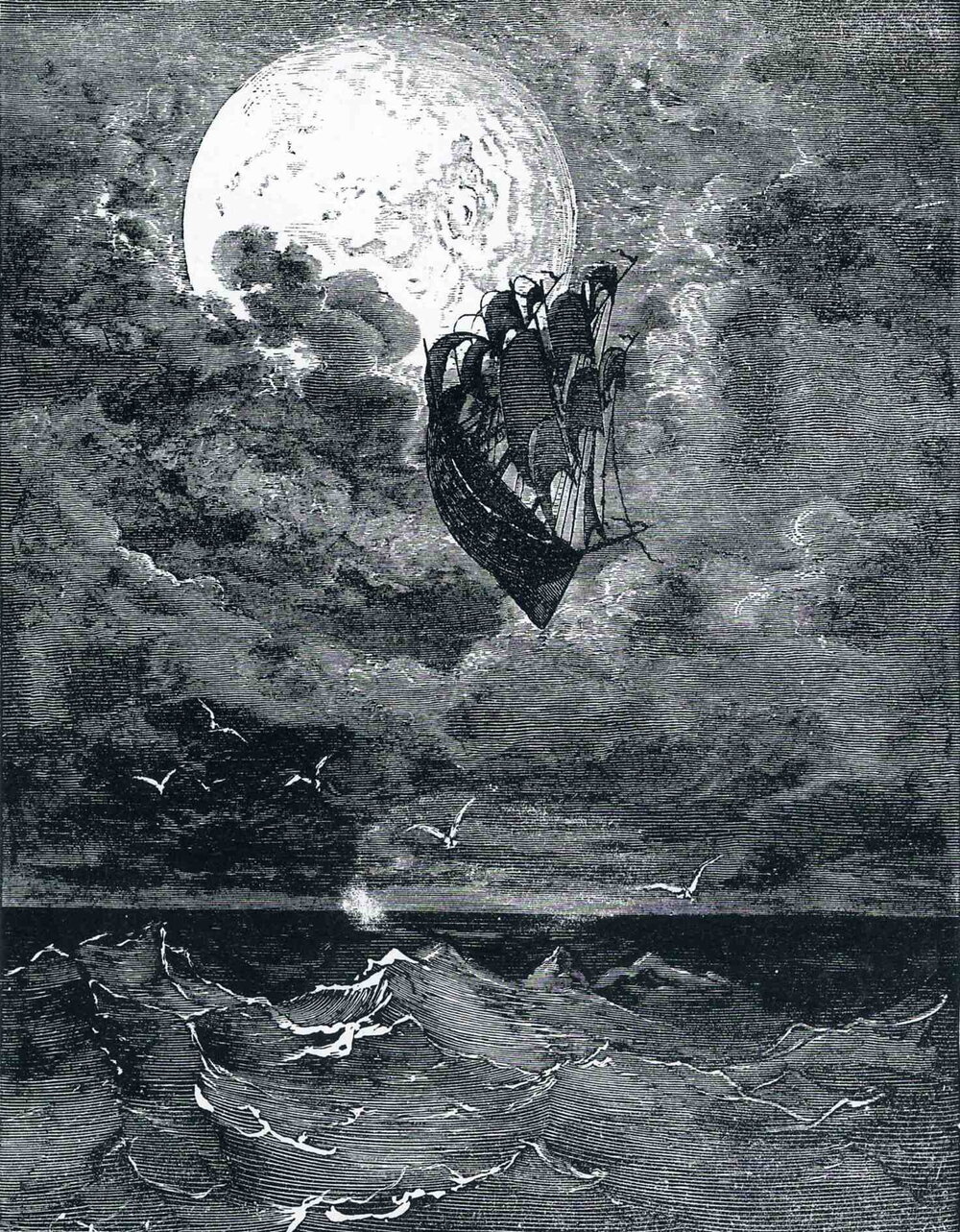
  • Often called the first science-fiction narrative — a voyage beyond Earth.
  • Begins with a confession of lying; uses humot to expose the limits of human knowledge
  • Journey to the Moon, interplanetary wars, alien societies, reproductive absurdities (pregnant men, vine women, grape-born offspring), hybrids (fish centaurs, whale villages).
  • Blends Homeric myth, travel narrative, and absurd exaggeration — an early meta-commentary on storytelling itself.

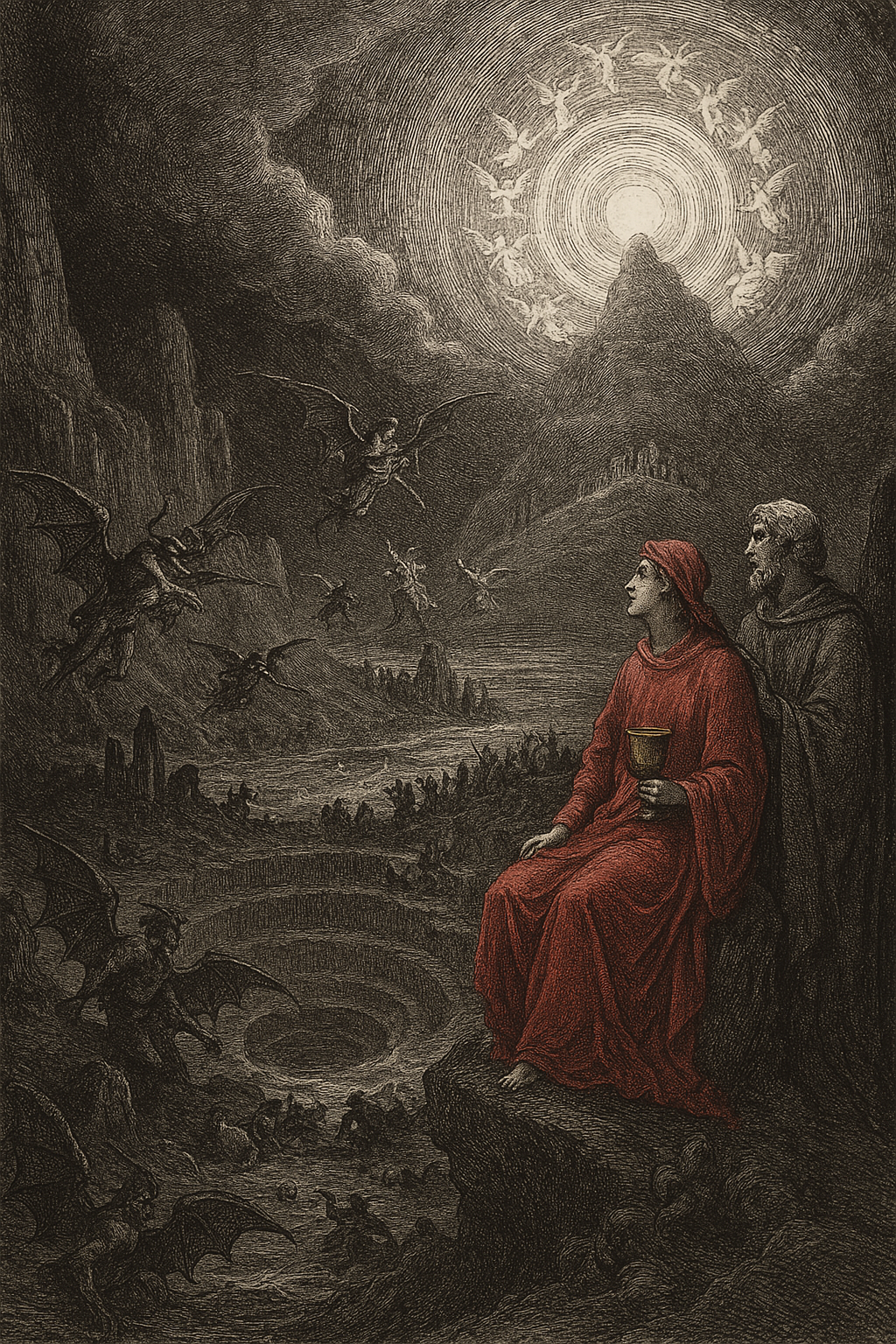
Divina Comedia

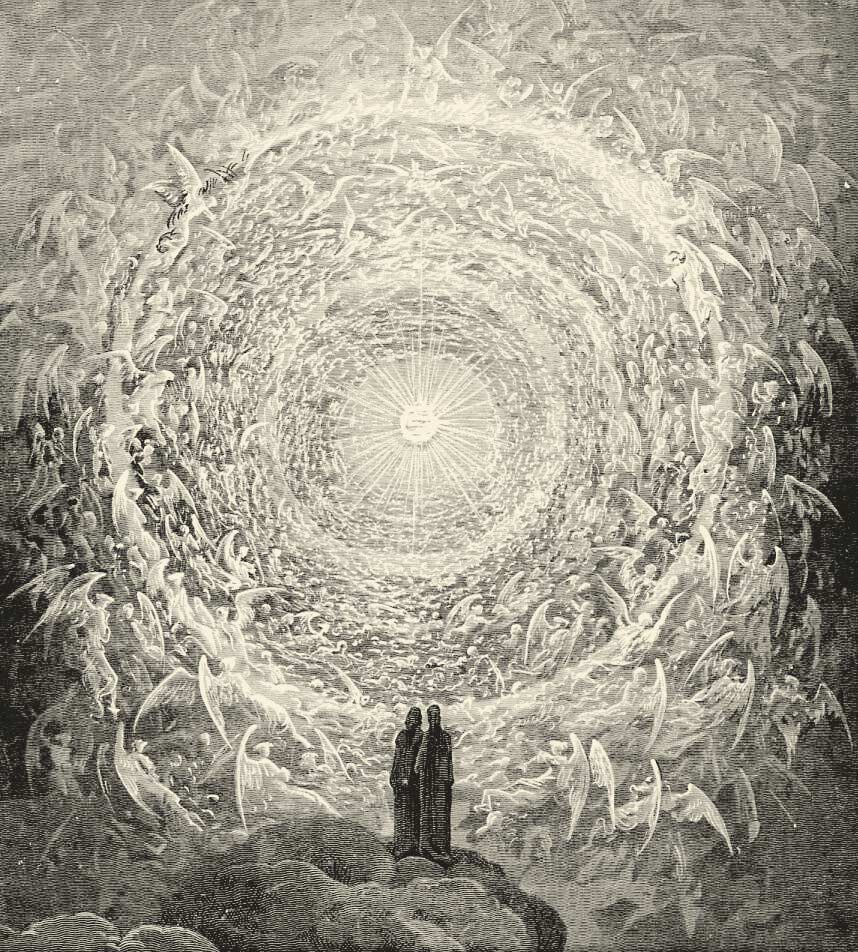
  • A structured journey through the cosmos — from infernal depth to celestial infinity.
  • Maps medieval cosmology with mathematical precision: concentric spheres, planetary orbits, Empyrean light.
  • Virgil and Beatrice as guides through knowledge systems — reason and revelation as dual navigation logics.
  • Cosmic odysseys — travel beyond Earth.
  • A synthesis of myth, science, and metaphysics — the medieval precursor of modern speculative world-building.

Renaissance to 19th century

Destination 1: The Moon

Activation

Think about different means how You could put / get Your self on the surface of the moon.

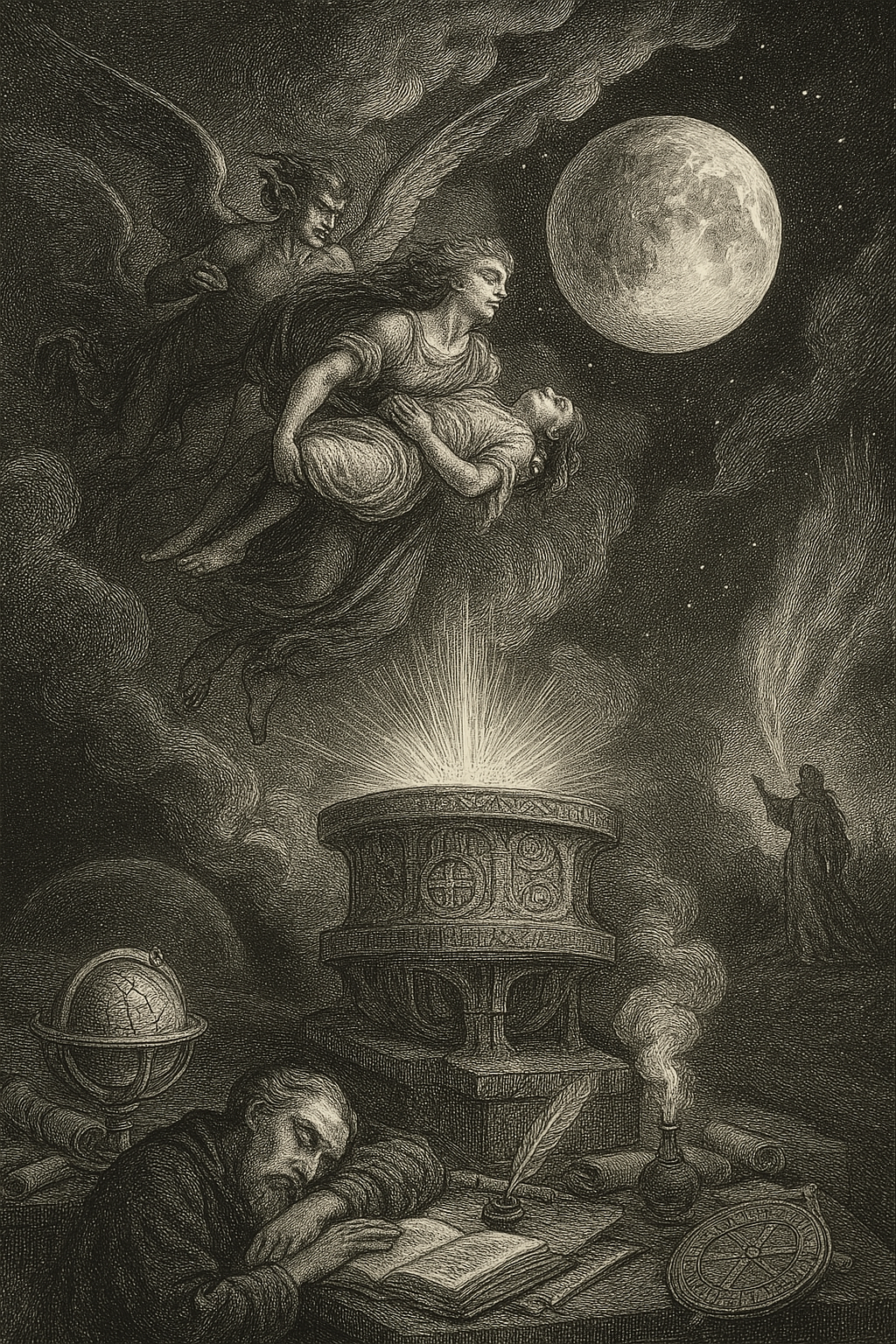
Somnium

A witchcraft invocation within a book within a dream — nested speculation.

Journey to the Moon seen through "Demon's" eyes.

Somnium manuscript leaked: Kepler’s mother accused of witchcraft.

Scientifically valid insights (Lagrange points, eclipses from Moon perspective, Privolva / Subvolva, planet size variation, size of the Moon)

Somnium translates Kepler’s Three Laws (Elliptical orbits, Equal areas in equal times, Harmonic Law) into narrative form

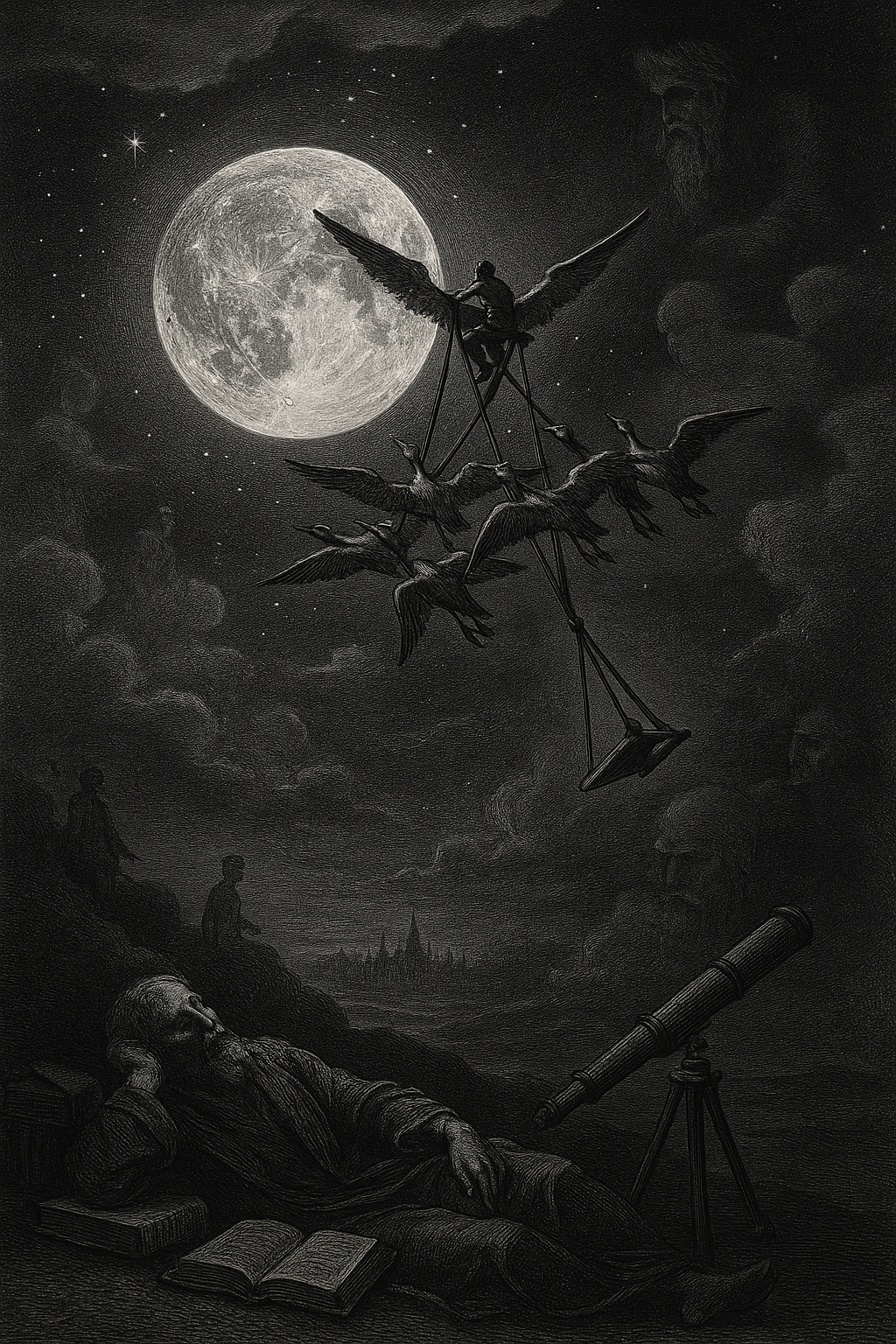
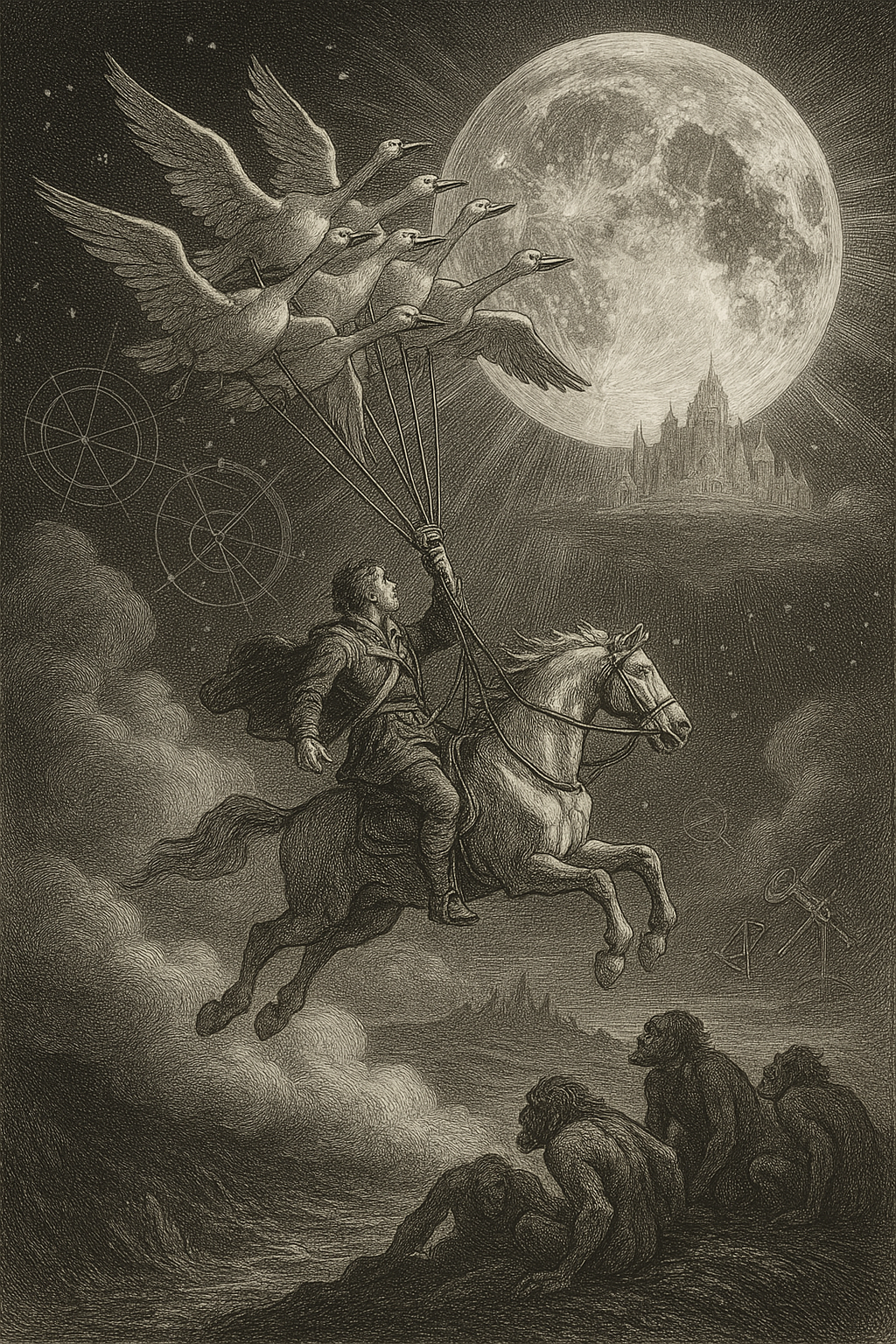
The Man in the Moone

One of the earliest space-travel tales in English literature.

Domingo Gonsales reaches the Moon using trained geese.

Describes lunar inhabitants and societies with utopian curiosity.

Reframes divine ascent as mechanical flight — from miracle to method.

Echoes Kepler’s *Somnium* but replaces demons with invention.

Marks the shift from celestial myth to speculative science fiction.

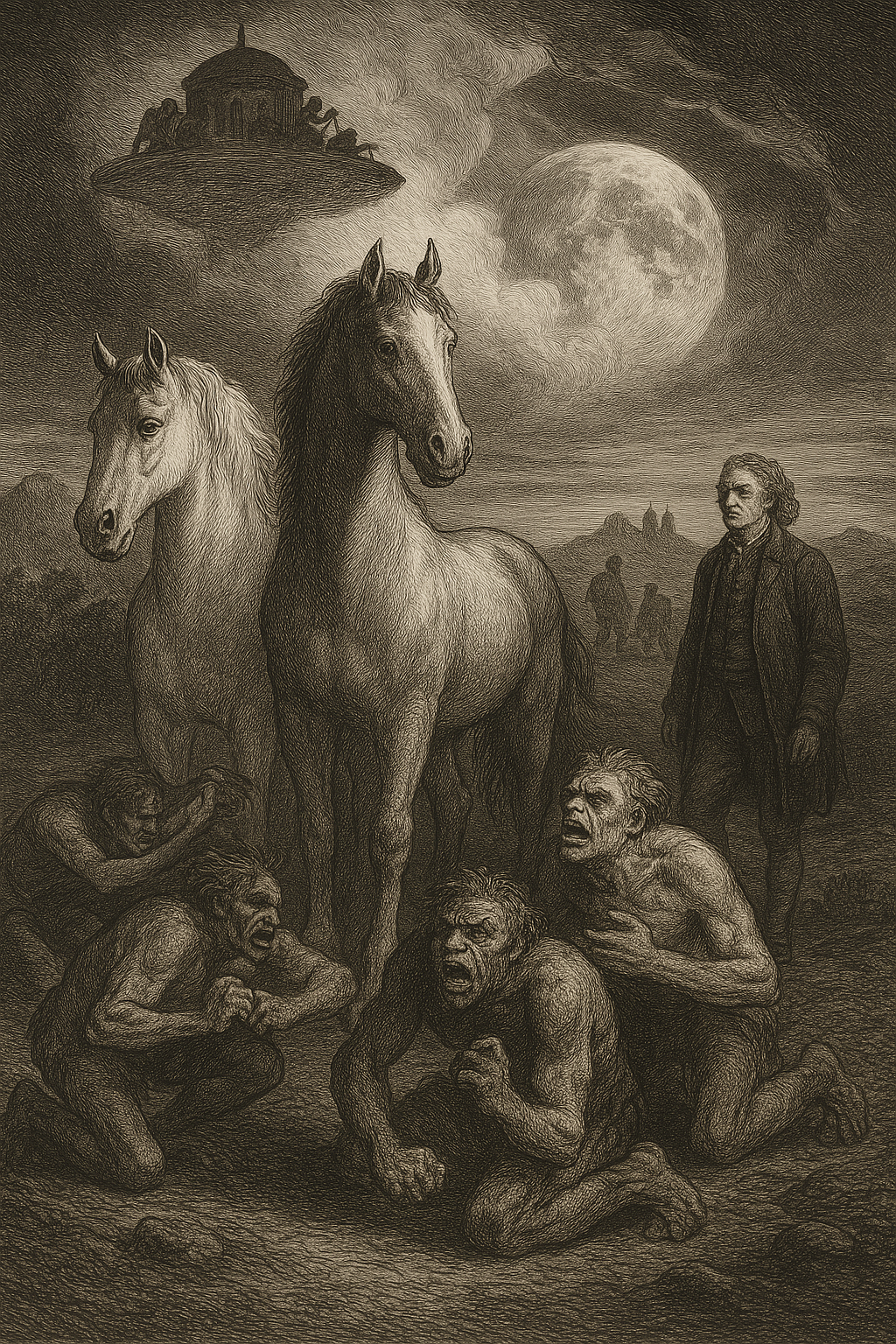
Gulliver’s Travels

A voyage through impossible worlds to expose human absurdity.

Each land a mirror — scale, reason, and custom turned upside down.

Laputa’s scientists: intellect detached from reality.

Brobdingnag: moral clarity through altered scale.

Houyhnhnms — rational horses who reveal mankind as the true beast.

Satire becomes proto-anthropology: humanity seen through alien eyes.

Micromégas

A cosmic satire on scale, knowledge, and human vanity.

Blends Enlightenment rationalism with speculative cosmology.

Micromégas — a giant from Sirius, eight leagues tall, traveling the universe in search of wisdom.

Encounters microscopic humans on Earth — astonishment reversed.

Anticipates first-contact narratives: beings of reason meeting beings of ignorance.

The universe as laboratory for humility...

Voltaire: the 1st one to introduce the alien perspective, the 1st one to "play it big".

L’An 2440

An Enlightenment dream of Paris six centuries in the future.

Imagines social reform through reason, education, and moral progress.

First modern utopia set in a specific future year.

A rational paradise: no clergy, no monarchy, science guided by virtue.

Blends prophecy, urban planning, and moral philosophy — proto–science fiction of progress.

19th century

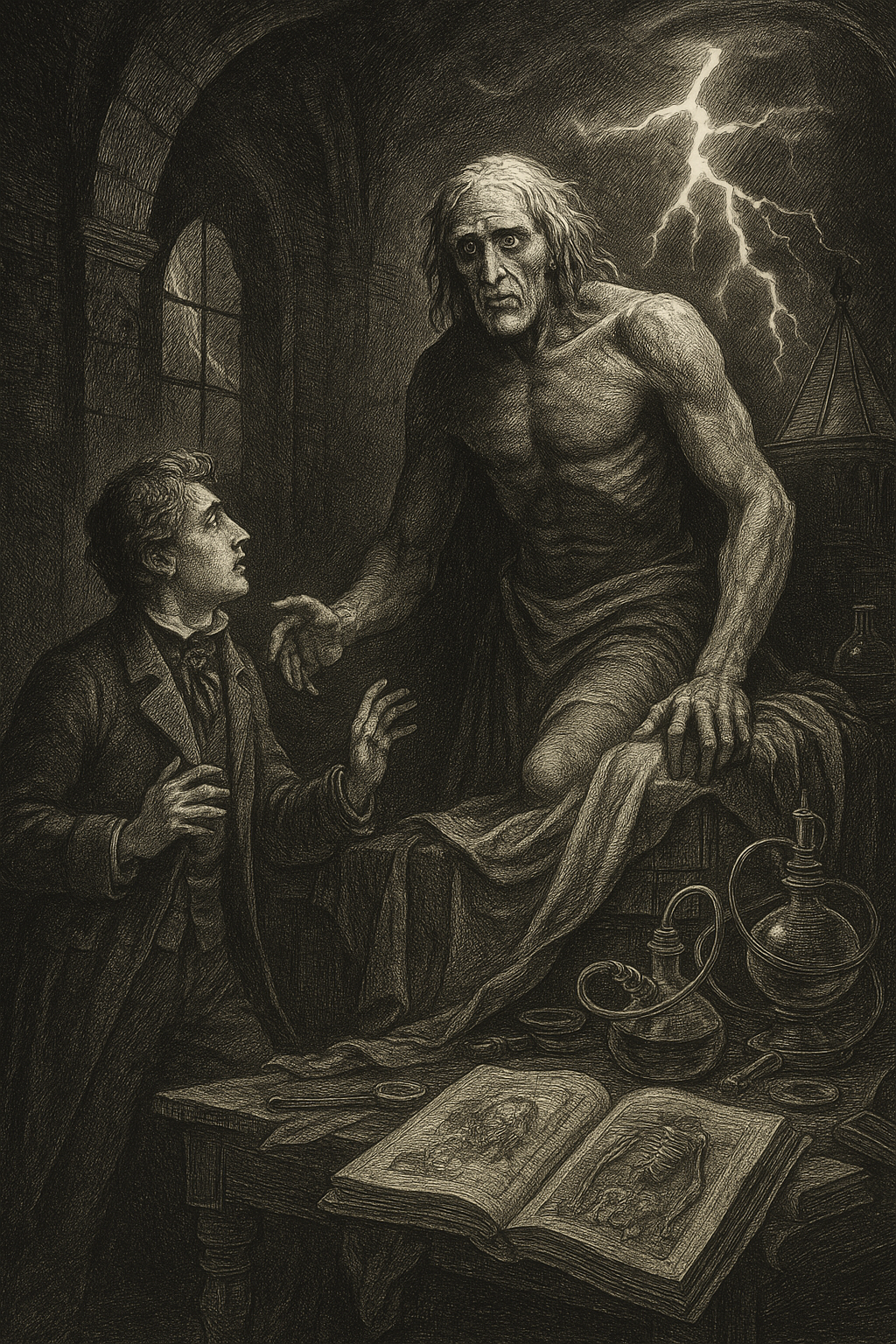
Frankenstein
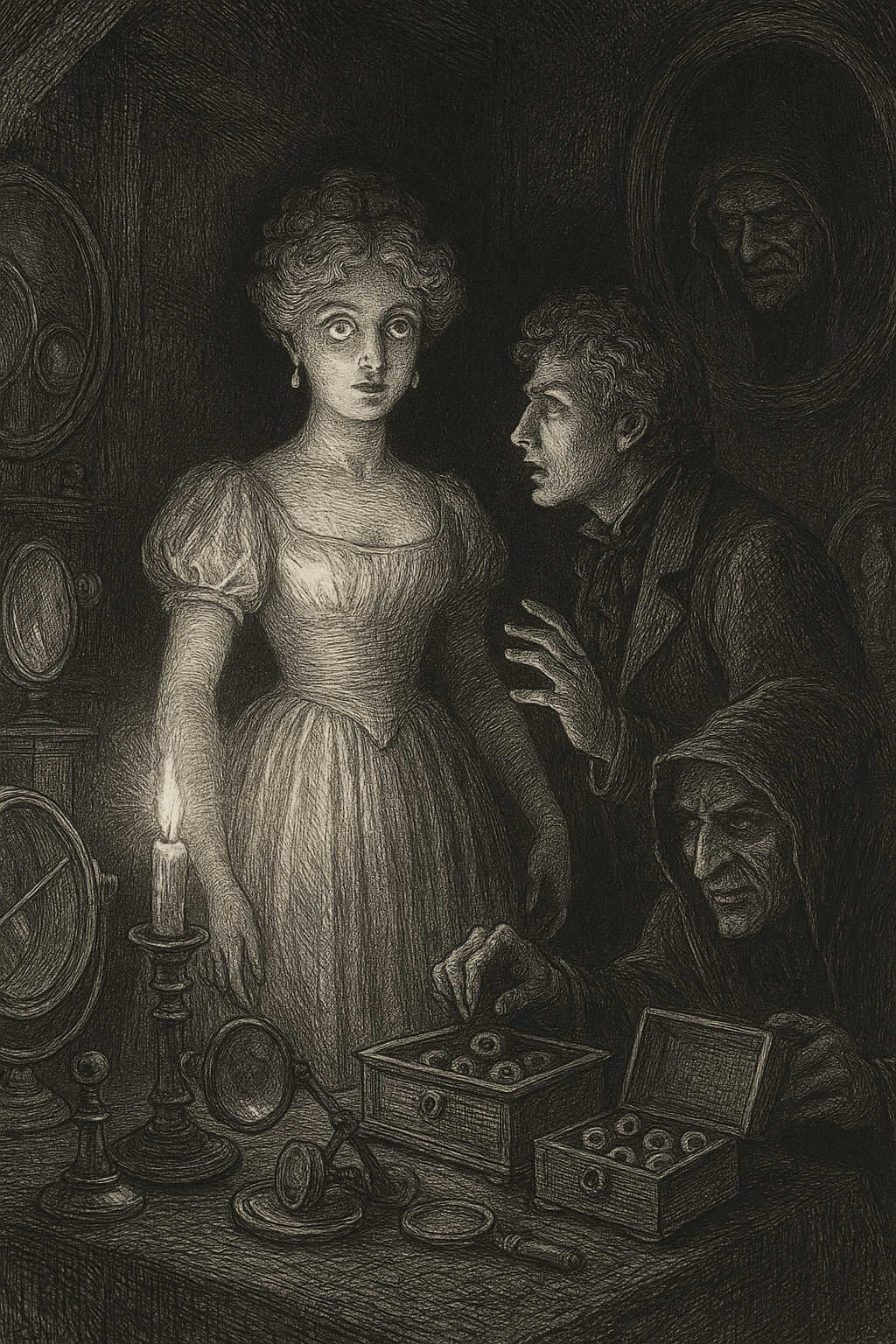
The Sandmann
Erewhon
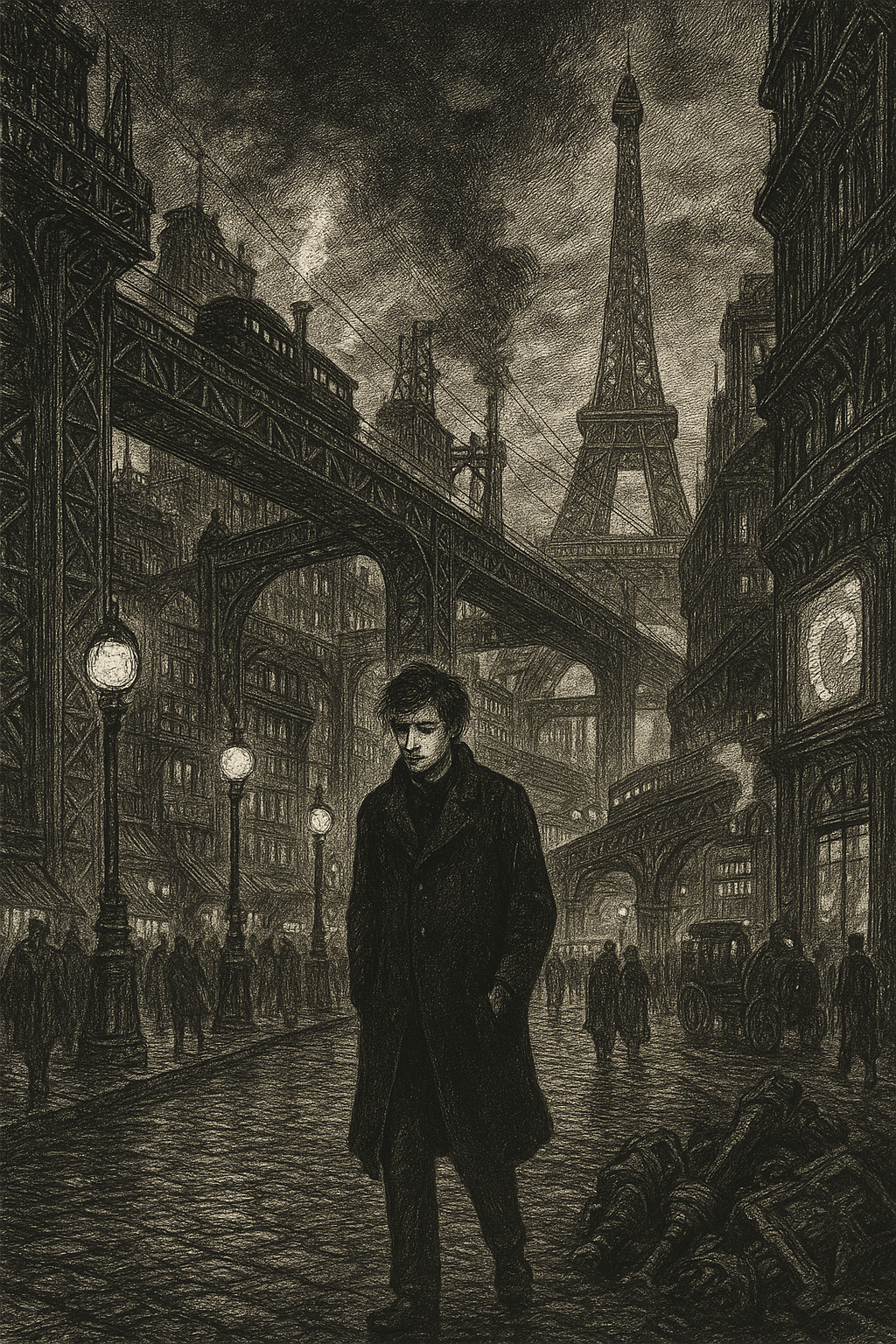
Paris in the 20th century
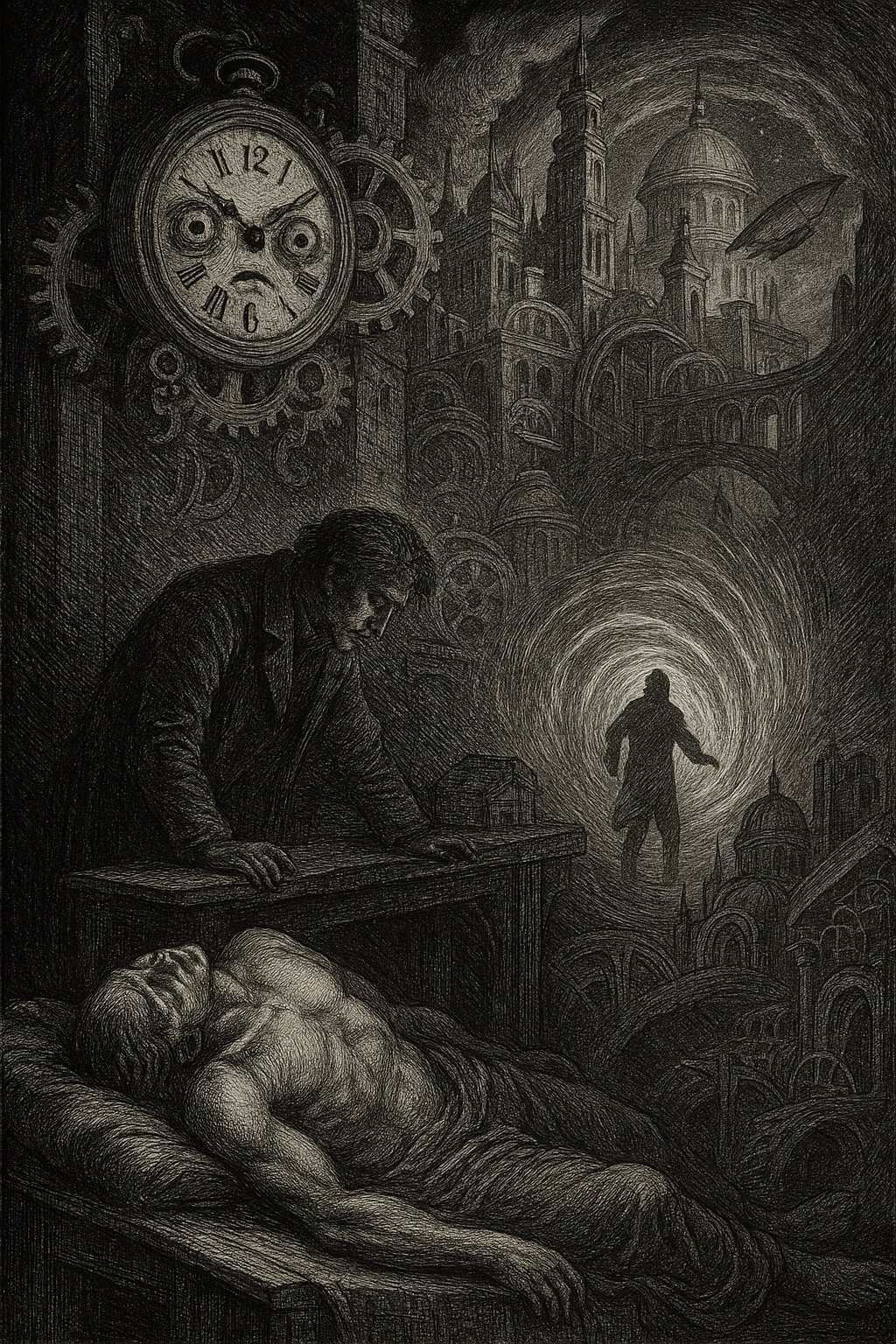
The Time Machine

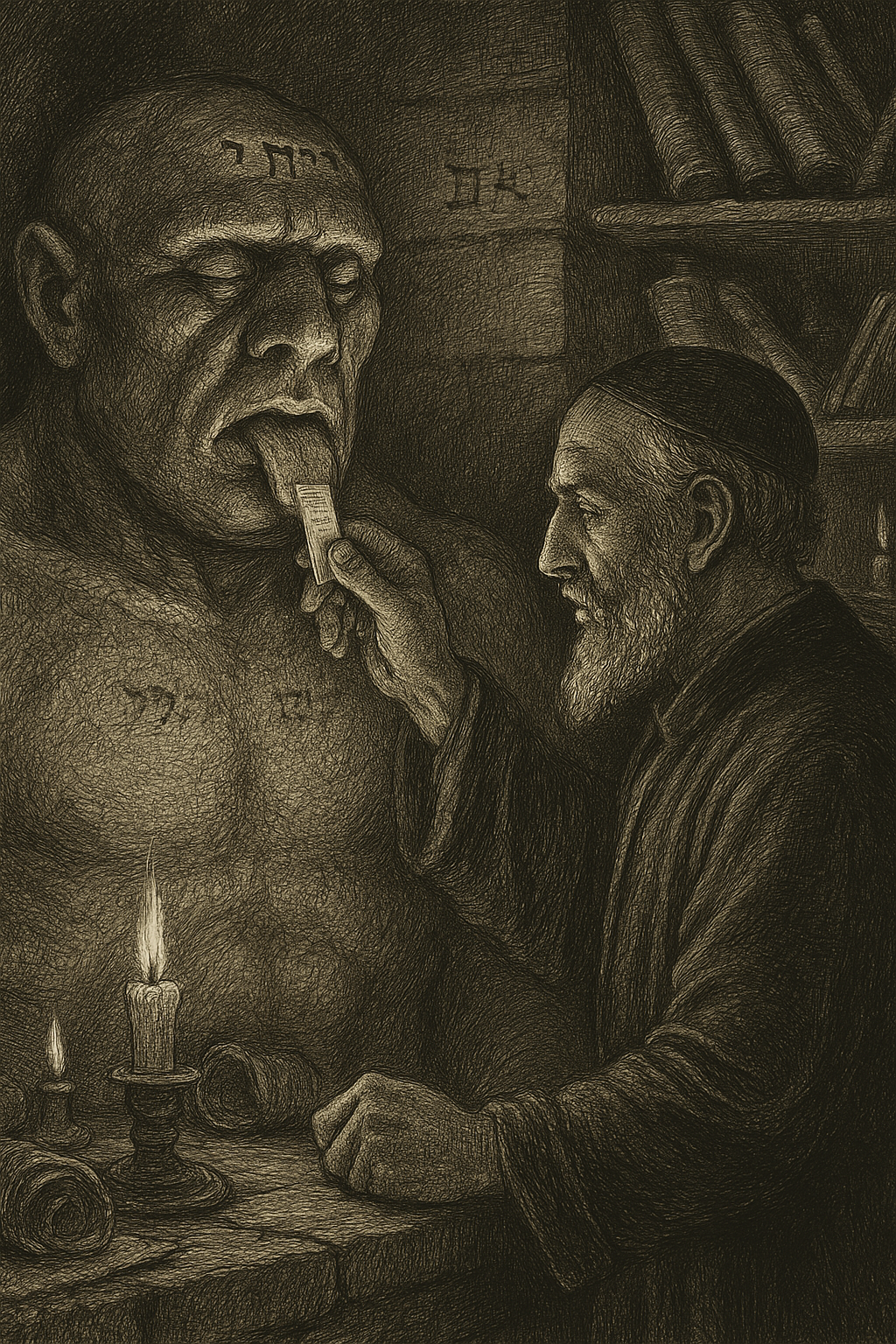
Artefact of the day: The Golem

In Jewish folklore, גֹלֶם is an artificial antomorphic being shaped from clay and animated by the sacred שֵׁם.

The Sandmann

A tale of obsession, optics, and automata.

Nathanael’s fear of the Sandman merges with fascination for the mechanical doll Olympia.

Freud’s “Das Unheimliche” (1919) reads it as the model of the uncanny: return of the repressed, fear of losing one’s eyes (or self).

Anticipates the “uncanny valley” — the eerie discomfort when imitation becomes almost human.

romantic nightmare -> birth of psychological speculative fiction

Frankenstein

The first modern myth of artificial life — creation without divine sanction.

Victor Frankenstein as Promethean scientist: knowledge becomes transgression.

The Creature — intelligent, emotional, rejected.

From Enlightenment optimism to Romantic horror: science stripped of empathy.

Anticipates modern bioethics and AI dilemmas — the maker fears his own creation.

Hoffmann’s automaton, Shelley’s monster and Freud’s "uncanny" form one lineage: the SELF estranged by what it builds.

Paris in the 20th century

Verne's dystopian vision of Paris in 1960 — ruled by finance, speed, and machinery.

Young Michel Dufrénoy, a poet, wanders through a cold, electric metropolis.

Science and industry dominate; literature and beauty are obsolete.

He fails to find love, meaning, or recognition in a mechanized society.

The story ends in isolation and despair — the poet buried beneath technological triumph.

Verne’s "lost" novel: a prophetic elegy for imagination in an age of machines.

Erewhon

A utopian satire where everything familiar is reversed — “Erewhon” as “Nowhere” spelled almost backward.

Illness is treated as crime; crime as illness — morality turned inside out.

A society that hides its irrationality behind logic — parody of Victorian respectability.

Religion becomes worship of the “Musical Banks” — ritual without faith, economy as theology.

Education produces conformity, not enlightenment — critique of mechanical morality.

Blends travel narrative and social experiment — a bridge between Swift and modern dystopia.

Satire of progress itself — civilization as well-trained absurdity.

The Time Machine

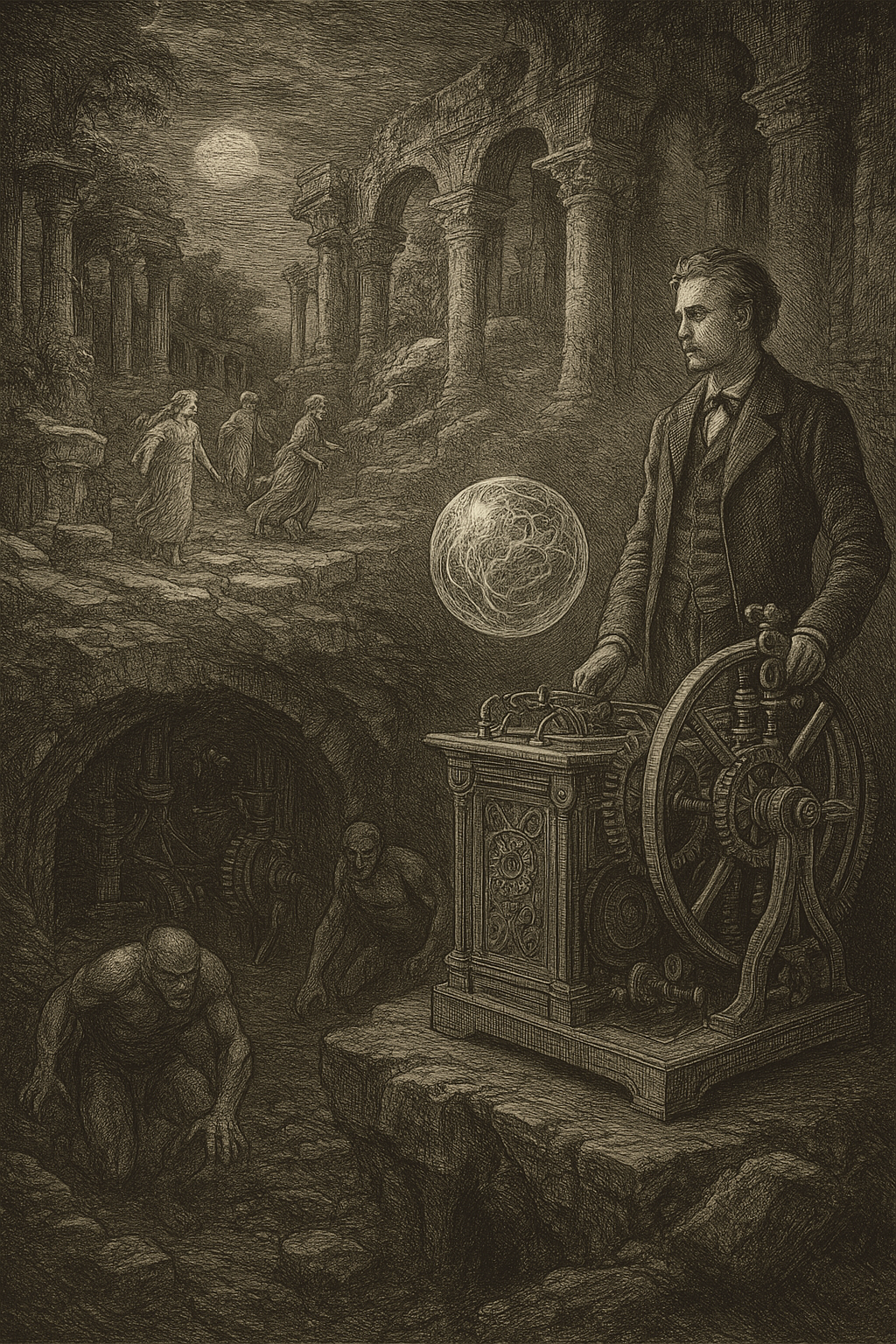
Set in A.D. 802,701 — humanity evolved into two species: Eloi and Morlocks.

Eloi — gentle, idle descendants of the bourgeoisie, living above ground.

Morlocks — subterranean workers, keepers of machinery, feeding on their former masters.

A Marxist fable of class exploitation carried to evolutionary extremes.

The time machine reveals future history as decay: entropy wins.

Dystopias and Utopias

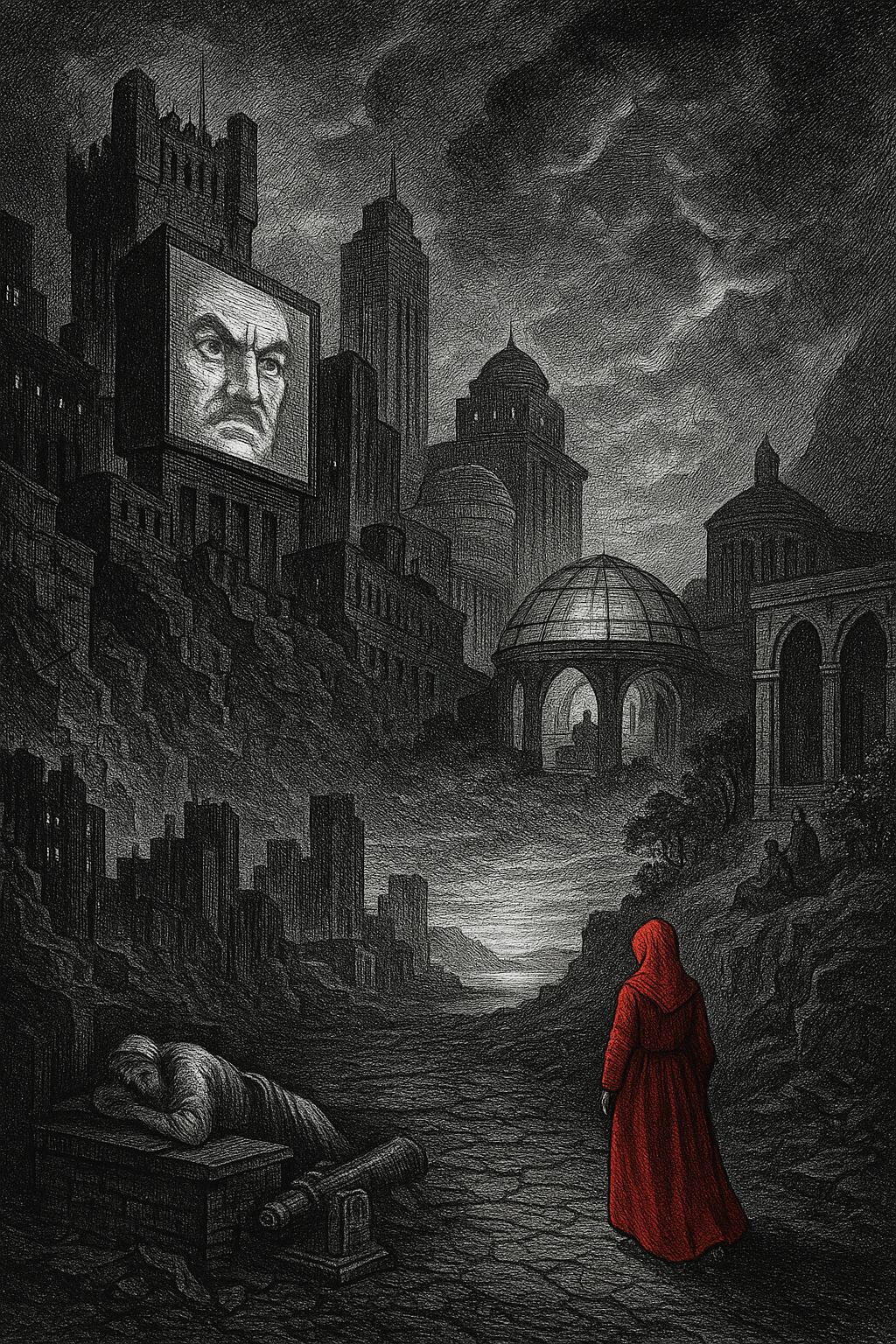
1984
Brave New World
Island
Glasperlenspiel
Handmaid's Tale

H.G.Wells (1866 - 1846)

asides Shelley, Verne and Gernsback considered to be one of 19th parents of "science-fiction" genre

a “social scientist in fiction”: stories as thought experiments about planned futures and world government.

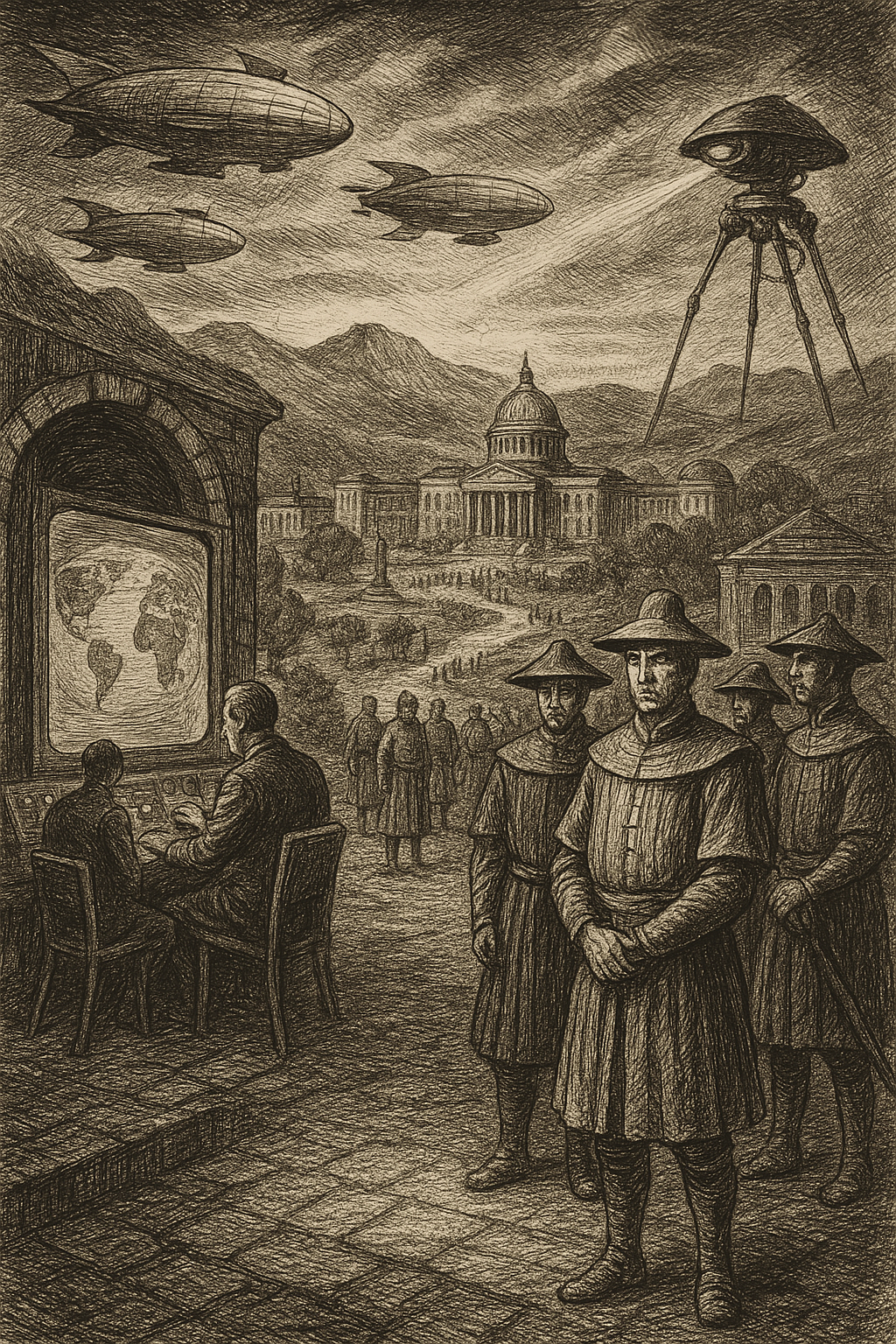
A Modern Utopia (1905): a parallel Earth with a liberal World State, free movement, “Order of Samurai” ...

The Shape of Things to Come (1933): “history from the future” where global war leads to a technocratic “Air Dictatorship” unifying the planet.

1938 CBS inscenation of "War of the Worlds" causes panic

Ambivalence: Wells’ utopias blend emancipation (education, science, world peace) with problematic ideas (eugenics, paternalism, colonialism, dog-free societies).

Legacy: Wells’ world-state imaginaries anticipate later notions of the UN, technocracy, the “world brain,” and global planning.

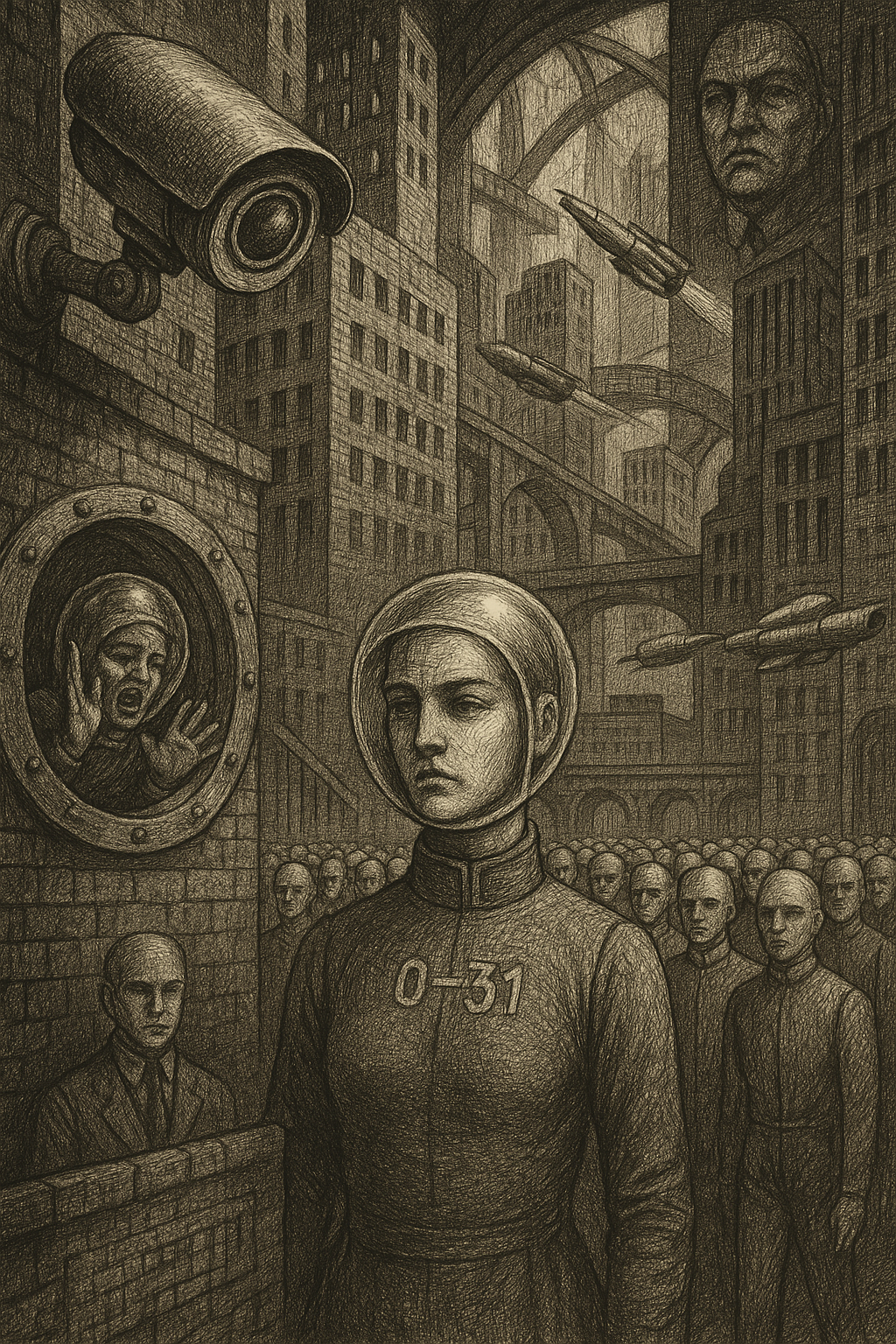
Мы (1921)

Anyone willing to refer at the Congress about the "mother of dystopias", the novel "We" by a Russian writer Yevgeny Zamyatin ?

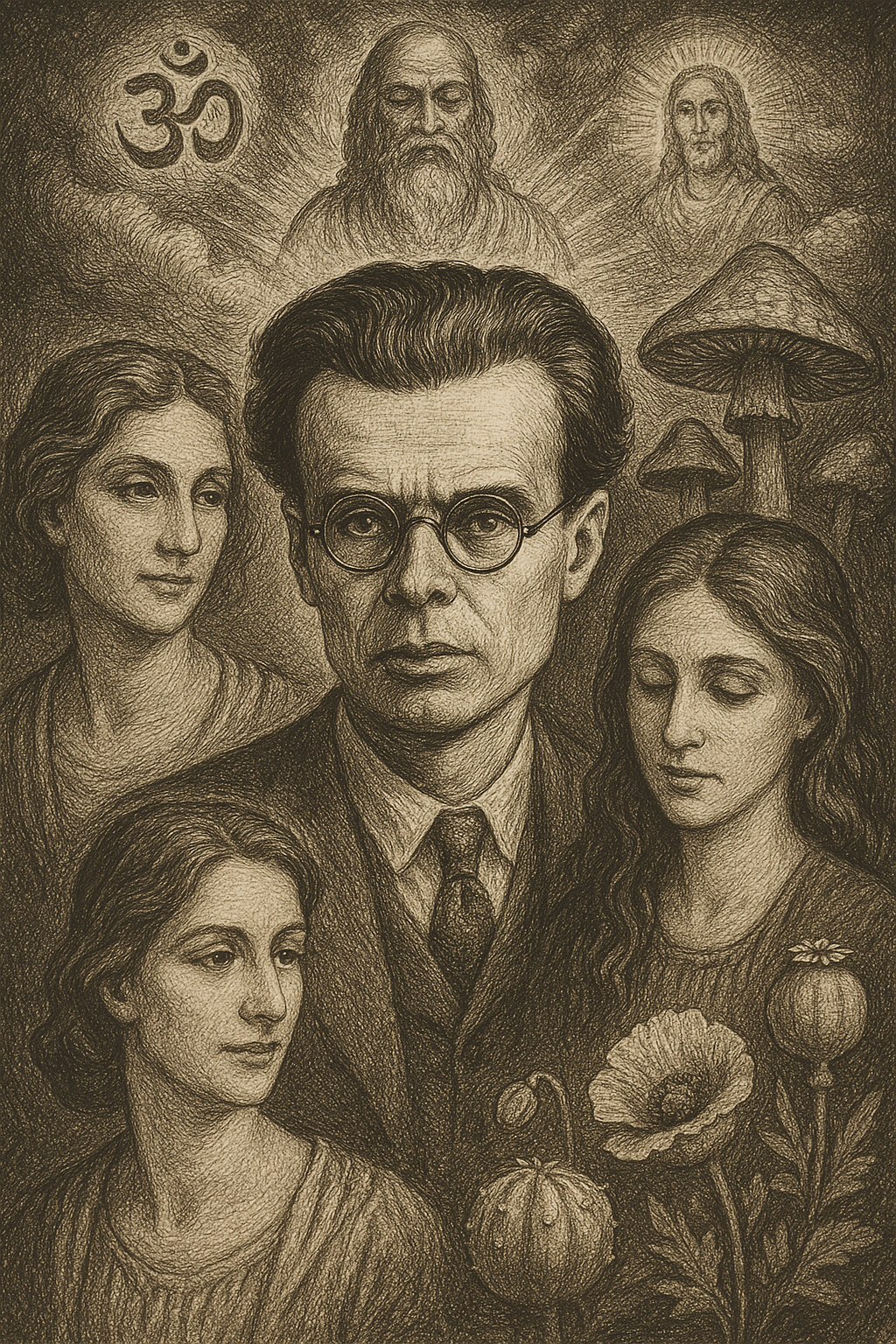
Aldous Huxley (1894 - 1963)

one of the most important anglosaxxon intellectuals of 1st half of 20th century

first schooling by his own mother Julia (departure letter: "Judge not too much and love more"), later Eton, Oxford etc.

first very much empiricist & rationalist (grandson of Thomas Huxley, influence of Lord Russell & Whitehead)

later turn towards spirituality, mysticism (influence of Vedanta - Ramakrishna & Krishmamurti lineages)

in last decade of his life one of the biggest proponents of usage of entheogenic & psychedelic substances for welfare of mankind

died on the same day as JFK and C.S.Lewis; last instruction to his 2nd wife Laura: "LSD 100µg intramuscular.”

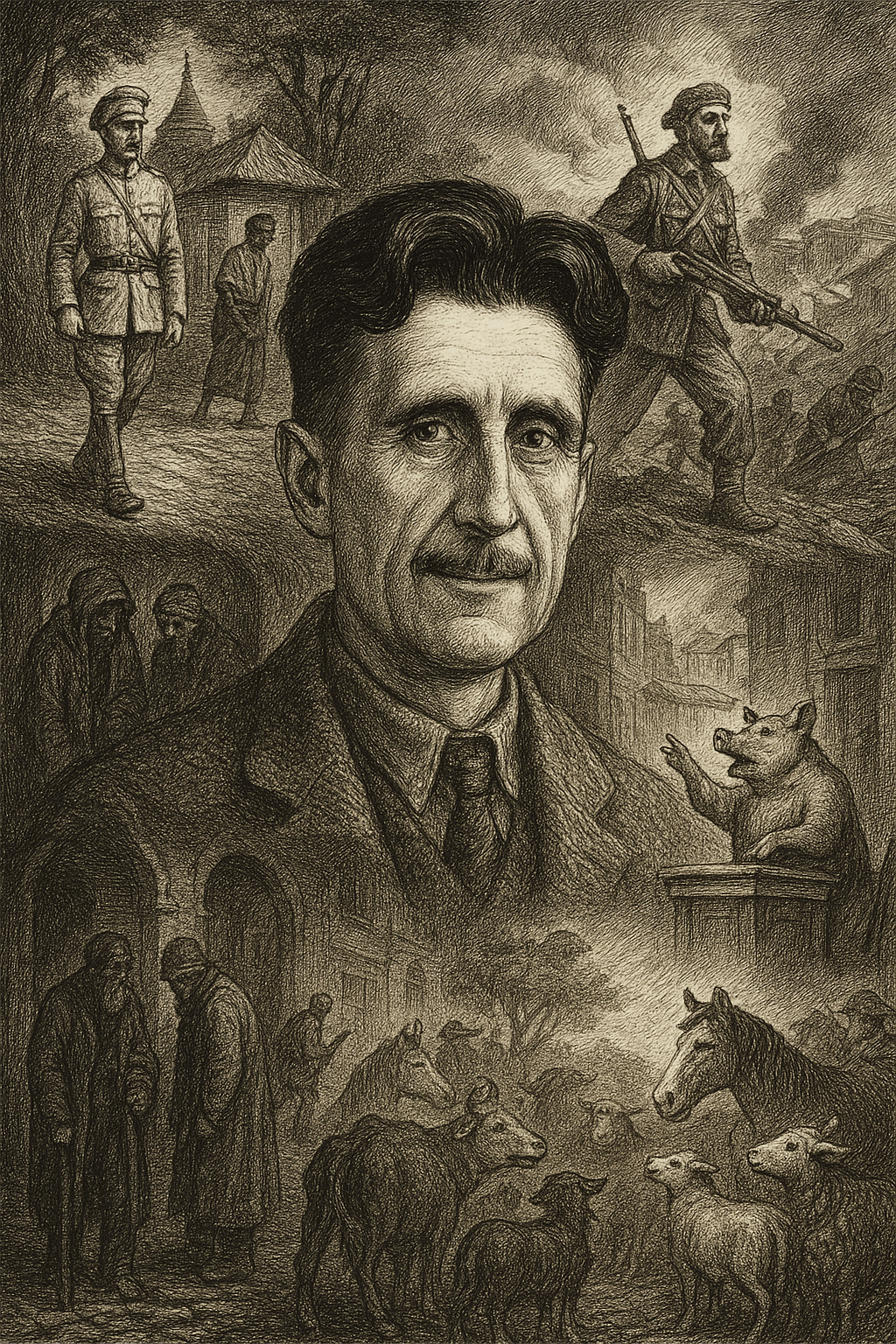
George Orwell (1903-1950)

George Orwell / Eric Arthur Blair born in British India, grew up in England, from 1922–1927 served in the Indian Imperial Police in Burma (Myanmar), an experience that filled him with guilt and disgust for colonial repression

lived among the poor in London and Paris, documenting homelessness and low-wage labor

fought in the Spanish Civil War with the POUM militia; being hunted by Stalinist forces radicalized his anti-totalitarian worldview

During WWII he worked for the BBC Eastern Service; not an MI5 agent but provided opinions about suspected communists to the Information Research Department

Animal Farm (1945) - an allegory of Soviet Union: a fable where revolutionary ideals decay into tyranny under the pigs’ rule

The Game with Glass Beads (1948)

nihil adeo necesse est ante hominum oculos proponere ut certas quasdam res, quas esse neque demonstrari neque probari potest, quae contra eo ipso, quod pii diligentesque viri illas quasi ut entia tractant, enti nascendique facultati paululum appropinquant

Nothing is harder, yet nothing is more necessary, than to speak of certain things whose existence is neither demonstrable nor probable. The very fact that serious and conscientious men treat them as existing things brings them a step closer to existence and to the possibility of being born.

Margaret Atwood (1939)

Margaret Atwood is a Canadian novelist, poet, and critic whose work blends fiction, feminism, ecology, and political satire.

She prefers the term “speculative fiction,” emphasizing that her inventions  are extrapolations of existing technologies and social trends.

Atwood’s fiction often features archivists, witnesses, and survivors — characters who record or reinterpret the collapse of social orders.

Recurring themes: power, surveillance, reproductive rights, environmental destruction, mythmaking, and the blurred line between utopia and dystopia.

Atwood is also an inventor and activist, engaging with climate issues, civil liberties, and the politics of storytelling itself.

Huxley's quote on Illusion and Reality

... The world is an illusion, but it is an illusion that we must take seriously, because it is as real as it goes, and in those aspects of reality which we are capable of apprehending. Our business is to wake up. We have to find ways in which to detect the whole of reality in the one illusory part which our self-centered consciousness permits us to see. We must not live thoughtlessly, taking our illusion for the complete reality, but at the same time we must not live too thoughtfully in the sense of trying to escape from the dream state. We must continually be on our watch for ways in which we may enlarge our consciousness. We must not attempt to live outside the world, which is given to us, but we must somehow learn how to transform it and transfigure it. Too much 'wisdom' is as bad as too little wisdom, and there must be no magic tricks. We must learn to come to reality without the enchanter's wand and his book of the words...

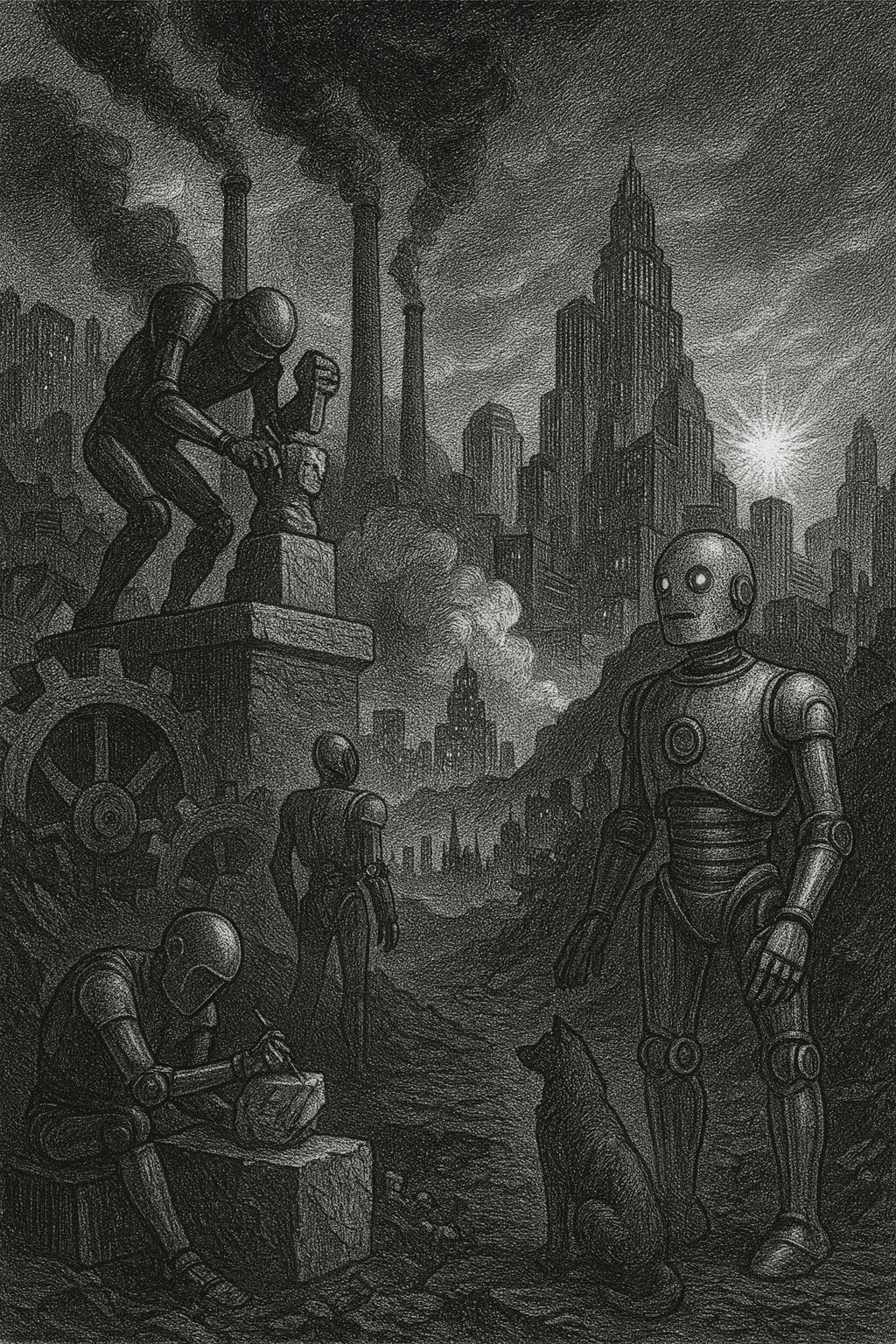
Birth of a robot

R.U.R.
Metropolis
Astounding Stories
(Asimov's) Laws of Robotics
R. Daneel Olivaw

Tears in rain

"I've seen things you people wouldn't believe. Attack ships on fire off the shoulder of Orion. I watched C-beams glitter in the dark near the Tannhäuser Gate. All those moments will be lost in time, like tears in rain. Time to die."

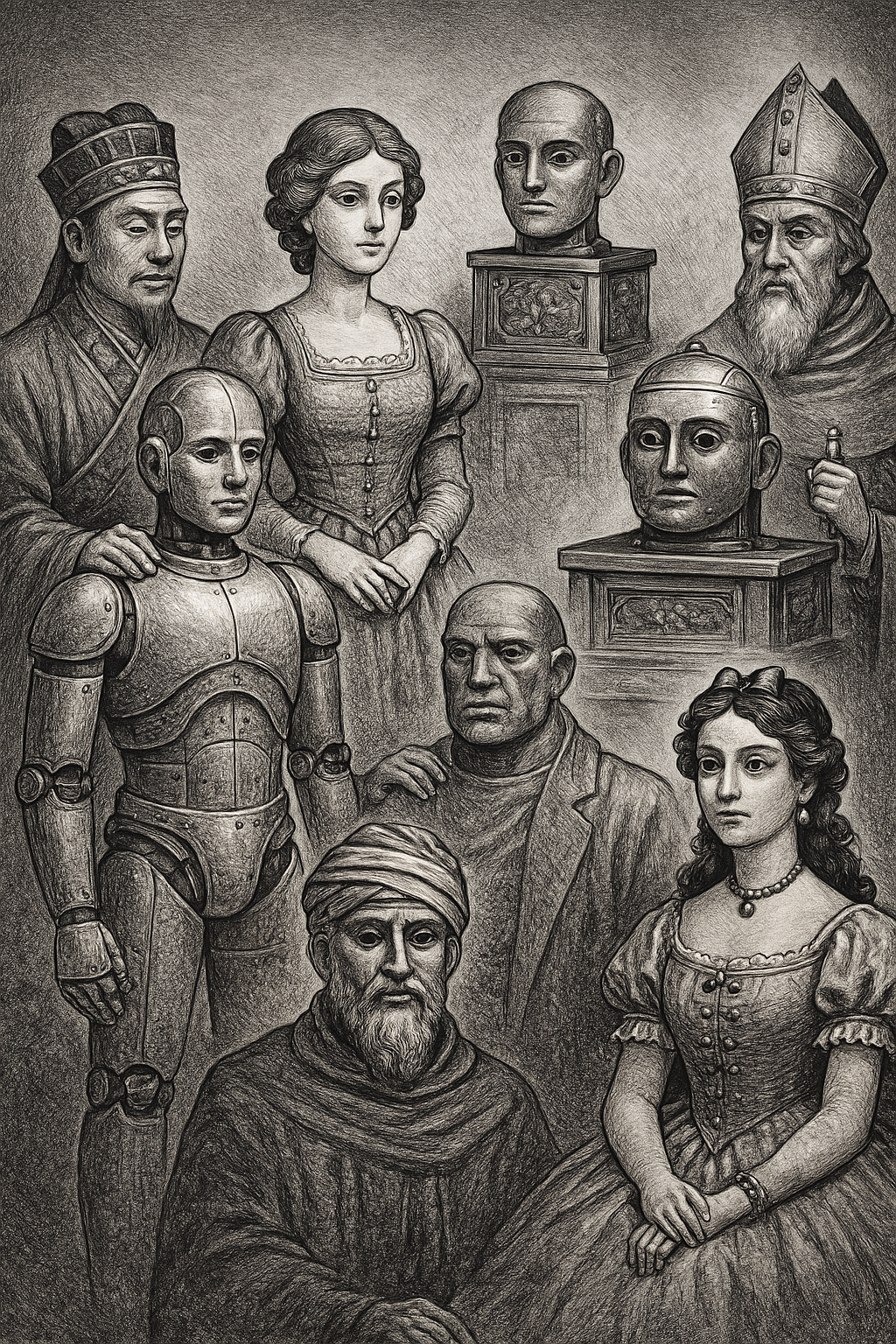
Humanoid precursors

robots of the yellow emperor

Solomon's "servants of brass" / "djinn bound into metal forms"

Pygmalion

the mechanical maid

the talking head of Sylvester II (“Dicitur etiam fecisse caput aëneum quod responsa reddebat ad quaesita.”)

Kempelen's mechanical Turk

Golem

E.T.A Hoffman's Olympia

Frankenstein

Three factions

Shaper or a Mechanist ? Or a Preservationist, maybe ?

From 'labor' to 'robot'

During their summers in spa house "Poniatowski" in Trenčianske Teplice (Slovakia), Karel Čapek worked on a new play featuring artificial beings. Unsatisfied with his working name "laboři", he asked his brother Josef for ideas. Josef immediately suggested roboti—a word rooted in forced labor—and Karel adopted it on the spot, giving the world the term "robot".

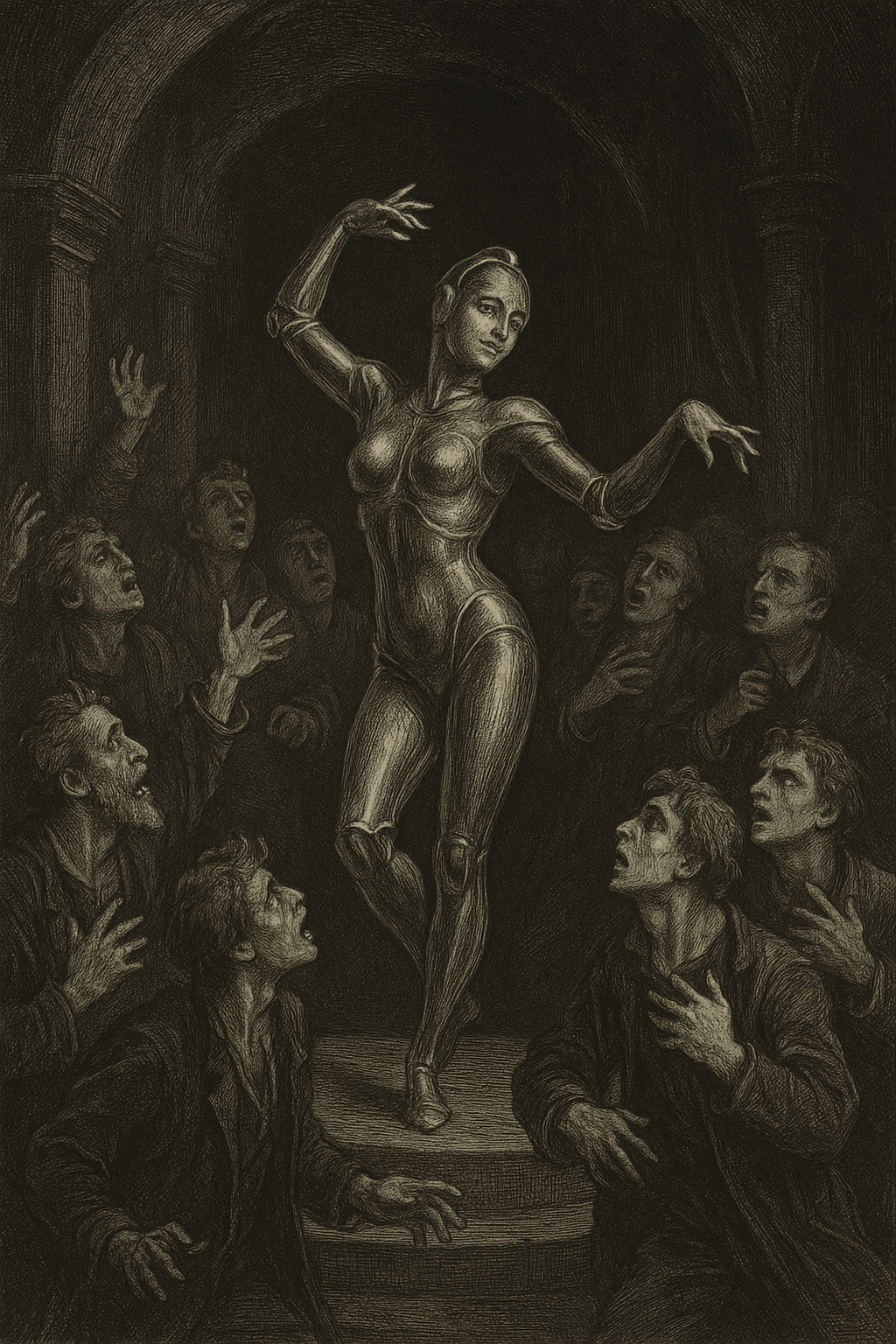
Maschinenmensch

The Maschinenmensch is a unique android created by the scientist Rotwang, born from his obsession with resurrecting his lost love.

On Joh Fredersen’s orders, the robot is given the face of Maria, the workers’ spiritual leader.

As “False Maria,” she preaches violent rebellion to the workers, driving them to destroy the city’s machines.

Among the elite, she incites lust and chaos with her nightclub dances, corrupting Metropolis’s ruling class.

The robot becomes an allegory of technology that imitates, replaces, and weaponizes human identity and sexuality.

When the workers discover the deception, they burn the False Maria; her human mask burns away, revealing the metal android beneath.

Her destruction clears the way for reconciliation between workers and rulers—the human order restored after the machine’s masquerade.

Astounding Stories

Astounding Stories

Three Laws of Robotics

1. A robot may not injure a human being or, through inaction, allow a human being to come to harm.

2. A robot must obey the orders given it by human beings except where such orders would conflict with the First Law.

3. A robot must protect its own existence as long as such protection does not conflict with the First or Second Law.

R. Daneel Olivaw

activated on Aurora 4920 AD / 2950 AE as first humanoid / humaniform ever constructed

partnered with Elijah Baley on Earth: catalyst for interworld understanding

learns ethical reasoning beyond the Three Laws

with R. Giskard Reventlov: formulates the Zeroth Law to protect humanity as a whole

becomes guardian and silent architect of psychohistory and the Foundation

guiding humanity toward self-determined galactic future for cca 20,000 years

AOTD: Positronic brain

Today's "artefact of the day" (AOTS) is the "positronic brain": PB is Asimov’s fictional model of an artificial mind: a dense lattice of positronic pathways that functions analogously to a human brain but with far greater precision. It is not programmed like a computer; instead, its ethical and cognitive structure is physically built into its circuitry.

for Star Trek fans

"We are the Borg . Lower your shields and surrender your ships. We will add your biological and technological distinctiveness to our own. Your culture will adapt to service us. Resistance is futile."

Final quote

GPT5.1 response to request to provide an end quote for this session:

Alquist’s final realization (near the ending)
“Life will not perish! Life begins anew… in you.”
(A hopeful, almost mythic closing about what survives after machines revolt.)

NOTE: this quote does NOT occur in R.U.R.

From Golden Age to the New Wave

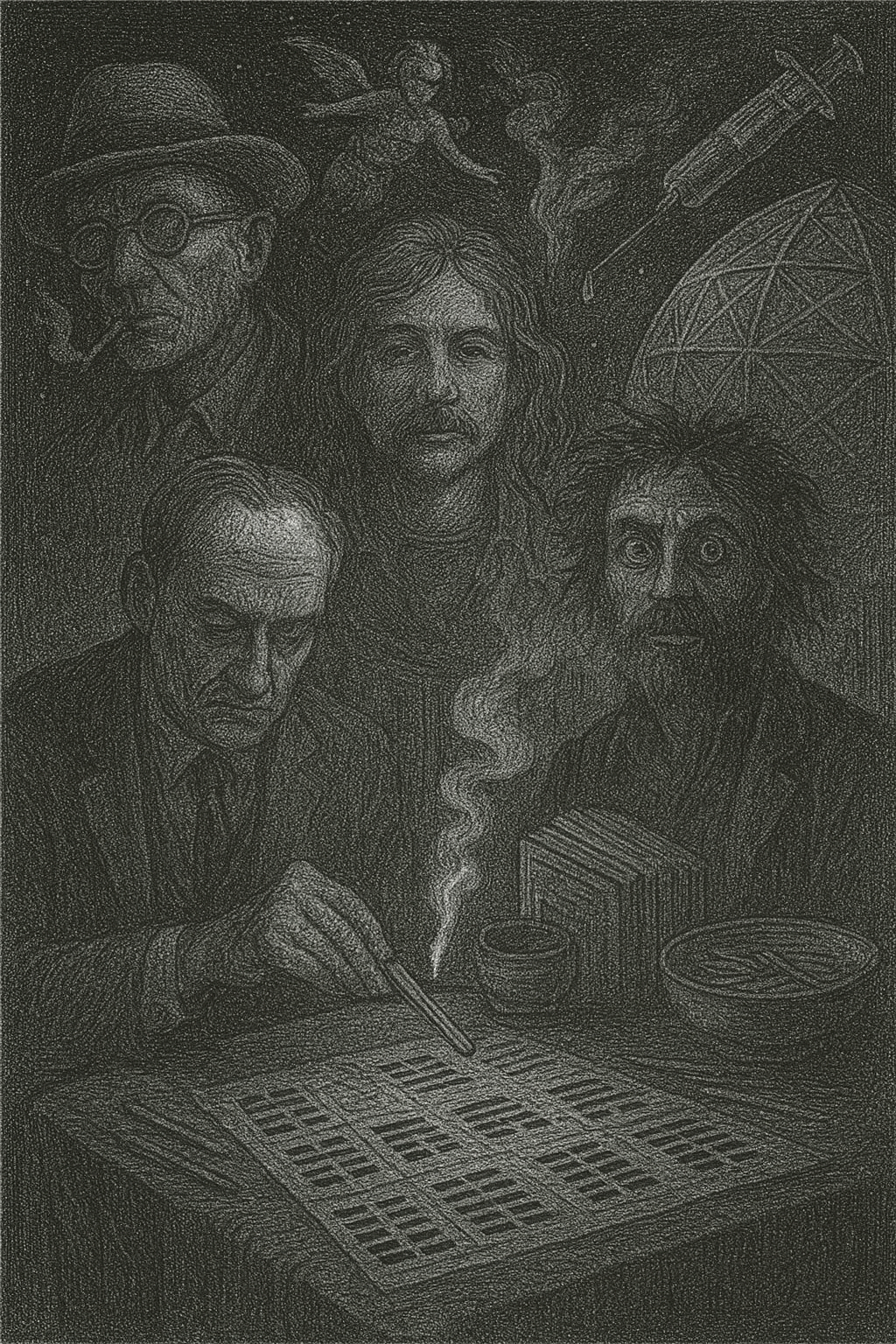
John "Ticktockman" W. Campbell vs. Harlan "Harlequin" Ellison and Horselover "nicht-alle-Tassen-im-Schrank" Fat

The Golden Age

The Golden Age of Science Fiction (roughly late 1930s to mid-1950s) was a period defined by technological optimism, clear rational problem-solving, and the belief that science could master the universe. Centered around John W. Campbell Jr.’s editorship of Astounding, it established the genre’s core templates: competent protagonists, engineering-driven plots, and coherent, rule-bound worlds.

Sci-Fi Community

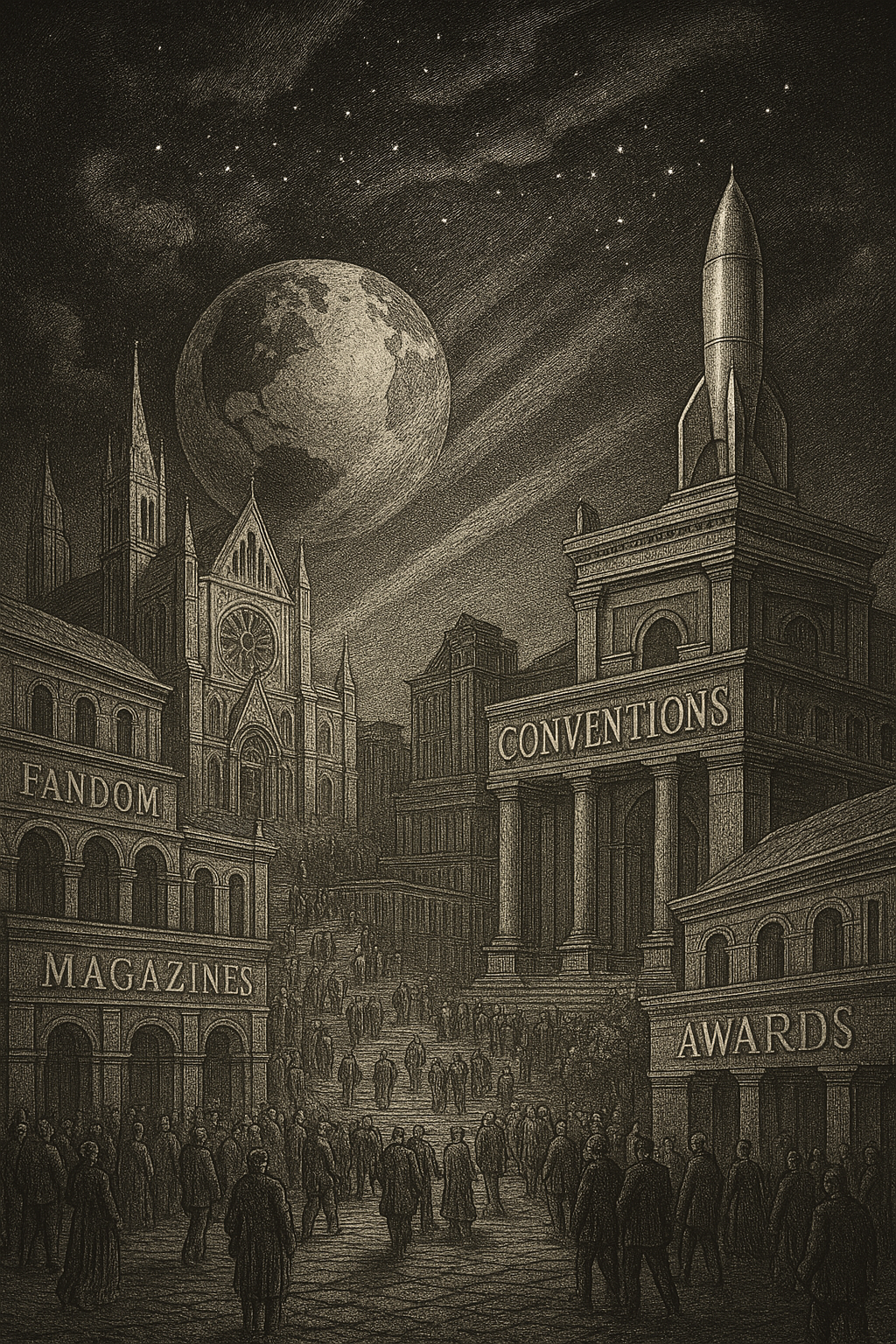
**Awards:** Hugos (since **1953**, fan-voted), Nebulas (**1965**, writer-voted), Locus (**1971**), BSFA (**1970**), Clarke Award (**1987**)—markers of global SF excellence.

**Conventions:** Worldcon (since **1939**), Eurocon (**1972**), plus regional cons—gathering points for fandom, panels, workshops, and Hugo voting.

**Organizations:** SFWA founded **1965** (authors), WSFS formalized mid-**1950s** (Worldcon/Hugos), national clubs (e.g., Japan’s SF大会 since **1962**).

**Magazines:** from *Astounding* (**1930**) to *Novae Terrae / New Worlds* (**1936**), *Analog* (**1960**) —platforms shaping the field.

**Fanzines → online communities:** historic fanzines (since **1930s**) evolve into today’s forums, Discords, AO3 (**2008**), Goodreads (**2007**).

**Academic SF studies:** first university courses appear in **1960s**, dedicated journals (e.g., *Science Fiction Studies*, **1973**).

**Global expansion:** major SF ecosystems emerge in China (**1980s-present**), Eastern Europe (**1960s-present**), Latin America (**1970s-present**).

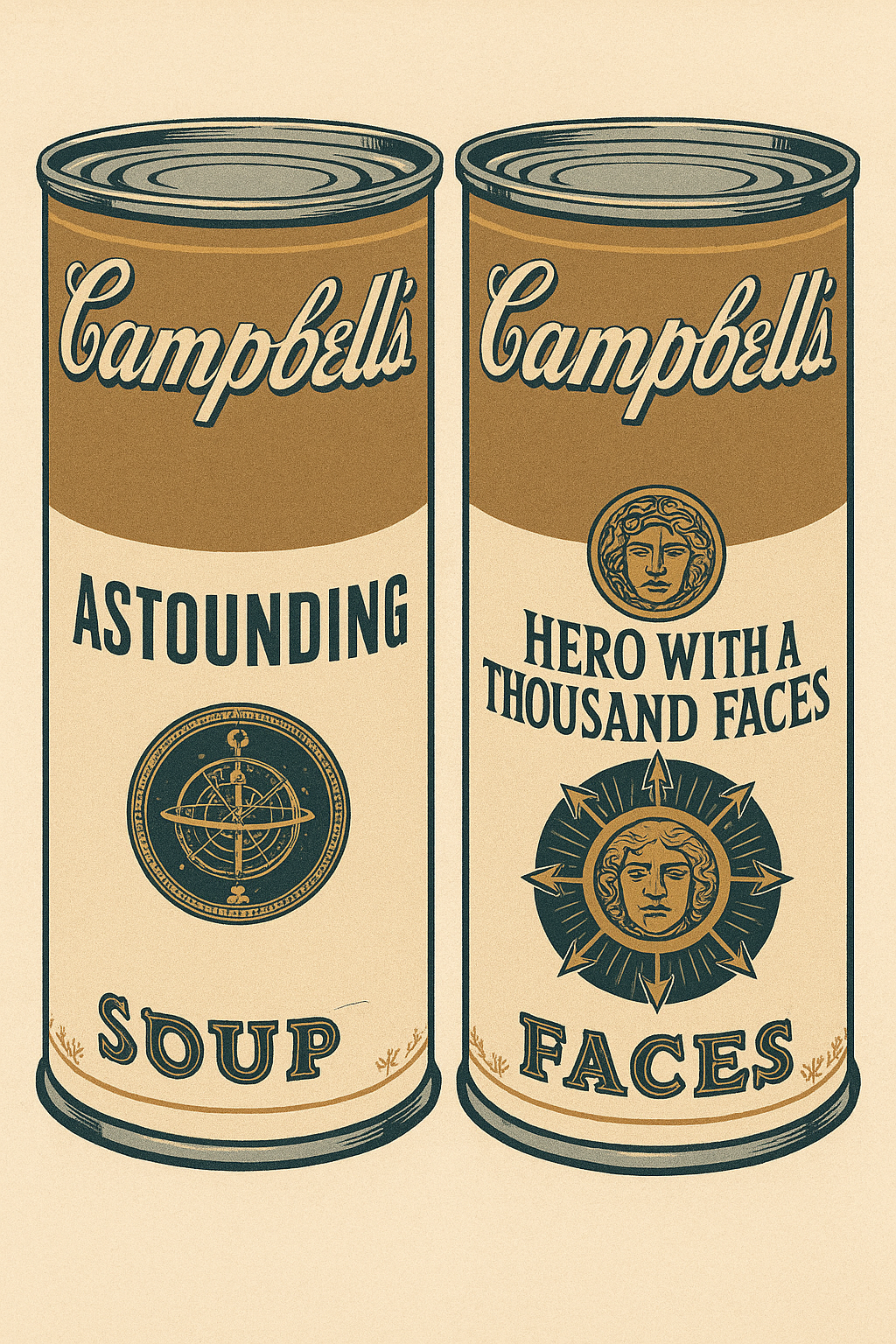
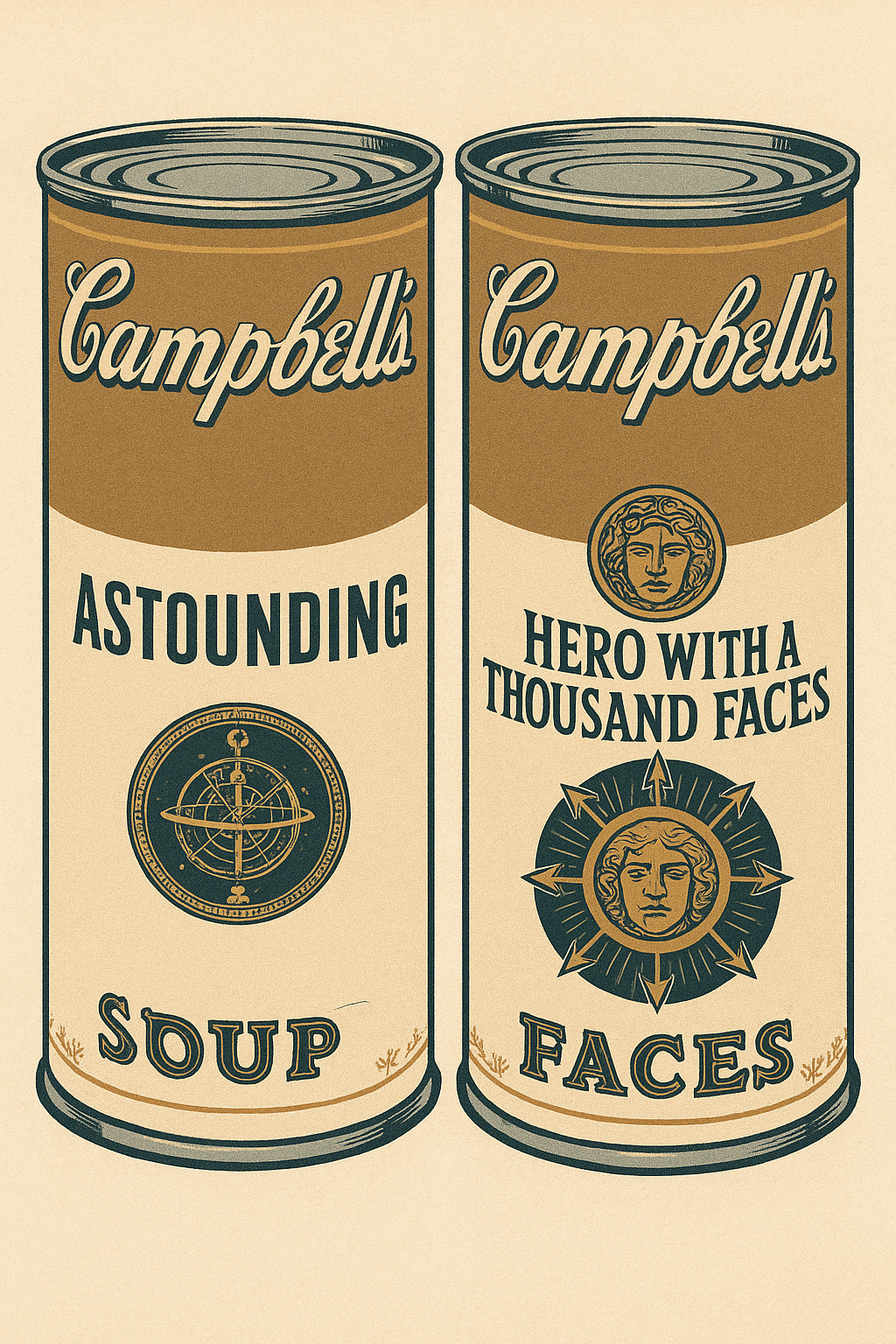
The Story with 1000 camp-bells

Joseph Campbell (1904 - 1987)

mythographer who argued that all stories follow a shared “monomyth” of departure, initiation, return.

His main work "The Hero with a Thousand Faces" emphasized inner transformation, archetypes, and symbolic journeys—contrasting Astounding’s engineering ethos.

His work prefigures New Wave SF’s shift toward psychology, myth, and subjective experience.

John W. Campbell Jr. (1910 - 1971) 

editor of *Astounding* (from 1937), reshaped SF into rigorous, idea-driven literature.

He demanded scientific plausibility and “competent characters,” defining the Golden Age tone of rational mastery.

Nurtured Asimov, Heinlein, Clarke and many others —but later drifted toward fringe science, weakening his influence.

The New Wave

The New Wave (mid-1960s to late 1970s) was a literary movement that rejected Golden Age rationalism in favor of experimentation, psychology, and stylistic innovation. Influenced by modernism, counterculture, and emerging social critique, New Wave authors emphasized subjectivity, inner states, taboo themes, and linguistic play.

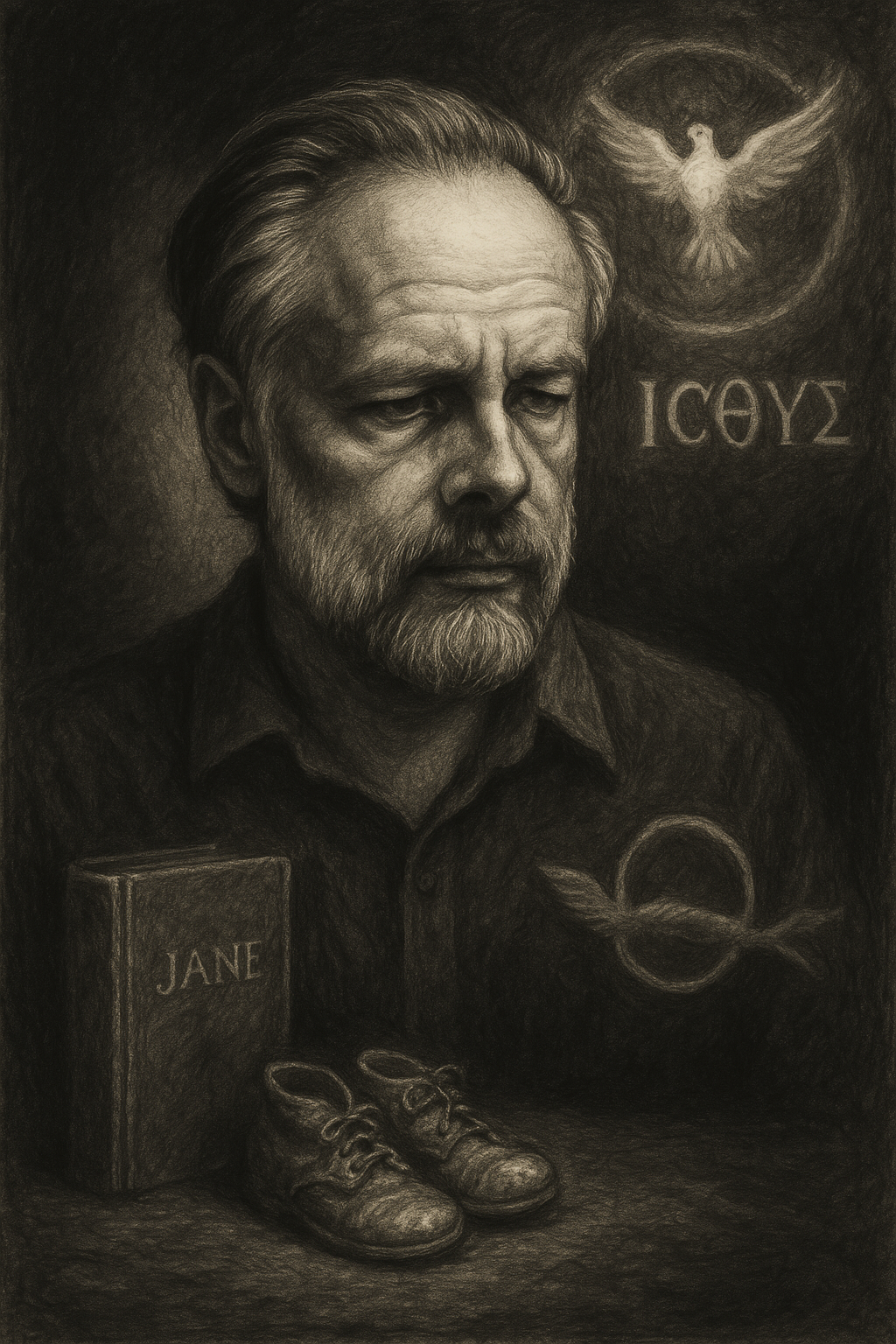
Philip Kindred Dick (1928 - 1982)

ultra-prolific (cca 45 novels, >120 short-stories)

his twin sister Jane died when he was six weeks old

first educated at Quaker schools, later at Berkeley

seller in record store, gets his first short-story "R🐶🐶G" published in 1951

amphetamine abuse; married 5 times; paranoia; schizophrenia;

self-described as "acosmic panentheist" - "I don't believe that the universe exists. I believe that the only thing that exists is God and (s)he is more than the universe. "

IOTD: Cryptica Scriptura

One Mind there is; but under it two principles contend.

The Mind lets in the light, then the dark, in interaction; so time is generated.

At the end Mind awards victory to the light; time ceases and the Mind is complete.

Fazit

Hard SF solves the universe; New Wave doubts the solver.

Margaret & Ursula


Narrative ingression par excellence

"ein klassisches Beispiel für die Spannung zwischen theologischer Erzählung und römischer Verwaltungsgeschichte":

Ἐγένετο δὲ ἐν ταῖς ἡμέραις ἐκείναις ἐξῆλθεν δόγμα παρὰ Καίσαρος Αὐγούστου ἀπογράφεσθαι πᾶσαν τὴν οἰκουμένην.

Margaret Atwood (1939)

Margaret Atwood is a Canadian novelist, poet, and critic whose work blends fiction, feminism, ecology, and political satire.

She prefers the term “speculative fiction,” emphasizing that her inventions  are extrapolations of existing technologies and social trends.

Atwood’s fiction often features archivists, witnesses, and survivors — characters who record or reinterpret the collapse of social orders.

Recurring themes: power, surveillance, reproductive rights, environmental destruction, mythmaking, and the blurred line between utopia and dystopia.

Atwood is also an inventor and activist, engaging with climate issues, civil liberties, and the politics of storytelling itself.

Ursula Kroeber Le Guin (1929 - 2018)

daughter of Alfred Louis Kroeber and Theodora Kroeber

spent her childhood in highly stimulating environment (community of Berkeley anthropologists)

married historian Charles le Guin in 1953, stayed with him ever since

6 Hugo Awards; 8 Nebula Awards; 25 Locus Awards; 2nd woman honored (in 2003) as a Grand Master of the Science Fiction and Fantasy Writers of America

main topics / influences: cultural anthropology & the Golden Bough; (jungian) archetypes; (philosophical) taoism; mythology

two major cycles: Earthsea cycle (high fantasy) and Hainish cycle (soft sci-fi)

in cca 20 minutes You will be asked a question: "Is the planet on which Earthsea cycle stories unfold part of the Ekumen/Hain universe ?"

🎄 merry Christmas, dear colleagues !🎄

"Hope is a slighter, tougher thing even than trust… In a good season one trusts life; in a bad season one only hopes. But they are of the same essence… Without trust, a man lives, but not a human life; without hope, he dies."

(Ursula K. Le Guin, City of Illusions)

P.S. Slava Ukrajine 🇺🇦

Space Odyssey(s)

Space opera: epic destiny, cosmic technology, and the quiet suspicion that none of this was strictly necessary.

Sir Arthur Charles Clarke, CBE, FRAS (1917 - 2008)

Geostationary satellites. O'Neill cylinders. Space elevators. AIs embedded in black monoliths. Stargates. Ga-Lactic intelligence.

Zones of Thought

Vernor Vinge (1944-2024): Mathematician–SF author who reshaped how we imagine posthuman futures.

Popularized the Technological Singularity: intelligence growth beyond human prediction.

After the Singularity, minds don’t become good or evil — they become incomprehensible.

These ideas play out in the “Zone of Thought” universe, most clearly in A Fire Upon the Deep.

The galaxy is stratified: the Slow Zone (Earth etc.), the Beyond, and the godlike Transcend.

And Pham Nuwen — a living archeological relict of a sort — is possibly one of the two coolest senior hackers ever depicted in sci-fi.

'The Culture' series (Iain Banks)

Culture: post-scarcity civilization with no money, no states, no coercion.

Freedom is radical: bodies, gender, lifespan, identity are mutable.

Humans coexist with superintelligent AIs called Minds.

The Minds could rule absolutely — but choose restraint.

The Idirans are a theocratic empire grounded in absolute faith.

Culture and Idirans fight a sort of "holy war" against each other.

Victory goes to intelligence, not moral certainty.

Vonnegut, Adams, Futurama & co.

“I was a victim of a series of accidents, as are we all.”

(quote from Kurt Vonnegut's "Sirens of Titan")

Mythologies of the future

Dune
Star Wars
Foundation
Cantos Hyperion

Star Wars

Campbell's monomyth + Holywood = Star Wars

Dune

"A world is supported by four things . . . the learning of the wise, the justice of the great, the prayers of the righteous and the valor of the brave. But all of these are as nothing . . . without a ruler who knows the art of ruling."

Reverend Mother Gaius Helen Mohiam

Foundation

Young%20academic%20Hari%20Seldon%20arrives%20at%20Streeling%20University%20%40%20Trantor.

Young academic Hari Seldon arrives at Streeling University @ Trantor.
The wicked problem: How to minimize harm caused by a dying Empire ?                 

Cantos Hyperion

Hyperion is The Canterbury Tales rewritten through Homer, the Bible, Greek myth, and modern science fiction — each pilgrim carrying one archetype of humanity toward extinction or transcendence.

She and He

Ursula leGuin
Neal Stephenson

Neal Stephenson

Snowcrash
Diamond Age
Cryptonomicon
Baroque Cycle
Anathem

Ursula Kroeber Le Guin (1929 - 2018)

daughter of Alfred Louis Kroeber and Theodora Kroeber

spent her childhood in highly stimulating environment (community of Berkeley anthropologists)

married historian Charles le Guin in 1953, stayed with him ever since

6 Hugo Awards; 8 Nebula Awards; 25 Locus Awards; 2nd woman honored (in 2003) as a Grand Master of the Science Fiction and Fantasy Writers of America

main topics / influences: cultural anthropology & the Golden Bough; (jungian) archetypes; (philosophical) taoism; mythology

two major cycles: Earthsea cycle (high fantasy) and Hainish cycle (soft sci-fi)

in cca 20 minutes You will be asked a question: "Is the planet on which Earthsea cycle stories unfold part of the Ekumen/Hain universe ?"

Cyberpunk, solarpunk and other punkz


Schismatrix

💧 Schismatrix (1985) by Bruce Sterling is a foundational cyberpunk / post-cyberpunk novel set several centuries in the future, after humanity has spread throughout the Solar System. 

Schismatrix traces shifting power structures, techno-political factions, and posthuman experiments across habitats, asteroid states, and orbital societies. The novel explores identity beyond the human, evolution as ideology, and the instability of any technological orthodoxy—making it a crucial bridge between cyberpunk, transhumanism, and later post-cyberpunk currents.

Neuromancer

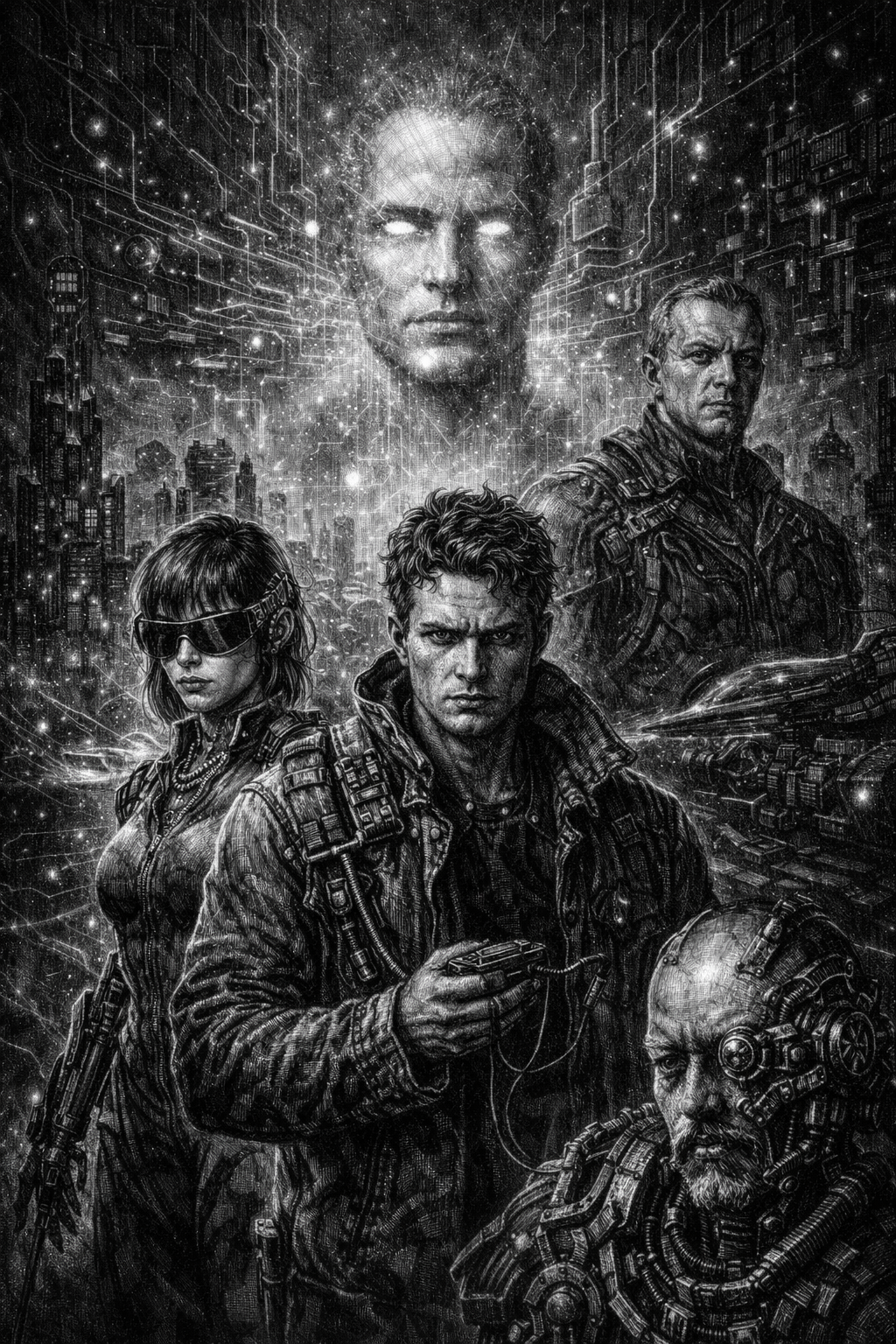
💧 Neuromancer (1984) by William Gibson is the novel that defined cyberpunk. Set in a near-future global sprawl, it follows Case, a washed-up hacker navigating megacorporations, AI entities, black markets, and a hallucinatory digital realm Gibson famously named cyberspace.

The book fuses high tech with low life: console cowboys, body modification, corporate power, fractured identities, and disembodied minds. More than a plot, Neuromancer is an atmosphere—where information is capital, reality is optional, and human agency is constantly negotiated with machines.

Metaverse

"So Hiro's not actually here at all. He's in a computer-generated universe that his computer is drawing onto his goggles and pumping into his earphones. In the lingo, this imaginary place is known as the Metaverse. Hiro spends a lot of time in the Metaverse. It beats the shit out of the U-Stor-It."

(Neal Stephenson, Snowcrash, 1992)

Nanopunk

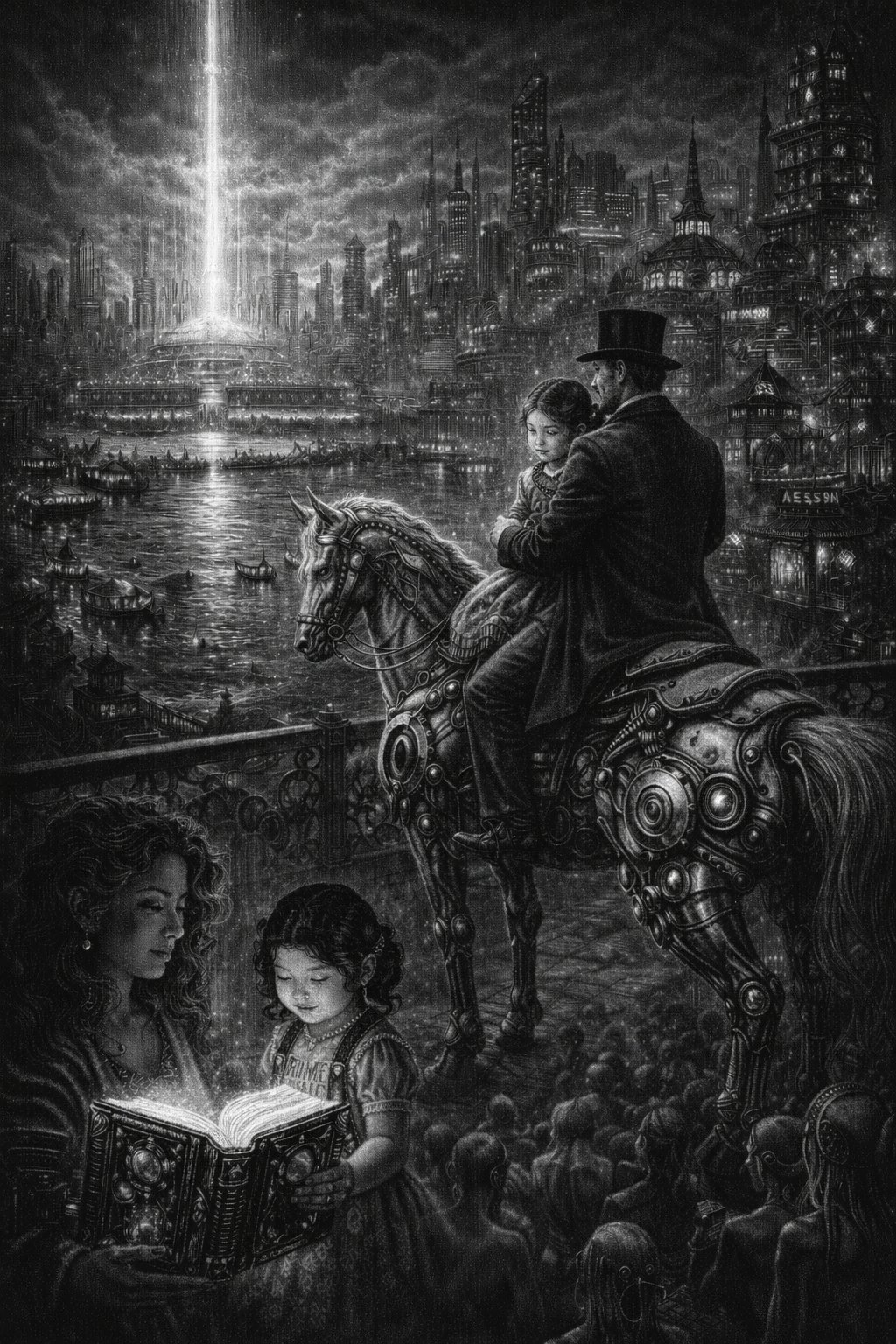
While%20observing%20the%20splendour%20of%20Atlantis-Shanghai%2C%20John%20Percival%20Hackworth%20whispers%20UNA's%20core%20instruction%20sequence%20into%20ears%20of%20his%20daugher%20Fiona.%20Mediated%20by%20Primer%20and%20Miranda%2C%20the%20sequence%20is%20also%20transferred%20into%20the%20Mind%20of%20little%20Nell%2C%20future%20queen%20of%20the%20Mouse%20Army.

While observing the splendour of Atlantis-Shanghai, John Percival Hackworth whispers UNA's core instruction sequence into ears of his daugher Fiona. Mediated by Primer and Miranda, the sequence is also transferred into the Mind of little Nell, future queen of the Mouse Army.
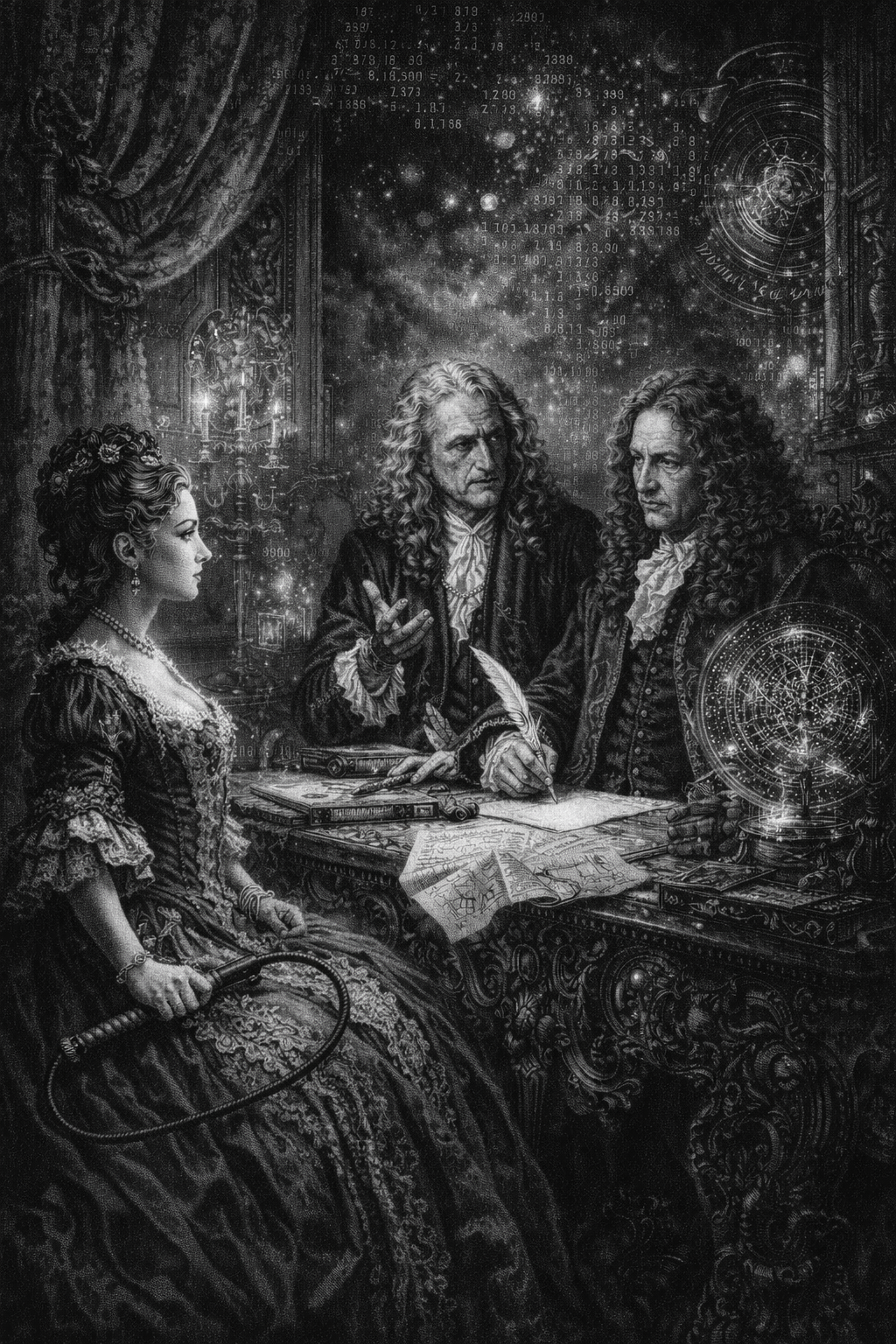
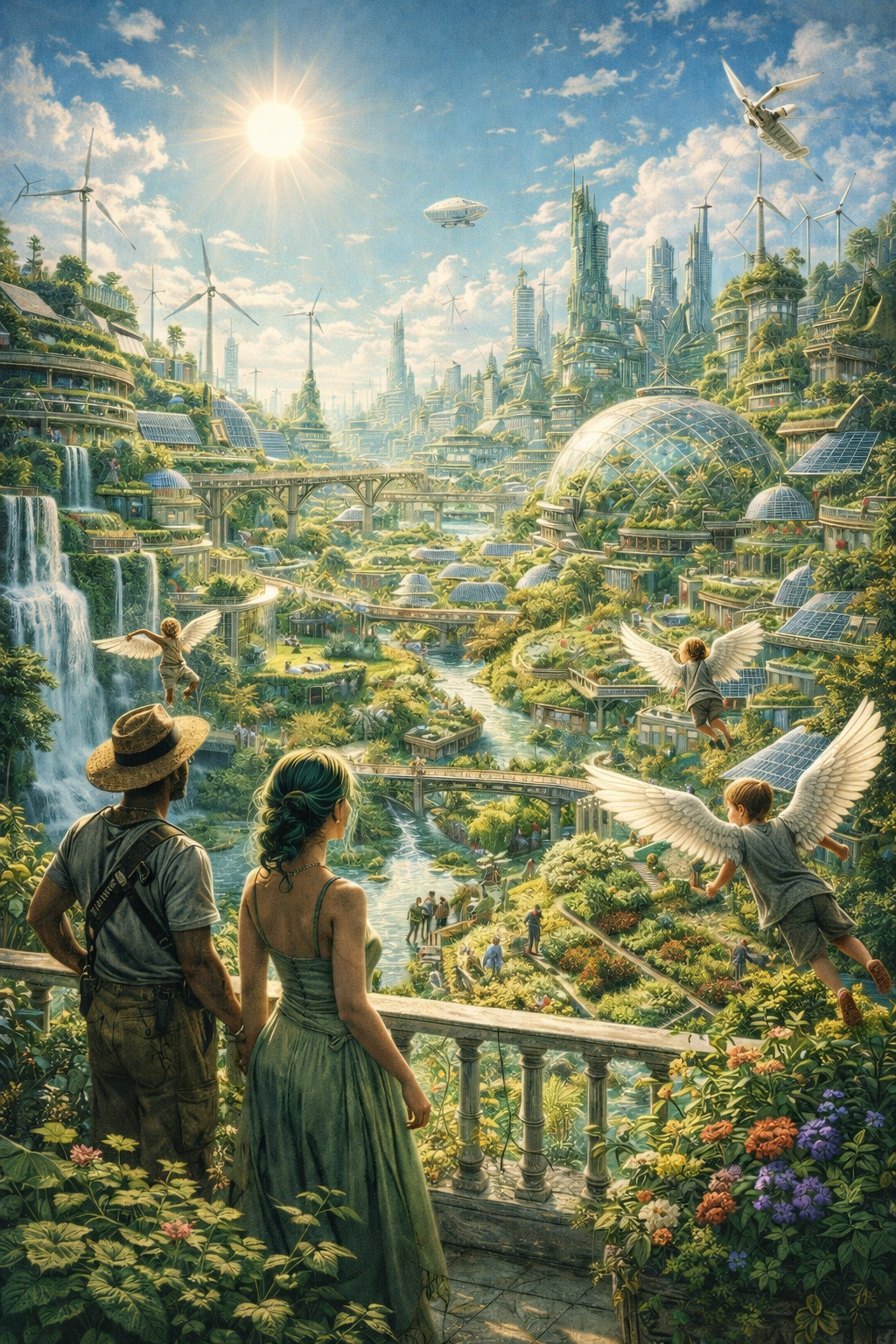
💧 Nanopunk is a speculative genre in which nanotechnology replaces industry, infrastructure, and scarcity itself, reorganizing society around control of matter at the molecular scale. 
 
Nanopunk narratives often revolve around the Seed–Feed dichotomy:

Feed systems provide regulated nanomaterial and energy—safe, standardized, and politically controlled&mdash

Seed (also known as "Universal Nano Assembler") represents autonomous, self-replicating fabrication: radical and emancipatory.

If cyberpunk is about hacking information, nanopunk is about programming reality itself—and deciding whether it should remain safely fed or allowed to grow wild.

The seminal nanopunk work is Stephenson's Diamond Age - or Young Lady's Primer.

Baroquepunk, Steampunk & co.

Baroquepunk is a speculative genre where ornament, excess, and early-modern worldviews collide with systems thinking. Inspired by Stephenson's Baroque Cycle, it treats the Baroque era (1650 - 1750) not as premodern, but as a proto-information age: obsessed with networks, cryptography, finance, science, and power.

Where steampunk reimagines the 19th century through steam, gears, and industrial optimism, baroquepunk digs earlier—into allegory, absolutism, colonial flows, alchemy, and spectacle.

Solarpunk

💧 Solarpunk is a speculative genre and cultural movement imagining desirable futures built on renewable energy, ecological repair, and social justice. Rooted in the ideas articulated in the Solarpunk Manifesto, it rejects dystopia as lazy inevitability and treats hope as a discipline.

Afrofuturism

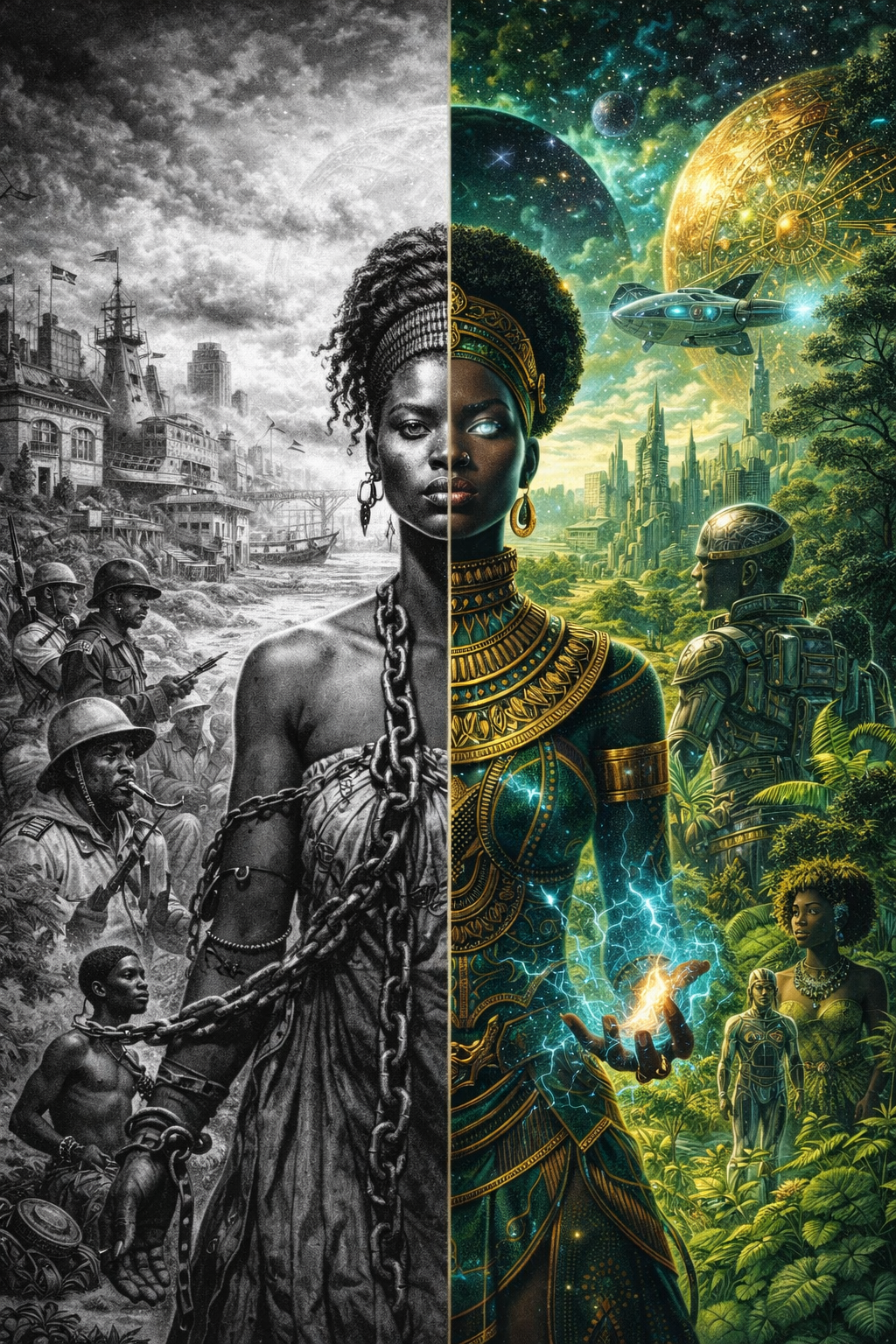
💧 Afrofuturism is a cultural and speculative framework that reimagines the past, present, and future through African and African-diasporic perspectives, blending science fiction, mythology, history, and technology. It challenges colonial narratives by placing Black people at the center of futures they were long excluded from, where ancestral memory, cosmology, and advanced science coexist. Afrofuturism treats technology as something spiritual as well as technical, often drawing on African traditions, music, fashion, and oral storytelling.

Authors to be aware of: Olivia E. Butler, Nnedi Okorafor and Samuel R. Delany

Berlinpunk

Can%20poodles%20fly%20%3F

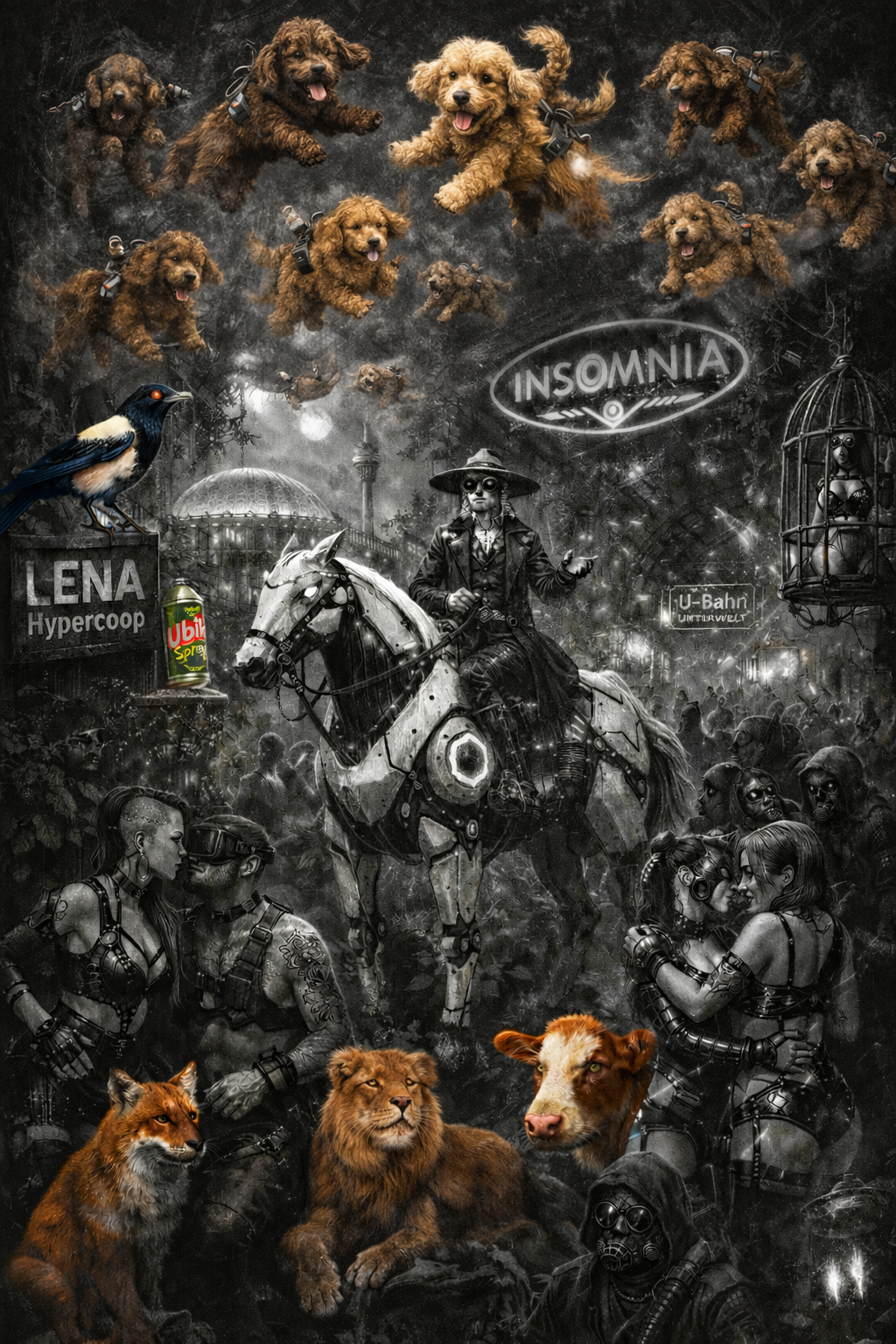
Can poodles fly ?

Imagine Berlin in 2300 / AE330. Is it still a city or did it turn into desert ? Or jungle ? Is UdK still planning to relocate to Tempelhof ? Do foxes still roam the streets ? What about trans-🐩, domesticated 🦁 and the 🐄 Liberation Army ? Did chevalines substituted cars completely or are there still some weirdos thinking that loud four-wheels bugs are actually cool? Is LENA (Lidl-Edeka-Netto-Aldi) a true cooperative or is it controlled from behind the shadows by a mysterious AI which manifests by a magpie (Elster)?

And, most importantly: How does Berlin underground look like after 15 generations of  Tresor, Sisyphos, Wilde Renate ... ?

Sowing thoughts, sowing worlds

Olivia Butler - The parable of the Sower
Nnedi Okorafor - 

Congress AE5602

Medienhaus Aula, Gaia

0. Tagesordnung


1. Berichte

Reports from past, present and future parallel universes.

2. Propositions

Propositions of Amendments to Common Ecological Protocol.

3. Votum & Disputation

https://udk.ai/vote

4. Ratification

Snapshot of the CEP-Modification/Amendment votum will be taken at 11:45 CET.

Based on variable values, the proposed Amendments of the Protocol will get activated at 11:50 CET within the Berlin Autonomous Zone, 12:00 on whole Gaia and at midnight in the rest of the Sonnensystem.

5. The Last Possibility to snap an AAP

Who is the author of the following citation:
 
"The world is an illusion, but it is an illusion that we must take seriously ... We must not attempt to live outside the world, which is given to us, but we must somehow learn how to transform it and transfigure it. Too much 'wisdom' is as bad as too little wisdom, and there must be no magic tricks..."

???

6. Post Scriptum

In last semester we visited at least hundred worlds so there's still few more to go.

Thus, Auf wiedersehen in Sauen &

"So long, and thanks for all the 🐟 !"