Kastalia Knowledge Management System · Glasperlenspiel template · knot 3997
Alan and his Enigma
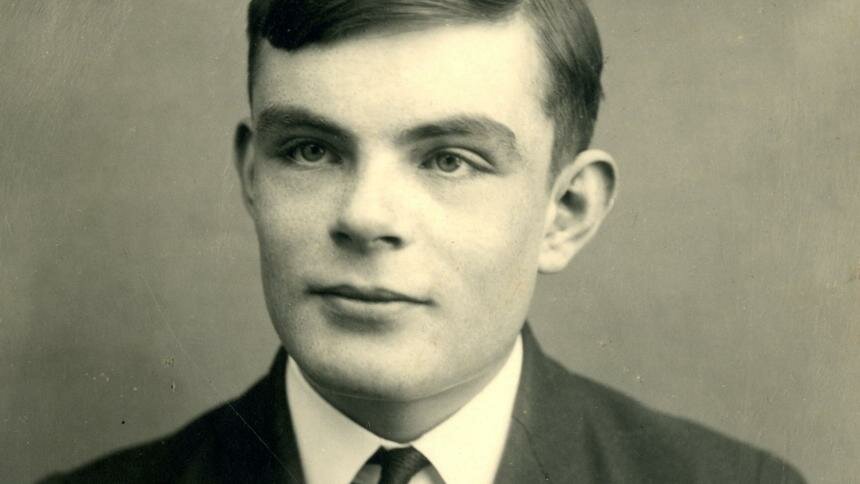
The story of Alan Matthison Turing, his machine(s) and his test(s)
Ancestors (1 superordinated path)
root/
baumhaus.digital/
Studium Generale/
Short History of the Learning Machine/
Alan and his Enigma
Descendants (at least 25 branches originate here)
-
Alan and his Enigma
🔊
The story of Alan Matthison Turing, his machine(s) and his test(s)
-
is_parent philosopher's definition of "thinking" ·
“We may say that thinking is essentially the activity of operating with signs.” — Ludwig Wittgenstein, The Blue Book (1933–1934), p.&nbs -
is_parent Halting Problem ·
On Computable Numbers, with an Application to the "Entscheidungsproblem" (1936) halting problem is the problem of determining, from a description of an arbitrar -
is_parent a Turing machine #1 ·
A "theoretical" machine consisting of tape with discrete symbols reading/writing header table of rules tape-moving mechanism Visualization of the Turing Machine -
is_parent Universal Turing machine ·
"It is possible to invent a single machine which can be used to compute any computable sequence. If this machine U is supplied with a tape on the beginning of w -
is_parent Turing test ·
"A TT is a way how to address the question "Can machines think?" in a scientifically plausible ye deeply empathic way. More concretely, Turing (1950) proposes t -
is_parent The imitation game ·
-
is_parent Computational machinery and intelligence (1950) ·
I propose to consider the question, "Can machines think?" This should begin with defnitions of the meaning of the terms "machine" and "think".(Turing, 1950) -
is_parent Watch: Alan Turing's Machines 🔒 ·
We start with a 1966 BBC programme, made twelve years after his death.While you watch, keep one question in mind: what is this “machine” made of? -
is_parent
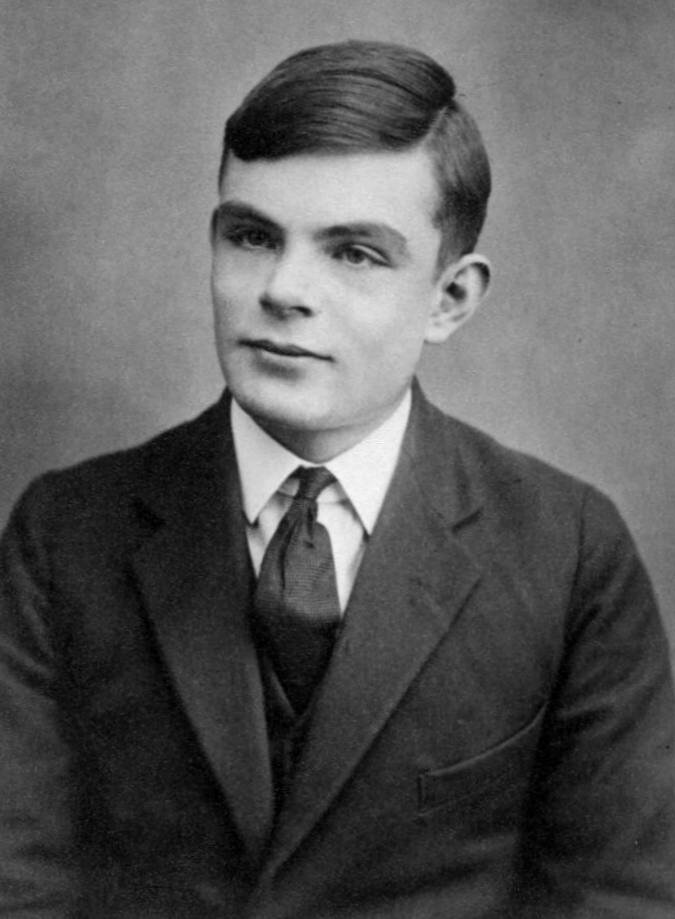 Alan Matthison Turing (1912–1954)
🔒
·
Born in London, 23 June 1912. Mathematician: Cambridge, then Princeton.1936, aged 23: On Computable Numbers — the paper that defines the computer before a
-
is_parent Enigma 🔒 ·
Enigma: a German cipher machine. Press a key, a different letter lights up — and the rotors turn, so the next key is scrambled differently.Bletchley Park: -
is_parent The question Hilbert asked 🔒 ·
1928, David Hilbert: is there a mechanical procedure that decides, for any mathematical statement, whether it is provable?Leibniz had dreamed of it: let us calc -
is_parent Computers were people 🔒 ·
Until the 1940s a “computer” was a person who computes — often a woman with pencil and paper at a desk.Turing asks: what does such a person ac -
is_parent Exercise · Be the machine 🔒 ·
The tape holds a binary number: 1 0 1 1. The head stands on the rightmost digit. State: CARRY.CARRY reads 1 → write 0, move left, stay in CARRYCARRY reads -
is_parent The tape can hold a machine 🔒 ·
A universal machine reads the rules of another machine from its tape and behaves like it.Program = data. Your laptop is such a machine; an app is just a long ta -
is_parent Halting · the trick in four lines 🔒 ·
Suppose a program H(p, x) always answers correctly: “p halts on x” or “p loops forever”.Build D(p): ask H(p, p). If it says halts, loop -
is_parent Question of the Day · Can machines think? 🔒 ·
Turn to your neighbour. Two minutes.What would a machine have to do for you to say “yes, it thinks”?Write the criterion down.We will test it at the -
is_parent The game as Turing wrote it 🔒 ·
Turing refuses to define “think”. He calls the question “too meaningless to deserve discussion” and replaces it with a game.Three player -
is_parent Watch: Can machines think? 🔒 ·
The famous question, in video form.While watching, note the one objection you would raise. -
is_parent Turing answers his critics 🔒 ·
Section 6 of the paper lists nine objections, among them theological, mathematical, from consciousness — and Lady Lovelace's.Lovelace (1843): the Analytic -
is_parent Does the test still work? 🔒 ·
ELIZA (Weizenbaum, 1966): a few pattern rules, and some users confided in it anyway.The Chinese Room (Searle, 1980): symbols shuffled correctly, nothing underst -
is_parent Exercise · Meet Alan 🔒 ·
Alan is a Matrix bot (@alan:udk.ai) running on our own server. You will chat with “Alan” — but behind him may be an AI persona or another stud -
is_parent Debrief · What gave him away? 🔒 ·
Which cues did you use? Speed? Spelling? Politeness? Never saying “I don't know”? A body, a weather, a bad day?Humans make typos and slip. Turing wr -
is_parent The enigma remains 🔒 ·
Turing machine: what can be computed — defined by what a procedure does, not what it is made of.Turing test: what we will call intelligent — defined -
is_parent Exercise · Your hand is a Turing machine 🔒 ·
Counting from 0 to 31 on the fingers of one hand is a Turing machine at work. Here is its anatomy:Tape — your five fingers: thumb = rightmost cell, little
-