Kastalia Knowledge Management System · Glasperlenspiel template · knot 3986
On Tracking : Dancing Piano II.
Ancestors (1 superordinated path)
Descendants (at least 32 branches originate here)
-
On Tracking : Dancing Piano II.
-
is_parent Pulse: How Fast Does a Body Move?
-
is_parent Welcome: Movement Has a Pulse ·
Every movement, however free it looks, has a pulse. A step, a swing of the arm, a beat of a wing — each repeats, and each repetition takes time.This sessi -
is_parent
 Period and Frequency
·
A period (T) is the time it takes for one complete cycle of a repeating motion — one full step, one full wingbeat, one full swing.Frequency (f) is simply
-
is_parent The Pendulum: A Clock Made of Motion ·
The simplest periodic body in physics is the pendulum: a weight swinging from a fixed point.Its period depends only on its length and on gravity — not on -
is_parent The Heartbeat: Your Own Metronome ·
The most intimate periodic motion you own is your own heart: roughly one beat per second at rest — about 60-80 beats per minute, close to 1 Hz.Under exert -
is_parent Walking: Cadence and Stride ·
Walking is periodic too: dancers and gait researchers alike call its frequency cadence — steps per minute. A relaxed walk sits around 100-120 steps/min, r -
is_parent Running and Sprinting: Frequency Is Not Speed ·
Speed is frequency multiplied by how far each cycle carries you — its amplitude, or in gait terms, the stride length.Sprinters increase both: a faster leg -
is_parent Why Small Creatures Move Faster ·
Remember the pendulum: a longer pendulum swings more slowly. The same logic applies to limbs and wings, which behave like pendulums built out of muscle and bone -
is_parent Extremes in the Animal Kingdom ·
A hummingbird's wings beat around 50 times per second (50 Hz) — fast enough to hover motionless in the air.A housefly's wings beat even faster, well above -
is_parent The Piano String Analogy ·
A piano string is, again, a pendulum in disguise — just a vibrating one instead of a swinging one.Short, thin, tightly-strung strings (the piano's high no -
is_parent Tempo in Music: BPM as Period ·
Music names the same quantity differently: tempo, measured in beats per minute (BPM).A tempo of 120 BPM means one beat every 0.5 seconds — a period of hal -
is_parent Entrainment: When the Body Syncs to the Beat ·
Entrainment is what happens when an independent periodic body — a footstep, a heartbeat, a swinging arm — locks its own frequency onto an external o -
is_parent Tracking the Untrackable ·
Measuring a heartbeat or a pendulum is easy. Measuring a dancer's full-body period, in real time, on stage, is not — which is exactly the technical proble -
is_parent From Movement to Sound ·
Once a movement's frequency is captured as a number, it can be mapped — frequency to pitch, amplitude to volume, period to rhythm — onto a piano, re -
is_parent Closing: What's Next ·
Today's vocabulary — period, frequency, amplitude, speed, entrainment — is the physical foundation for everything that follows in this course.Next s
-
-
is_parent
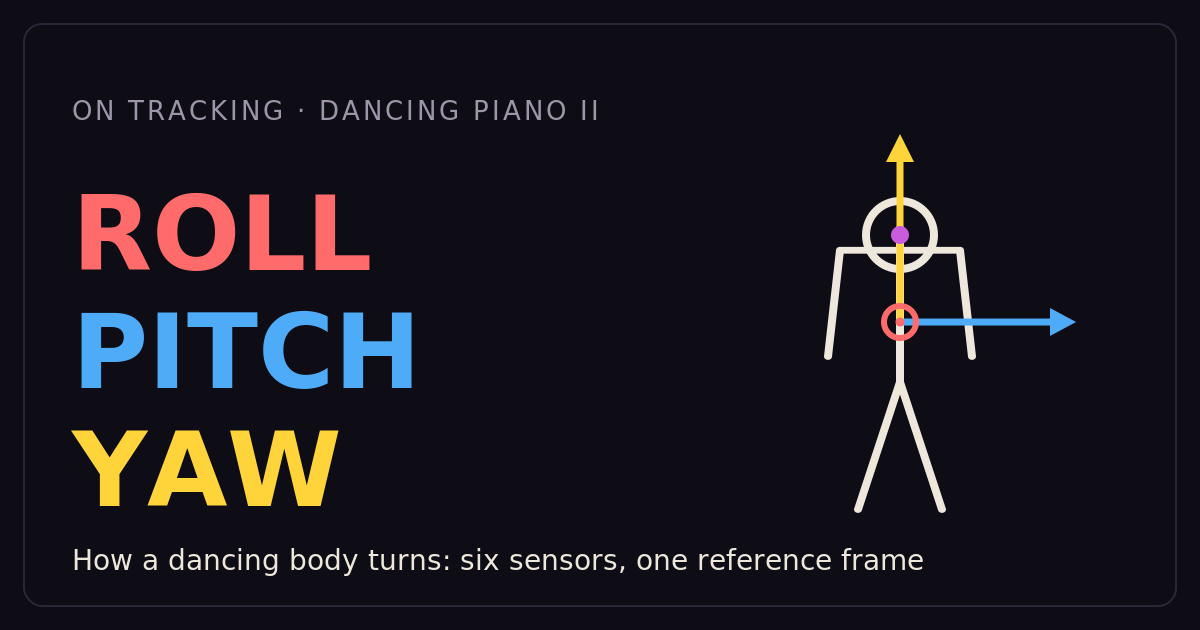 Roll, Pitch, Yaw
Roll, pitch and yaw on a dancing body: one reference frame, six motion sensors, three rotations.
-
is_parent Why three angles? ·
Six small sensors on one dancer. Six streams of numbers. What do they actually say?Each sensor answers one question: how am I turned, compared with the moment y -
is_parent
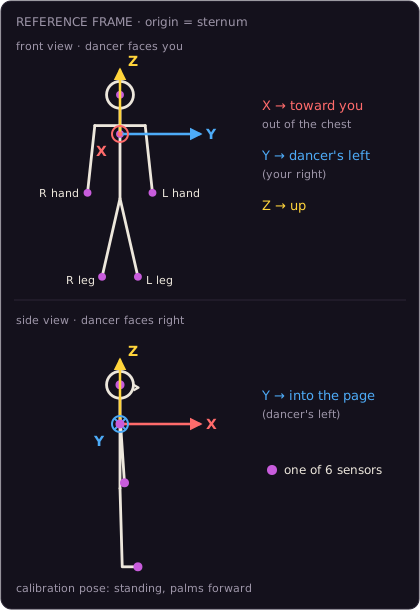 The body is the coordinate system
·
Origin: the sternum.Calibration pose: standing straight, arms hanging, palms turned forward.X points forward, out of the chest. Y points to the dancer's left. Z
-
is_parent
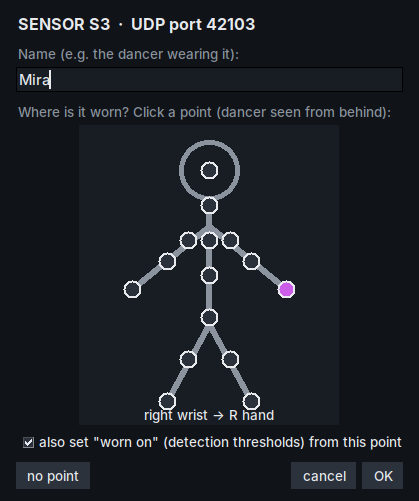 Six sensors, one skeleton
·
Two hands, two legs, torso, head.Each sensor reports its orientation (roll, pitch, yaw), its rotation speed and its acceleration — at rest it feels gravit
-
is_parent Three ways to turn ·
A rigid body in space can turn in exactly three independent ways.Pilots named them. roll: tilt a wing down. pitch: nose up or down. yaw: nose left or right.In o -
is_parent
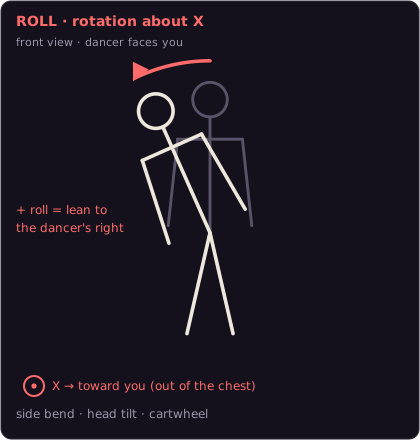 Roll · about X
·
Turn about the axis that points out of your chest.Torso: side bend. Head: tilt, ear to shoulder. Whole body: cartwheel.Positive roll: leaning to the dancer's ri
-
is_parent
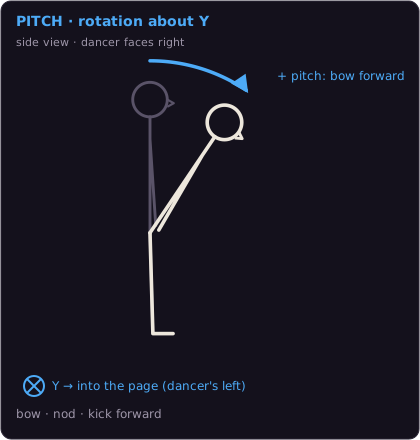 Pitch · about Y
·
Turn about the axis that runs through you from right to left.Torso: bow. Head: nod. Leg: kick forward.Positive pitch: bowing forward.In the app: lean.Try it: no
-
is_parent
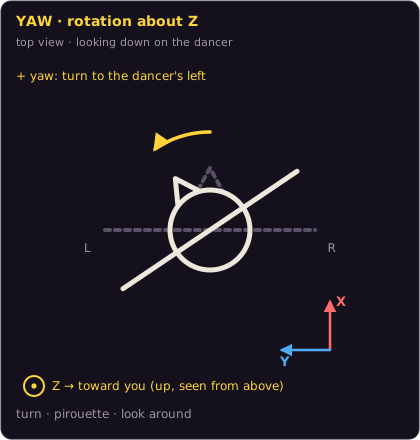 Yaw · about Z
·
Turn about the vertical axis.Torso: turn, pirouette. Head: look around, shake “no”.Positive yaw: turning to the dancer's left (counter-clockwise, se
-
is_parent
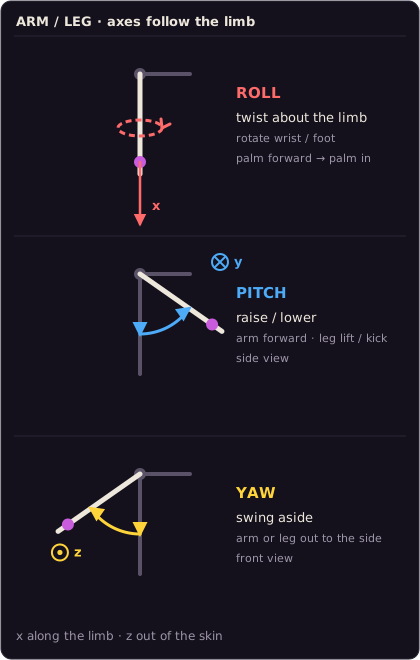 Arms and legs: the axes follow the limb
·
On a limb the frame travels with the limb.x runs along the bone towards the hand or foot; z points out of the skin; y completes the triple.roll = twist the limb
-
is_parent
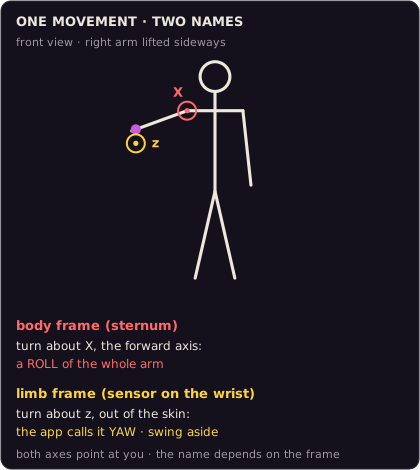 One movement, two names
·
Lift your right arm sideways, like a jumping jack.In the body frame that is a turn about X, the forward axis: a roll.For the sensor on the wrist it is a turn ab
-
is_parent Exercise · the order matters ·
Hold your phone flat in front of you, screen up.A: turn it 90° to the left (yaw), then tip its far edge down 90° (pitch). Note where the screen points.B -
is_parent
 Gimbal lock
·
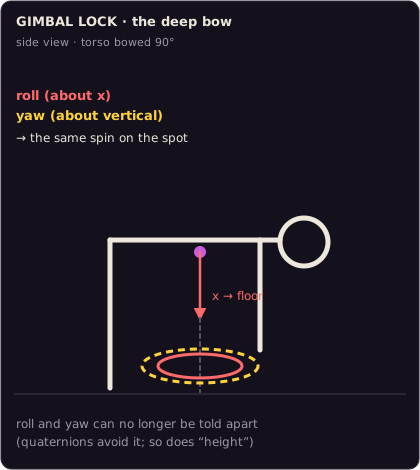
Bow deeply, torso horizontal: the axis out of your chest now points at the floor.Now a turn about x (roll) and a turn about the vertical (yaw) are the same move
-
is_parent Why yaw drifts ·
At rest, the accelerometer feels gravity. That gives roll and pitch — absolute.Turning about the vertical does not change where gravity points. Yaw has no -
is_parent
 From angles to music
·
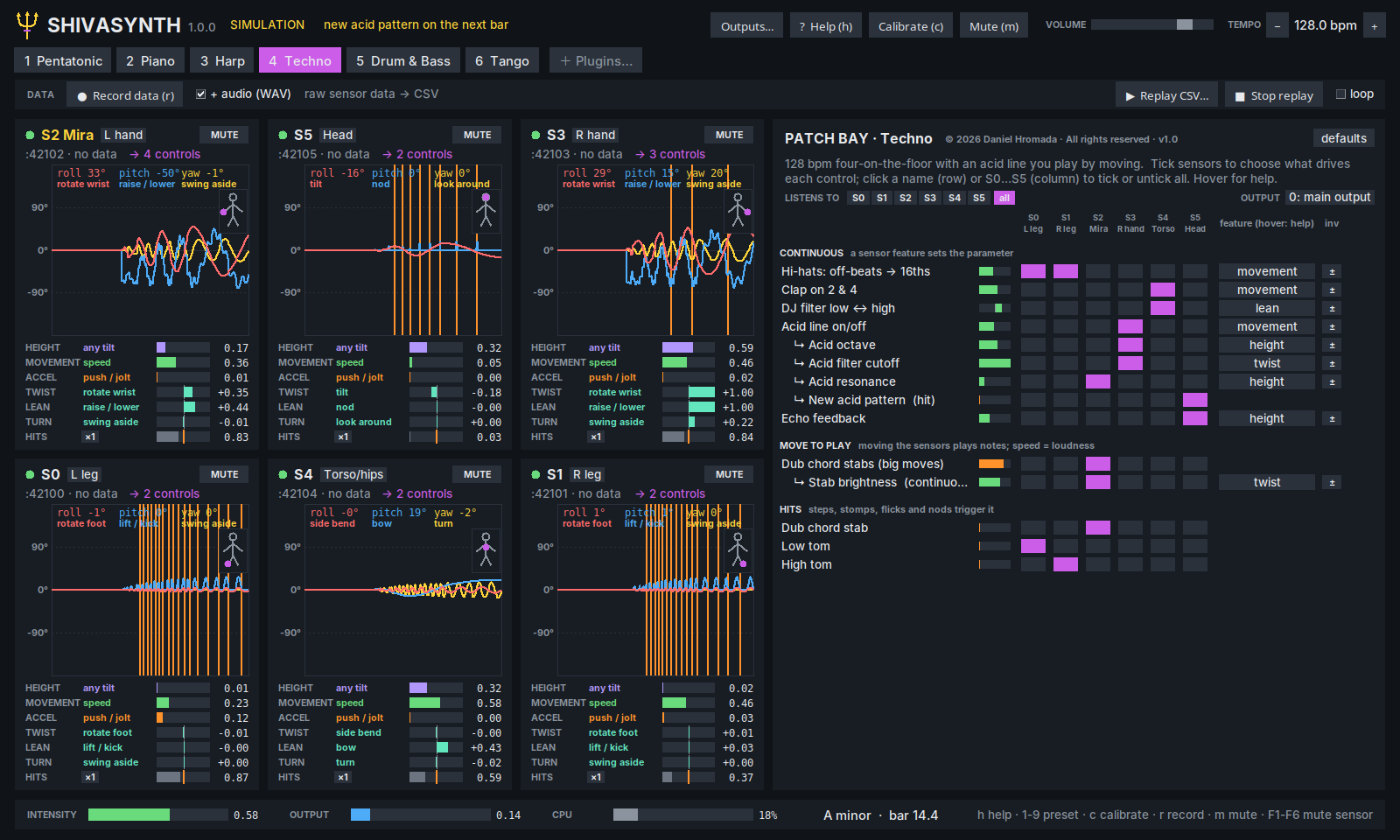
In the dashboard every sensor plots its roll (red), pitch (blue) and yaw (yellow).The patch bay turns them into controls: twist = roll, lean = pitch, turn = yaw
-
is_parent Exercise · name that movement ·
Which sensor, which angle? Do each movement and say it aloud.Nod “yes” → head, pitchShake “no” → head, yawEar to shoulder &rar -
is_parent Take home ·
Frame: origin at the sternum, X forward, Y left, Z up.roll about X, pitch about Y, yaw about Z — and on a limb, the axes follow the limb.The names depend
-
-