Kastalia Knowledge Management System · Glasperlenspiel template · knot 2710
The Second Replicator
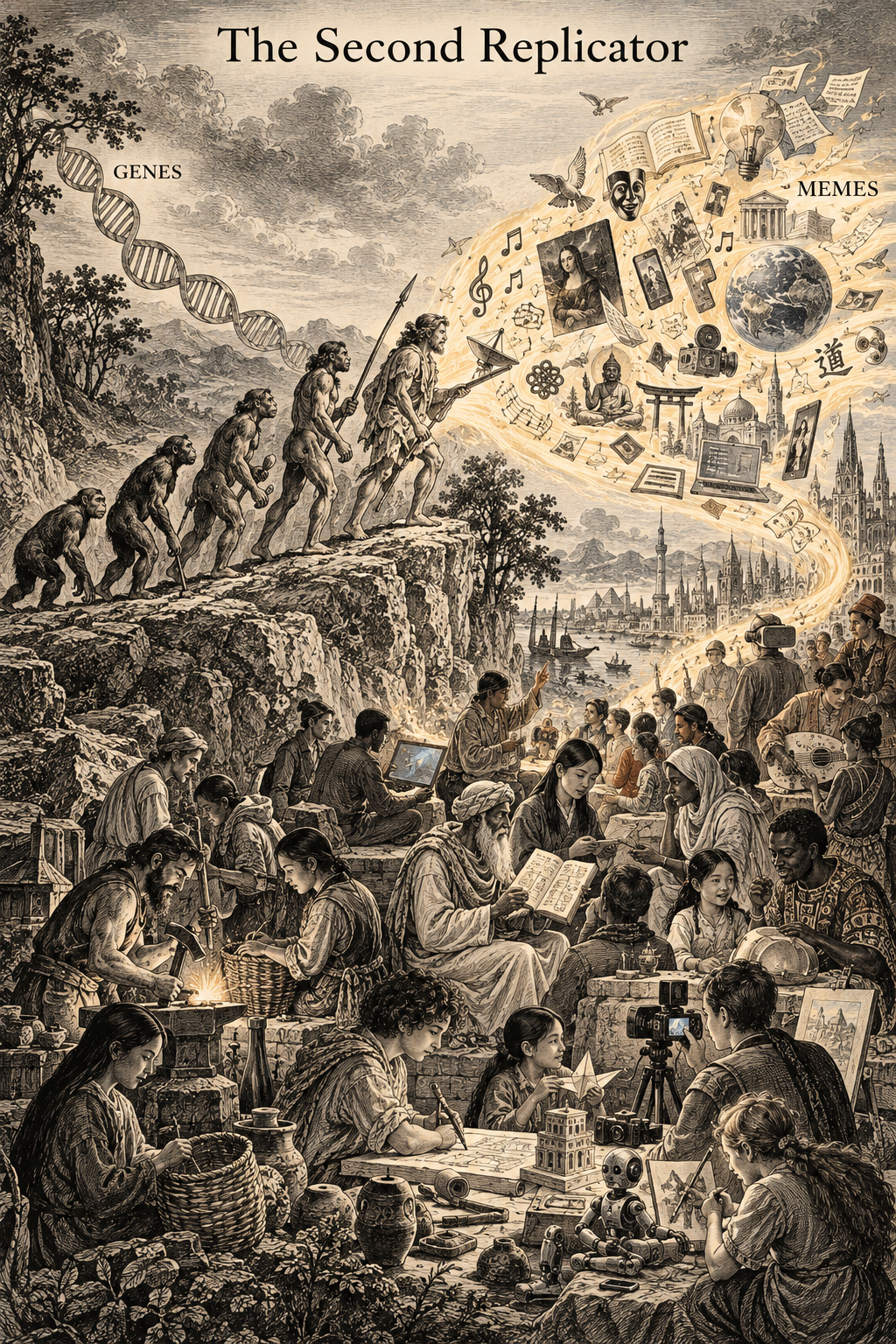
Replication + Variation + Selection = Evolution
Ancestors (1 superordinated path)
root/
baumhaus.digital/
Klasse Leben/
WiSeAE56/
Memes, Mindworms, Memplexes &c./
The Second Replicator
Descendants (at least 18 branches originate here)
-
The Second Replicator
Replication + Variation + Selection = Evolution
-
is_parent Before Darwin ·
For most of human history, the diversity of life was explained by one simple idea: species are fixed, created once, unchanging.A rabbit begets a rabbit. An oak -
is_parent Darwin's Insight ·
In 1859, Charles Darwin proposed something radical: species are not fixed.They change, slowly, over generations — new species arise from old ones through -
is_parent The Engine of Evolution ·
Replication + Variation + Selection = EvolutionDarwin never used these three words this way — but this is the abstract engine hiding inside his argument.T -
is_parent Replication ·
Something must be copied from one generation to the next.Offspring resemble parents — not perfectly, but closely enough that traits persist.Darwin did not -
is_parent Variation ·
No copy is perfect.Within any population, individuals differ — in size, colour, behaviour, shape.Some of this variation is heritable: it gets passed on, i -
is_parent Selection ·
Not every variant survives. Not every survivor reproduces equally.Resources are limited; environments are demanding.Whatever traits make an individual slightly -
is_parent
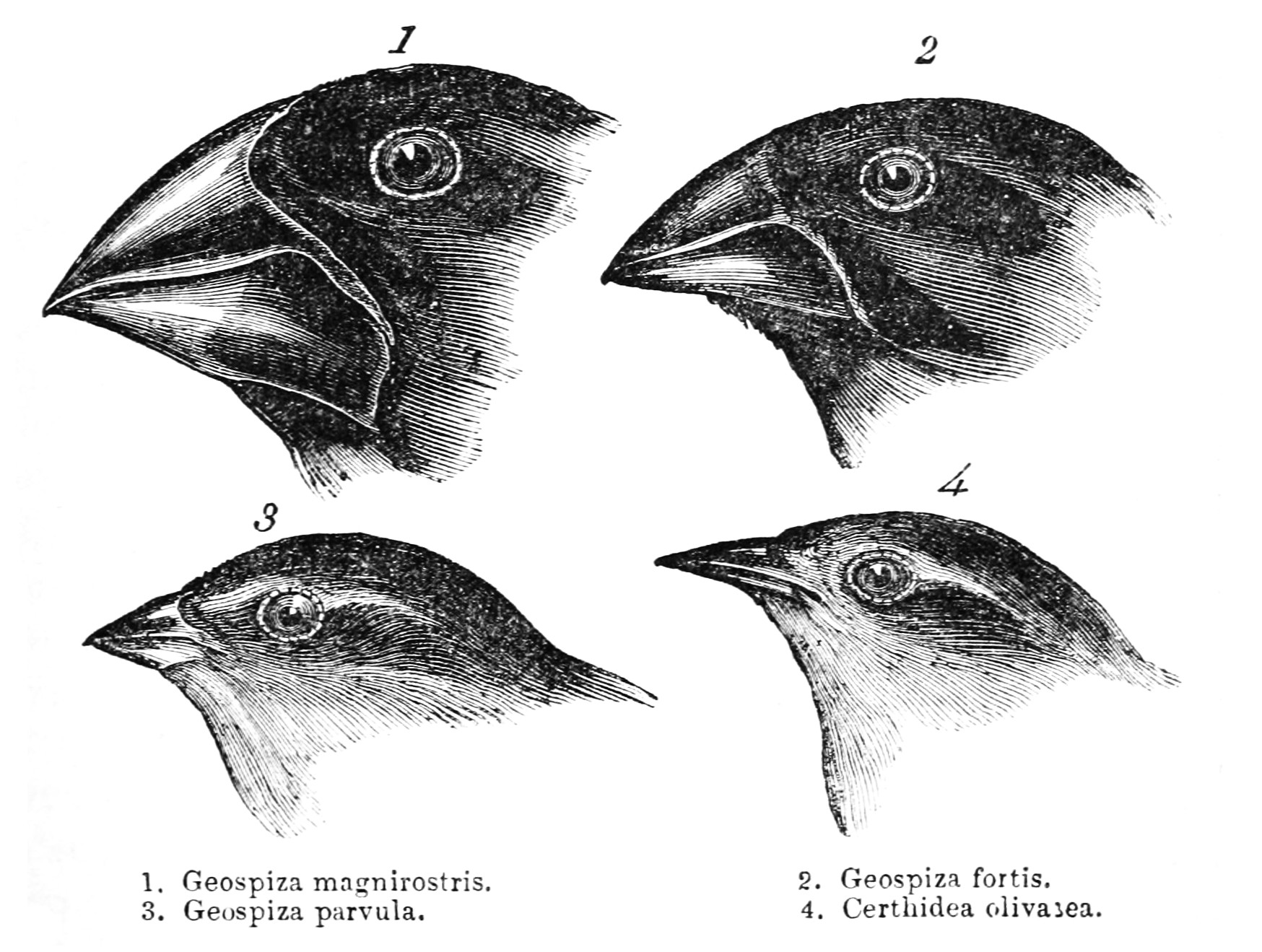 Darwin's Finches
·
In 1835, Darwin collected small birds across the Galápagos Islands — a few hundred kilometres off the coast of Ecuador.Back in London, ornithologis
-
is_parent One Ancestor, Many Beaks ·
The beaks matched the food available on each island: hard seeds, soft fruit, insects, nectar.Darwin's explanation: all the finches descended from a single ances -
is_parent Why Finches Matter ·
The finches are not proof of evolution by themselves — but they are an unusually clean illustration of the engine in action, isolated on real islands, at -
is_parent Universal Darwinism ·
Darwin described biological evolution. But notice: nothing in the three-step engine mentions DNA, cells, or carbon chemistry.It only requires: entities that are -
is_parent Beyond Carbon ·
The pattern shows up again and again, once you know to look for it:your immune system selects among antibody variants for the ones that bind an intruder;compute -
is_parent Dawkins' Reframing ·
In 1976, Richard Dawkins published The Selfish Gene — and reframed the whole story.It is not organisms that are the true unit of selection, he argued. It -
is_parent Replicators and Vehicles ·
Two roles, easy to confuse:Replicator — the thing that gets copied. The gene.Vehicle — the thing that is built, survives, and reproduces, carrying r -
is_parent A Question Dawkins Asked ·
If the gene is just one possible kind of replicator……could there be others? Things that are copied, vary, and are selected — but are made of -
is_parent The Second Replicator ·
“I think that a new kind of replicator has recently emerged on this very planet… I shall call it a meme.”— Richard Dawkins, The Selfish -
is_parent Genes and Memes Compared ·
Gene — replicated via reproduction; vehicle: the body; variation: mutation; selection: survival & reproduction.Meme — replicated via imitation; -
is_parent Ideas in Motion ·
We began with finches on volcanic islands and ended with an idea that may be living, right now, inside each of you.If memes are real replicators, then minds are
-