i
Diese Präsentation ist für die Ansicht im Querformat gestaltet.
Session 0 · Memetics begins at home.
Before Internet memes, before ideology, before theory: gestures, tunes, habits, rituals, phrases, drawings, interfaces and everyday acts of copying.
“A meme is whatever is copied from person to person.”
— Susan Blackmore, working definition
For today, let us start with this deliberately simple definition.
Copying does not necessarily mean making an exact duplicate.
You hear a joke.
You remember the structure, forget several words, change a character...
...and tell it to somebody else.
Something survived the transformation.
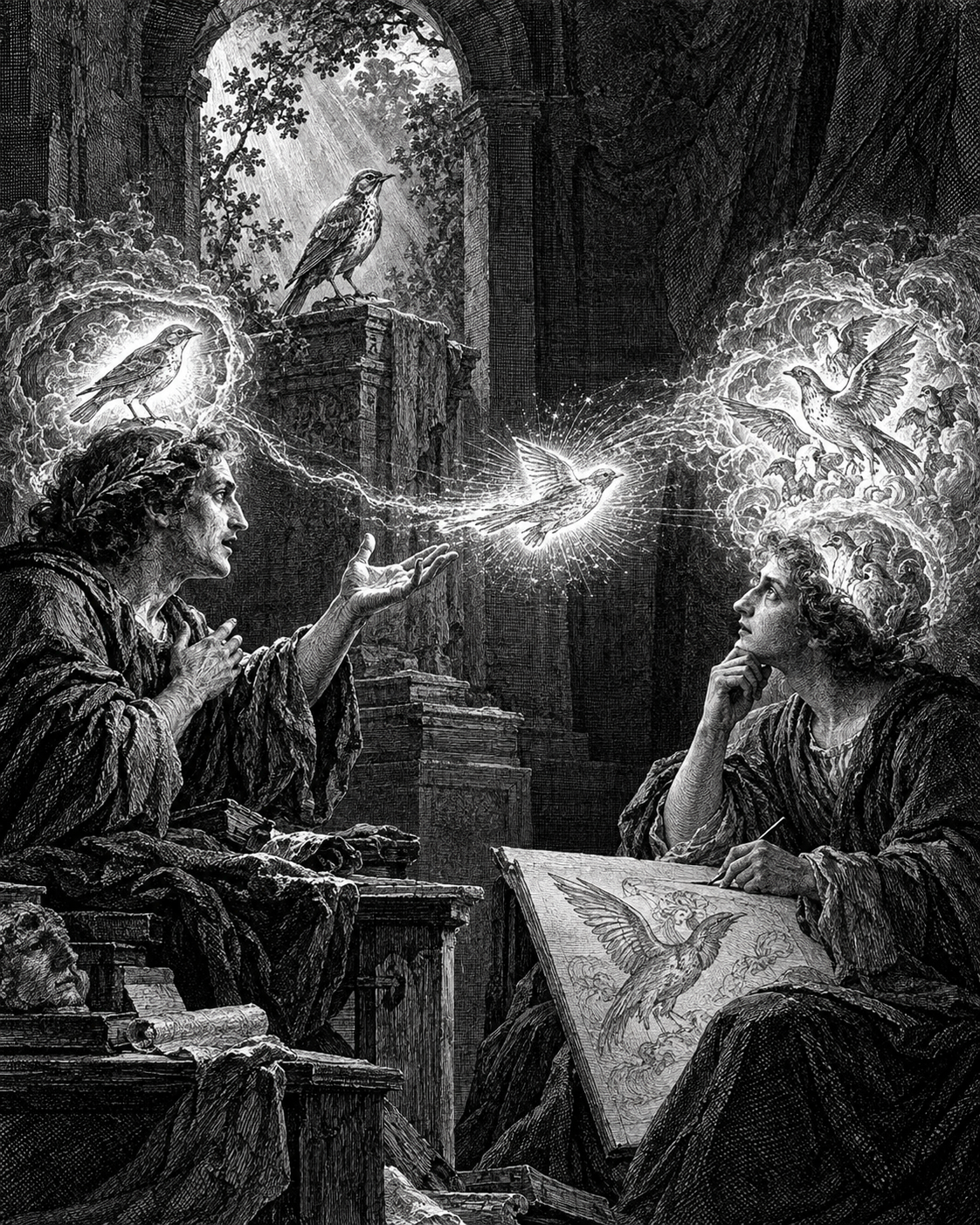
external expression → perception → internal reconstruction → expression
A meme can appear outside us: as sound, gesture, image, text, object, ritual.
It can be reconstructed inside us: as memory, rule, association, expectation, intention.
Then it can become external again.
What exactly is being copied?
Memetics is a theory among other theories.
Human culture can also be studied through psychology, anthropology, sociology, cultural evolution, semiotics, media theory, neuroscience and many other perspectives.
Memetics highlights replication, variation and selection.
It does not explain the whole human being.
And although it may begin to look as if everything is a meme...
...it is not.
A virus spreads. That does not make it a cultural meme.
Genes are copied. That does not make them memes.
You discover by yourself that fire is hot. No person-to-person copying was necessary.
A yawn may trigger another yawn through an evolved response rather than culturally learned imitation.
Spread alone is not enough.
Is the meme the sentence?
The idea expressed by the sentence?
The memory in somebody's brain?
The rule that allows the sentence to be reconstructed?
The pattern distributed across people, media and artifacts?
Different memetic theories answer differently.
Memethical engineering is the deliberate design, modification, and circulation of memes and memetic environments in accordance with explicit ethical goals.
For example: counteracting propaganda and manipulation.
Increasing epistemic and cultural diversity.
Supporting critical reflection.
Increasing resilience against harmful or monopolizing meme complexes.
Memetic engineering asks: How can this spread?
Memethical engineering must additionally ask: Should it spread?
Who benefits?
What disappears when it succeeds?
Can people recognize the mechanism?
Can alternatives survive?
Success ≠ virality.
Let us now temporarily leave theory behind.
Look at ordinary life as a landscape of things passing from person to person.
We will move from the smallest and fastest patterns...
...toward increasingly complex cultural structures.
😮 yawning
😂 laughter
👏 applause
👀 looking where everybody else is looking
🌊 the stadium wave
These are useful starting examples because copying is immediately visible.
But some may be biological contagion rather than memes in Blackmore's strict sense.
🤝 handshake
✋ high five
👊 fist bump
✌ peace sign
🫶 hand-heart
finger hearts
air quotes
A tiny movement can carry socially learned meaning.
🎂 birthday cake + candles + song + wish
🥂 touching glasses before drinking
🎆 counting down at New Year
🪵 knocking on wood
🤞 crossing fingers
💰 throwing a coin into a fountain
Memes can become coordinated social scripts.
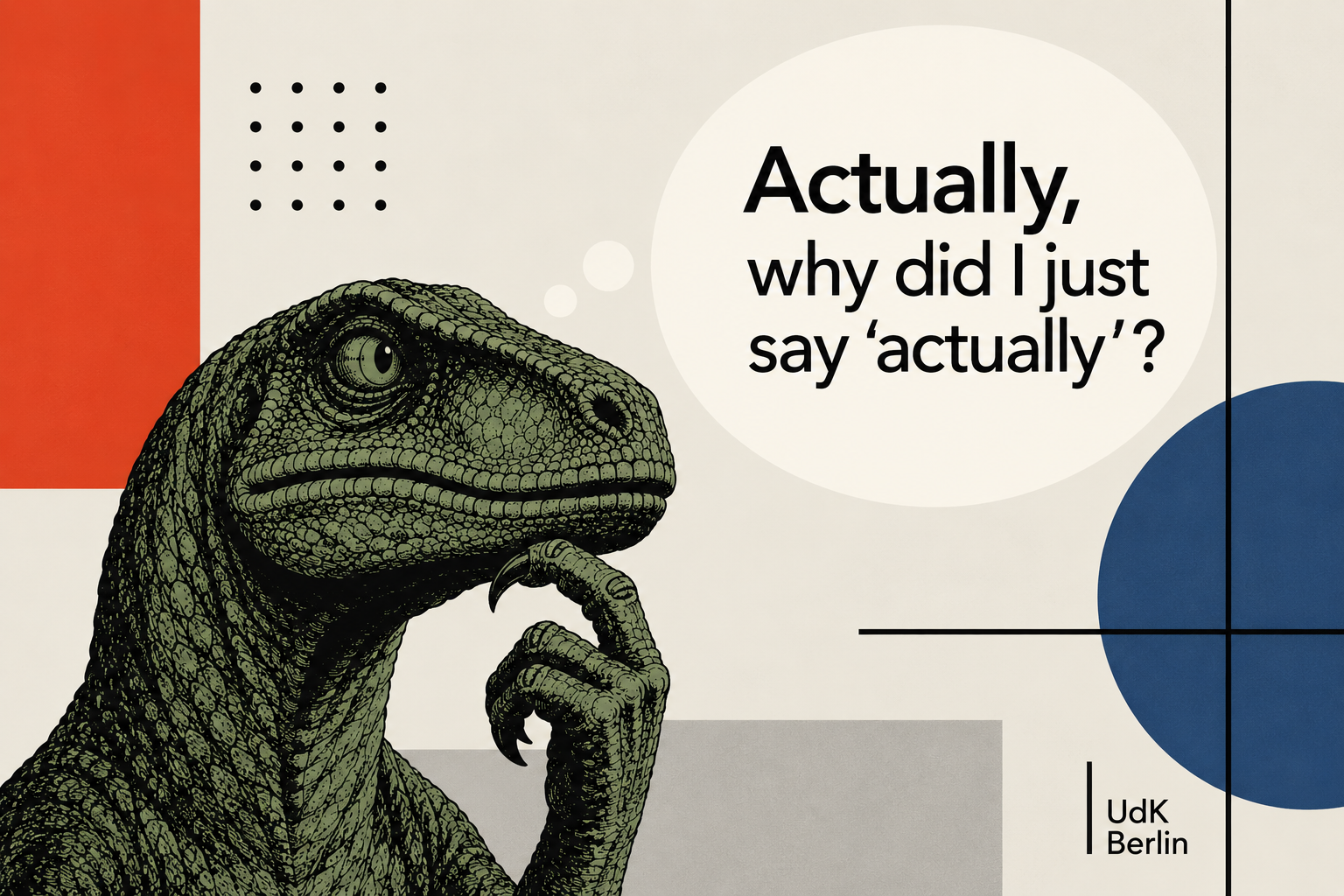
“Actually...”
“However...”
“You know?”
“At the end of the day...”
euh… [øː] , bah oui
блядь, f*ck, vole ...
Language is full of units which seem to "live their own life".
A melody enters through the ears.
Hours later it is still playing internally.
You hum it.
Somebody else hears it.
Now it may inhabit another mind.
An earworm is almost a cartoonishly clear memetic lifecycle.
♥ a heart that looks nothing like an anatomical heart
★ a five-pointed star
☀ a circle with rays
🏠 a square house with a triangular roof
💡 a light bulb meaning “idea”
We learn visual conventions by repeatedly encountering them.
💾 floppy disk = save
🔍 magnifying glass = search
⚙ gear = settings
🗑 bin = delete
♥ heart = like
☰ three lines = menu
The original object can disappear while its symbolic descendant survives.
ripped jeans
mullets
moustaches
Crocs
rolling trouser legs
particular sneaker styles
black clothing in particular creative milieus
Bodies become media.
family recipes
sourdough starters
cutting sandwiches diagonally
particular ways of folding pizza
“five-second rule”
putting a wet phone into rice
Useful, useless and questionable practices can all be culturally transmitted.
the elevator pitch
brainstorming with Post-its
the agenda slide
the TED-style talk
“three things I learned...”
the Venn diagram
the iceberg diagram
Sometimes the meme is not the content but the format.
image macros
reaction GIFs
“POV:”
“starter pack”
“nobody: / absolutely nobody:”
“tell me X without telling me X”
“how it started / how it's going”
The Internet did not invent memes. It created an extraordinarily fast memetic environment.
urban legends
schoolyard rumours
ghost stories
“a friend of a friend once...”
life hacks
folk explanations
Stories are compressed, reconstructed and altered every time they move.
superstitions
stereotypes
ideas about success
ideas about beauty
ideas about what a “proper career” looks like
ideas about how families, schools or workplaces should function
At this scale, memes begin to shape perception itself.
Memes rarely live alone.
They support, trigger and protect one another.
A fashion includes clothes, vocabulary, gestures, music, places and identities.
A profession includes practices, jargon, values, rituals and status symbols.
Religions, ideologies, artistic movements and institutions can contain enormous interconnected systems of culturally transmitted elements.
Such complexes are often called memeplexes.

Something is encountered.
Something is reconstructed.
Something is expressed again.
Another person encounters it.
Replication does not require perfect duplication.
Misremember it.
Translate it.
Improve it.
Simplify it.
Exaggerate it.
Parody it.
Combine it with another meme.
Every transmission is an opportunity for mutation.
Some variants disappear.
Some are remembered.
Some are repeated.
Some fit a particular medium particularly well.
Some become part of institutions and persist for centuries.
Cultural environments select.
easy to remember?
easy to reproduce?
emotionally intense?
funny?
useful?
beautiful?
shocking?
socially rewarded?
already familiar?
And are these the same properties that make a meme good?
A communication system optimized only for replication may reward whatever replicates best.
But the fastest-spreading cultural environment is not necessarily the most desirable one.
Memethical engineering asks how environments might instead preserve:
diversity · autonomy · transparency · reflection · plurality · resilience
Think of one meme you encountered today.
Not necessarily an Internet meme.
Where did you encounter it?
What was its external form?
What did you reconstruct internally?
Did you reproduce it?
Did you modify it?
Why might this particular pattern survive?
gesture?
ritual?
phrase?
melody?
visual convention?
interface convention?
fashion?
social script?
story or belief?
memeplex?
Or perhaps: not a meme at all?
1. What is being copied?
2. Why does this variant survive?
3. What kind of cultural environment does its survival create?
A handshake.
A birthday song.
A stupid little drawing in a school notebook.
A phrase you suddenly notice yourself saying.
A floppy disk that survived its floppy disk.
A belief nobody remembers learning.
Culture replicates through us—but never without being reconstructed by us.