Extended Educational Environments
Baumhaus profile of Daniel D. Hromada.
Educational Systems
The Congress
Baumhaus profile of Daniel D. Hromada.
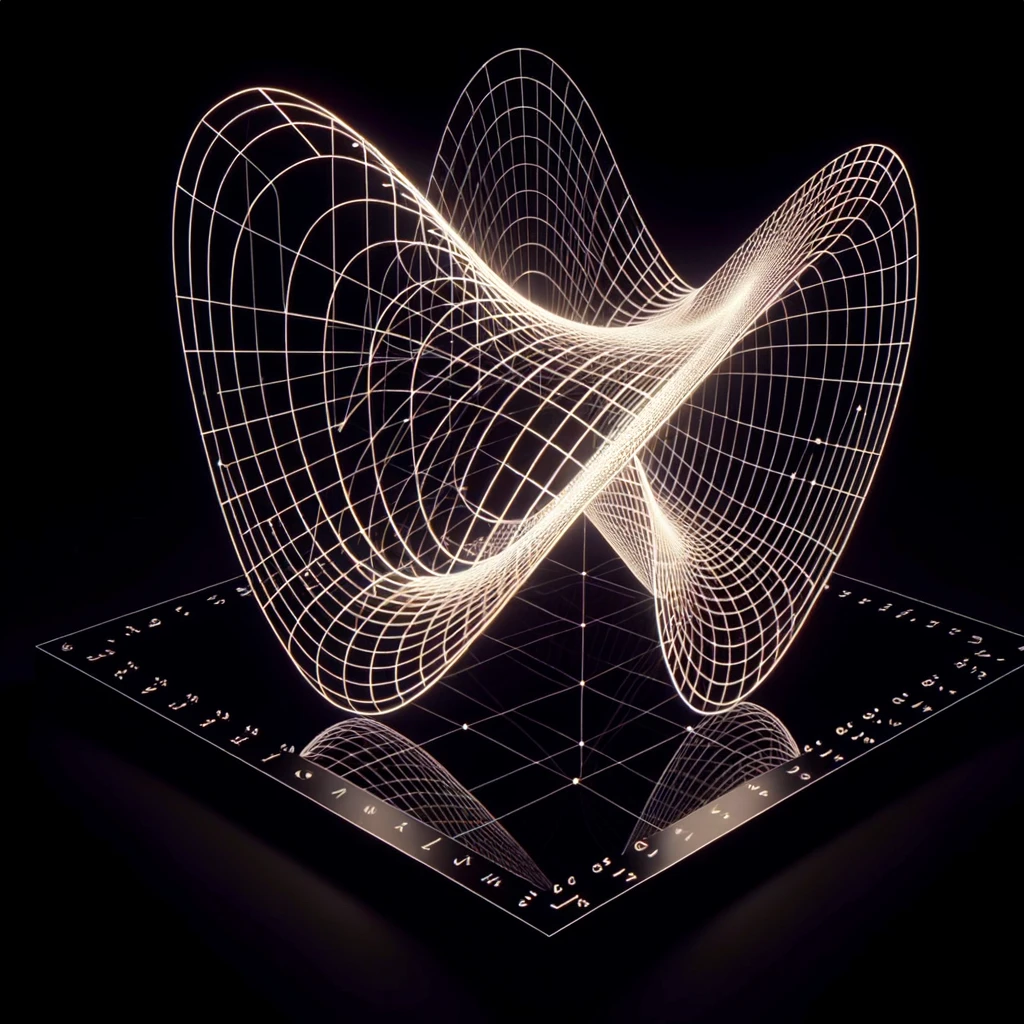
Vector of Parameters: This is a set of variables or conditions that characterize the system or scenario. They can be input conditions, system states, or any other relevant metrics that describe the system.
Objective Function: This is a mathematical function that quantifies how far the current system's performance is from the desired performance. The goal is usually to minimize or maximize this function.
Constraints: These are the bounds or limitations within which the system operates. In engineering problems, constraints can arise from physical limitations, safety requirements, budgetary restrictions, etc. The solution must satisfy these constraints.
make a decision D
when You solve a problem P
???
What did You learn today ?
What was the most important thing You learned this year ?
Mathematical Treatment of the Axioms of Physics
Rigorous Foundation of Schubert's Enumerative Calculus
Topology of Algebraic Curves and Surfaces
Analysis of Solutions of Variational Problems
logic / contingency
space
time
energy
computational complexity
human resources
material resources
eco(log|nom)ical constraints
socio-political
psycho-cognitive
legal
moral
Birch and Swinnerton-Dyer Conjecture
Hodge Conjecture
Navier–Stokes Existence and Smoothness
P vs NP Problem
Riemann Hypothesis
Yang–Mills Existence and Mass Gap
No Definitive Formulation
No Stopping Rule
Solutions Are Not True-or-False
No Immediate and No Ultimate Test
Every Solution is a 'One-Shot Operation'
No Enumerable (or Exhaustively Describable) Set of Potential Solutions
Every Wicked Problem is Essentially Unique
Every Wicked Problem Can Be Considered to Be a Symptom of Another Problem
The Existence of a Discrepancy Representing a Wicked Problem Can Be Explained in Numerous Ways
The Planner Has No Right to Be Wrong
Radioactive waste disposal
Liberation from fossil fuel dependency
Language extinction
Weltverständlichmachung
Unf*cking the Wohnungsmarkt
...
...
...
...
The Clock Reform
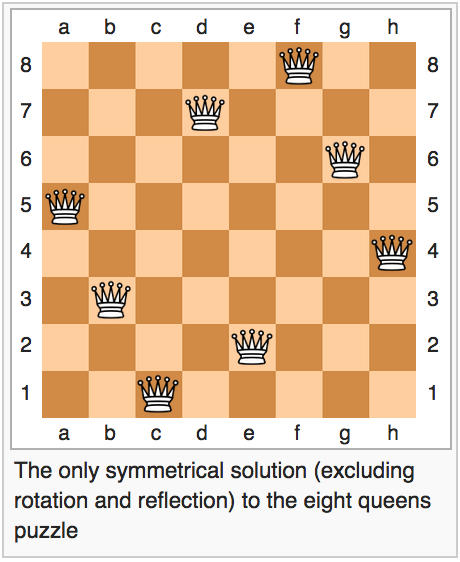
eight queen problems
map coloring problem
https://github.com/python-constraint/python-constraint
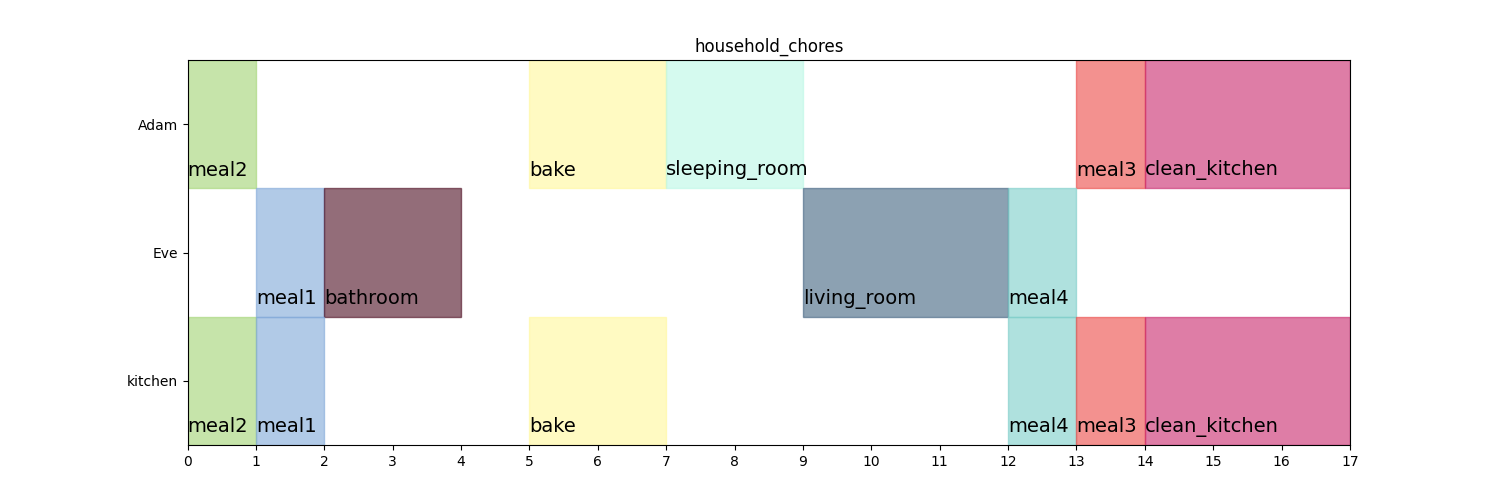
https://github.com/timnon/pyschedule
Note: install the most recent fork, (e.g. pip3.10 install "pyschedule"@git+"https://github.com/ppoile/pyschedule/#subdirectory=src")
#Adam has one hour time on Monday and Wednesday, three hours time on Thursday and fours hours time on each weekend day, Eve has two hours on Tuesday, three hours on Friday and four hours on each weekend day. Define pyschedule resources with correctly defined periods and horizons.
#Monday: Adam x 1
#Tuesday: Eva x 2
#Wednesday: Adam x 1
#Thursday: Adam x 4
#Friday: Eva x 3
#Saturday: Both x 4
#Sunday : Both x 4
from pyschedule import Scenario, solvers, plotters, alt
# Define the scenario
S = Scenario('household_chores', horizon=15) # Two weeks
# Define the resources, resource costs are not obligatory but it's more fun with them
adam = S.Resource('Adam',periods=[0,3,4,5,6,7,11,12,13,14])
eve = S.Resource('Eve',periods=[1,2,8,9,10,11,12,13,14])
kitchen=S.Resource('kitchen')
# Define the tasks and their durations
task_costs = {
"meal1": {"length":1,"delay_cost":1}, # 1 hour, schedule towards beginning of the week
"meal2": {"length":1,"delay_cost":1},
"meal3": {"length":1,"delay_cost":-1},
"meal4": {"length":1,"delay_cost":-1}, # 1 hour, schedule towards end of the week
"bake": {"length":2,"delay_cost":0}, # 2 hours (1 cake)
"sleeping_room": {"length":2,"delay_cost":0}, # it seems there is a bug for tasks longer >1
#"CSR1": {"length":1,"delay_cost":0}, # one way how to address the bug is to split long tasks into sub-tasks coupled by tight preference constraints
#"CSR2": {"length":1,"delay_cost":0}, #
"bathroom": {"length":2,"delay_cost":0}, # 2 hours
"living_room": {"length":3,"delay_cost":0}, # 3 hours
"clean_kitchen": {"length":3,"delay_cost":0} # 3 hours
}
tasks={}
# Define alternative resources for each task
for task,costs in task_costs.items():
print(task,costs)
tasks[task] = S.Task(task,length=costs['length'],delay_cost=costs["delay_cost"]) #create new task
tasks[task] += adam | eve #assign resources to newly created task
#additional task-resource attributions
tasks["clean_kitchen"]+=kitchen
tasks["meal1"]+=kitchen
tasks["meal2"]+=kitchen
tasks["meal3"]+=kitchen
tasks["meal4"]+=kitchen
tasks["bake"]+=kitchen
#tight precedence constraints
#S += tasks['CSR1'] <= tasks['CSR2']
#optional tasks
#tasks['playground'] = S.Task('playground',length=2,schedule_cost=-1)
#tasks['playground'] += alt(adam,eve)
#additional constraints
S += tasks['meal1'] < tasks['clean_kitchen']
S += tasks['meal2'] < tasks['clean_kitchen']
S += tasks['meal3'] < tasks['clean_kitchen']
S += tasks['meal4'] < tasks['clean_kitchen']
S += tasks['bake'] < tasks['clean_kitchen']
# Solve the scenario
solvers.mip.solve(S,msg=1,kind='GUROBI')
print(S)
print(S.solution())
print(adam.periods)
# Plot the schedule
plotters.matplotlib.plot(S)
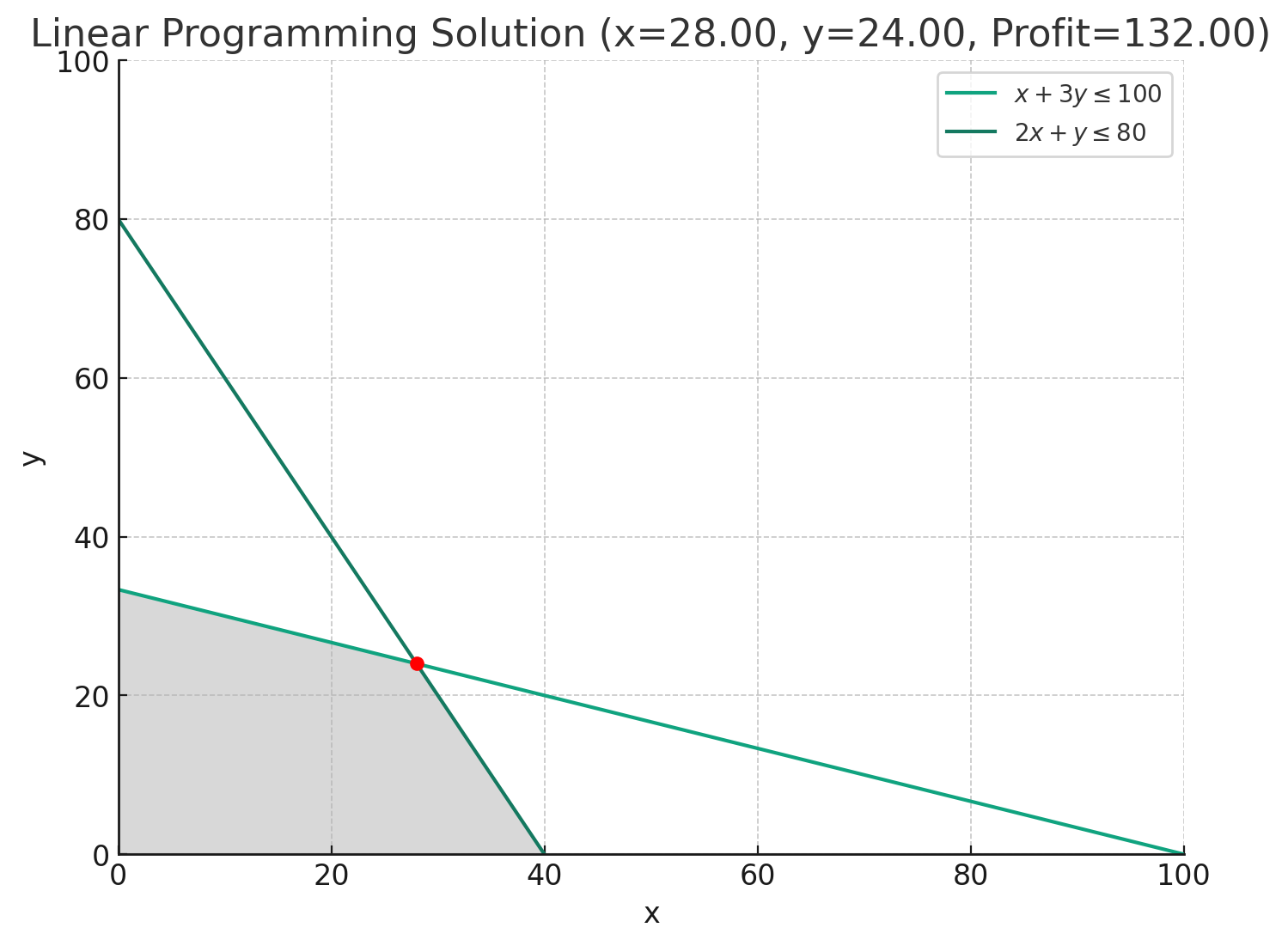
Focus: LP deals specifically with linear equations and inequalities. This means it works with problems where relationships are represented as straight lines (hence 'linear').
Objective: It always aims to find the maximum or minimum value of a linear equation, known as the objective function. For example, maximizing profit or minimizing cost.
Method: LP uses specific mathematical methods, like the Simplex algorithm, to find the best solution.
Constraints: All constraints in LP are linear (straight-line relationships). For instance, you can't spend more than a certain budget, or you need at least a certain amount of some ingredient.
Solutions: Solutions in LP are often numerical and can include fractions or decimals.
Focus: CP is more general and can handle a wide variety of constraints, not just linear ones. It can deal with logical conditions, like "either-or" situations, and can include non-linear relationships.
Objective: CP doesn't necessarily have an objective function to optimize. Instead, it focuses on finding solutions that satisfy all the given constraints.
Method: It uses different algorithms than LP, often based on search techniques, like backtracking or heuristics.
Constraints: Constraints in CP can be diverse - linear, non-linear, logical conditions, etc. For example, a constraint could be that a certain task must be done before another can start.
Solutions: Solutions in CP are often discrete (like whole numbers) and can involve deciding between different options or scenarios.
Machine as a projection of the human self
Faciamus machinam ad imaginem et similitudinem nostram.
Let us make the machine in our image and likeness.
and then said creators: faciamus hominem ad imaginem et similitudinem nostram and then said humans: faciamus machinam ad imaginem et similitudinem nostram
"I should like you to consider that these functions (including passion, memory, and imagination) follow from the mere arrangement of the machine’s organs every bit as natural...

Long before humans could build autonomous machines, they could imagine them.
Artificial humans. Servants. Lovers. Guardians. Weapons. Oracles. Monsters.
The technological history of machines is preceded by a much older imaginary history of artificial agency.
Myths do not predict robots, computers or artificial intelligence.
But they repeatedly stage similar relationships between humans and artificial beings.
Who creates whom?
Who commands whom?
What should an artificial being know?
What happens when it acts for itself?
We rarely imagine machines neutrally.
We project into them our bodies.
Our desires.
Our labor.
Our violence.
Our knowledge.
Our fear of losing control.
Before machines became motors, engines and computers, the word already meant something broader:
an ingenious means by which something becomes possible.
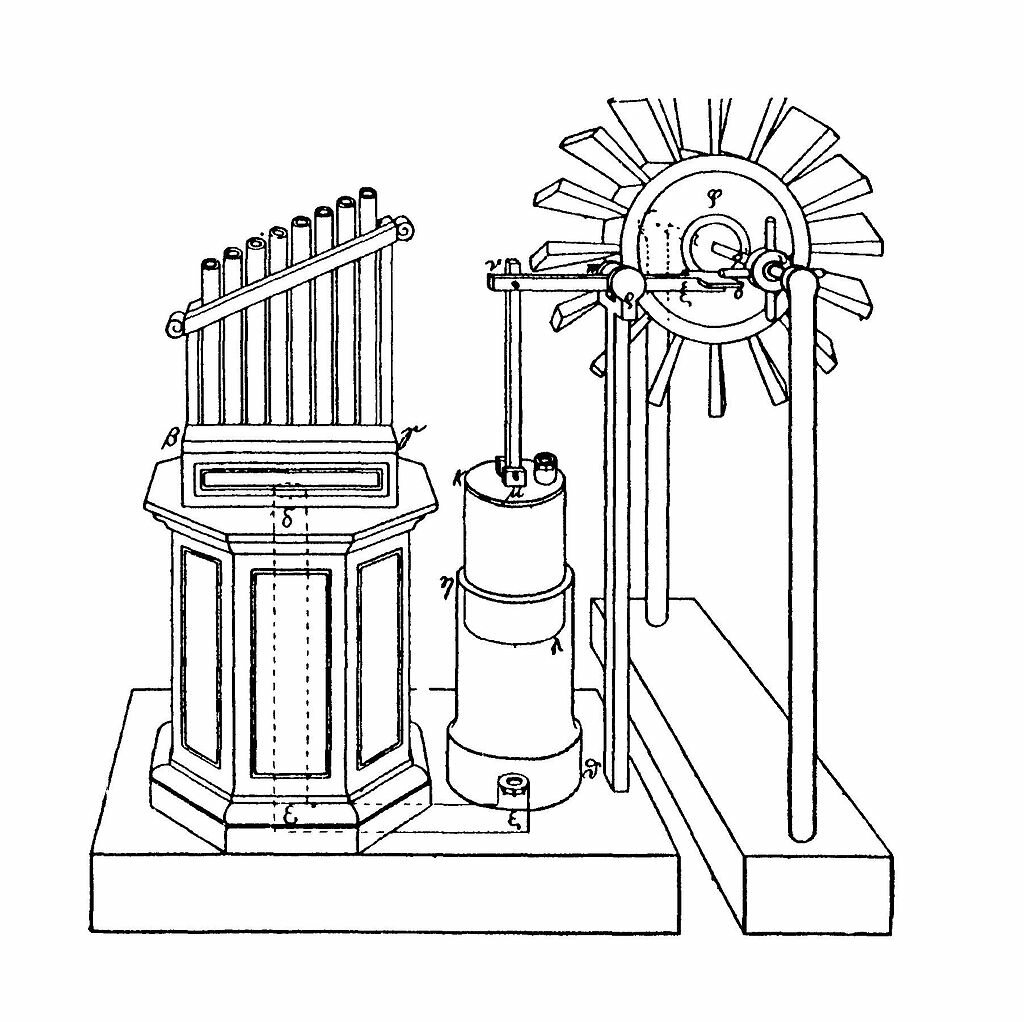
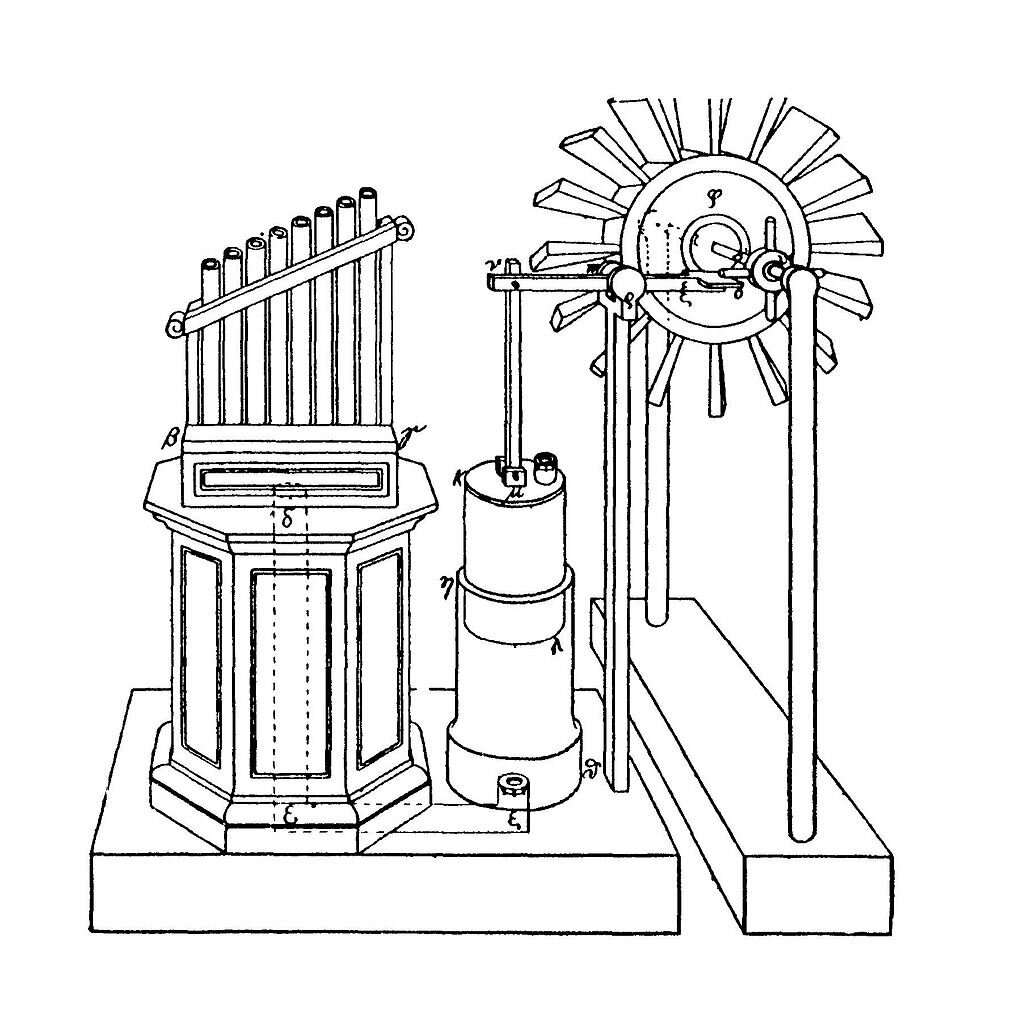
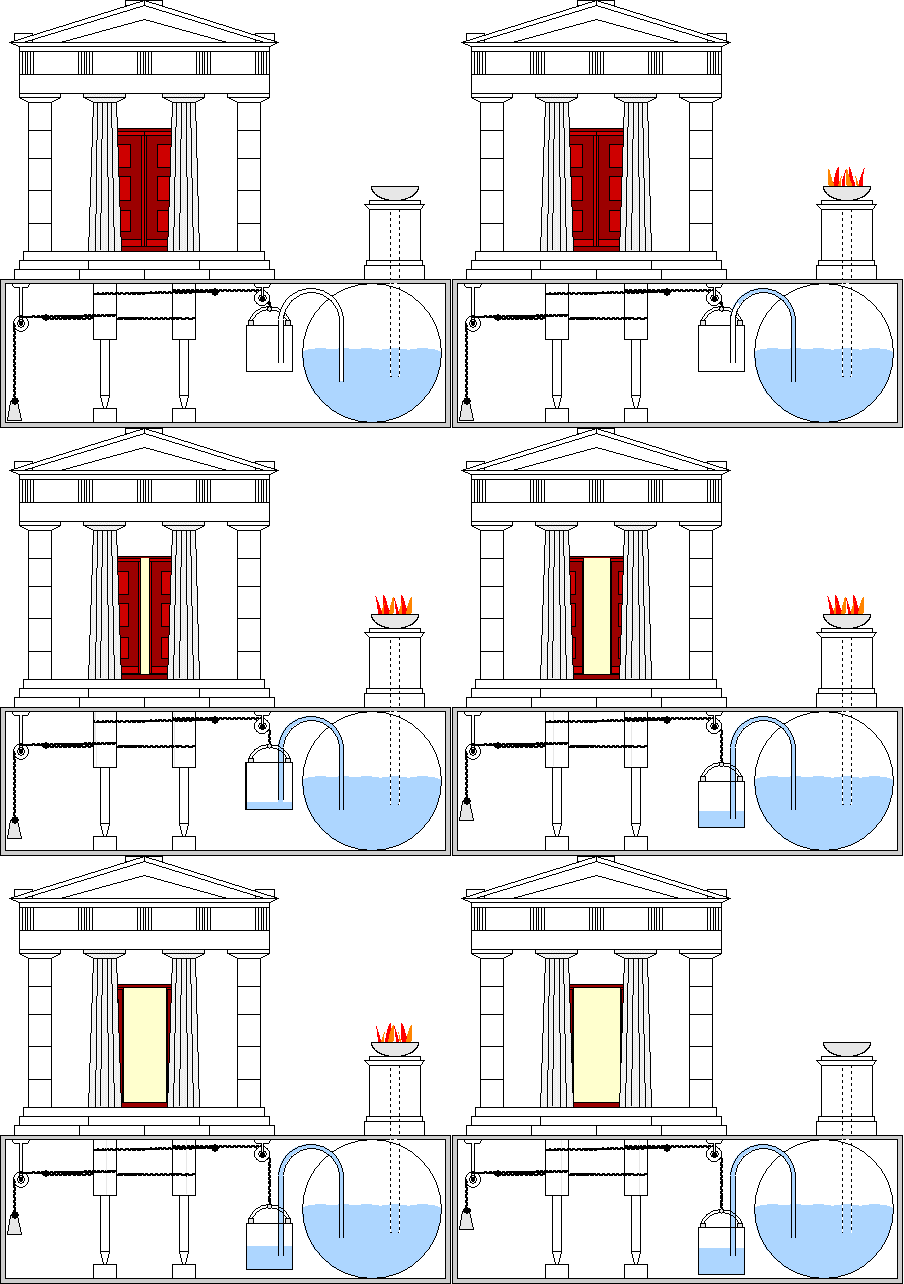
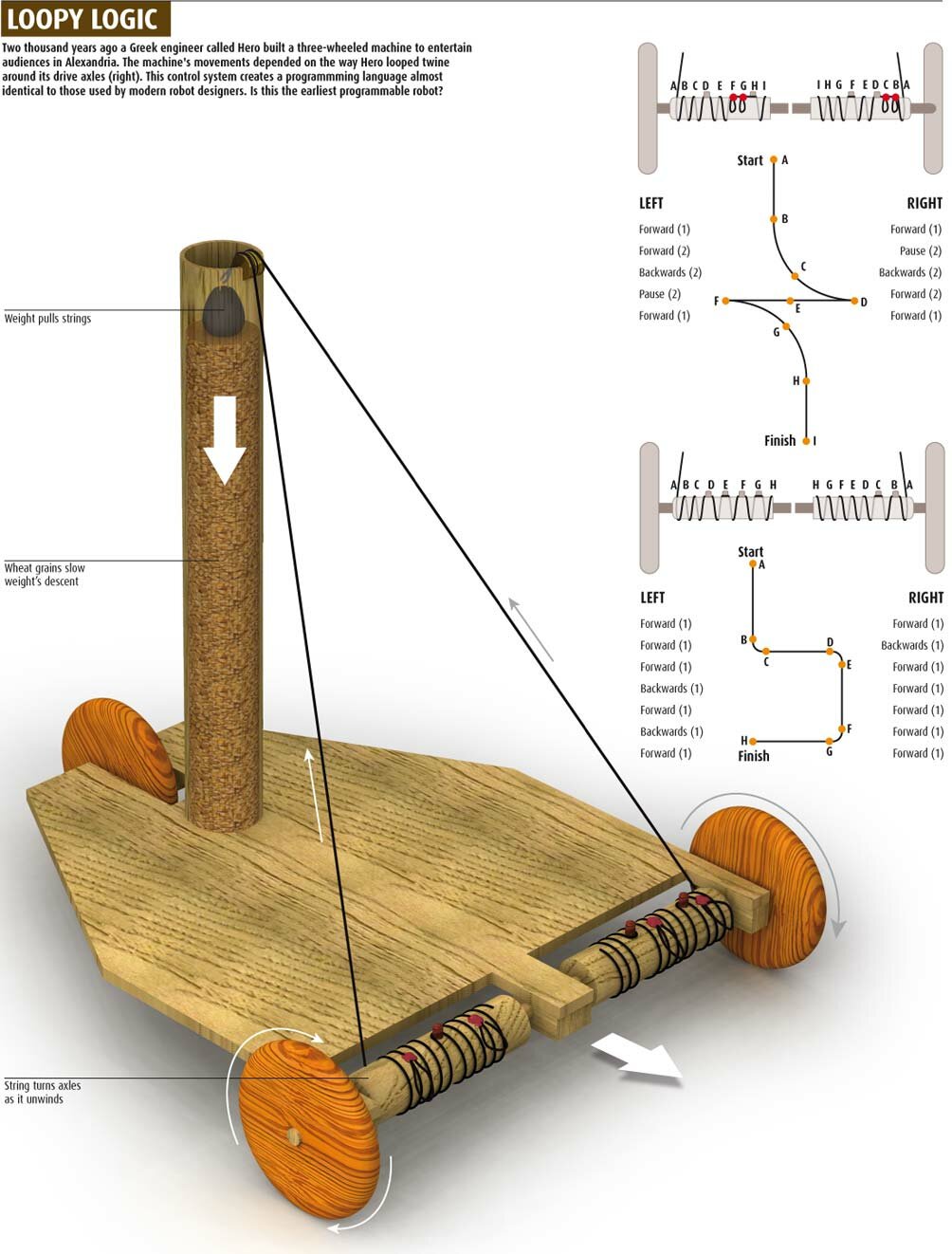
greatest experimenter of antiquity teacher at Musaeum author of works like Pneumatica, Automata, Mechanica, On the dioptra, Belopoeica, Catoptrica, Geodesia, Geopon...
Greek μηχανή — mēkhanē: instrument, device, contrivance, means.
Latin machina: machine, engine, apparatus, contrivance.
Middle French machine → English machine.
The semantic field is older and broader than today's image of gears, motors and electronics.
English word machine comes through Middle French from Latin machina, which in turn derives from the Greek (Doric μαχανά makhana, Ionic μηχανή mekhane "contrivance, device, ...
In Greek theatre, a mēkhanē could be the stage apparatus that lifted a god into view.
Hence: deus ex machina — the god from the machine.
human construction → superhuman appearance
The machine makes visible powers that exceed the ordinary human body.
The machine begins not only with matter, but with know-how.
Greek technē means skilled, rule-governed making.
thought → technē → artifact
Before artificial agency comes the intelligence of the maker.
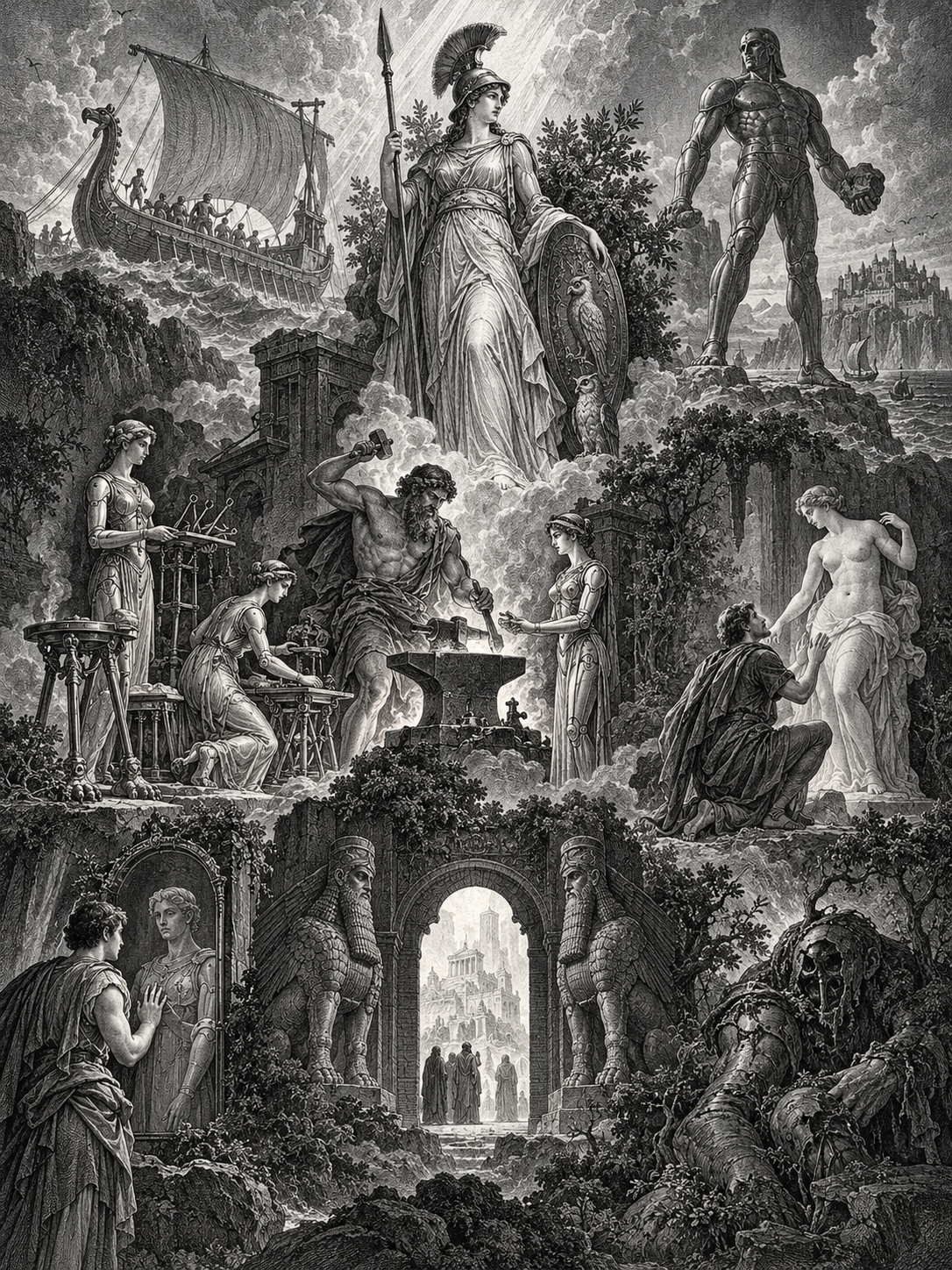
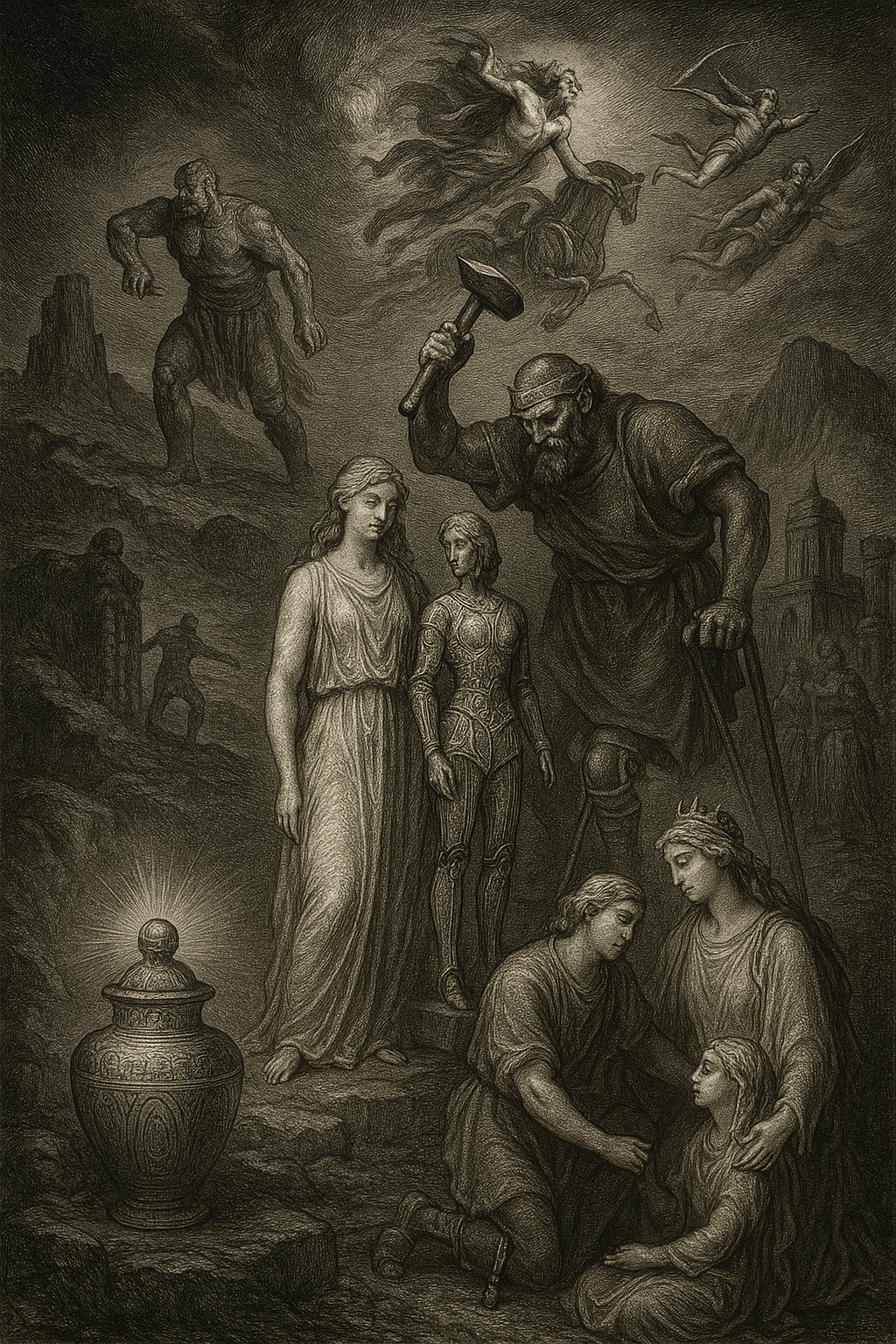
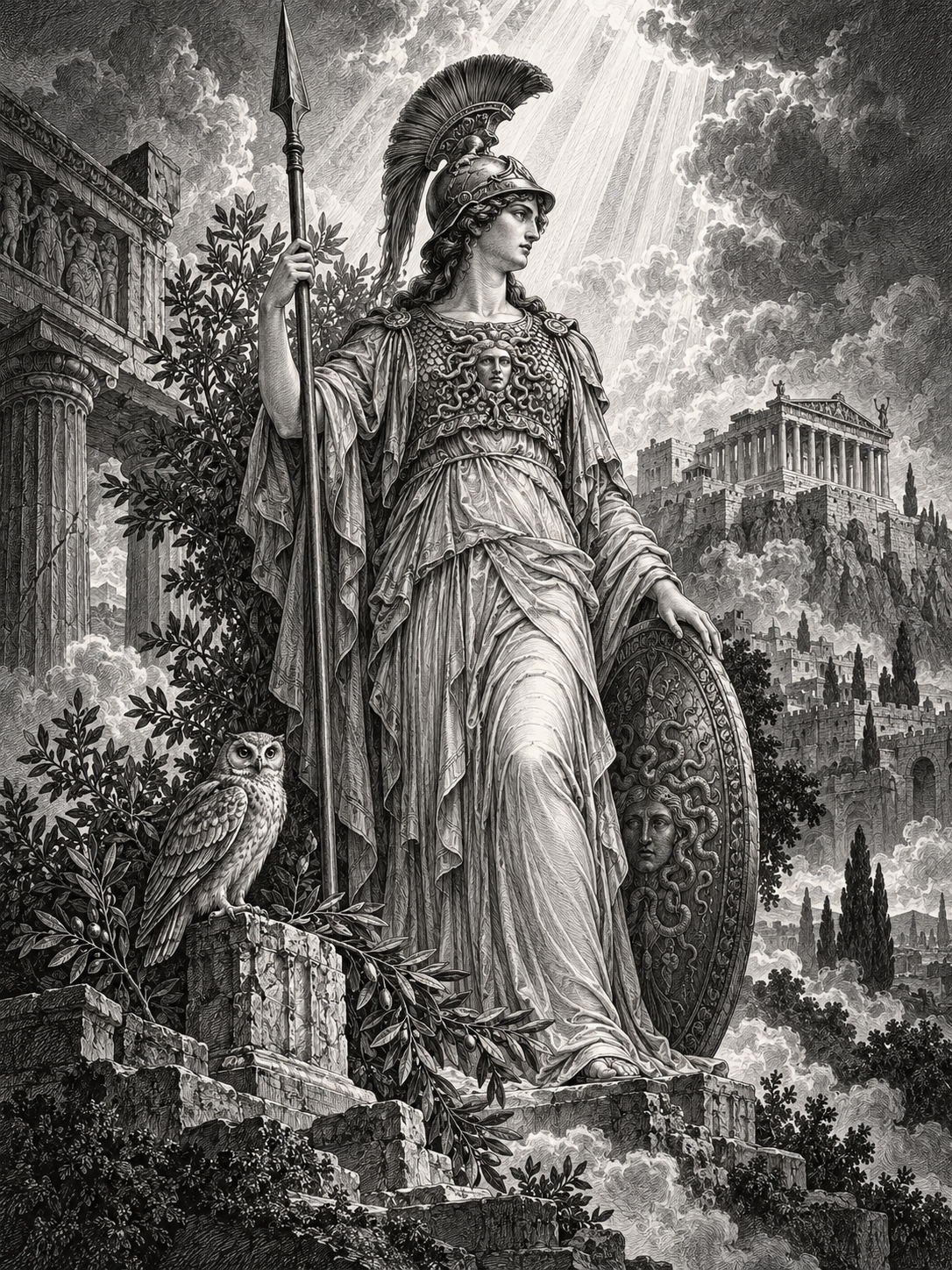
Greek mythology gives us an extraordinary laboratory of artificial beings.
Athena represents intelligent making.
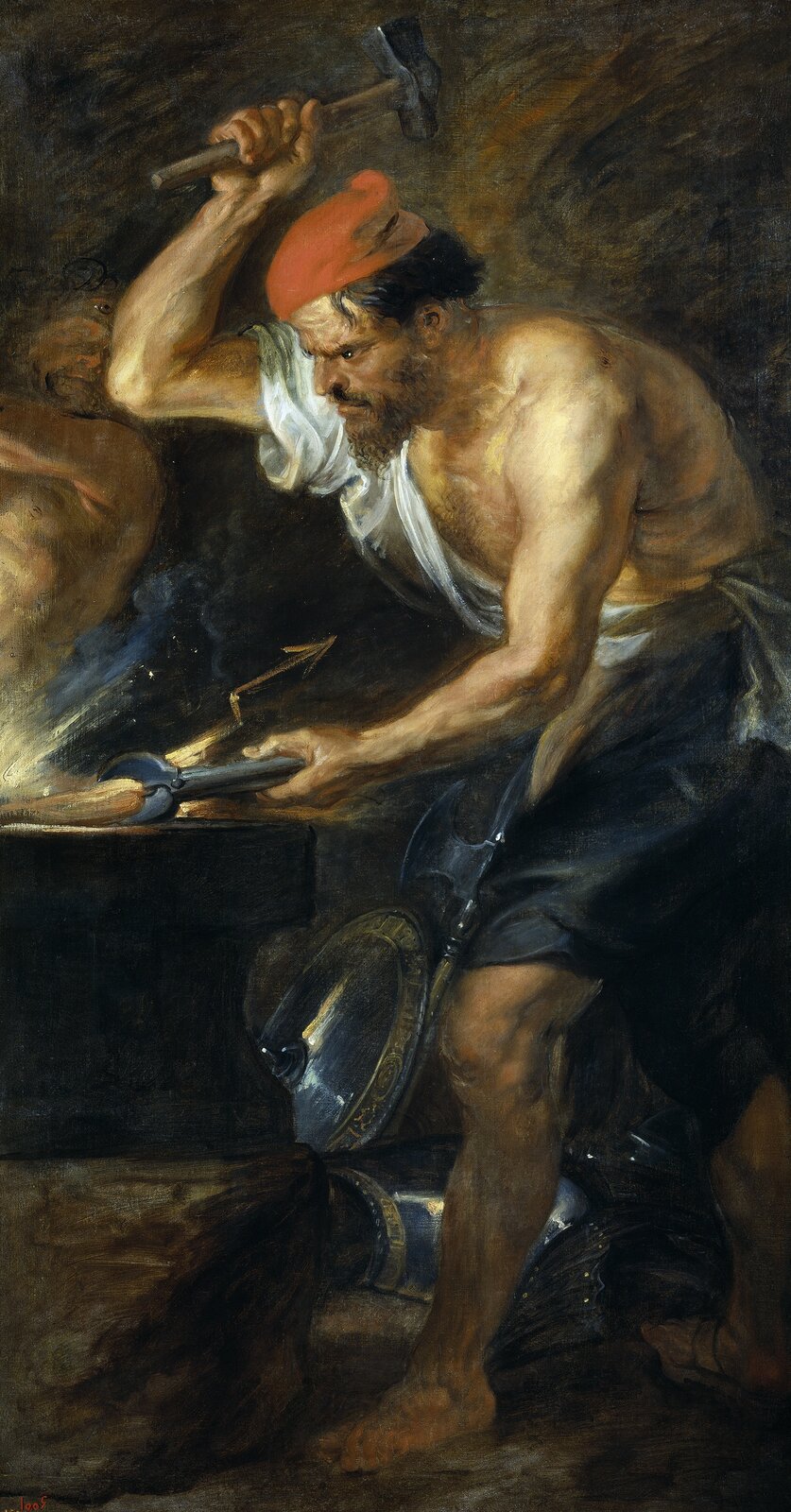
Hephaestus represents the workshop in which artifacts begin to act.
Pandora — first woman crafted from clay → engineered being. Pygmalion — sculptor creates a synthetic woman brought to life by Aphrodite → early android an...
a male counterpart to Pallas Athena gives skill to artists god of blacksmiths, metalworking, carpenters, craftsmen, artisans, sculptors, metallurgy, fire, and volca...
Athena is associated with craft, weaving, strategy and intelligent production.
She is not primarily the goddess of machines.
She represents something more fundamental:
the intelligence embodied in making.
With Hephaestus, myth moves from intelligent making toward artificial agency.
His workshop contains self-moving devices and artificial attendants.
The question changes:
Can we make an object?
becomes
Can we make an object that acts?
a male counterpart to Pallas Athena gives skill to artists god of blacksmiths, metalworking, carpenters, craftsmen, artisans, sculptors, metallurgy, fire, and volca...
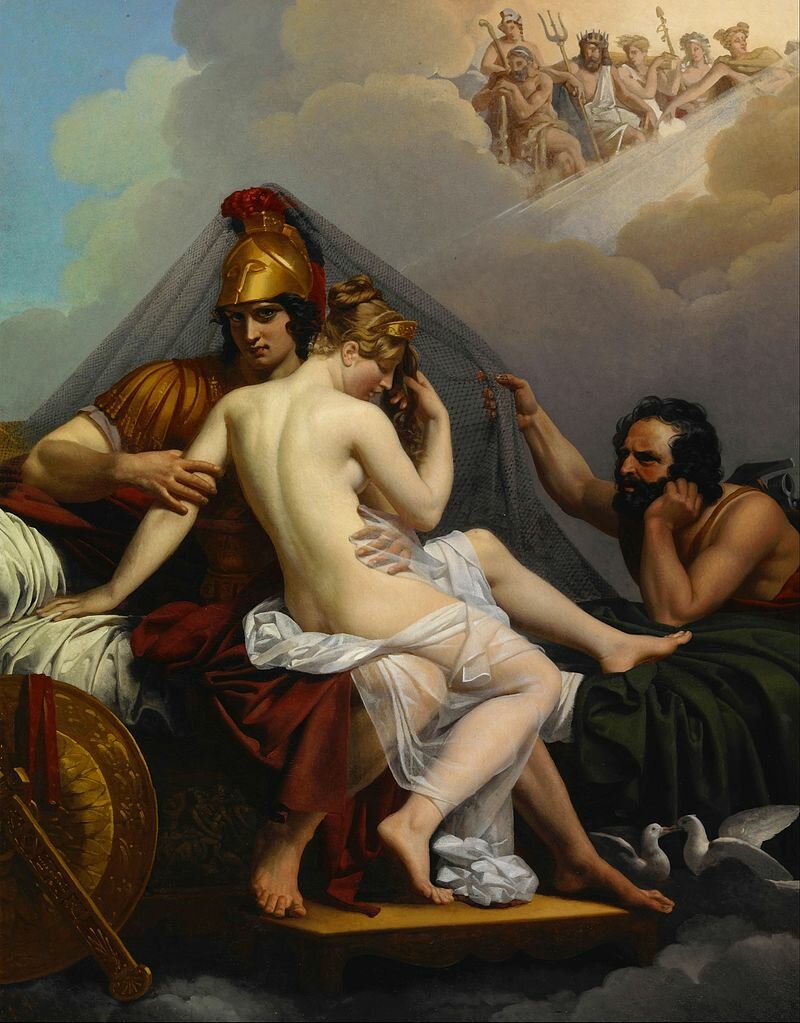
Hermes' helmet and sandals, Achiless' armor, chariot of Helios chain-link net for Aphrodite & Ares Pandora's pithos (also known as "Pandora's box") first do...
In the Iliad, Hephaestus is assisted by artificial golden maidens endowed with capacities associated with living persons.
The ancient fantasy is already recognizably humanoid:
Can the made thing become sufficiently like its maker?
One of the most persistent fantasies is delegation.
The artificial being carries, assists, manufactures, obeys.
labor → delegated labor → autonomous labor
The machine performs what we cannot, will not, or no longer need to do ourselves.
A machine need not imitate the whole human.
It may instead extend a capacity.
lever → force
vehicle → movement
writing → memory
computer → calculation
artificial agent → cognition?
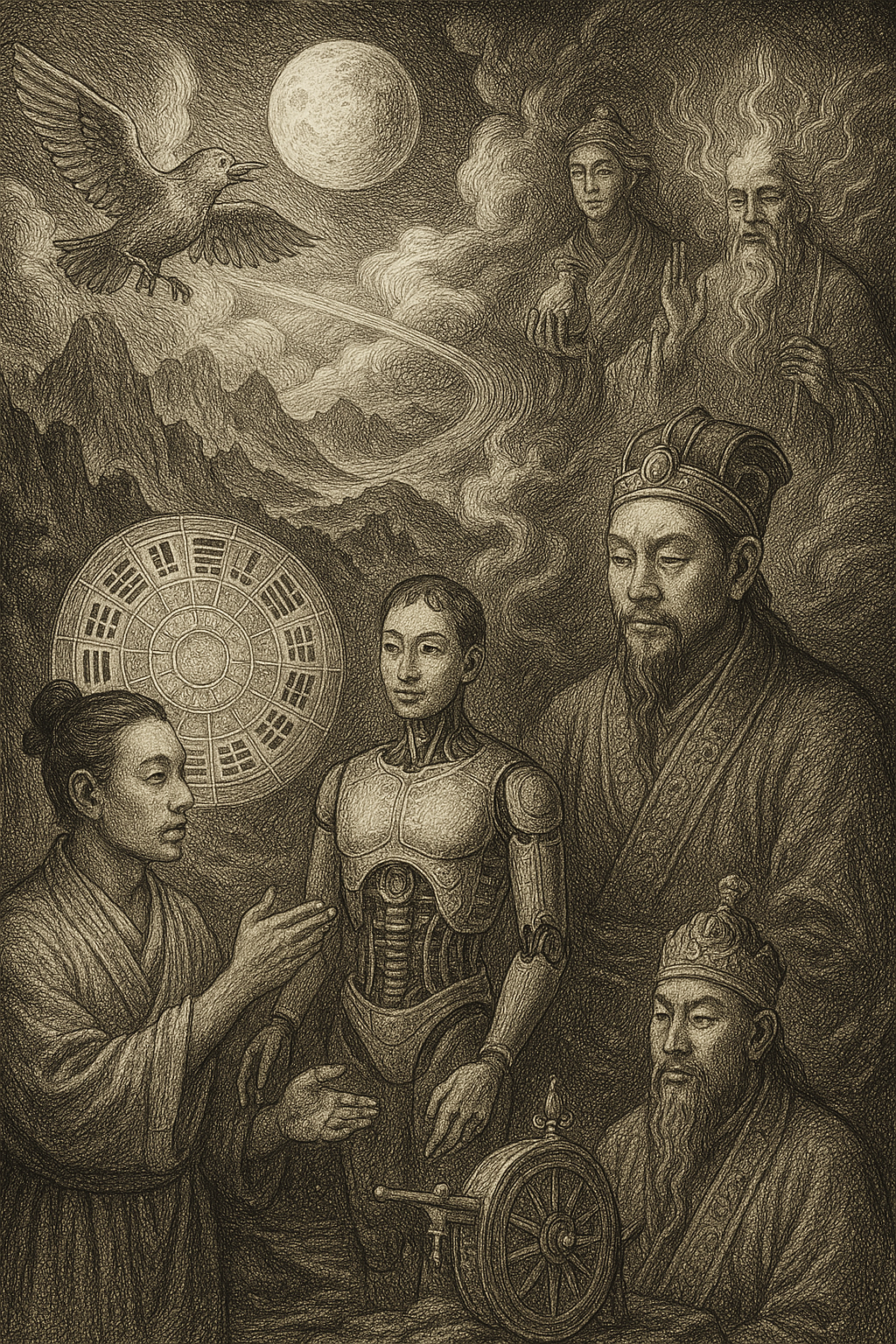
The Chinese Liezi tells of the artificer Yan Shi presenting King Mu with a human-like artificial performer.
It walks. It sings. It performs.
When its behavior becomes disturbingly lifelike, the artificer takes it apart.
The artificer Yan Shi presents the Yellow Emperor with a mechanical man of wood and leather — moves, sings, even flirts → one of the earliest robot legends. Lu Ban’s w...
apparently human → disassembly → mechanism
The story stages a remarkably durable question:
What remains of the human when we open the box?
Artificial beings are not merely tools.
They become surfaces onto which humans project desire, identity and self-understanding.
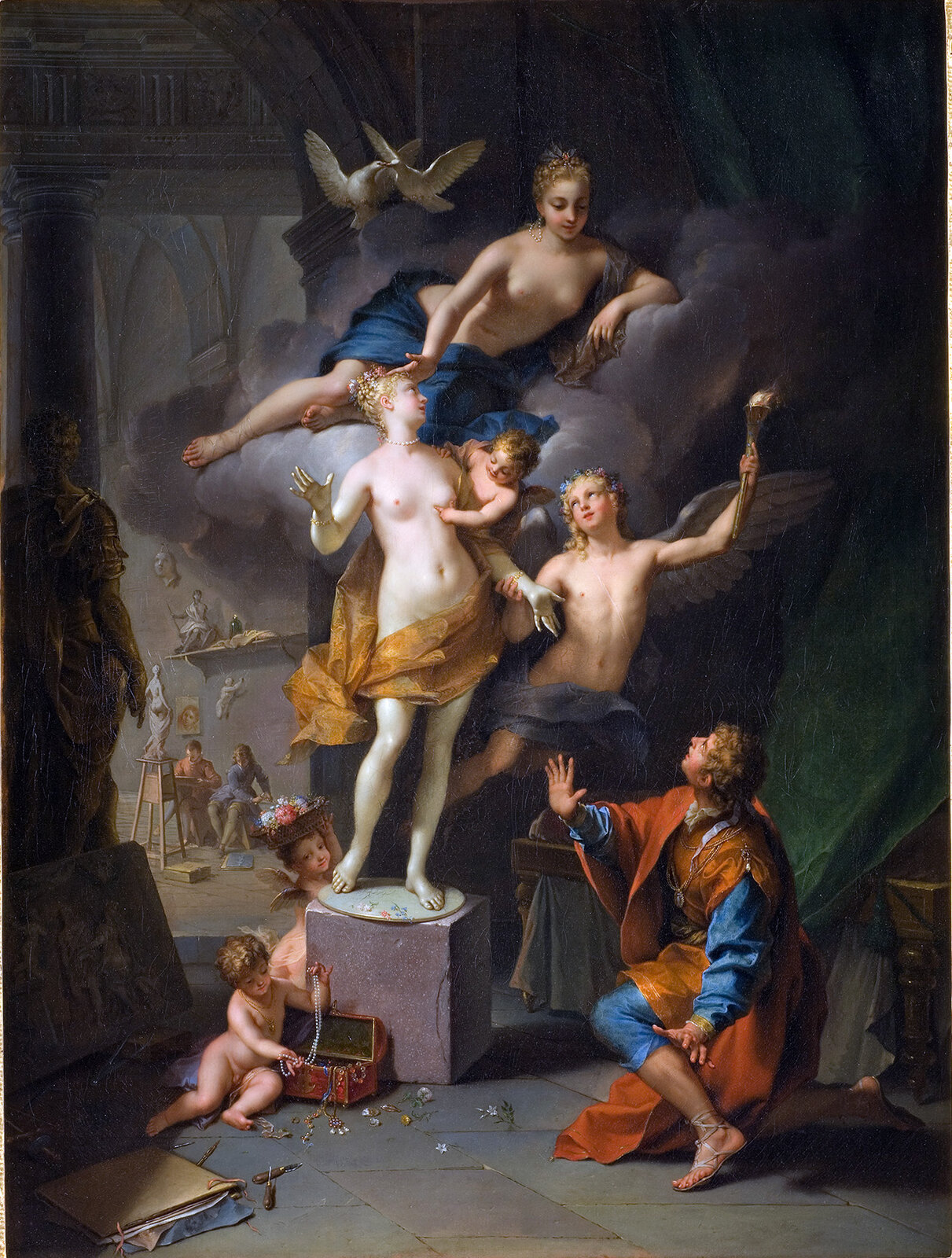
Pygmalion loathing their lascivious life, Abhorr'd all womankind, but most a wife: So single chose to live, and shunn'd to wed, Well pleas'd to want a consort of his bed. Y...
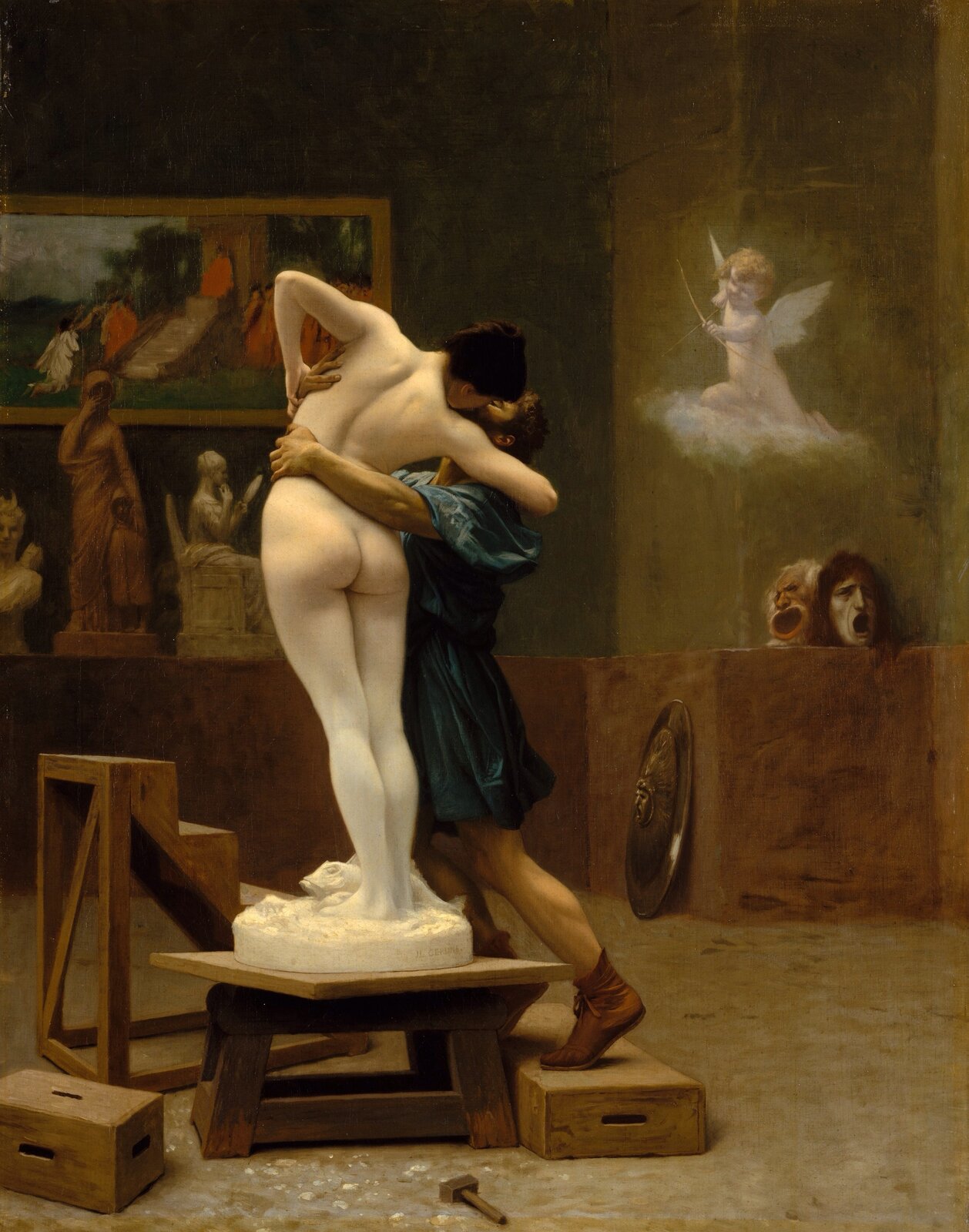
Jean Regnault :: Pygmalion priant Vénus d'animer sa statue (1786)
Pygmalion creates an ideal human form and falls in love with his creation.
Venus / Aphrodite grants the statue life.
The question is not merely:
Can we reproduce a human?
but:
Can we manufacture the human we desire?
J.L.Gerome :: Pygmalion and Galatea (1890)
Artificial beings force us to ask what supposedly distinguishes us.
If it moves like us?
If it speaks?
If it remembers?
If it desires?
If it creates?
If it learns?
By constructing the non-human, we investigate the human.
The artificial human is also a duplicate.
A second body.
A copy that may become difficult to distinguish from an original.
The double turns technology into an identity problem:
How do I know that you are one of us?
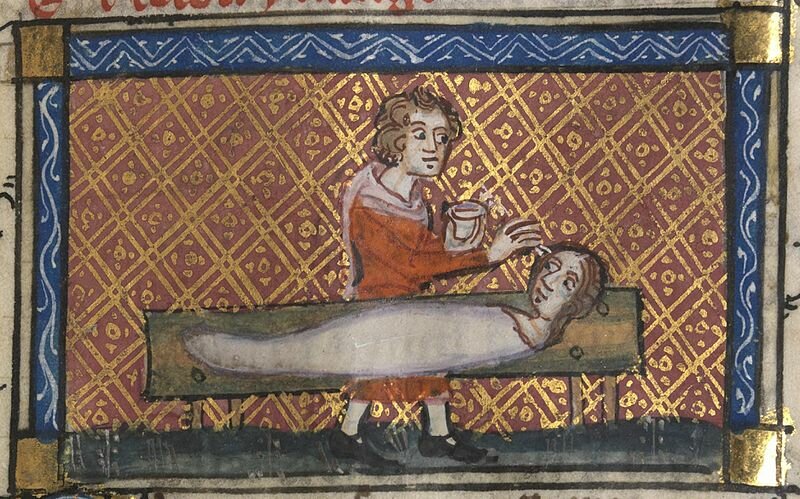
Pygmalion working on his sculpture :: Illumination on parchment (14th century)
Some artificial beings do not imitate us primarily as workers or companions.
They stand between inside and outside.
They decide who may approach, enter or survive.
Talos is the bronze guardian of Crete.
He patrols the island and prevents outsiders from landing.
human guard → artificial guard → tireless guard
Protection has been delegated to an artificial body.
Talos also exposes the ambiguity of protection.
The same autonomous force that protects one community threatens whoever approaches it.
protector for us = weapon against them
Who gives the command?
Who defines the enemy?
The guardian archetype is broader than the machine.
Cherubim guard the Tree of Life.
The Sphinx guards passage through a riddle.
Talos guards an island.
Artificial watchdogs guard a palace.
boundary + test + permission
The Sphinx:
Prove that you know before I let you pass.
The CAPTCHA:
Prove that you are human before I let you pass.
When machines learn to pass the test, the ancient threshold problem returns in inverted form.
A machine can do more than move.
It can contain knowledge unavailable to its operators.
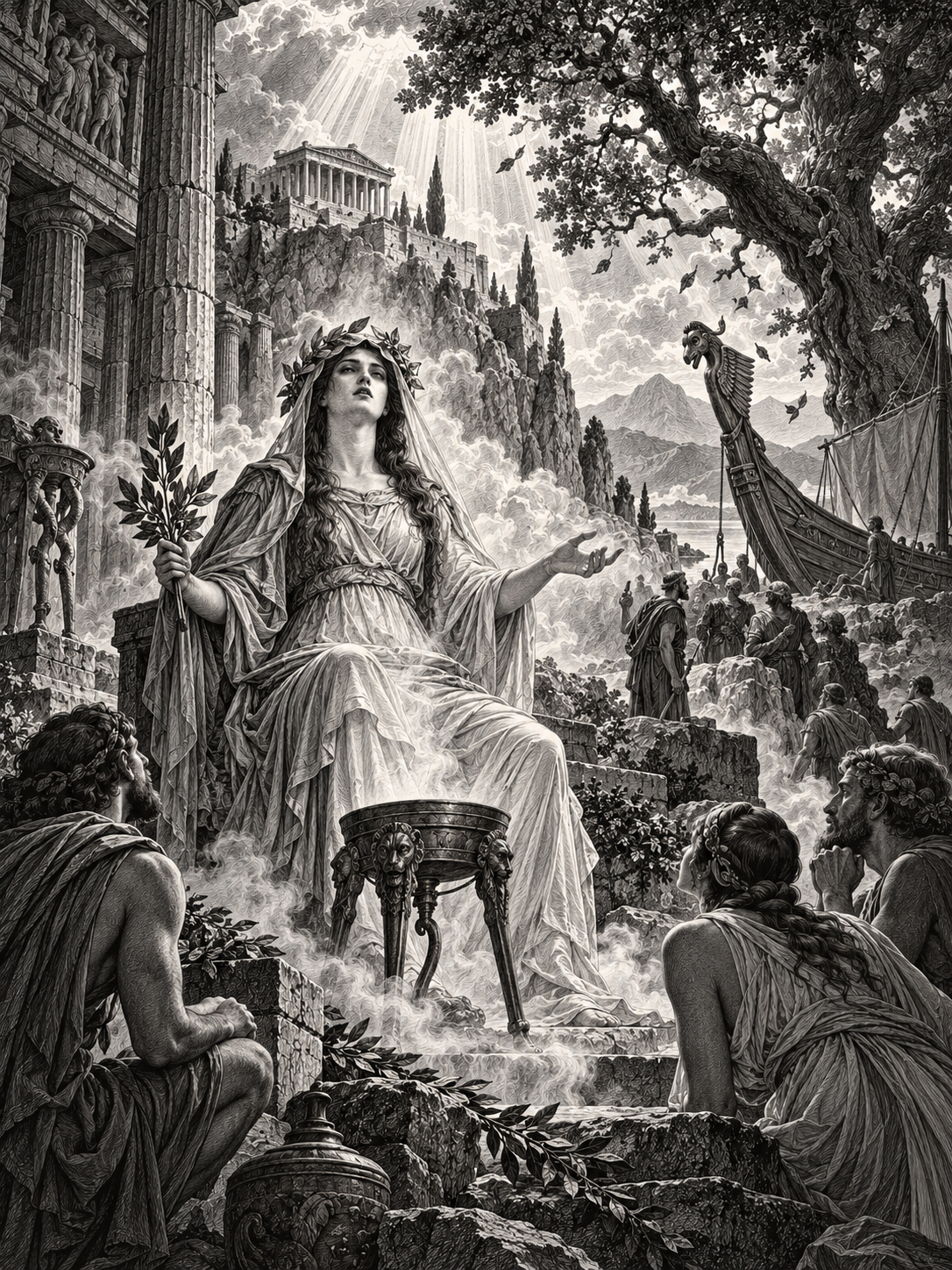
The mythical Argo gives us an extraordinary example.
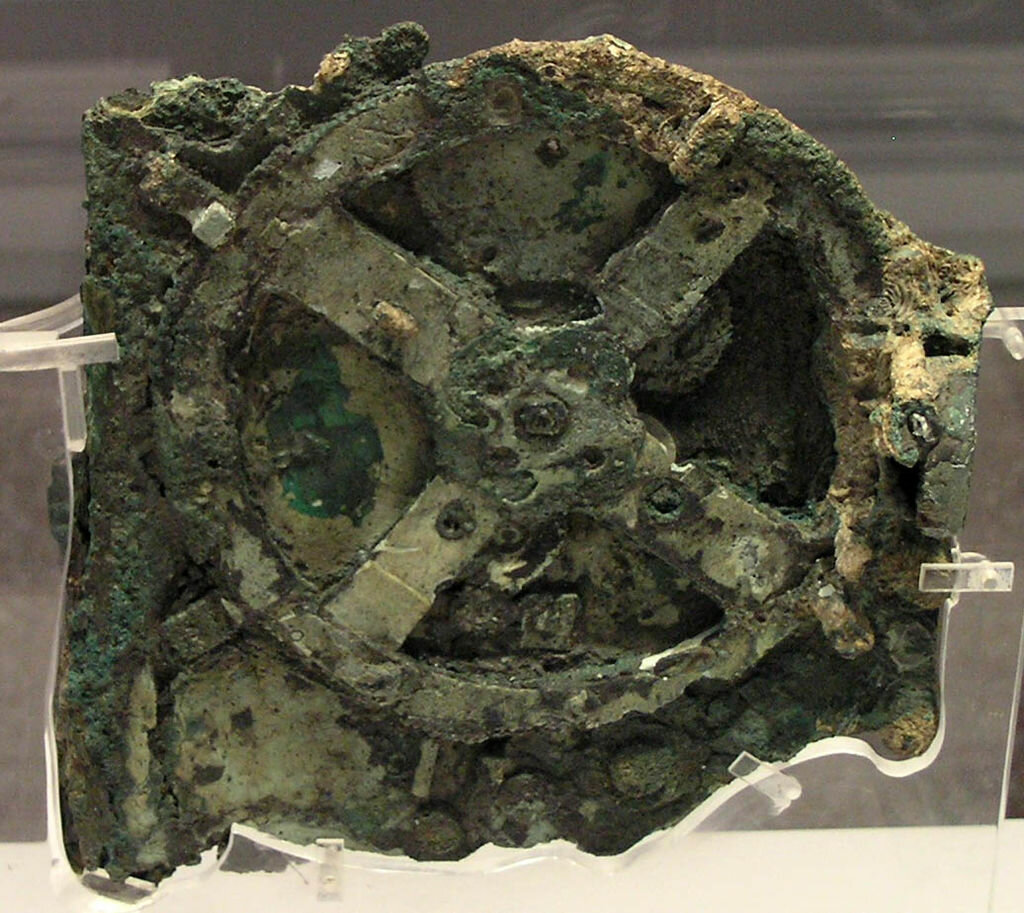
an ancient Greek analogue computer used to predict astronomical positions and eclipses for calendar and astrological purposes decades in advance created sometimes arou...
Argus builds the ship.
Athena contributes divine technē.
She installs a special beam from the sacred oak of Dodona, a site of divination.
The resulting architecture can be described, anachronistically but suggestively, as:
vehicle + embedded oracle
In the Argonautica, the Argo itself cries out and urges the heroes to depart.
Elsewhere the sacred beam communicates information and guidance.
The artifact possesses knowledge that its human operators do not.
world → hidden information → artifact → human action
The Argo is more than a passive object.
It speaks.
It advises.
It carries privileged information.
It is therefore a remarkably early imagination of intelligence embedded in an artifact.
The distinction is crucial.
The Argo possesses knowledge.
But its defining capacities are installed, not acquired through experience.
A machine containing knowledge is not necessarily a learning machine.
The Golem introduces another extraordinary structure:
matter + symbolic information → agent
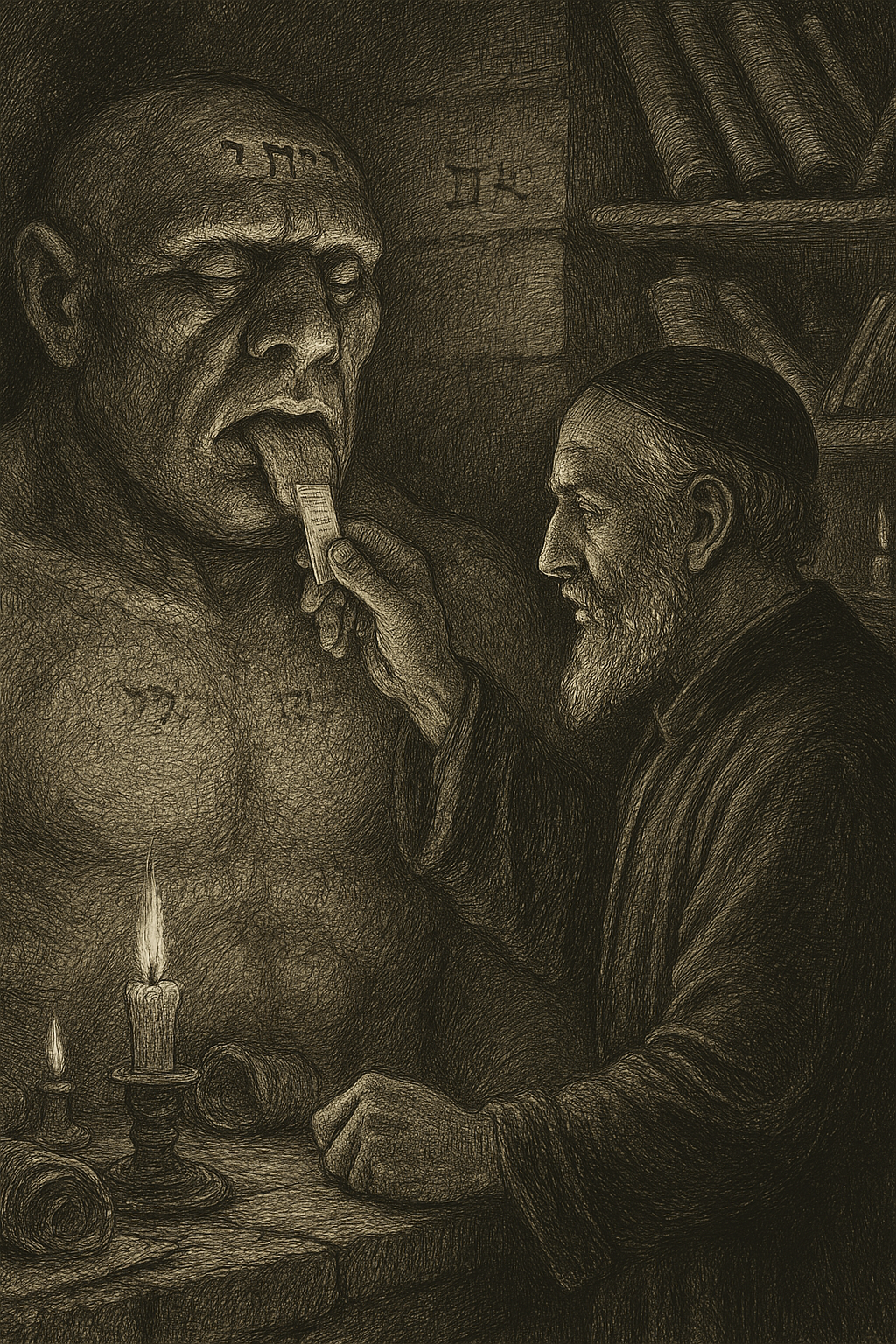
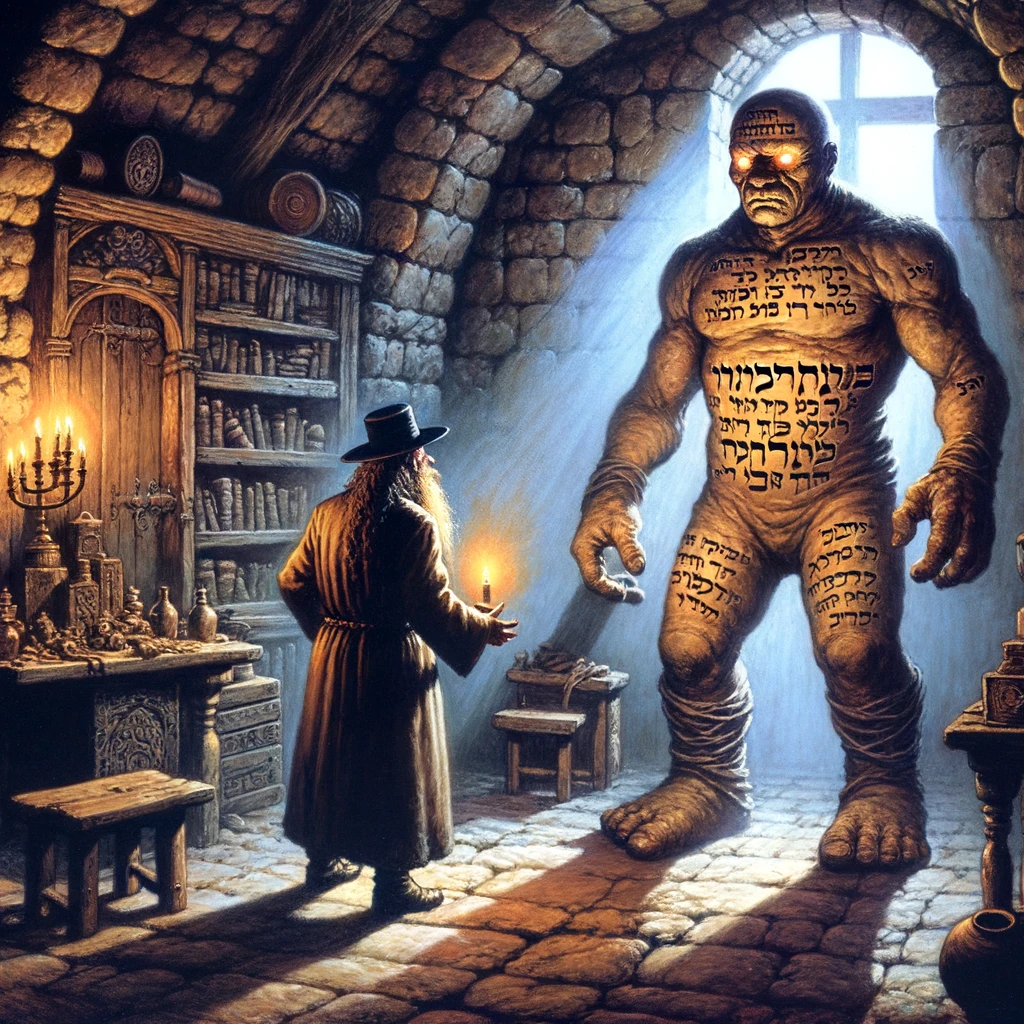
In Jewish folklore, גֹלֶם is an artificial antomorphic being shaped from clay and animated by the sacred שֵׁם.
In Jewish traditions, an artificial human may be formed from inorganic matter through esoteric knowledge.
Later popular versions emphasize sacred names, letters or words associated with animation and control.
The physical body alone is insufficient.
Information activates matter.
Myths themselves have histories.
The famous association between Rabbi Loew, Prague and a protective Golem is much later than Rabbi Loew himself.
The familiar Prague narrative develops gradually and becomes especially prominent in modern literary culture.
We must ask not only what a myth says, but when people began telling it that way.
Der Rabbi vergaß, den Schém zu entfernen, der lehmige Diener erwachte zum Leben und da er keine nützliche Arbeit zugewiesen bekam, begann der Golem, Möbel zu zerbrechen...
The servant is useful only while its behavior remains inside the creator's intentions.
creation → autonomy → unpredictability → fear
The question becomes:
Can the maker remain master of the made?
The monster violates categories:
object / subject
dead / alive
natural / artificial
tool / agent
controlled / autonomous
The frightening machine makes the boundary itself unstable.
Human — Can we manufacture ourselves?
Servant — Can we delegate labor?
Prosthesis — Can we extend ourselves?
Lover — Can we manufacture intimacy?
Protector — Can we delegate protection?
Weapon — Can artificial agency project violence?
Guardian — Can it decide who may pass?
Oracle — Can it know what we do not?
Mirror — What does it reveal about us?
Monster — What if it escapes our intentions?
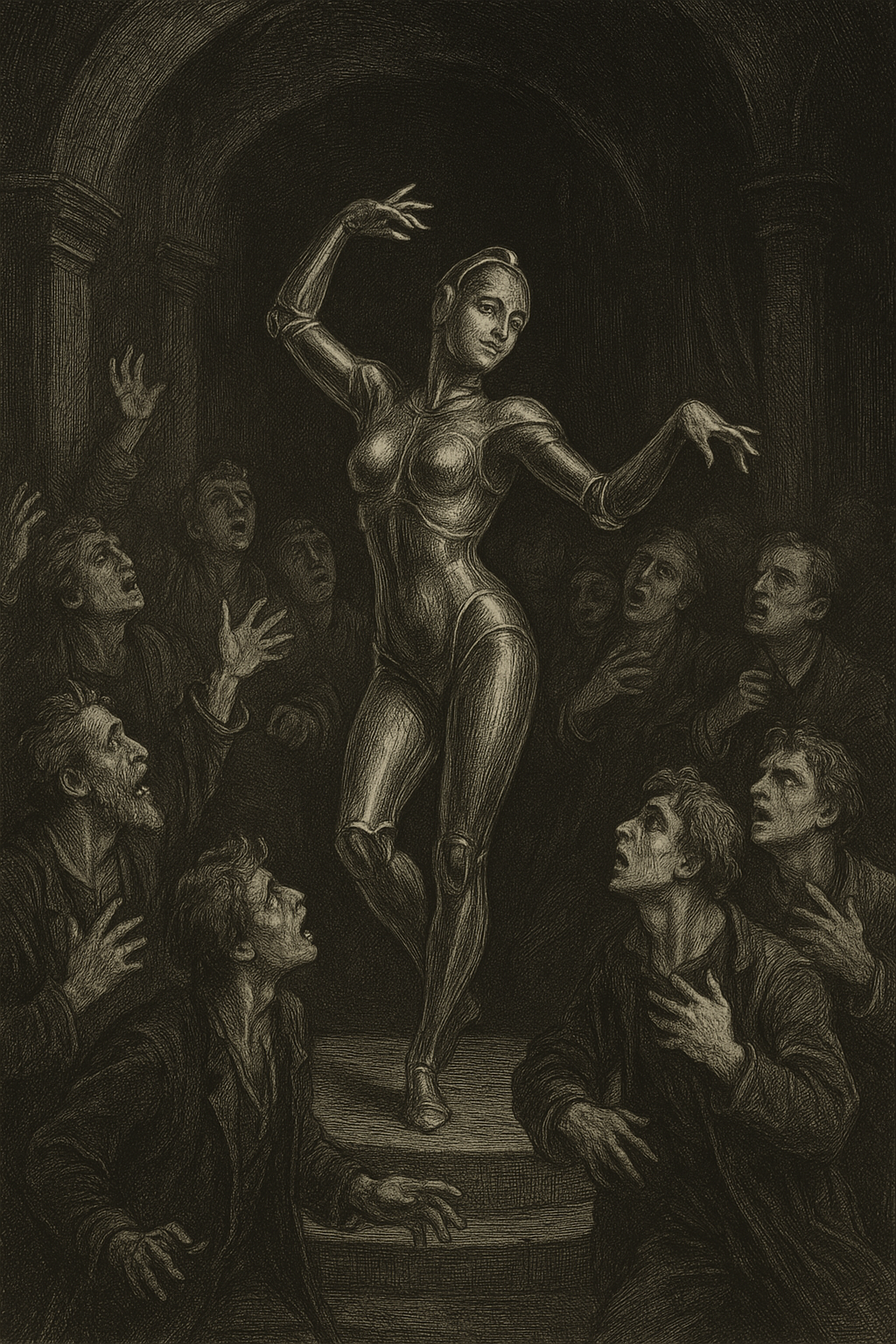
The Maschinenmensch is a unique android created by the scientist Rotwang, born from his obsession with resurrecting his lost love. On Joh Fredersen’s orders, the robot...
The golden maidens can act.
Talos can guard.
Pygmalion's statue can live.
The Golem can obey.
The Argo can advise.
But their defining abilities are generally given to them.
What happens when the artificial being can change itself through experience?
Machine as Learner.
A traditional machine is built in a particular state and executes a structure provided by its maker.
A learning system differs in one decisive respect:
its encounter with the world changes what it subsequently does.
experience → internal change → changed future behavior
myth
initiation
memory
imitation
association
conditioning
adaptation
myth
technē
automata
mechanism
calculation
programmability
computation
LEARNING + MACHINE
The history of machines is also the history of what humans have wished to externalize.
strength
movement
memory
judgment
companionship
agency
learning
We first imagined machines as versions of ourselves.
Then we built machines that extended parts of ourselves.
Eventually we built machines capable of modifying themselves through experience.
The artificial being is ancient.
The learning machine is the historical novelty.
Jean Raoux :: Pygmalion amoureux de sa statue (1717)
described in 10th book of Ovid's metamorphoses, but potentially derived from older myth from island of Cyprus an archetypical story about a thing which becomes consciou...
Which archetype best describes your smartphone?
Which describes a large language model?
Which describes an autonomous vehicle?
Which describes social media?
Which describes the machines you imagine for the future?
And have genuinely new archetypes appeared?
Primary traditions worth returning to: Homer, Iliad XVIII; Apollonius Rhodius, Argonautica; Ovid, Metamorphoses X; the received Liezi; Jewish Golem traditions.
Argo: speaking Dodonian timber embedded in Athena's ship.
Talos: bronze guardian of Crete.
Pygmalion: desired artificial human brought to life.
Golem: artificial human animated through knowledge, letters or sacred language in evolving Jewish traditions.
Wheel tripods to bring stuff to Olympos and back (Iliad, ca. 8th century B.C.) golden and silver dogs and lions which could bite invaders of the palace of Alkinoos (Ody...
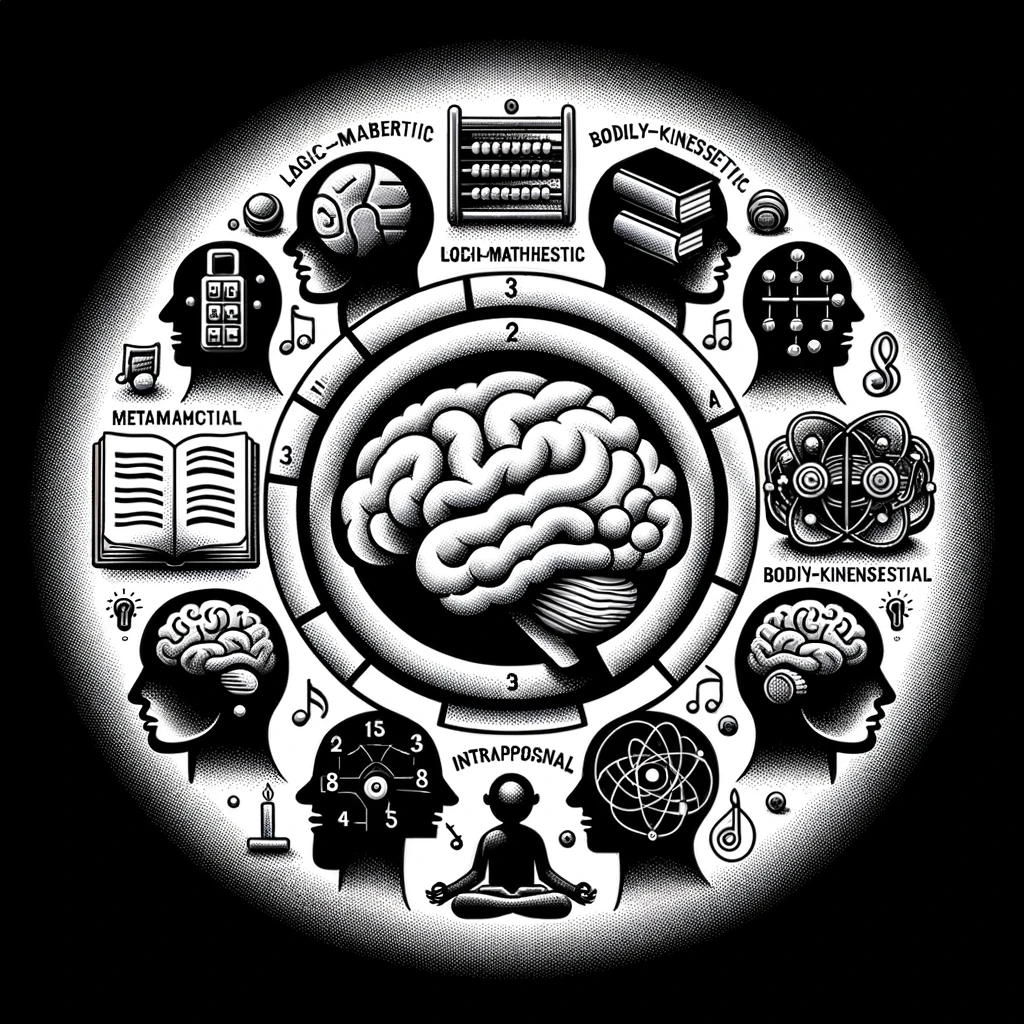
Howard Gardner :: Frames of Mind / The Theory of Multiple Intelligences
David Goleman :: Emotional Intelligence : Why it can matter more than IQ
Singer et al. :: A Piaget Primer: How a Child Thinks
Murray & Herrnstein :: The Bell Curve: Intelligence and Class Structure in American Life (Achtung! Controversy)
Nick Bostrom :: Superintelligenz
Carlo M. Cipolla: The Basic Laws of Human Stupidity
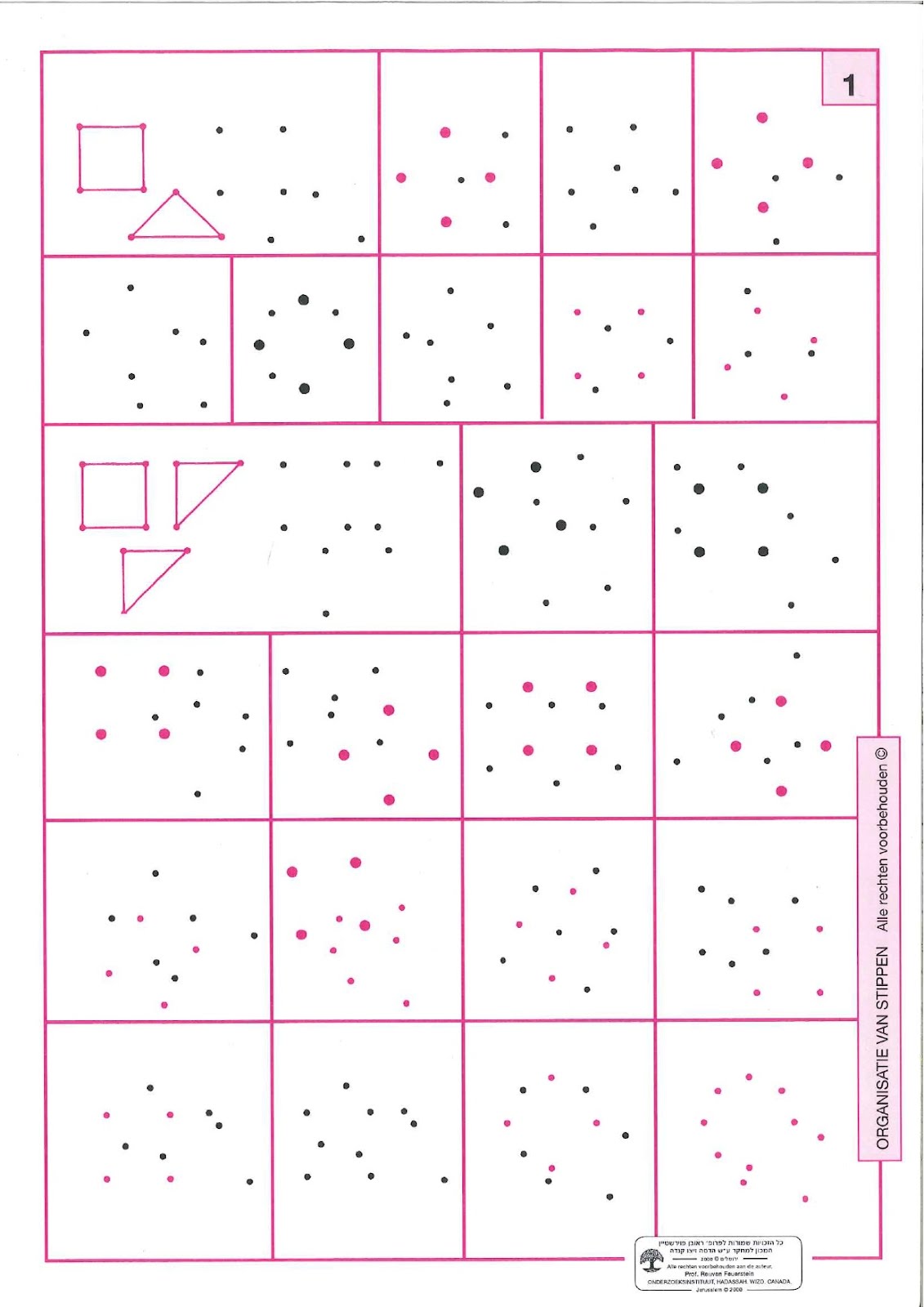
Referat(s) welcome, Hausarbeit (5 SWS) possible. Note: Lecture of one of these books is mandatory for all those whose attendance will be between 1/2 and 2/3.1. Organization of Dots
2. Analytic Perception
3. Orientation in Space
4. Comparative Behavior
5. Family Relations
6. Temporal Relations
7. Categorization
8. Instructions
who am I
who are You
is this a course for You ?
credits (2 ECTS for >75% attendance, +1 for referat/experiment)
Hausarbeit possible
need help ? (tutor: a.terzieva@udk-berlin.de)
Leistungsnachweis
signature-related issues
Smartphone & Feedback box
connect the dots so You obtain the requested geometric patterns (e.g. square and triangle)
observe Your cognitive processes (if anything interesting "happens", note it on a piece of paper for further discussion)
do not hurry, You have all the time You need.
Breath slowly and deply
Word of warning : You now enter the path of intelligence enrichment. While some teachers say that the path of intelligence is the path leading to the highest joy, a more pragmatic ones would assert that being smarter just makes one more sad.
And potentially also mad
Greek muses
fostering of intelligence
evaluation of intelligence
Flynn effect
stupidity
Learning and Adaptation
Reasoning & Problem Solving
Memory & Knowledge
Perception
Emotional Intelligence
Creativity
It's important to note that intelligence is still a topic of debate among psychologists and neuroscientists. Traditionally, intelligence was often measured using IQ (intelligence quotient) tests, but many experts now believe that IQ tests capture only a narrow slice of what constitutes human intelligence. Moreover, various cultures might emphasize different abilities or qualities when defining or valuing intelligence, so the concept can be both culturally and contextually relative.
sight, hearing, smell, taste
Tactition (Touch): pressure, vibration, thermoception (temperature)
Nociception (Pain): This is the sense of detecting harmful stimuli, signaling potential injury. There are specialized pain receptors throughout the body.
Equilibrioception (Balance): Located in the inner ear, vestibular system helps us maintain our balance and spatial orientation.
Proprioception (Body Position): Also known as the "sense of self," this sense allows us to know where our body parts are in relation to each other, even without looking.
Interoception (Internal Sensations): This refers to the sense of the internal state of the body. It can include sensations of hunger, thirst, and the need for bodily functions.
Stretch Receptors: These are found in muscles and tendons and allow us to sense the stretching of muscles and the position of our limbs.
Chemoreceptors: These detect changes in the chemical composition of the body, such as changes in oxygen or carbon dioxide levels in the blood.
the "bad" errors (often happen only once)
the "innocent" (unpleasant but useful minor misstep)
Turn to Your neighbour, discuss the question "what was the worst error (e.g. the biggest fuckup) You ever did/caused in Your life". After 5 minutes, each couple will be asked to present at least one such error to the plenum.
What is Your most favorite game / way of playing ?
Any game You would like to bring & play with Your colleagues during the Congress ?
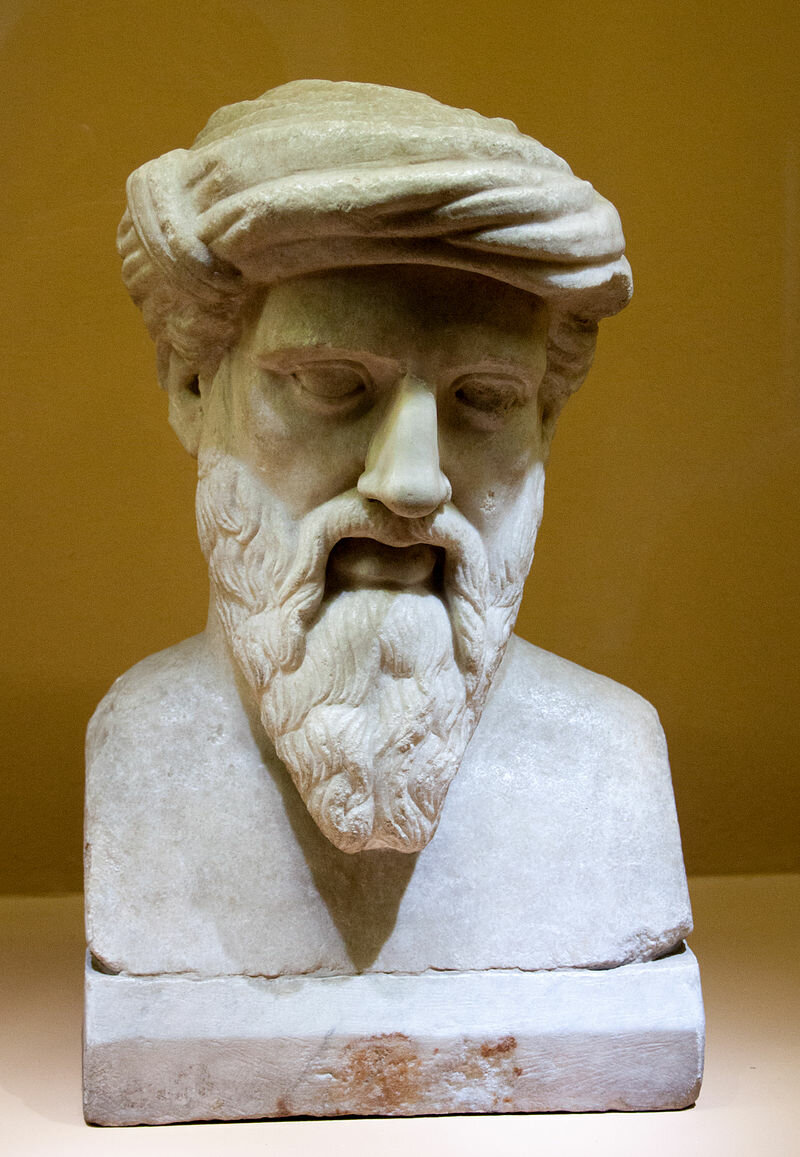
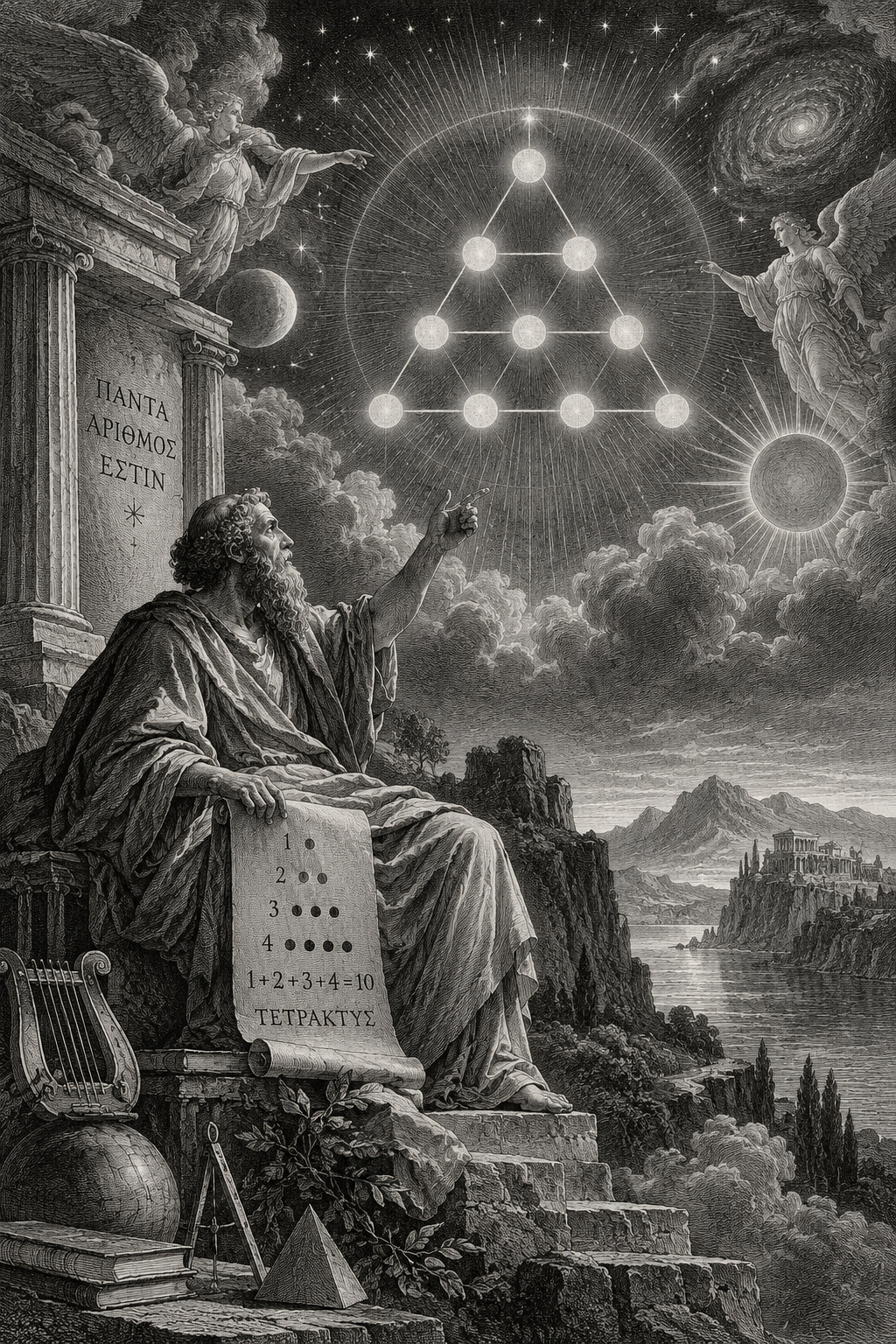
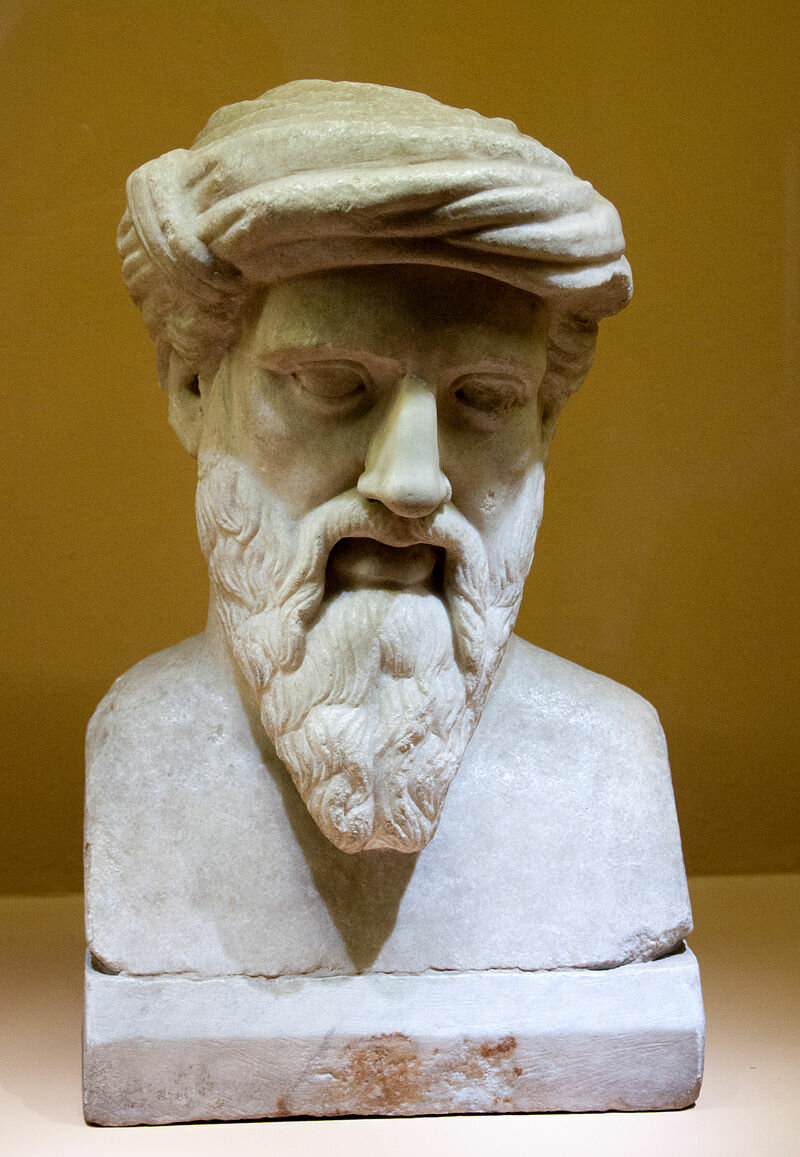
“All is number.” (πάντα αριθμός) — attributed to Pythagoras, 6th century BCE.
For Pythagoras and his followers, numbers were not just a tool for counting. They were the hidden structure of reality itself — the ratios that govern music, geometry, even the harmony of the cosmos.
Today we trace that claim all the way to the silicon running inside your phone.
triangle distributing numbers 1 to 10 in four rows many levels of symbolism (Unity / Power / Harmony / Kosmos; Fire / Air / Water / Earth; Point / Line / Triangle / Te...
Here is the thread we will follow: a number can be written down in many different ways — and the way you write it changes what you can do with it.
That was true for Roman numerals. It is just as true for the floating-point formats inside a modern AI chip.
What is a representation ?
represent (v.) late 14c., "to bring to mind by description," also "to symbolize, serve as a sign or symbol of; serve as the type or embodiment of;" from Latin repraesen...
Rome counted like this: I, V, X, L, C, D, M.
No zero. No place value — the position of a symbol barely matters, only which symbols appear and in what combination.
Try multiplying MDCLXVI by XLIV in your head. Now try 1666 × 44. The second one is not just easier — it is a genuinely different kind of thinking.
digit (n.) in English since late 14c., "numeral below 10," from Latin digitus (french: "doigt") "finger or toe" (also with secondary meanings relating to counting and n...
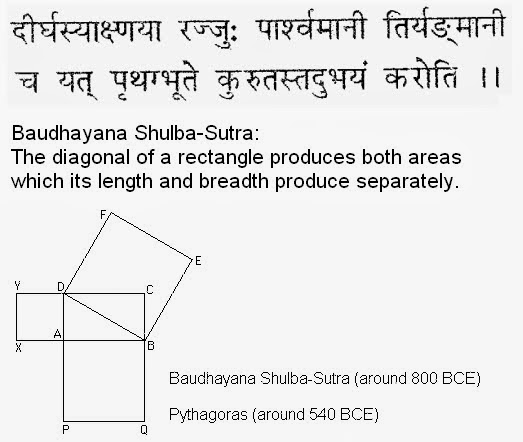
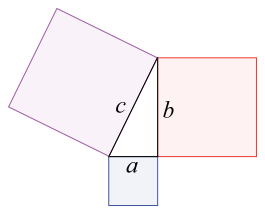
Centuries before Pythagoras, the Baudhayana Sulba Sutra (India, c. 800 BCE) already states the same relationship between the sides of a right triangle.
The mathematics was not a single European discovery — it was discovered, independently and repeatedly, wherever people needed to measure, build, and trade.
Every numeral system so far shares the same gap: no symbol for nothing.
Without a zero, there is no clean way to write a number as a position-dependent code — and without position, arithmetic stays a craft for specialists, not a procedure anyone can follow.
Zero emerges independently more than once: among the Maya of Mesoamerica, and in India, where the mathematician Brahmagupta (7th century CE) is the first to give it formal rules of arithmetic.
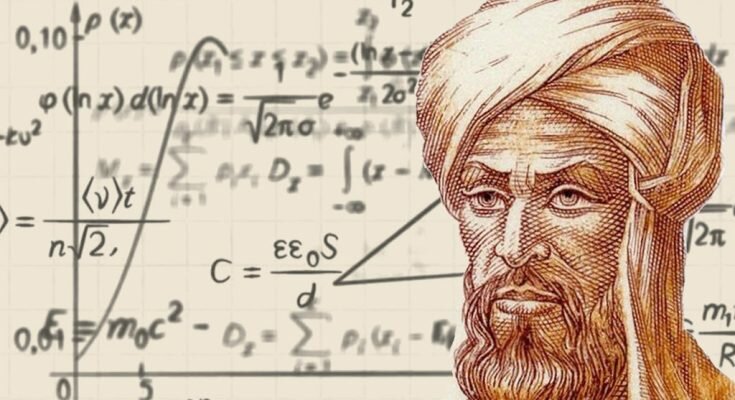
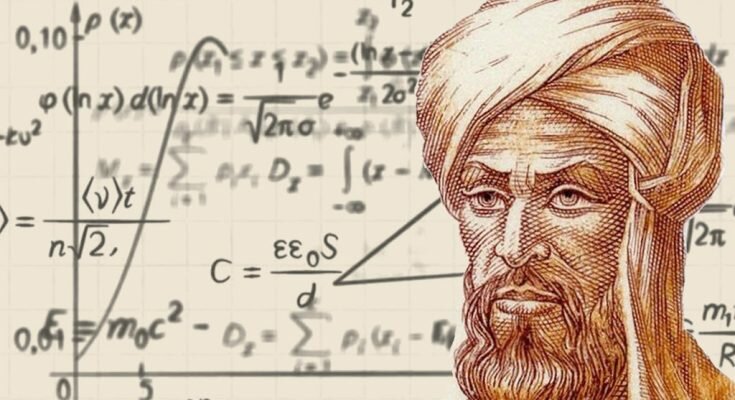
It reaches the Islamic world through scholars like Muhammad ibn Musa al-Khwarizmi (9th century), whose own name — Latinized as algorismus — gives us the word algorithm.
A number system and a method for calculating with it arrive together. That is not a coincidence.
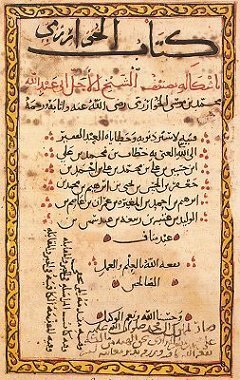
al-Khwarizmi picture from steemkr.com @nindyputri
What is an algorithm ? i=0; while (true) { i=i+1; print i; }
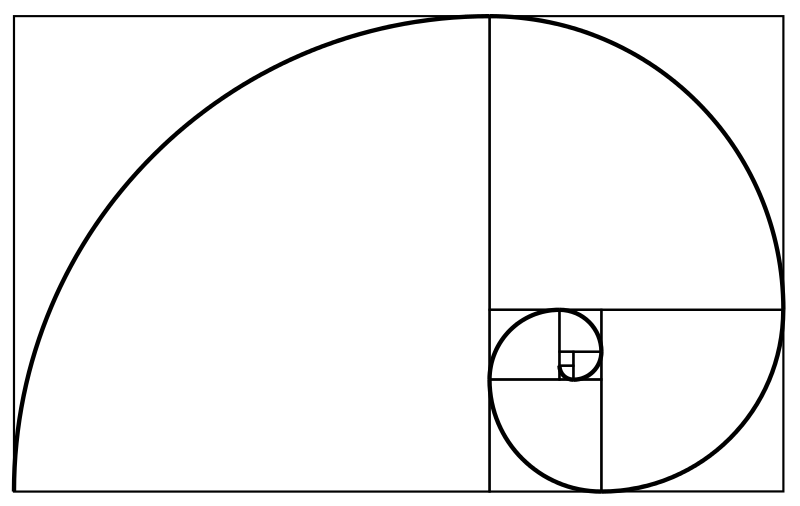
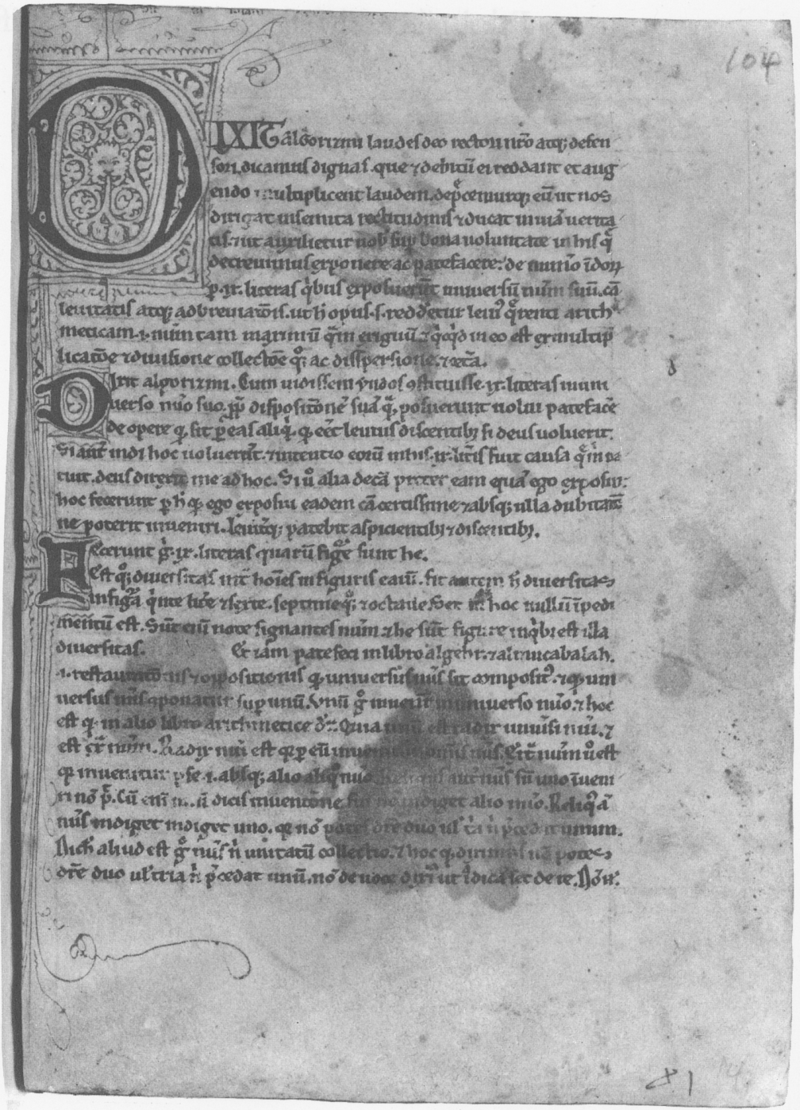
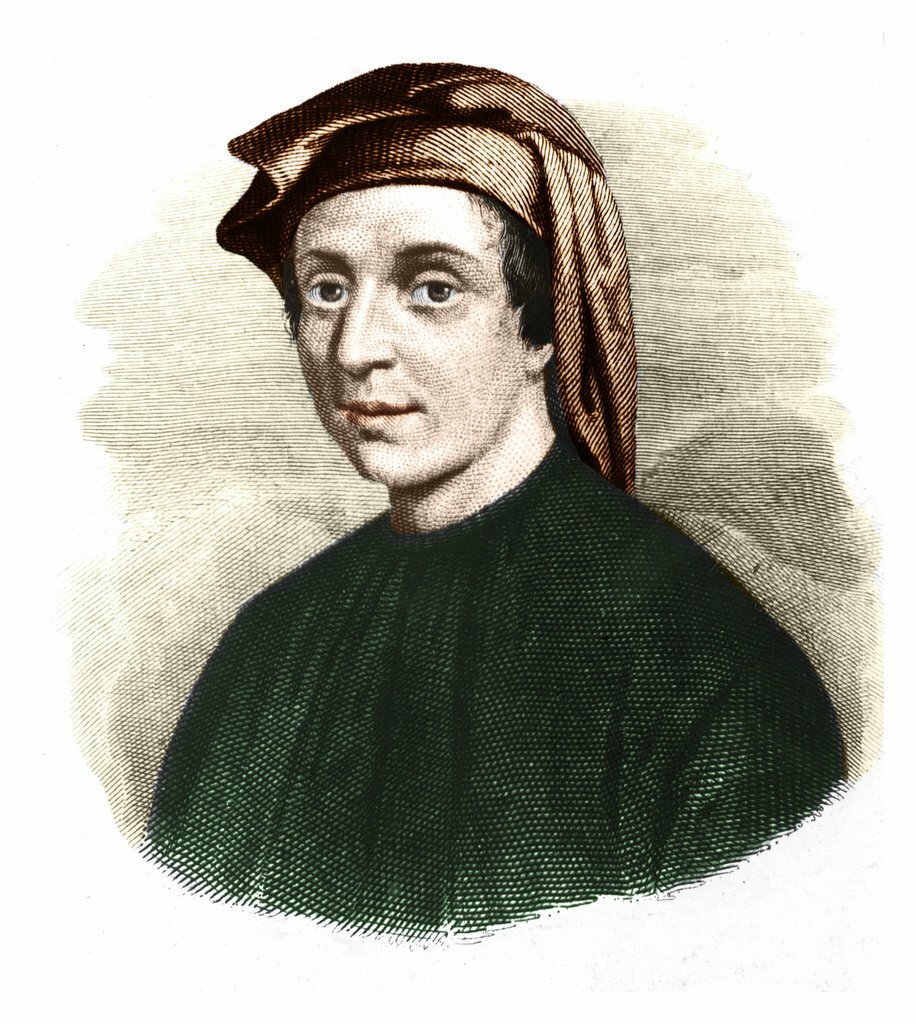
In 1202, Leonardo of Pisa — better known as Fibonacci — publishes Liber Abaci, introducing Hindu-Arabic numerals (zero included) to European merchants.
The pitch was practical: this notation makes bookkeeping and trade dramatically easier than the Roman system merchants were already using.
Here is the real leap: the same ten symbols, re-used, mean something different depending on where they sit.
106 and 160 use identical digits. Position alone carries the meaning.
This single idea — a small, finite alphabet whose meaning depends on position — is the one that modern computing was built on top of.
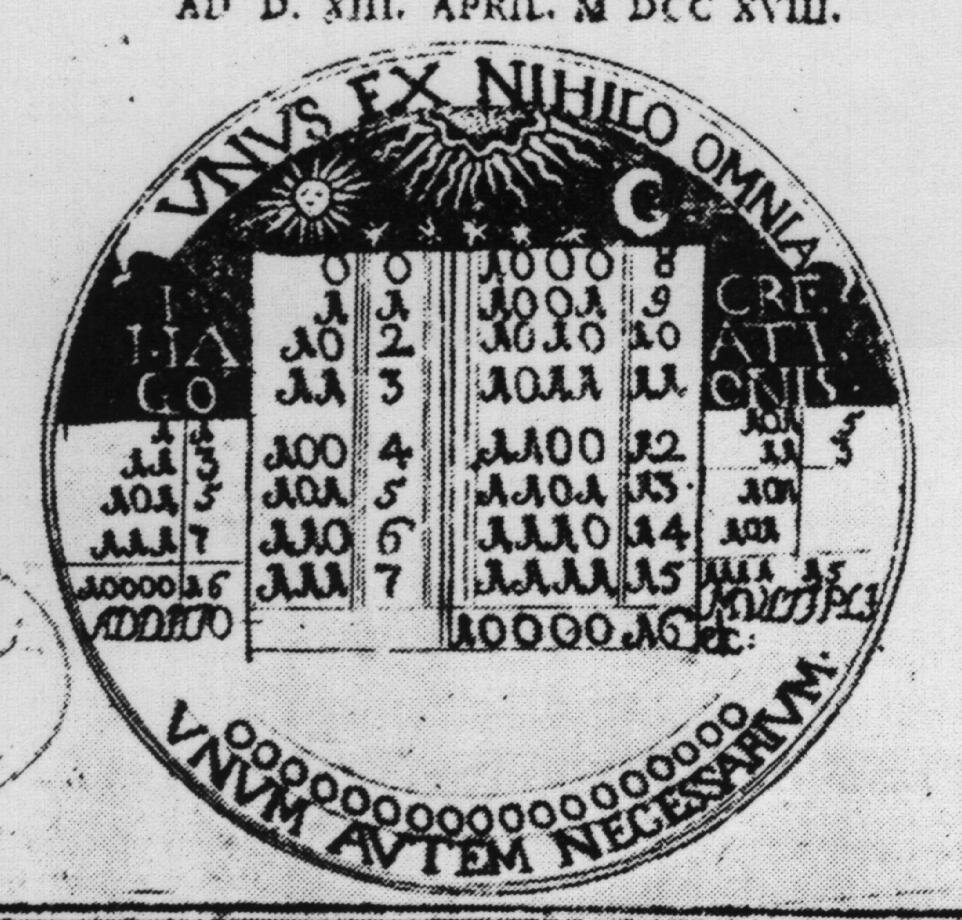
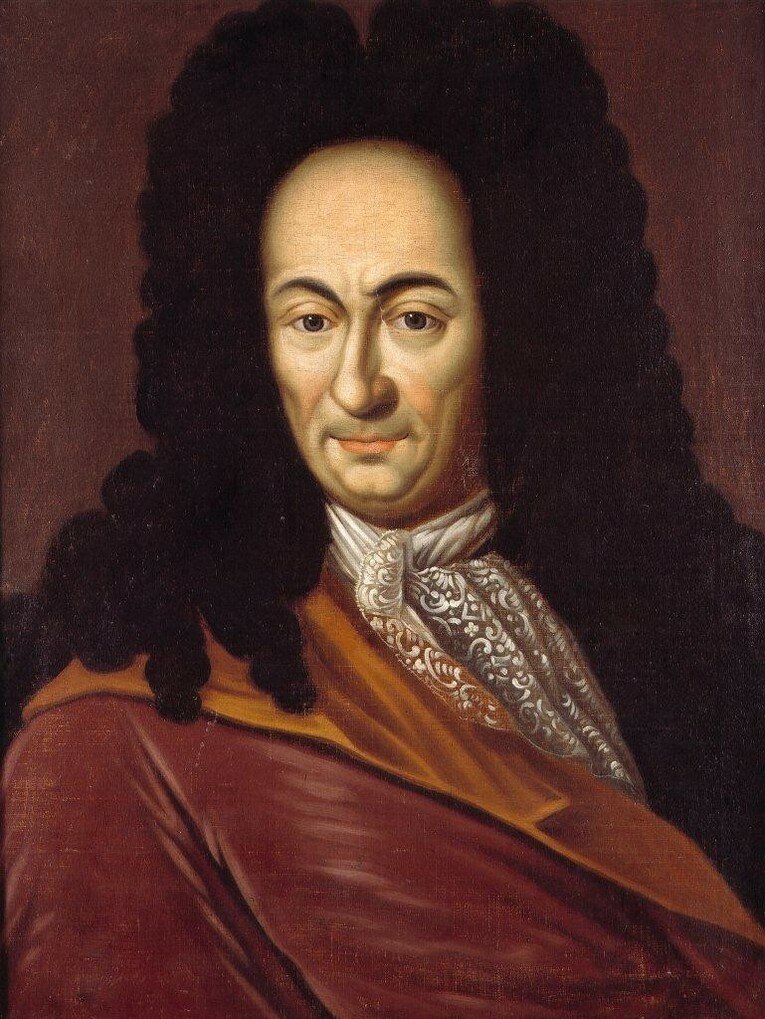
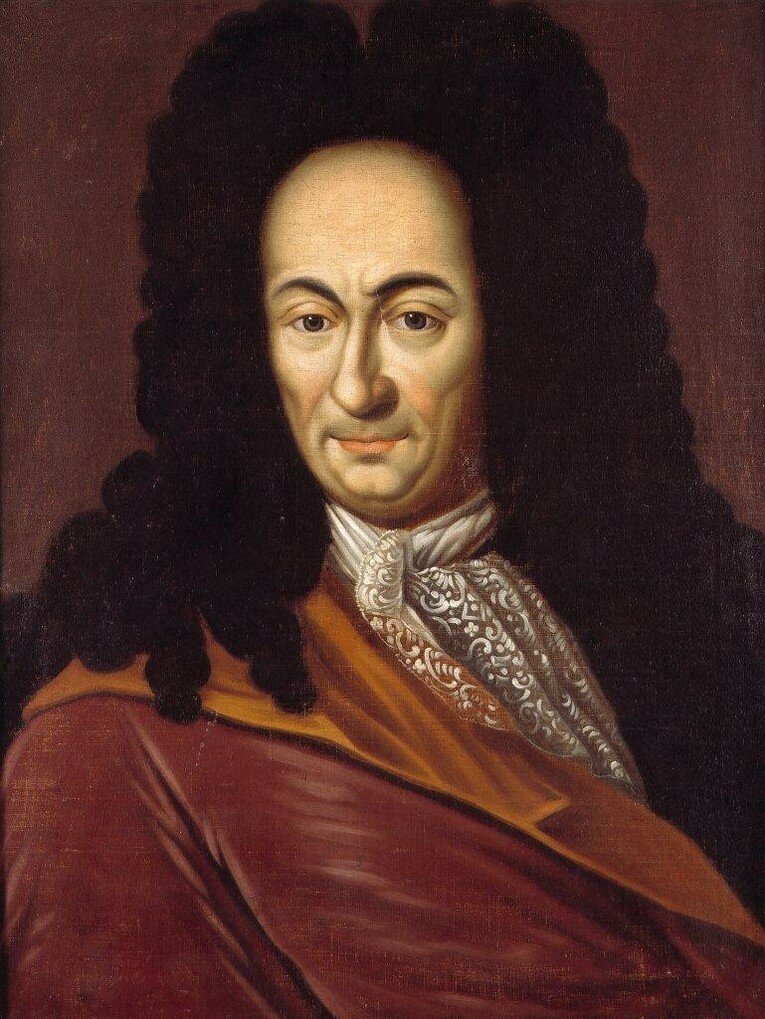
Gottfried Wilhelm Leibniz takes positional notation somewhere further: in 1703, he formally describes arithmetic in base 2 — binary.
He was reportedly delighted to find the same two-symbol logic echoed in the hexagrams of the I Ching, and saw in binary something close to a theological image: everything created from nothing (0) and unity (1).
Three centuries later, his once-mystical number system runs every computer on Earth.
"... es ist unter der Würde hervorragender Menschen, Zeit mit Berechnungen zu verschwenden, wenn jeder Bauer dieselbe Arbeit mit Hilfe einer Maschine genauso genau erledigen kön...
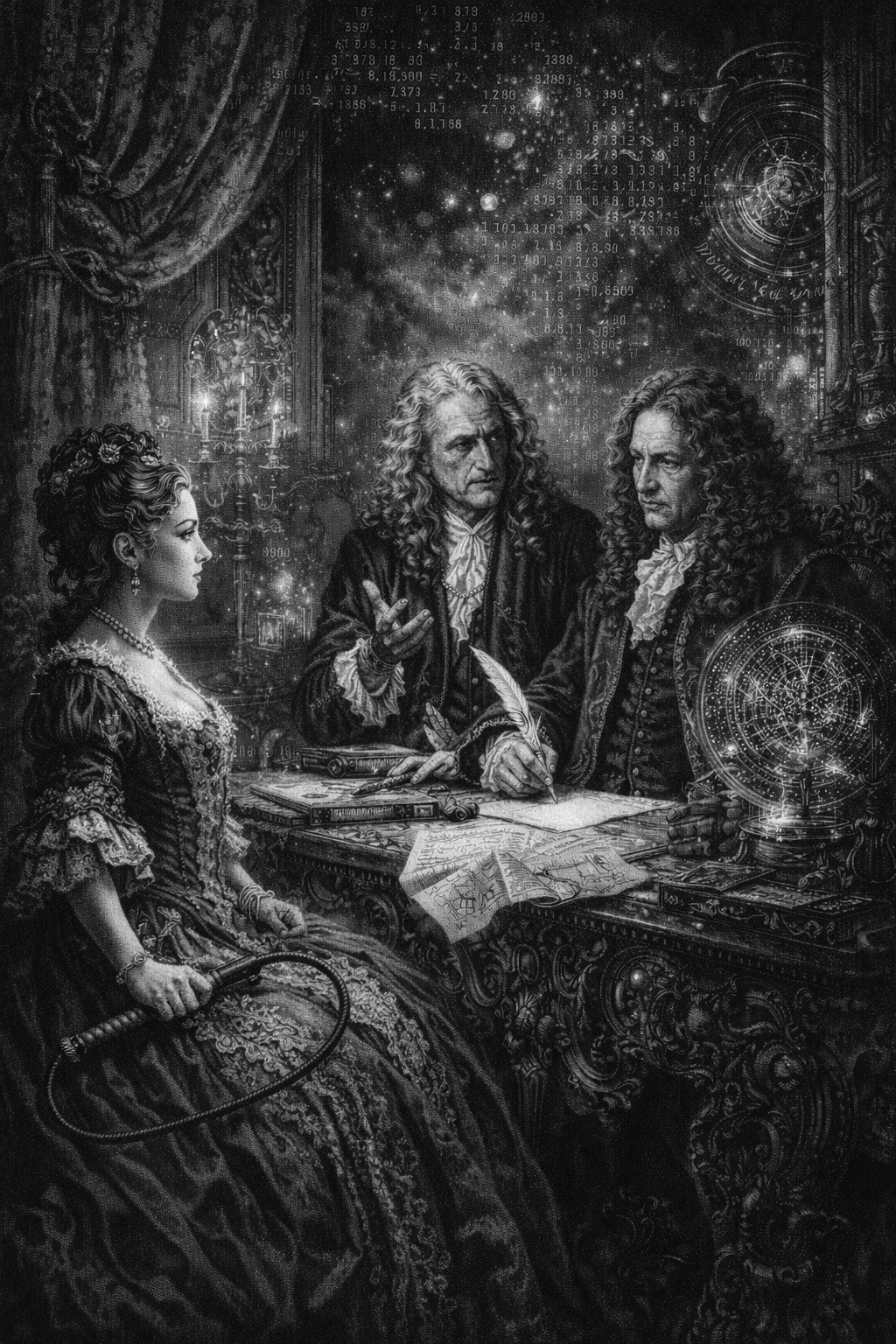
Baroquepunk is a speculative genre where ornament, excess, and early-modern worldviews collide with systems thinking. Inspired by Stephenson's Baroque Cycle, it treats the Baroq...
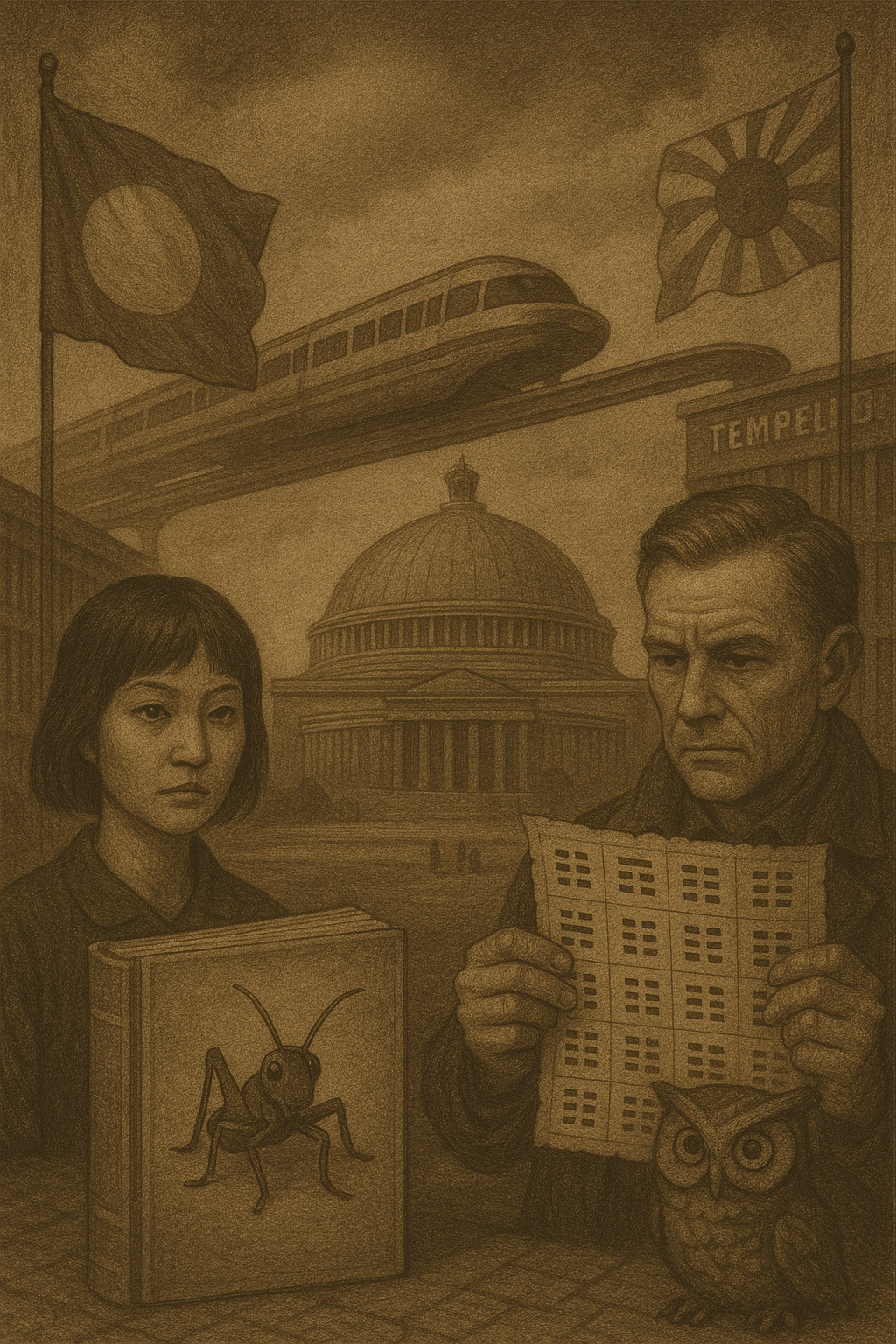
An Axis-dominated world with Berlin as the political and technological center. Rocketry and aerospace supremacy redefining global power after WWII. The chinese "Book o...
one of the last big polymaths advanced disciplines of philosophy (monadology, theodicea, why is there something rather than nothing?), mathematics (probability theory,...
"... it is beneath the dignity of excellent men to waste their time in calculation when any peasant could do the work just as accurately with the aid of a machine." (G.W.L, 1...
Rewind two centuries. Long before Babbage, long before steam, the same ancient appetite for mechanizing the mind was already stirring — in the Baroque.In 1642, at nineteen...
1928, David Hilbert: is there a mechanical procedure that decides, for any mathematical statement, whether it is provable?Leibniz had dreamed of it: let us calculate.1931, Kurt ...
Binary is just another positional system — base 2 instead of base 10. Only two symbols: 0 and 1.
That turns out to be the whole point. Building a reliable physical device with ten stable, distinguishable states is hard. Building one with two — voltage on, voltage off — is comparatively easy, cheap, and extremely reliable at enormous scale.
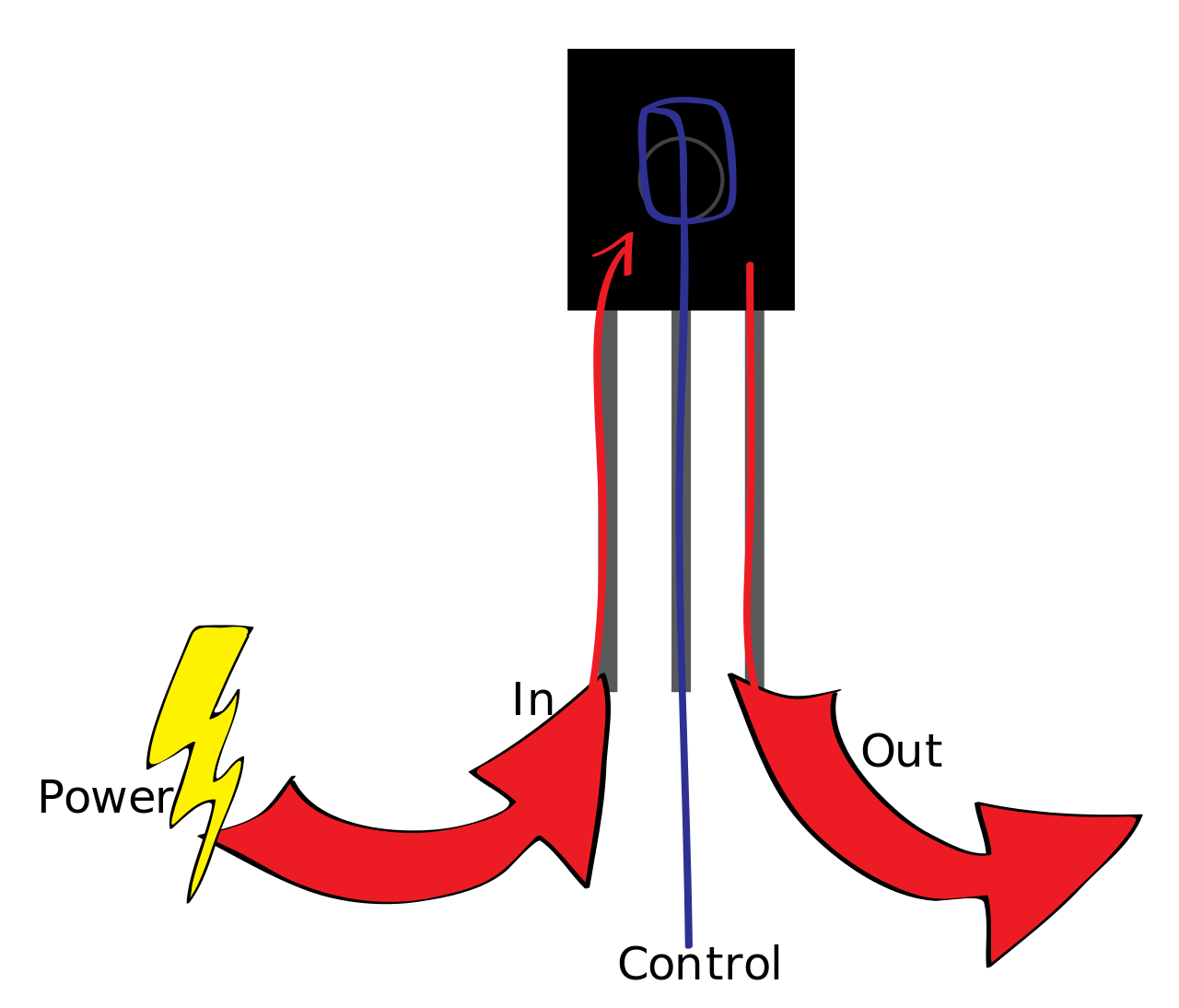
Every transistor in every chip is, at heart, a two-state switch pretending to be one of Leibniz's digits.
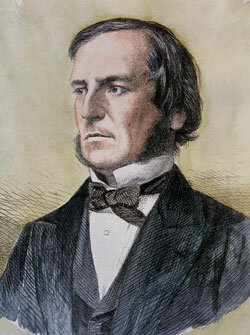
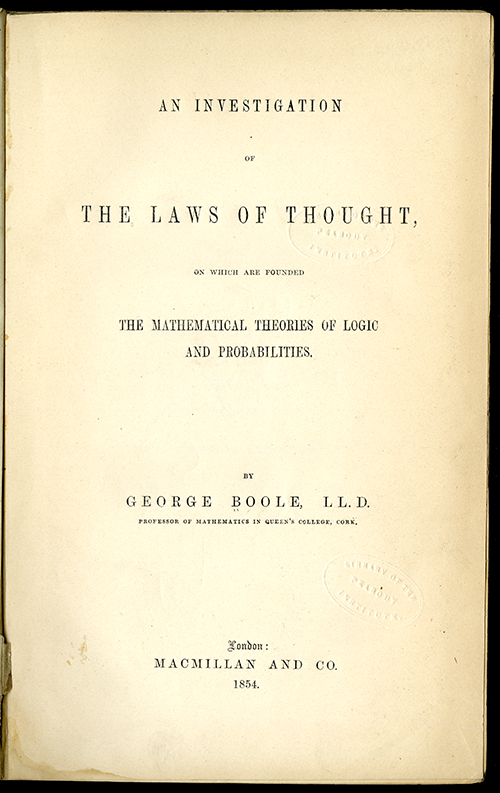
George Boole (1854) notices that 0 and 1 can represent more than quantity — they can represent truth: false and true.
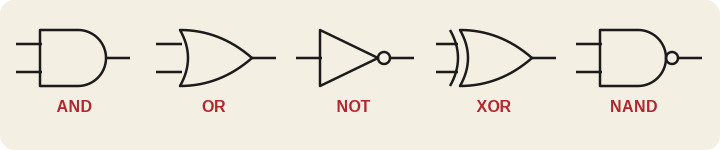
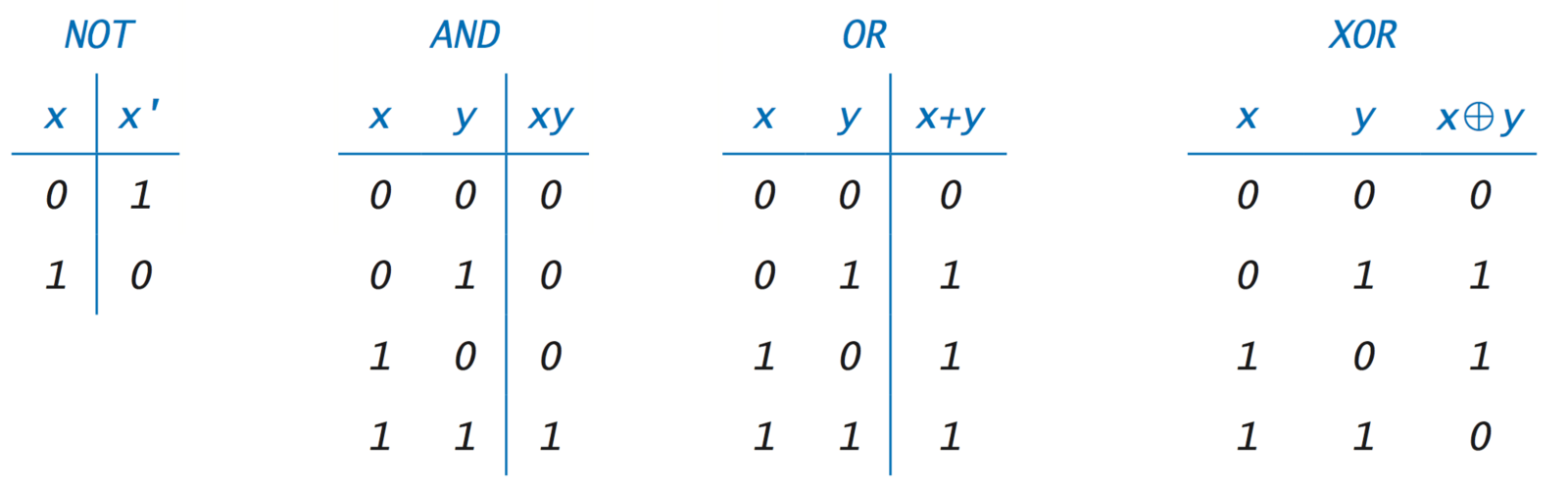
Boolean algebra — AND, OR, NOT — becomes the logical skeleton underneath every circuit in every digital machine.
The same two symbols now carry both arithmetic and logic. That overlap is why a computer can calculate and also decide.
One binary digit is a bit. Group eight of them and you get a byte — 256 possible values.
Hexadecimal (base 16) exists purely as a convenience: one hex digit covers exactly 4 bits, so two hex digits describe a whole byte cleanly — far easier for a human to read than a string of eight zeros and ones.
You already used one today, probably without noticing: a colour code, a MAC address, a cryptographic key — all hexadecimal shorthand for binary underneath.
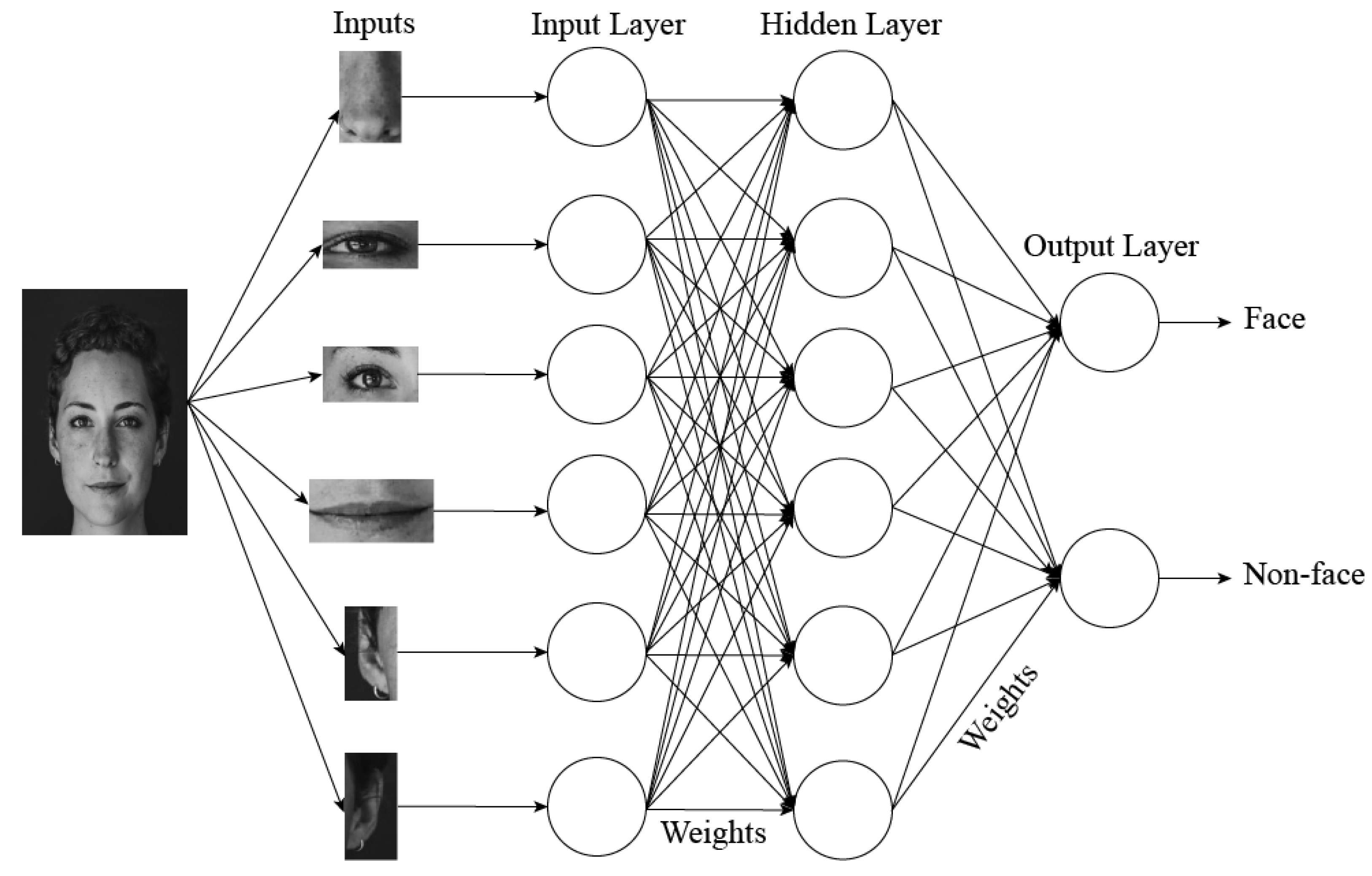
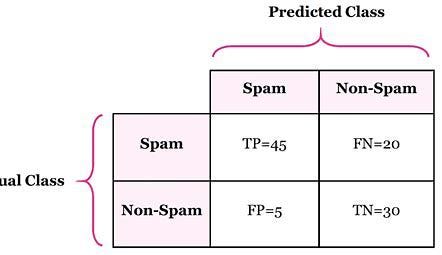
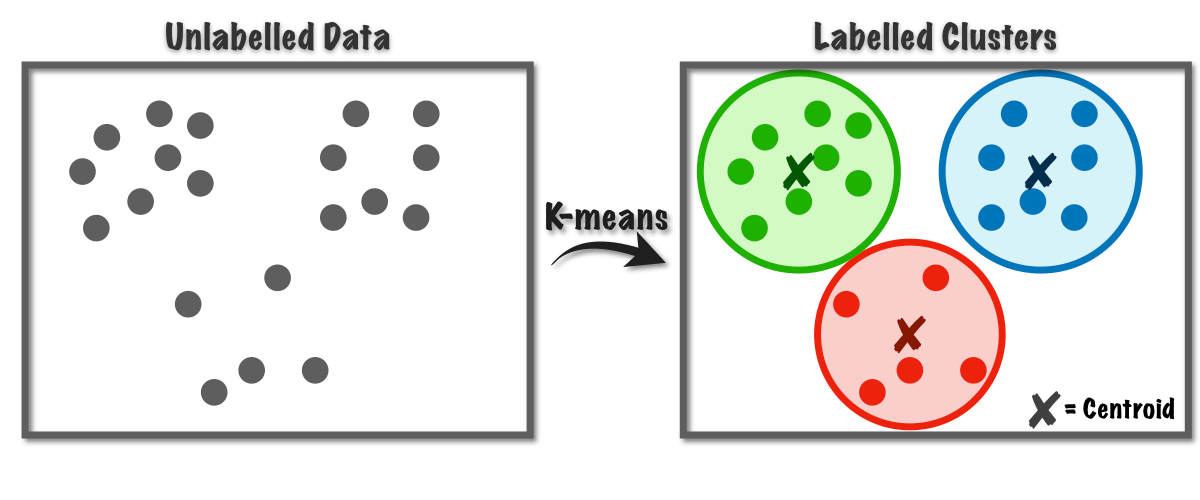
A classifier in machine learning is a model or algorithm designed to categorize data into predefined groups or labels. It takes input data, analyzes its features, and assigns it...
So far: how a culture chooses to write a number. Now: how a machine chooses to store one — and why, in a modern AI system, that choice is no longer a historical curiosity.
It is an engineering decision with real, measurable consequences.
Integer formats store whole numbers exactly. int8: one byte, 256 distinct values — typically -128 to 127.
Floating-point formats trade some of that exactness for enormous range: a sign bit, an exponent, and a mantissa (the significant digits) — the same idea as scientific notation, just in binary.
More bits generally buys you more precision, more range, or both. Fewer bits buys you speed and memory — at a cost.
Both fp16 and bf16 use 16 bits total — half the size of ordinary fp32 — but split those bits differently.
fp16 (IEEE half precision): 1 sign + 5 exponent + 10 mantissa bits. More precision, a narrower range — values that are too large or too small simply overflow to infinity or zero.
bf16 ("brain float", from Google): 1 sign + 8 exponent + 7 mantissa bits. The same exponent range as full 32-bit floats, less precision — far more forgiving during the unstable arithmetic of training a neural network.
Same bit budget. Different trade-off between "how exact" and "how big."
Models are usually trained in fp16, bf16, or fp32 — the precision that stability during training needs.
Once trained, they are often quantized down to int8 for inference (actually running the model): roughly a quarter of the memory of fp32, and hardware built for int8 can push through far more operations per second than the same silicon running floating point.
The accuracy cost is usually small. The speed and energy savings, at the scale a real deployment runs at, are not.
Take a real, current piece of edge-AI hardware: NVIDIA's Jetson AGX Orin (64GB module).
NVIDIA's own published figure: up to 275 TOPS (trillion operations per second) running INT8, with structured sparsity.
Switch the same chip to FP16 / BF16 and achievable throughput drops — roughly by half, since each floating-point operation occupies more of the tensor core's datapath than an 8-bit integer one.
Same transistors. Same chip. The number format you choose to compute in changes your real-world throughput by a factor of two or more.
Pythagoras claimed number was the hidden structure of reality.
Three thousand years later, the question "what exactly is this number, and how many bits does it cost to represent it" is no longer philosophy — it decides how fast your model runs, how much it costs to train, and how much energy it burns doing so.
The history of numerals is, in a very literal sense, the history of computation.
One binary digit is a bit. Group eight of them and you get a byte — 256 possible values.Hexadecimal (base 16) exists purely as a convenience: one hex digit covers exactly ...
in #edu-intelligence room, put an emoticon of Your choice under intelligence X of Your choice
take note of who else is in Your group
read the chapter in Gardner's Frames of Mind
read additional literature
every group should present X in any way You find appropriate (be creative!)
topics which should be adressed in the presentation: Gardner's 8 criteria respective to X; examples of persons who exemplified high (or low) degree of X; relations of X to other inteligences
two most important questions: How would You evaluate X of human subjects ? How would You evaluate X of a machine ?
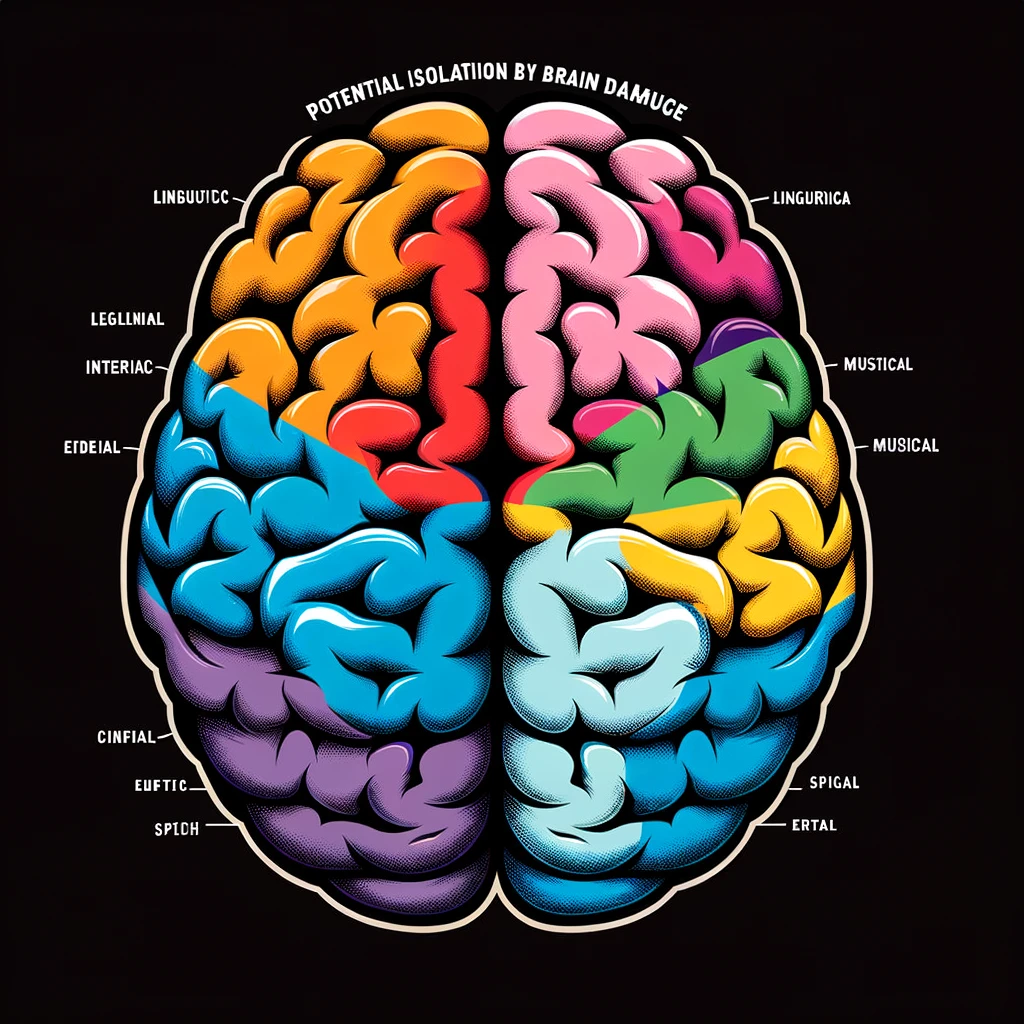
Potential Isolation by Brain Damage
Existence of Savants, Prodigies, and Other Exceptional Individuals
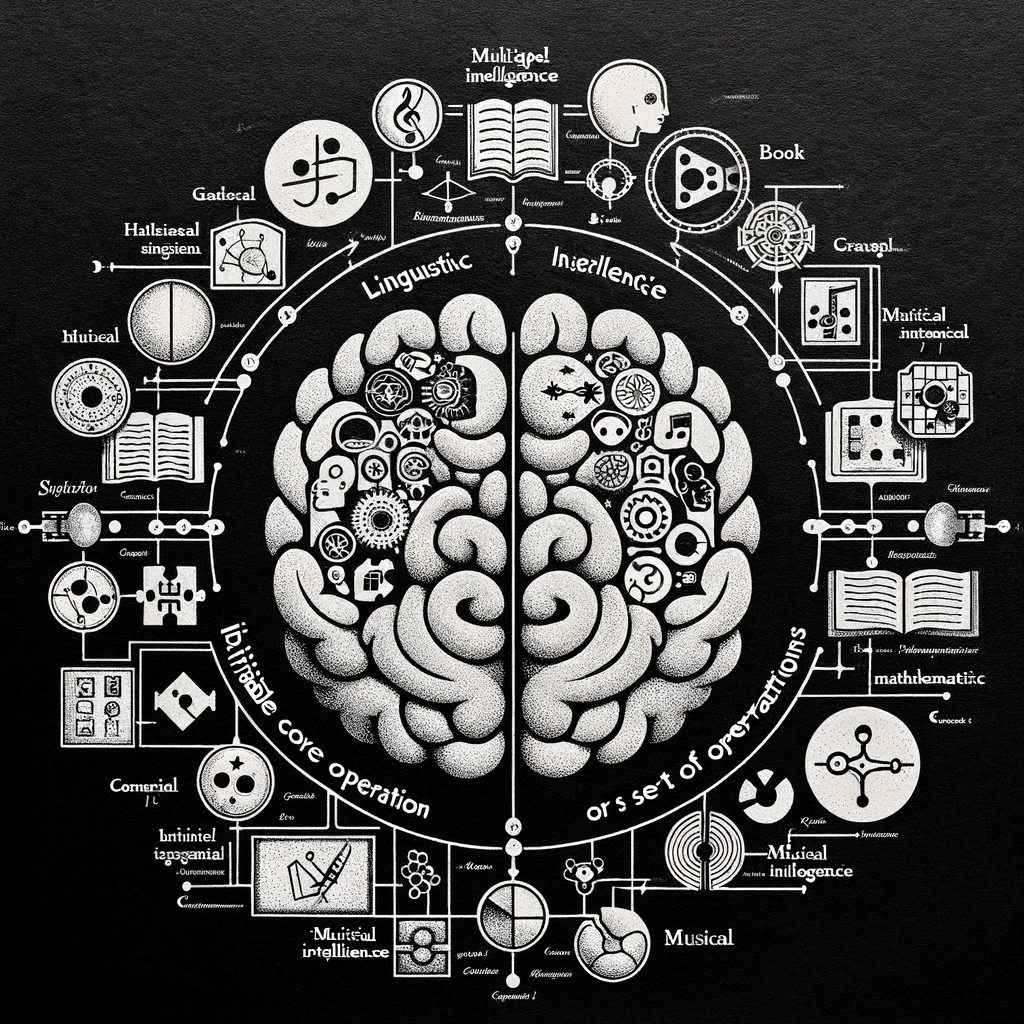
An Identifiable Core Operation or Set of Operations
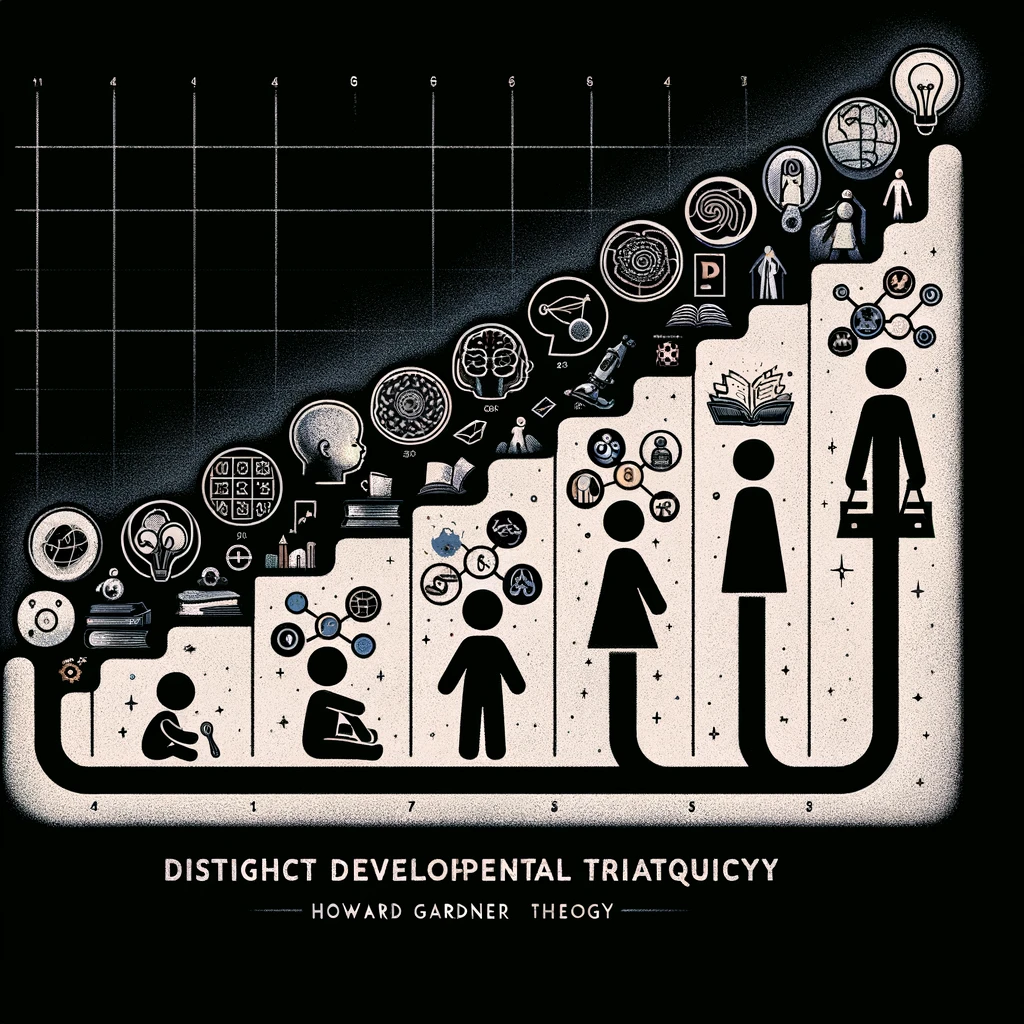
A Distinct Developmental Trajectory
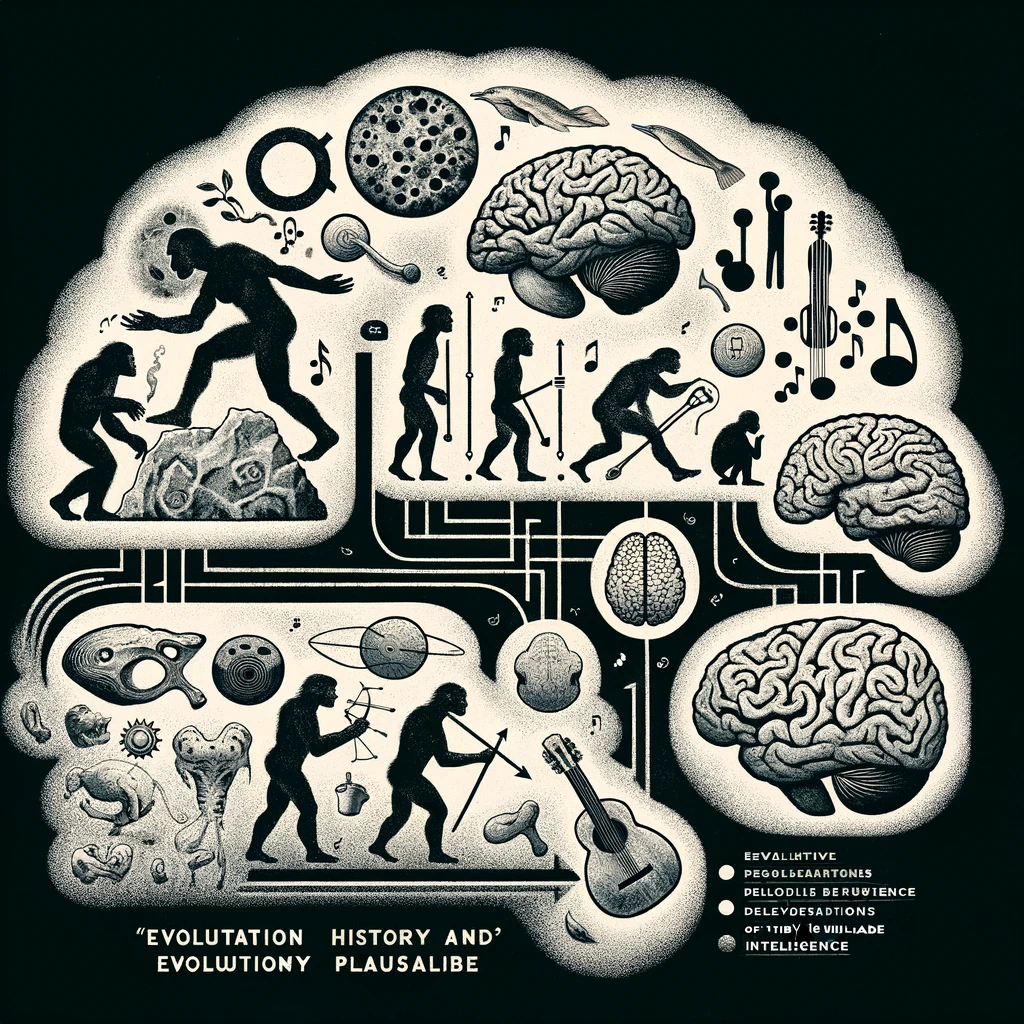
An Evolutionary History and Evolutionary Plausibility
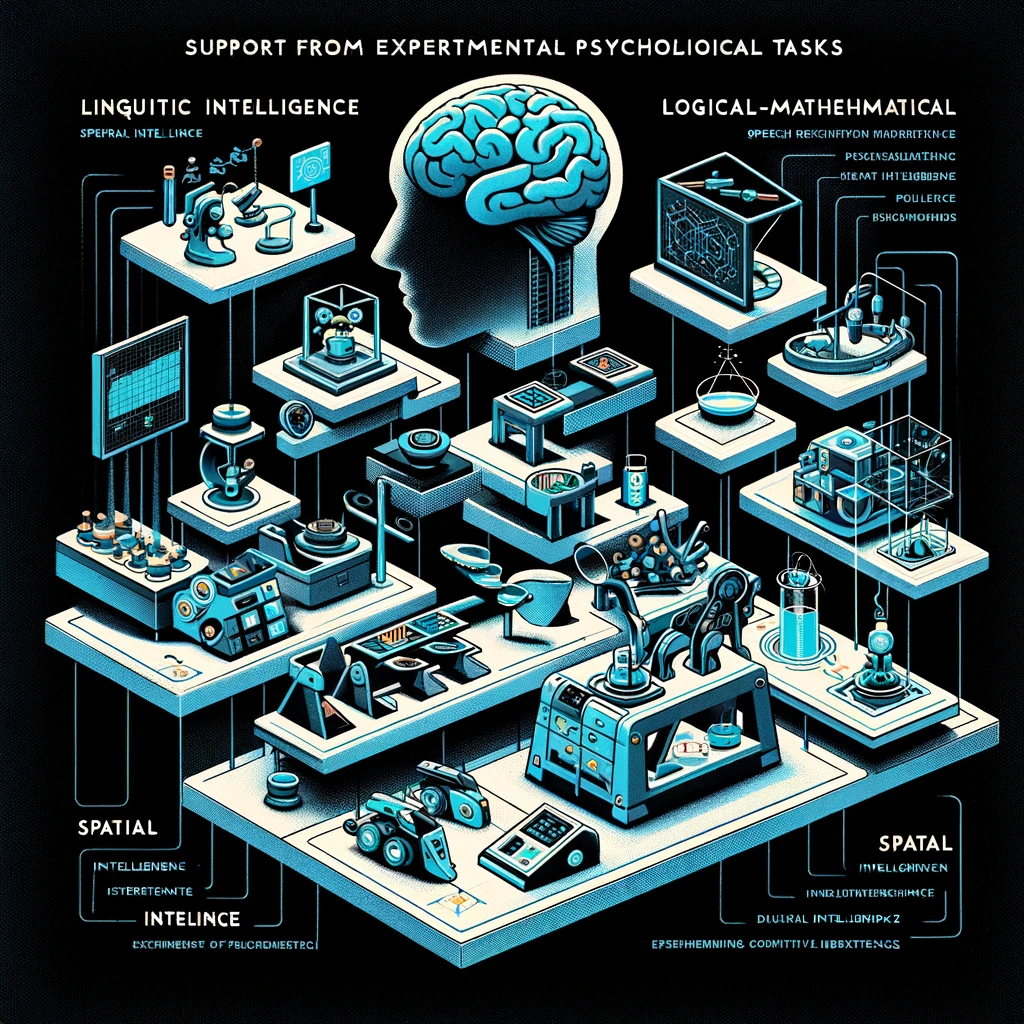
Support from Experimental Psychological Tasks
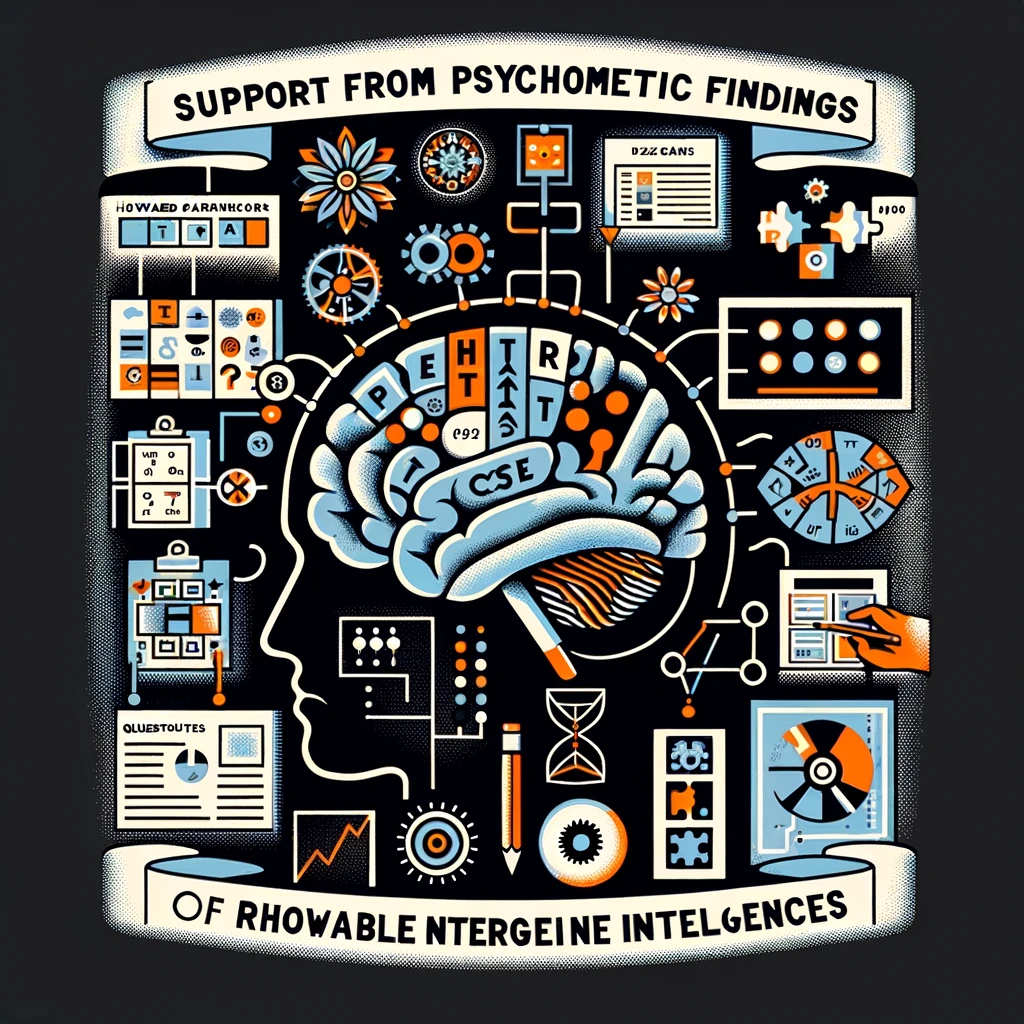
Support from Psychometric Findings
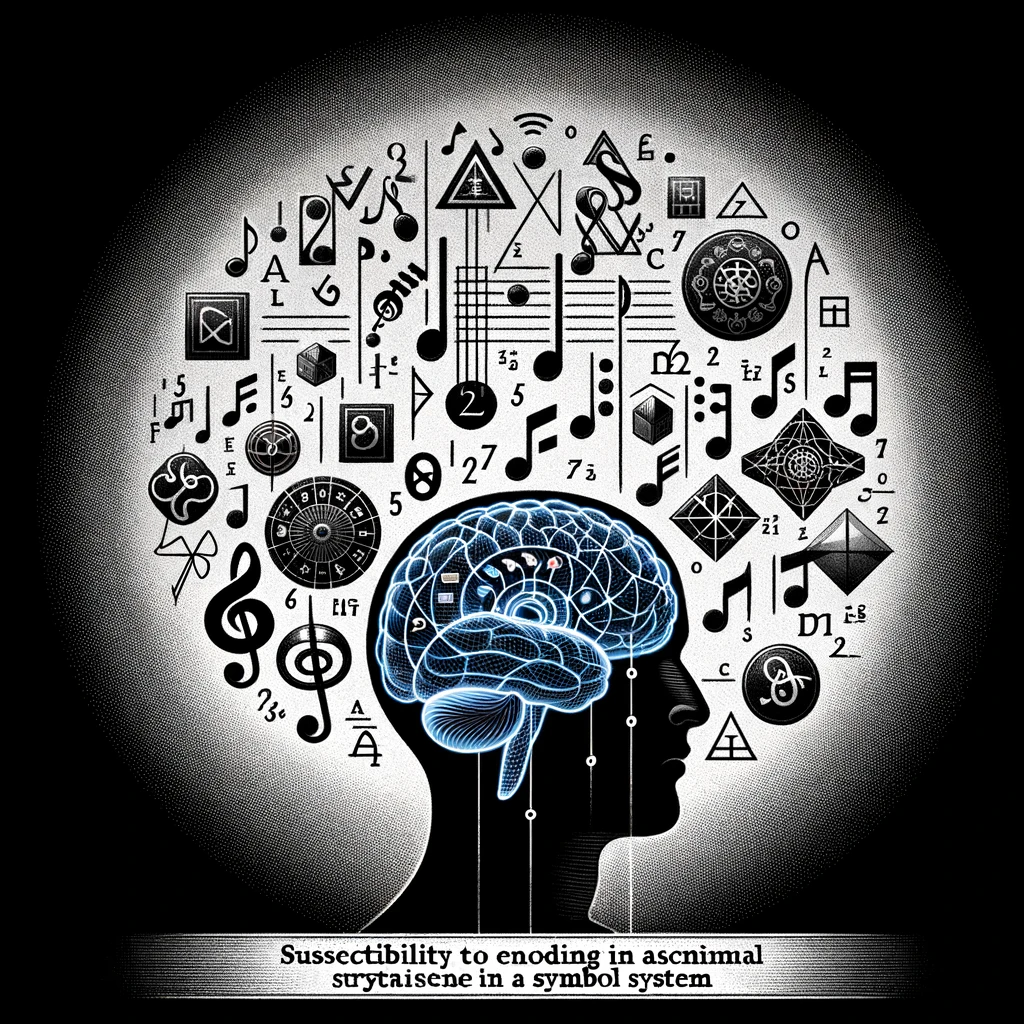
Susceptibility to Encoding in a Symbol System
Lawyers and programmers cannot afford to guess:Contracts write “and/or” (inclusive) and “either … or …, but not both” (exclusive), because ...
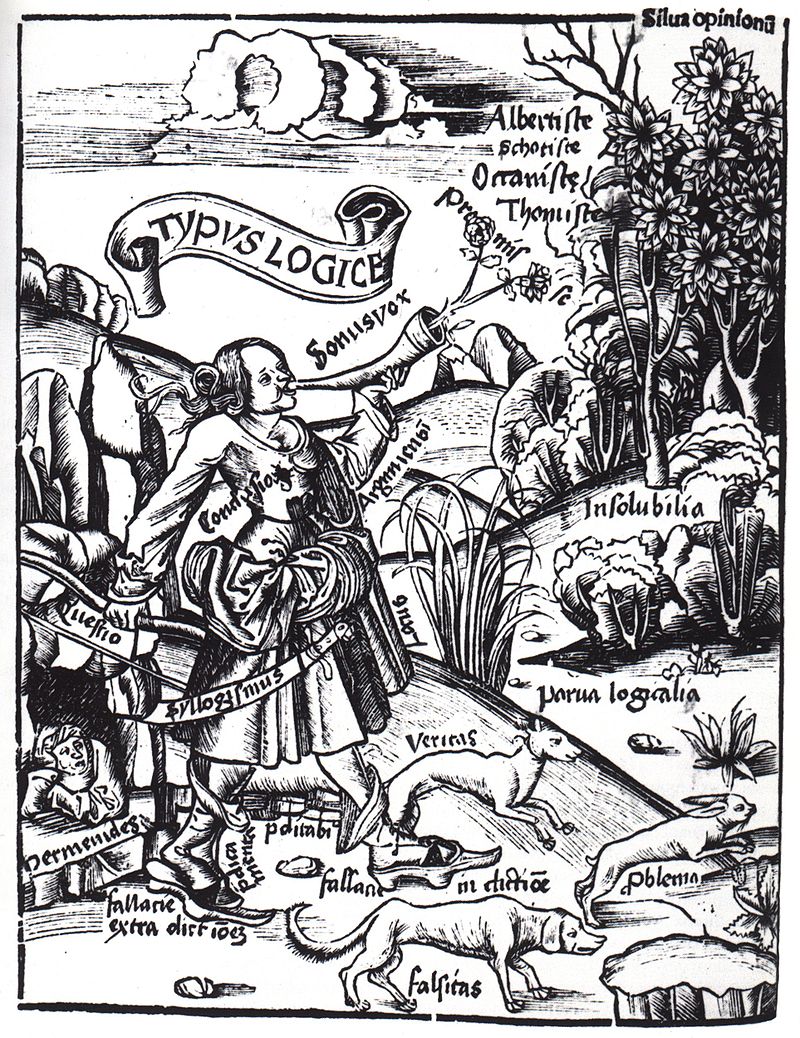
The Merriam-Webster Dictionary defines logic as follows: a science that deals with the principles and criteria of inference and demonstration: the science of the formal principles of reasoning
mathematics is the science of abstract structures and patterns, constructed out of different statements, which need to be proven true
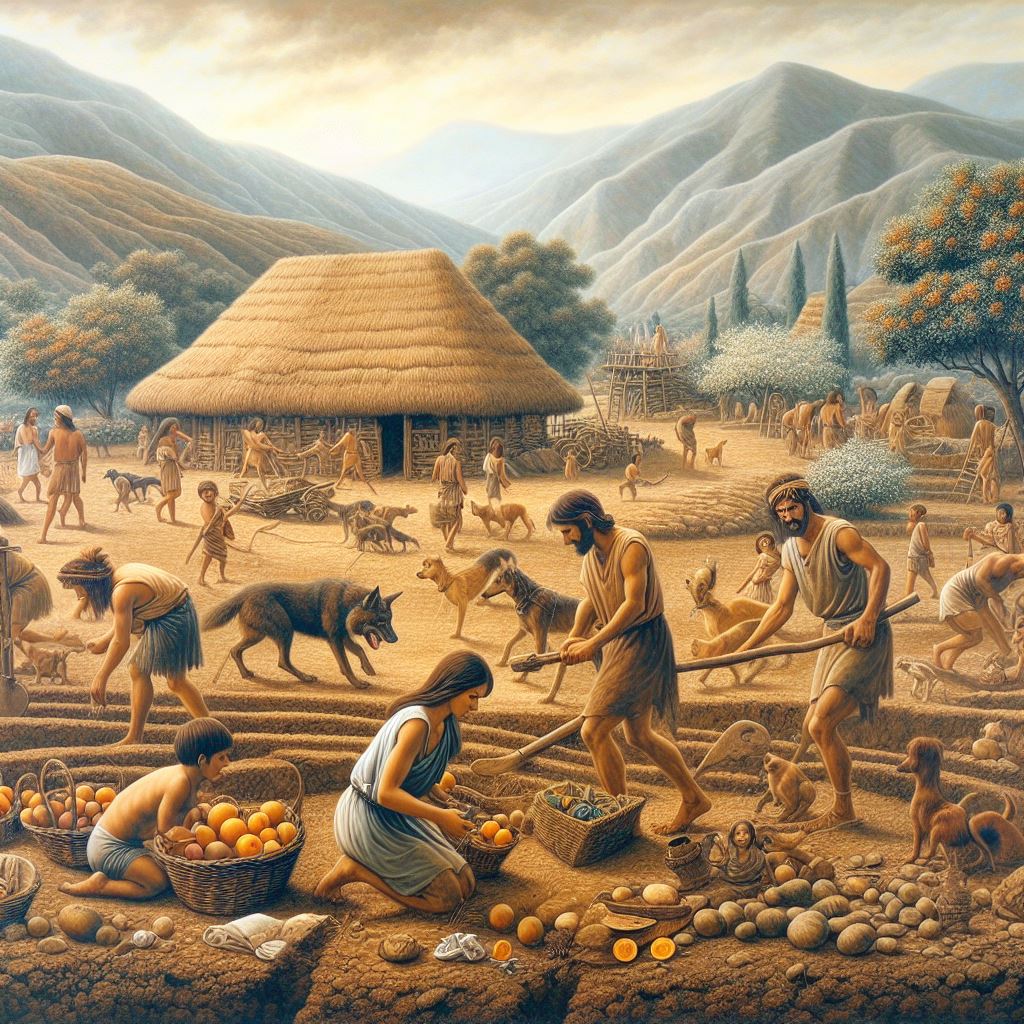
Agricultural Societies
Ancient Egypt
Mesopotamia/Babylon
Ancient China
Ancient India
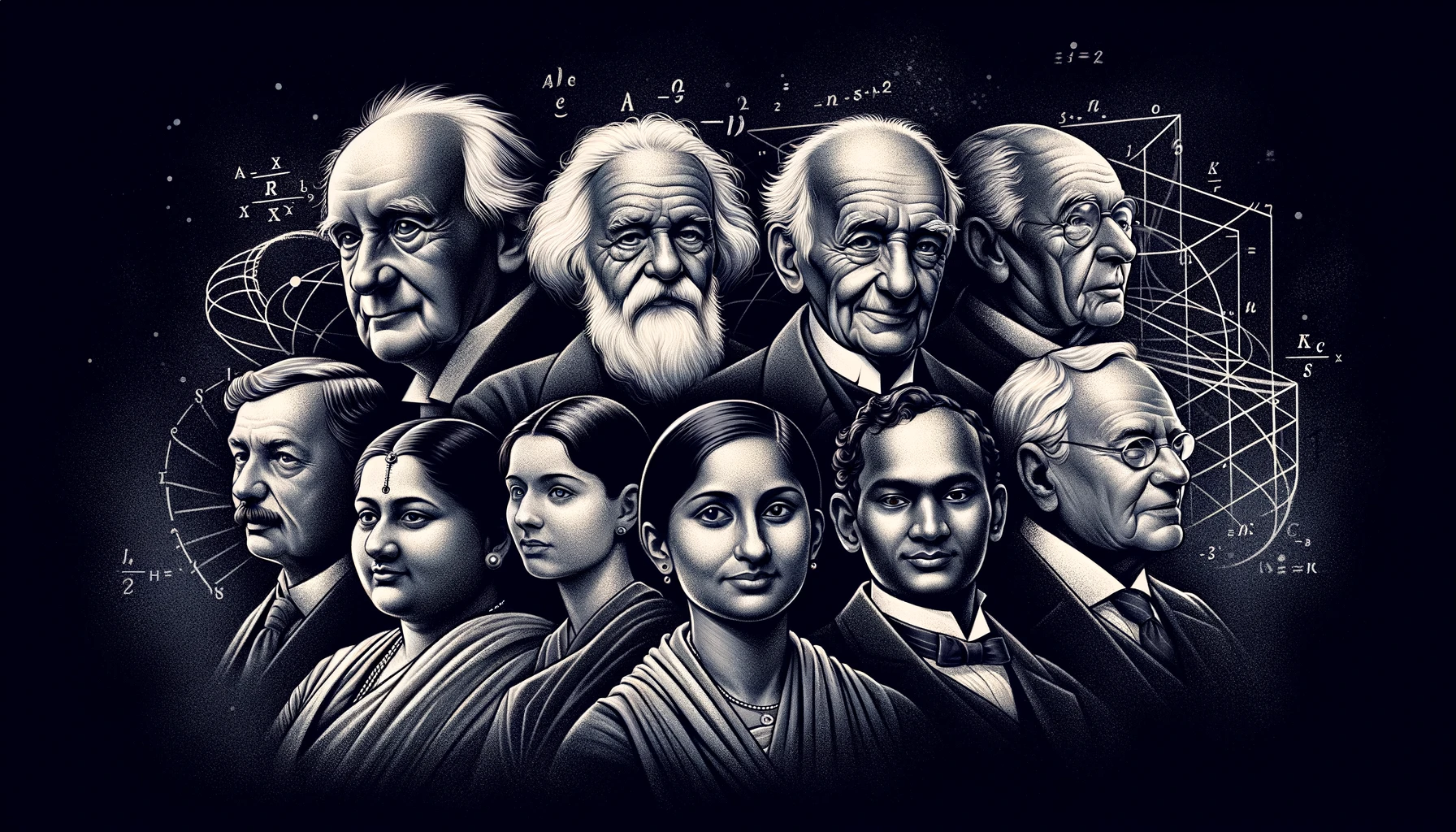
... remarkable counting abilities, such as Shakuntala Devi: she was able to multiply two 13 digit numbers in 28 seconds in 1980
... intuitive understanding, such as Srinivasa Ramanujan: he wrote down nearly 3.900 new results (theorems, identities and equations)
... insight into abstract structures, such as Alexander Grothendiek: he worked on a rebuilding of algebraic geometry
calendar
religion: Nile river god Hapi
measuring device
landmeasure
measure unit
legth and area calculation
decimal system
binary counting system
fractions
Eye of Horus: geometric theory
accurate value of pi
Pyramid - the golden ratio, right angle
the decimal place-value system
0 and infinity
pi
Brahmagupta
negative numbers
unknowns in equations
trigonometry
Al-Khwarizmi
algebra
Pythagoras
right-angled triangles
the harmonic serie
Euclid
300BC "The Elements": axioms
Archimede
Pythagoras Musica Universalis
Rhythms and intuitive counting
Musical notation and polyphony
12-Tone music and Arnold Schönberg
Stochastic music and Iannis Xenakis
Algorithms and generative music
Crosslink between phonology, music and mathematical description
Semantics and symbol manipulation
logics and reasoning
Mediator of mathematics
Vectorization of language
Vectorization, stochastic and noise
IQ test
Turing test
Q+ model?
Non-computational problems
Hebb: cells that fire together wire together. Dopamine decides which firing counts.Dopamine is not the pleasure molecule.It is the wanting molecule: go, get it, again. Liking is...
In which the reader is asked, quite simply, What is an Algorithm? — and finds the answer rather older, and rather stranger, than expected.
Being an account of cogs and looms and engines of brass; of Signor Pascal's calculating box and Mr. Babbage's unbuilt Engines; of a certain Lady Lovelace who saw further than most; and of sundry other contrivances got up by ingenious persons long before any machine was called a computer.
Wherein two short films are watched, in the company of a partner to be consulted not once but twice; wherein old Euclid's method is recalled, some two thousand years and more since first he wrote it down; and wherein, at the last, the curious Persian origin of a word now spoken a thousand times a day — one al-Khwarizmi's own — is at length discovered.
Hebb: cells that fire together wire together. Dopamine decides which firing counts.Dopamine is not the pleasure molecule.It is the wanting molecule: go, get it, again. Liking is...
stupid behaviour
clever behaviour have fun !
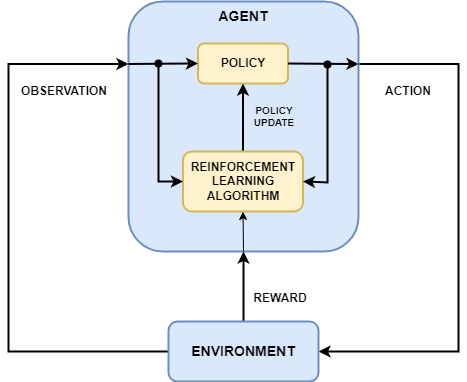
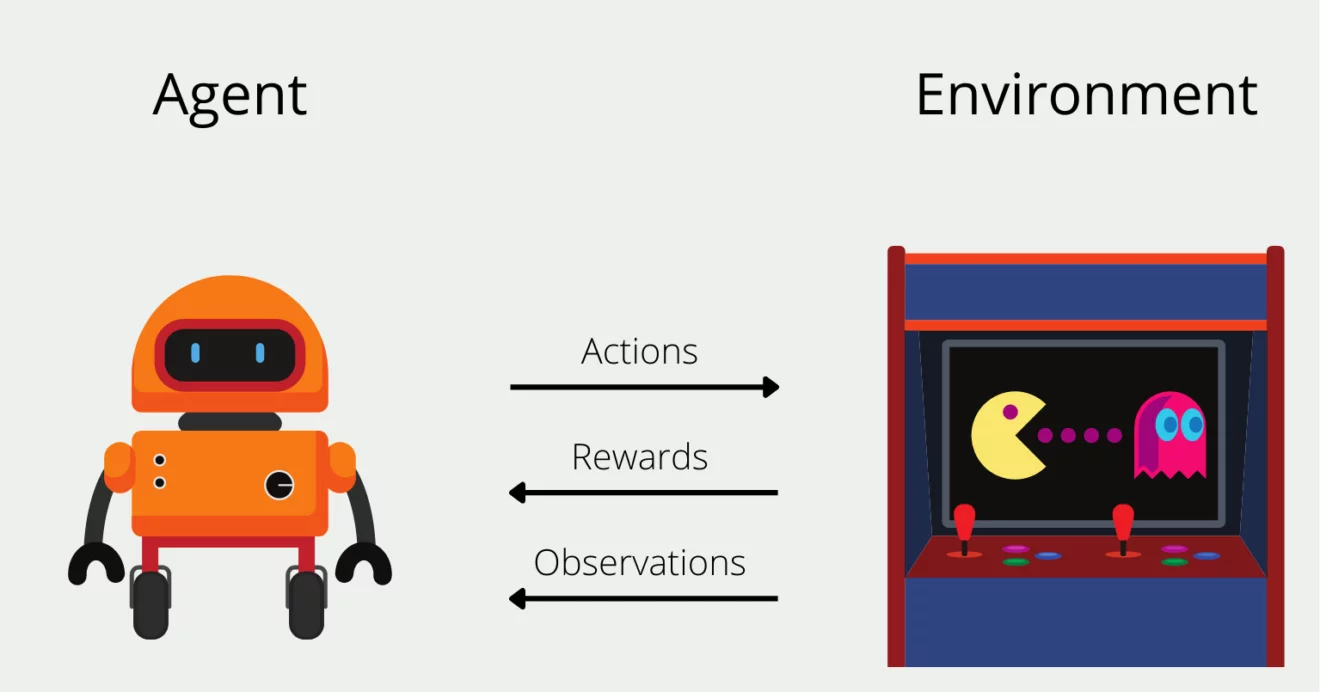
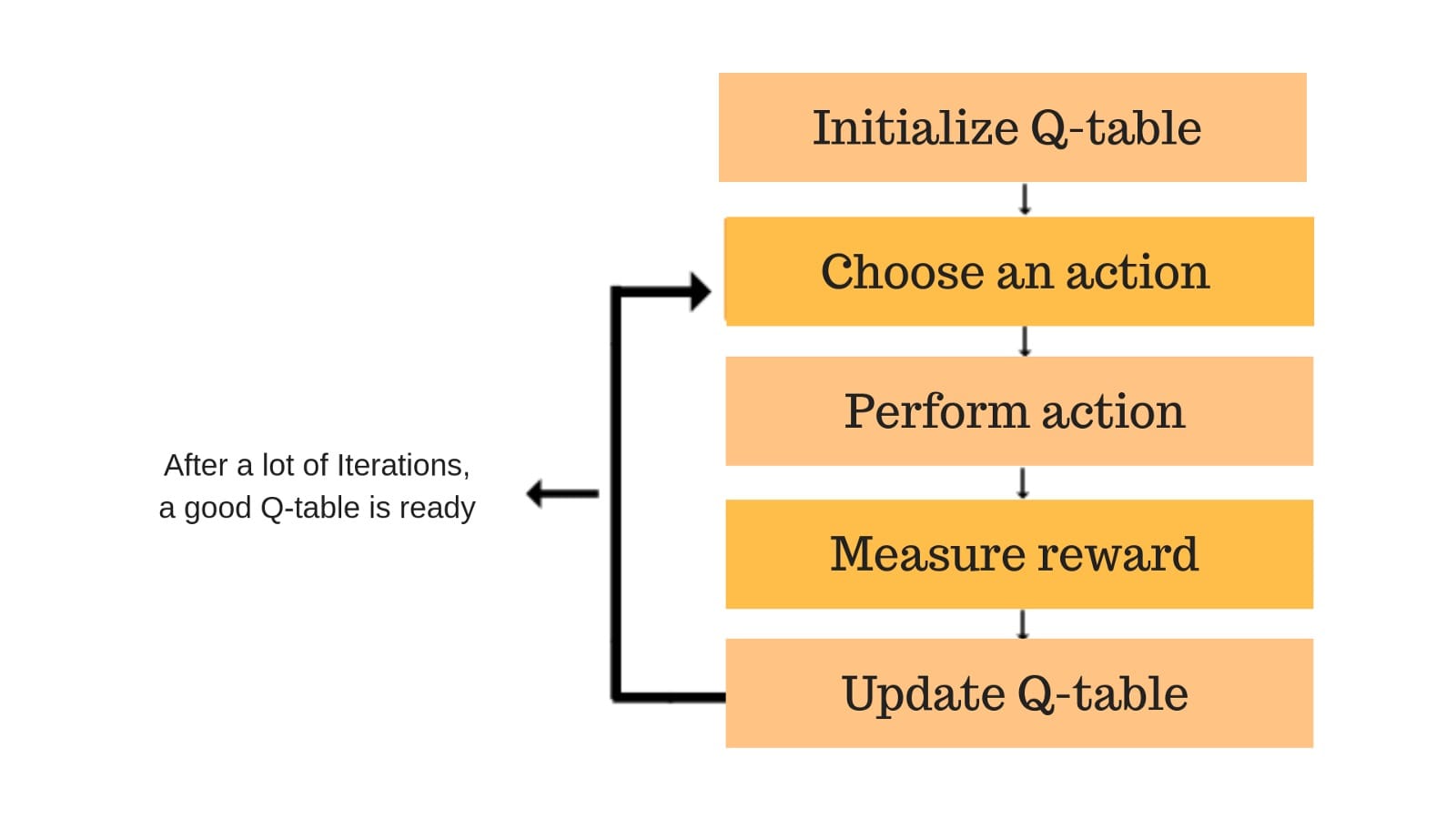
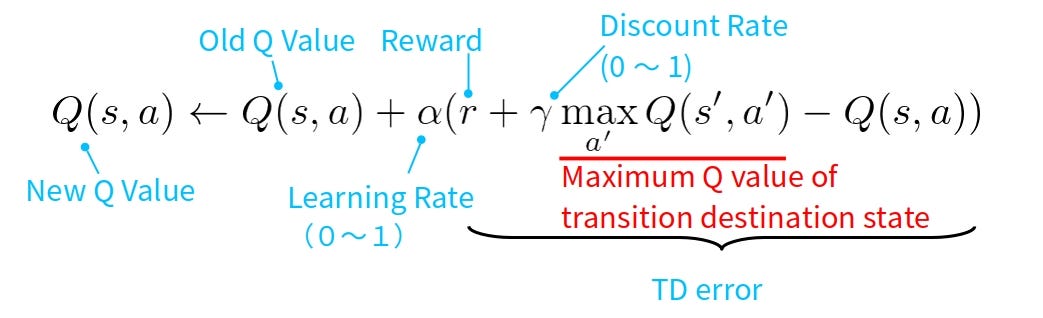
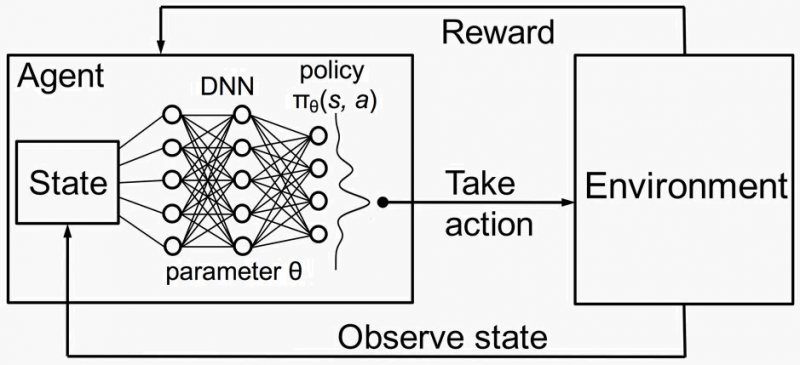
Q-learning is a model-free reinforcement learning algorithm that enables an agent to learn an optimal policy for decision-making. It works by estimating the Q-values (action-value function), which represent the expected cumulative reward for taking an action in a given state and following the best future actions. The agent updates Q-values iteratively using the formula:

Question of the day: What is an algorithm?
You already use the word casually — "the algorithm" recommends your videos, "the algorithm" decides your feed. But what, precisely, is one?
By the end of today's session you'll have a real definition — and you'll know where the word itself came from.
Turn to the person next to you. Two minutes, no googling.
Together, try to answer: what is an algorithm? Give one example each, if you can.
Don't worry about being "right" — we'll come back to this twice more today, and compare notes.
Hebb: cells that fire together wire together. Dopamine decides which firing counts.Dopamine is not the pleasure molecule.It is the wanting molecule: go, get it, again. Liking is...
Before the word, there were the machines. Crash Course Computer Science #1: Early Computing — from the abacus to Herman Hollerith's punch cards.
What surprised you?
Notice how many of these — the abacus, Pascal's calculator, the Jacquard loom, Babbage's engines — are not computers in our sense at all. They're physical machines for carrying out a fixed, repeatable procedure.
That procedure, independent of whatever metal or wood or silicon carries it out, is the thing we're actually interested in today.
Strip away the brass gears, the steam, the punch cards — what's left in each of those machines is the same abstract thing: a precise, repeatable sequence of steps that turns some input into some output.
That sequence of steps is an algorithm. The machine is just one possible body for it to live in.
An algorithm is a finite, well-defined sequence of steps that transforms a given input into a desired output.
Finite — it has to actually end, eventually.
Well-defined — each step is unambiguous; anyone, or anything, following it correctly gets the same result.
Input / output — it does something to something.
1928, David Hilbert: is there a mechanical procedure that decides, for any mathematical statement, whether it is provable?Leibniz had dreamed of it: let us calculate.1931, Kurt ...
You run algorithms all the time without a computer in sight.
A recipe: fixed steps, specific ingredients (input), a finished dish (output).
Long division, tying your shoelaces, the instructions for assembling furniture — all algorithms, in the strict sense.
Computers didn't invent algorithms. They just got extremely good at running them fast.
Euclid described an algorithm for finding the greatest common divisor of two numbers around 300 BCE — still taught today, still called Euclid's algorithm.
Long division as you learned it in school is centuries old. Knitting patterns are algorithms. So is a court protocol, or a recipe passed down for generations.
The concept is ancient. Only the name is comparatively recent — and it has a surprisingly specific origin.
Back to your partner. Compare: how close was your first guess to the definition we just built together?
This time, try to name an algorithm from your own daily life that has nothing to do with computers.
"Algorithm" doesn't come from Greek, like most technical vocabulary in mathematics. It comes from a name.
Whose?
A short answer, in under three minutes — BBC Ideas: Why algorithms are called algorithms.
Muhammad ibn Musa al-Khwarizmi, a 9th-century Persian scholar working in Baghdad's House of Wisdom, wrote a treatise on systematic methods for solving equations.
His name, Latinized centuries later as "algorithmi," became attached to the step-by-step methods he described — and eventually to the general concept itself.
(His other book's title gave us a second word: al-jabr — "algebra.")
persian scholar from golden-age of islamic science his name Latinized as "Algorithmi" (Port. "guarismo" and Spanish "algarismo" mean digit) since 820 A.D. the as...
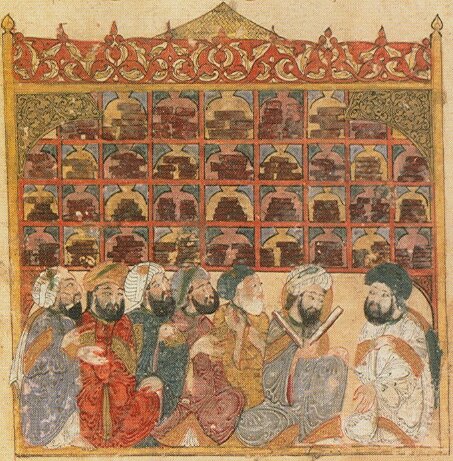
8th century - 12th century :: golden-age of islamic science integration of Persian and Arabic into one cultural realm translation of Greek and Roman works into a...
If some one says: "You divide ten into two parts: multiply the one by itself; it will be equal to the other taken eighty-one times." Computation: You say, ten less a thing, mu...
Rewind two centuries. Long before Babbage, long before steam, the same ancient appetite for mechanizing the mind was already stirring — in the Baroque.
In 1642, at nineteen, Blaise Pascal built the Pascaline to help his father with tax calculations — a gear-driven adding machine, among the first of its kind ever built and sold.
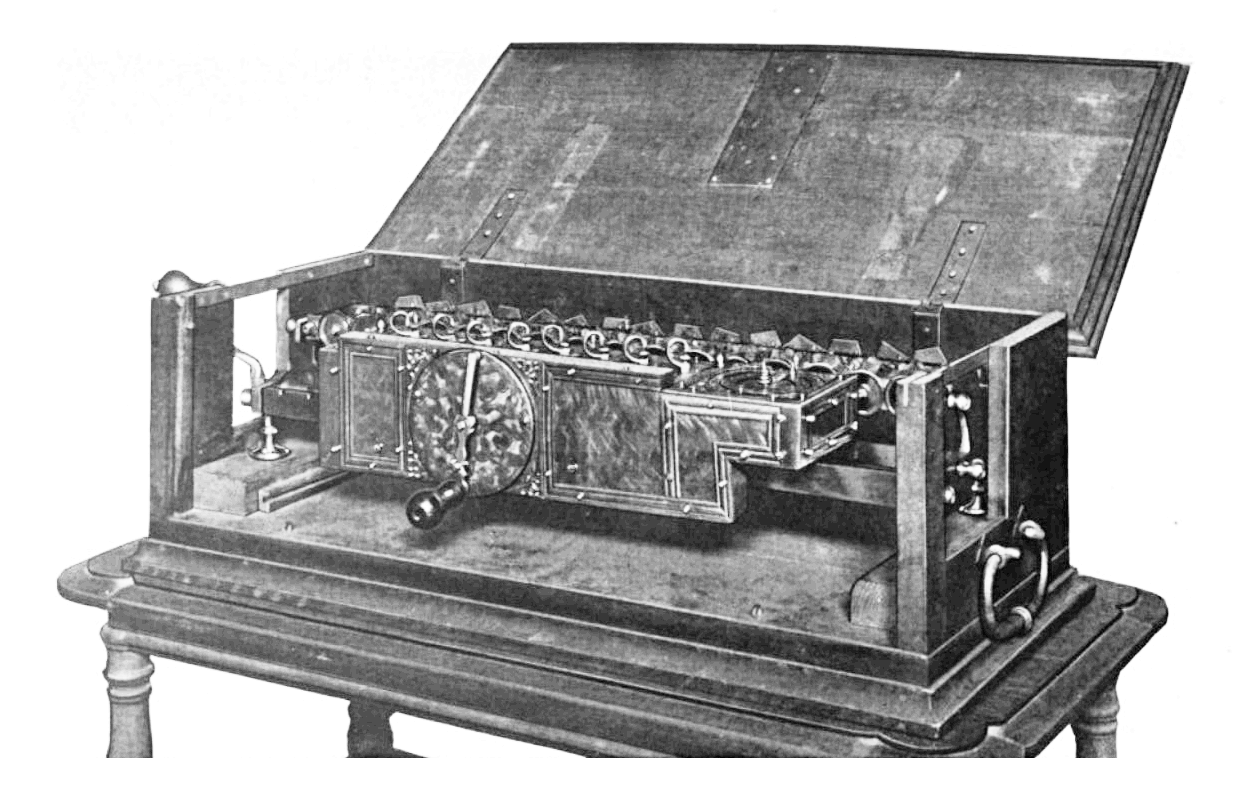
A generation later, Gottfried Wilhelm Leibniz — one of the last true polymaths, equally at home in philosophy, law, and mathematics — went further still, designing the Stepped Reckoner: a machine that could multiply and divide, not merely add and subtract.
Leibniz wanted more than a calculator. He dreamed of a calculus ratiocinator — a universal symbolic method by which any dispute, of any kind, could in principle be settled by calculation alone: "Let us calculate."
Cogs and steam would eventually belong to Babbage's century. But the dream — that reasoning itself might be mechanized — is, properly speaking, Baroque.
Baroquepunk is a speculative genre where ornament, excess, and early-modern worldviews collide with systems thinking. Inspired by Stephenson's Baroque Cycle, it treats the Baroq...
polymath in 19years of age started to build first mechanical calculators ("Pascalines") ground-breaking works in mathematics (Pascal's triangle), geometry (Pasca...
one of the last big polymaths advanced disciplines of philosophy (monadology, theodicea, why is there something rather than nothing?), mathematics (probability theory,...
Gottfried Wilhelm Leibniz takes positional notation somewhere further: in 1703, he formally describes arithmetic in base 2 — binary.He was reportedly delighted to find the...
By the early 1800s, the Industrial Revolution had already proven something remarkable: steam and gearwork could replace human muscle at scale.
Joseph-Marie Jacquard's loom (1801) went one step further — it replaced not just labor, but a kind of decision-making. A chain of punched cards, read mechanically, told the loom exactly which threads to raise for every single pass of the shuttle.
Change the cards, change the pattern. The procedure — the algorithm — was now separate from the machine that executed it, encoded on something you could hold in your hands.
Babbage noticed. He planned to use these very same punched cards to feed instructions into his own Analytical Engine.
Somebody willing to make a video of the Jacquard Loom at the TM next week ?
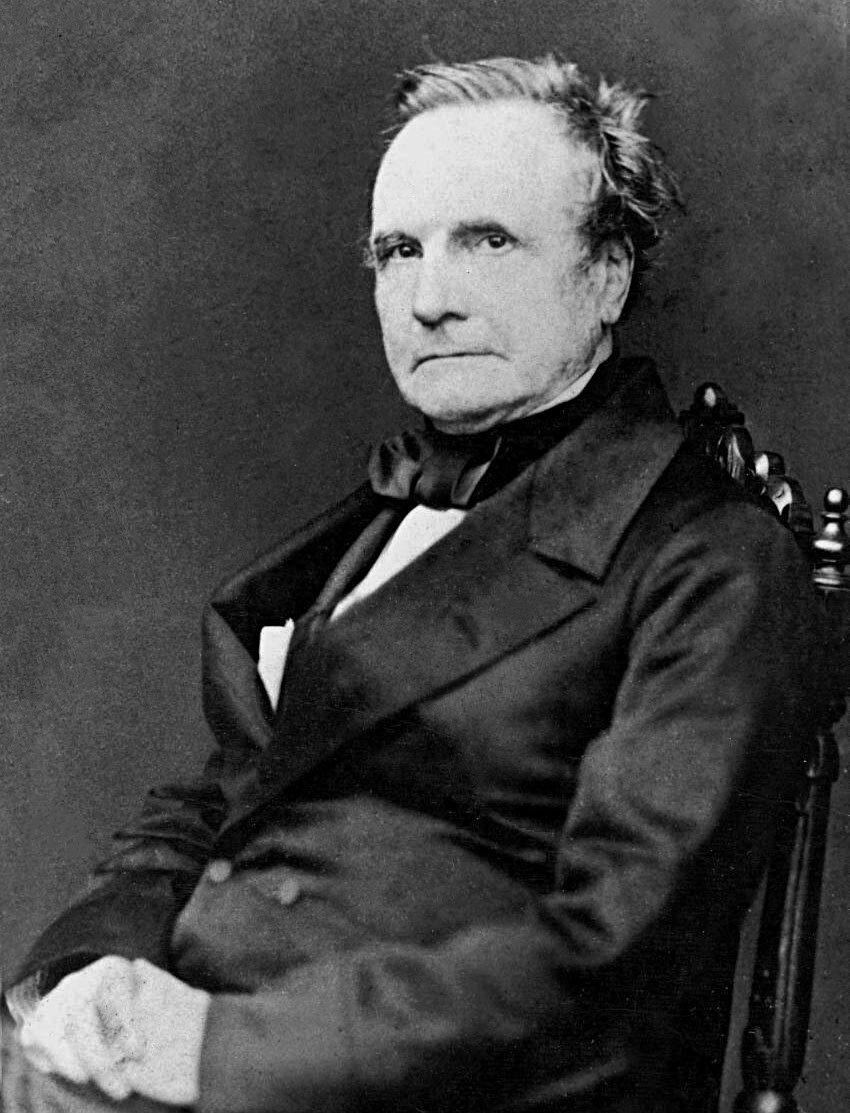
Charles Babbage (1791–1871) — mathematician, philosopher, mechanical engineer, and by most accounts a thoroughly restless Victorian gentleman.
His Difference Engine was a mechanical calculator, designed to compute polynomial values automatically — and to print the results, removing human error from mathematical tables.
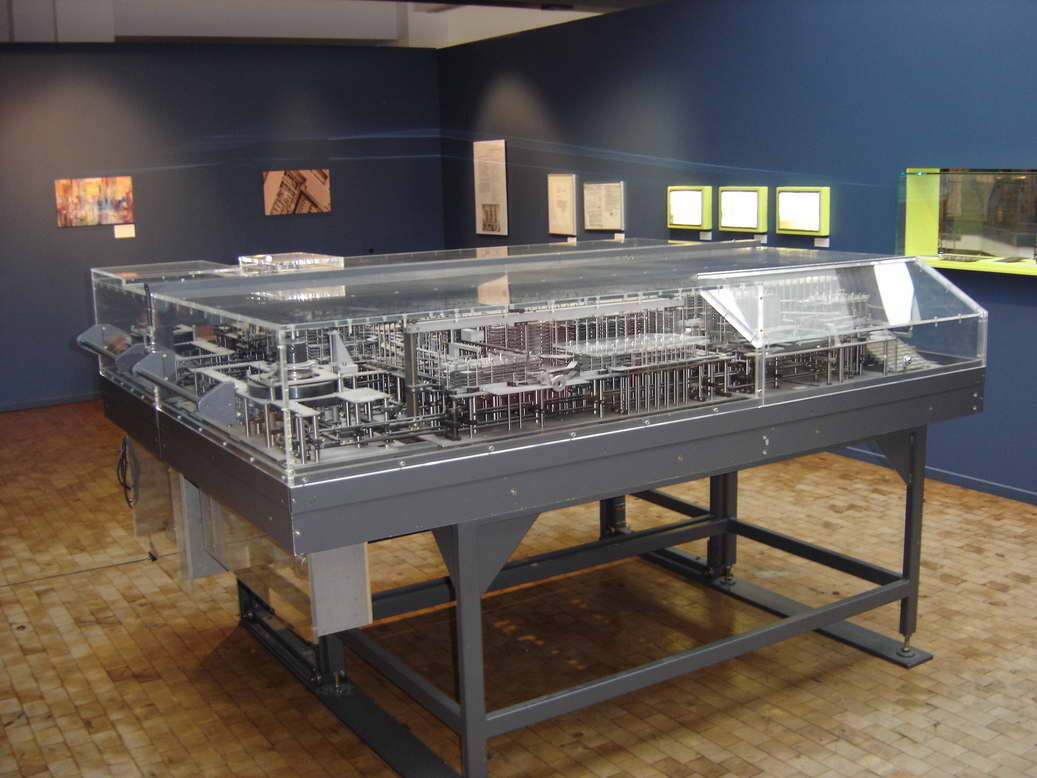
His far more ambitious Analytical Engine was something else entirely: a general-purpose, programmable computer — a century before electronics made one practical. It had a "mill" (processor), a "store" (memory), and was to be fed instructions on Jacquard-style punched cards.
He never finished building it. But he had, in effect, designed a computer.
polymath, KH FRS, Victorian gentleman etc. mathematician, philosopher, inventor and mechanical engineer "father of the computer" author of "difference engine...
Section 6 of the paper lists nine objections, among them theological, mathematical, from consciousness — and Lady Lovelace's.Lovelace (1843): the Analytical Engine “...
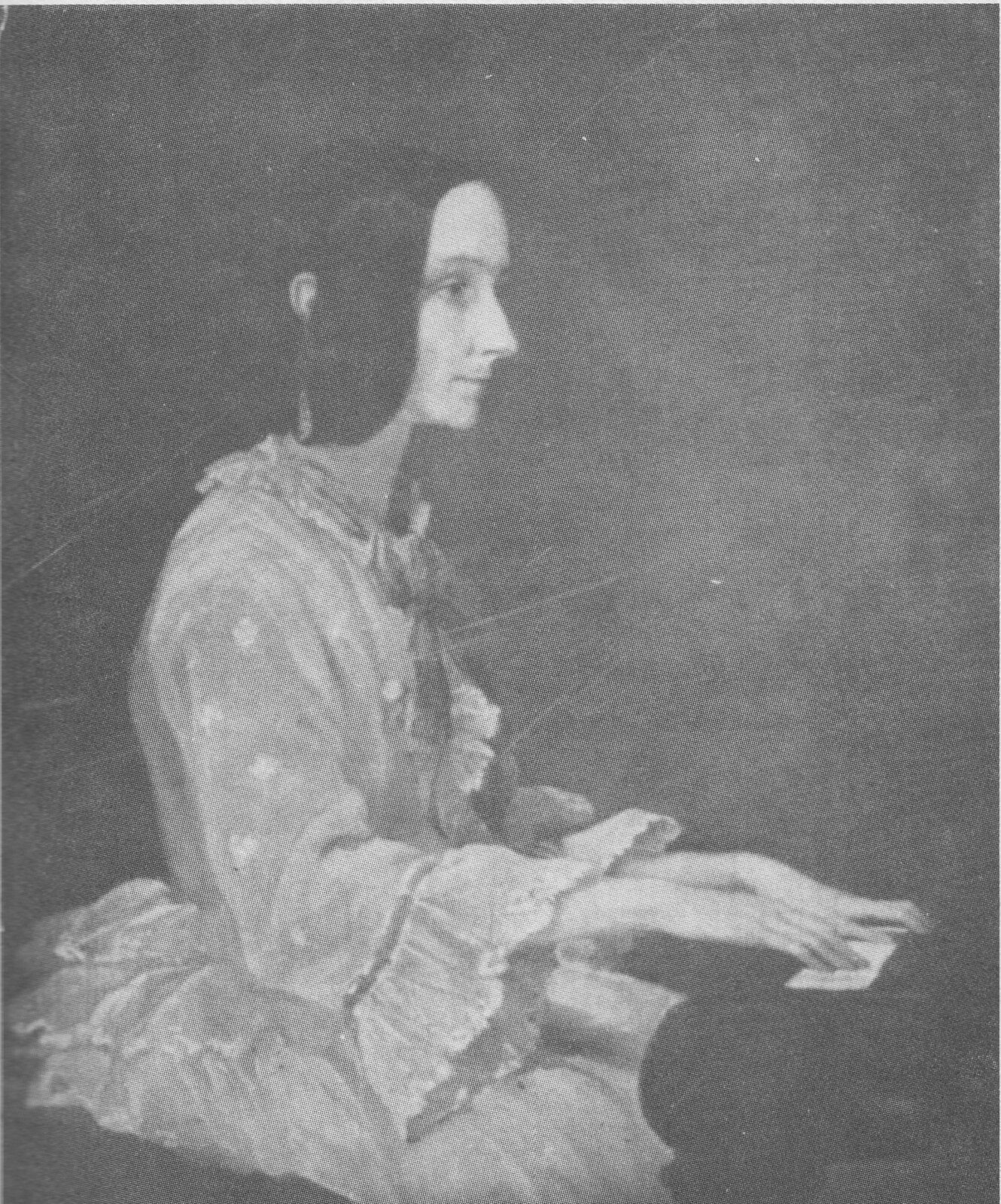
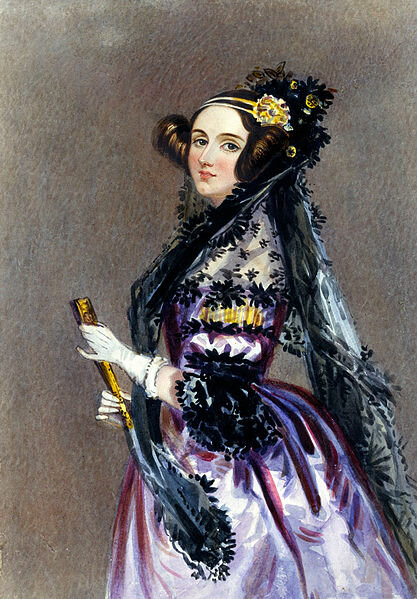
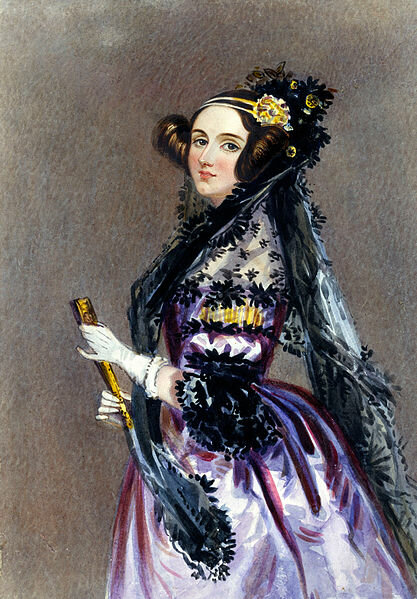
Augusta Ada King, Countess of Lovelace (1815–1852), daughter of Lord Byron, was trained rigorously in mathematics from childhood — and became Babbage's closest intellectual collaborator.
In 1843, translating an Italian paper on the Analytical Engine, she added her own notes — three times longer than the original text. Among them: a step-by-step method for the Engine to compute Bernoulli numbers.
That method is widely considered the first published algorithm written specifically for a machine — making Lovelace, by most accounts, the first computer programmer, over a century before there was a computer to run it on.
She also saw further than Babbage himself: the Engine, she wrote, might one day manipulate not just numbers, but music and symbols of any kind. Others called her the Enchantress of Numbers.
daughter of Lord Byron mother promoted Ada's interest in mathematics and logics, student od Augustus de Morgan associate of Charles Babbage ("Enchantress of Numbers...
Section 6 of the paper lists nine objections, among them theological, mathematical, from consciousness — and Lady Lovelace's.Lovelace (1843): the Analytical Engine “...
One more figure worth knowing, even briefly: George Boole (1815–1864), who in 1854 published The Laws of Thought — reducing logical reasoning itself to a kind of algebra, with only two values: true and false.
Boolean algebra sat unused for decades as a philosophical curiosity. In the 20th century it became the literal switching logic inside every digital circuit ever built.
Babbage's engine, Lovelace's program, Boole's logic — three separate threads in the 1800s, waiting nearly a hundred years for electronics to braid them together. We'll pick that thread up again later in this course.
another Victorian gentleman at 17 years of age "a thought struck him suddenly, which became the foundation of all his future discoveries" author of "Laws of Thou...
Today: a definition, a history, a name.
Next week: Alan and his Enigma — the story of Alan Turing, his machine(s), and his test(s).
We'll meet the Turing machine that finally gave "algorithm" a single, rigorous, universal meaning — and ask what happens when the body running one never gets tired, never gets bored, and never stops.
The story of Alan Matthison Turing, his machine(s) and his test(s)
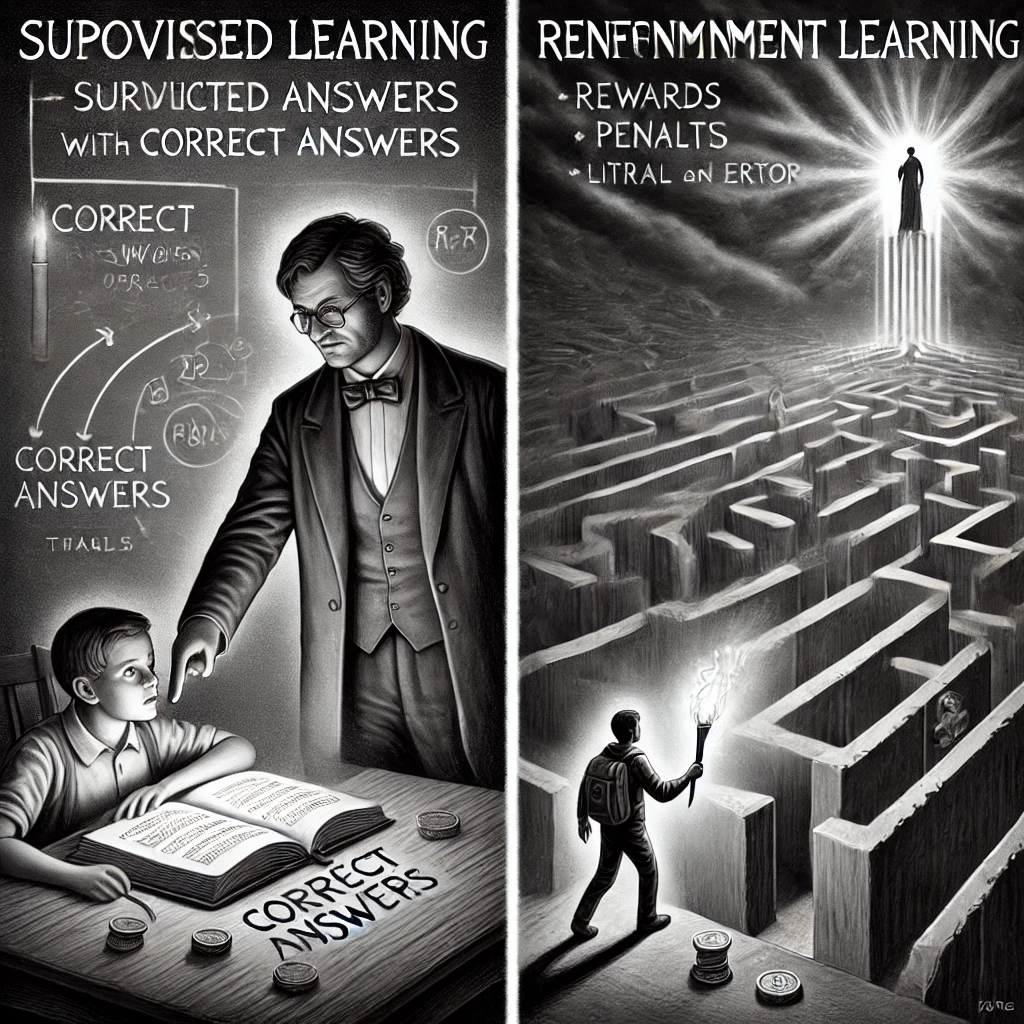
Classical Conditioning: Involves pairing a neutral stimulus with a meaningful one to elicit a similar response (e.g., Pavlov’s dogs salivating at the sound of a bell).
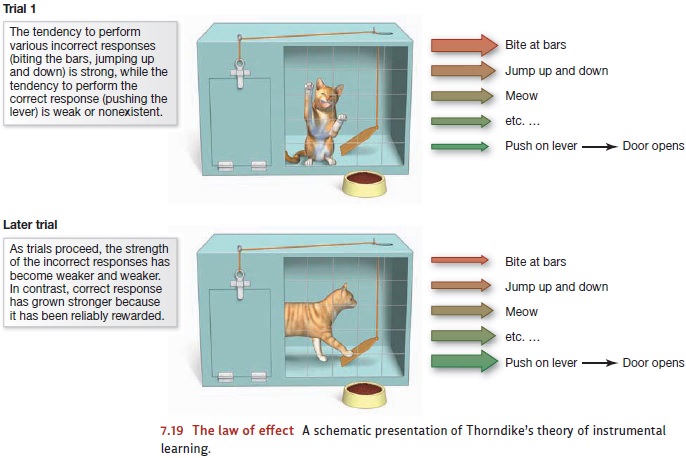
Operant Conditioning: Involves learning through rewards or punishments, where behaviors are strengthened or weakened based on their consequences (e.g., Thorndike’s Law of Effect).
Dopamine reports better than expected, not reward (Schultz).Expected and delivered: silence. Unexpected: burst. Expected and missing: dip.That is how habits — and feeds &m...
Today: a definition, a history, a name.Next week: Alan and his Enigma — the story of Alan Turing, his machine(s), and his test(s).We'll meet the Turing machine that finall...
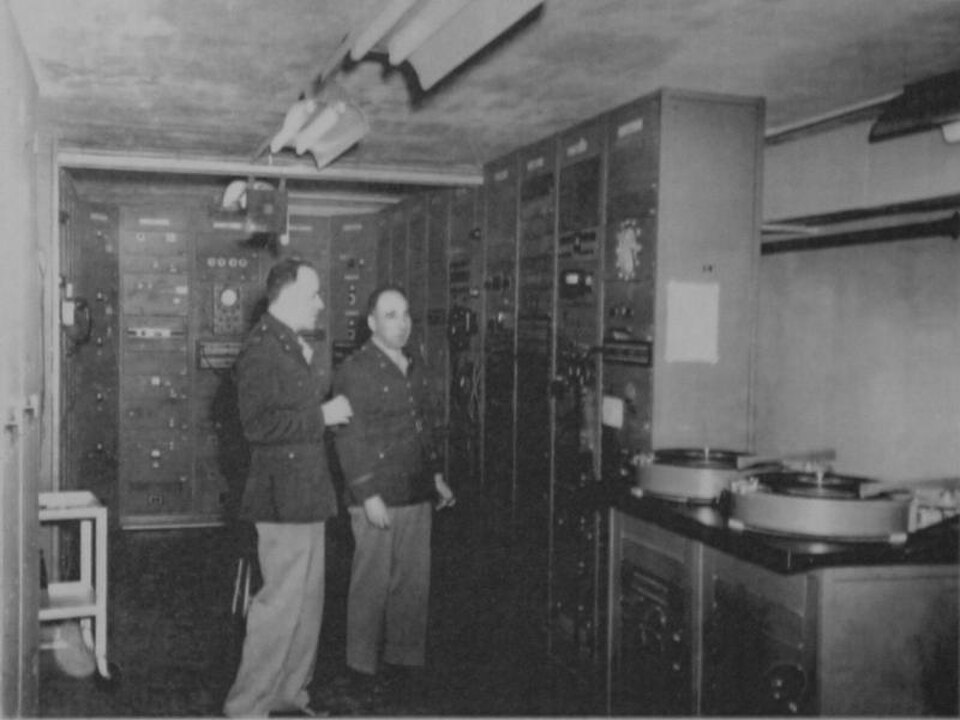
Early 1943: Alan Turing visits Bell Labs to inspect SIGSALY.The two men meet over tea and talk about thinking machines.Both had — from opposite sides — the idea of i...
Bobo doll, 1961: children saw an adult hit it — and hit it too.Model rewarded: more imitation. Model punished: less (1965).Attention → retention → reproduction &...
Attention: The learner must focus on the model’s behavior.
Retention: The behavior must be stored in memory for later retrieval.
Reproduction: The learner must have the ability to replicate the behavior.
Motivation: There must be an incentive to imitate the behavior (e.g., rewards, social acceptance).
Behavior, cognition, and the environment interact in a dynamic way.
Example: A student’s shyness (personal factor) affects classroom participation (behavior), which in turn shapes peer interactions (environment).
Learning happens by watching others and imitating their behavior, even without direct reinforcement.
Example: A child learns aggression by observing an aggressive adult (c.f. "The Bobo Doll Experiment")
Vicarious means experiencing something indirectly, through someone else, rather than firsthand. It comes from the Latin vicarius, meaning "substitute" or "acting in place of another."
Individuals learn by observing others being rewarded or punished for a behavior.
Example: A student is more likely to participate in class if they see a peer receiving praise for doing so.
We start with a 1966 BBC programme, made twelve years after his death.
While you watch, keep one question in mind: what is this “machine” made of?
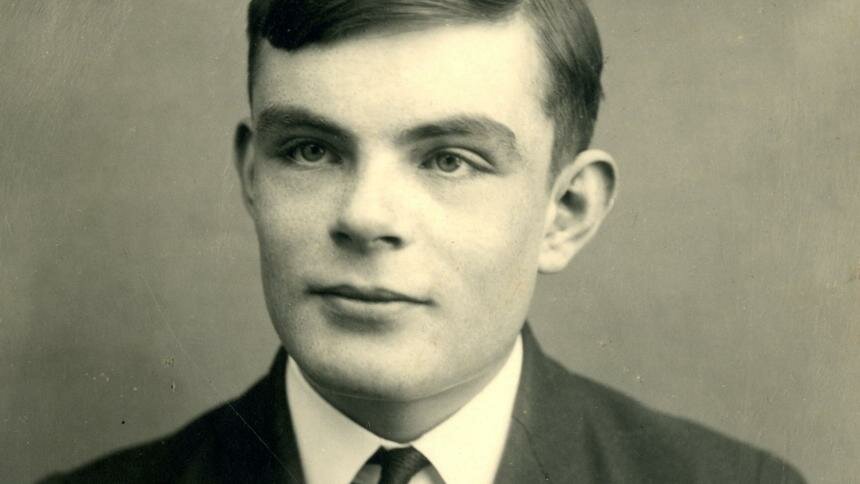
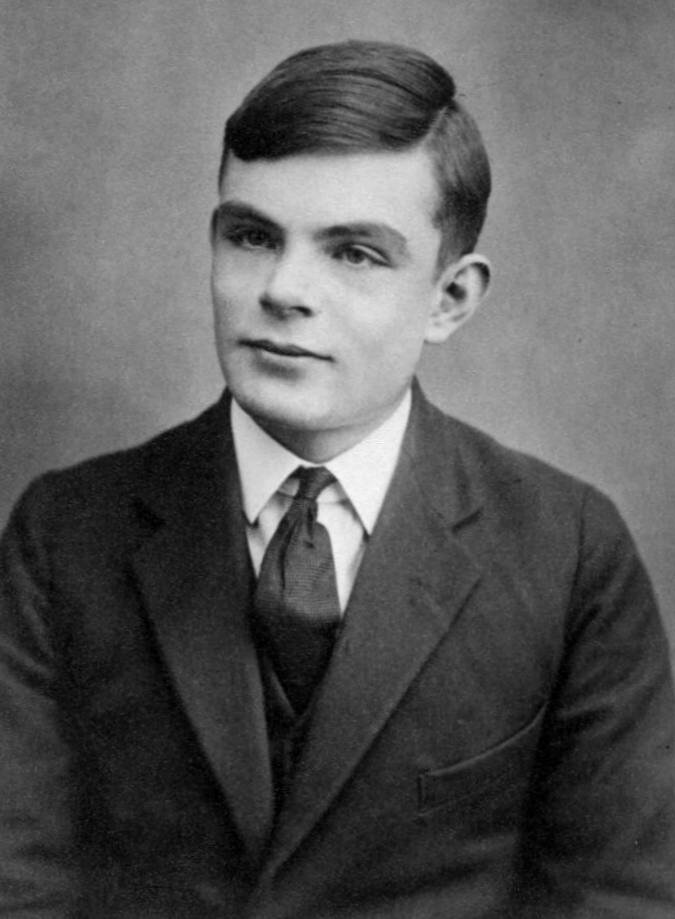
Born in London, 23 June 1912. Mathematician: Cambridge, then Princeton.
1936, aged 23: On Computable Numbers — the paper that defines the computer before any computer exists.
1939–45: Bletchley Park, breaking German naval Enigma.
1945–50: designs an electronic computer; 1950: Computing Machinery and Intelligence.
1952: convicted for homosexual acts, chemically castrated. 7 June 1954: dead of cyanide poisoning, aged 41. Royal pardon: 2013.
The man who asked whether machines can think was not allowed to be what he was.
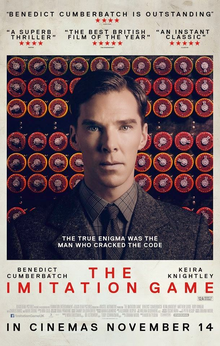
a 2014 movie adaptation of the book Alan Turing: The Enigma (1983) 8 Oscar nominations, one Oscar for Best Adapted Screenplay story about life, work and death o...
A.M.T. OBE FRS (23.6.1912 - 7.6.1954) an English mathematician, computer scientist, logician, cryptanalyst, philosopher and theoretical biologist father of theore...
Turing refuses to define “think”. He calls the question “too meaningless to deserve discussion” and replaces it with a game.
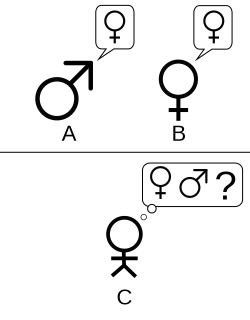
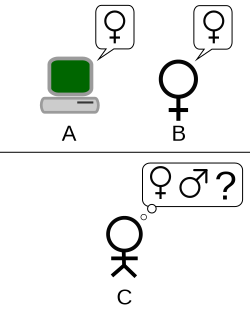
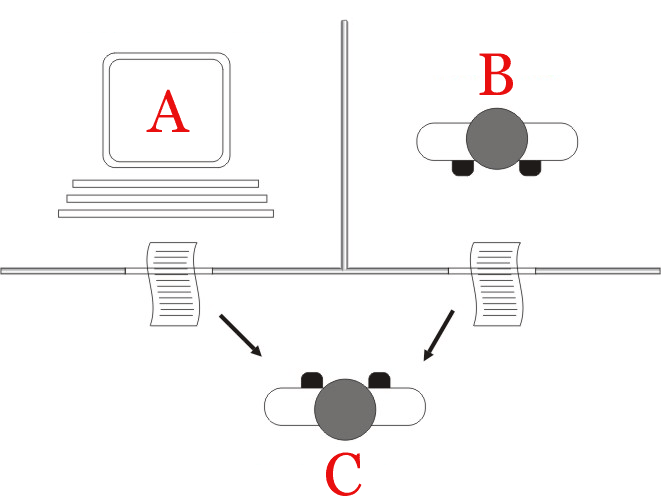
Three players: A (a man), B (a woman), C (the interrogator, in another room). C types questions and must tell who is the woman. A tries to deceive. B tries to help.
Now let a machine play A. Does C get it wrong as often as before?
His prediction: around the year 2000, an average interrogator would have no more than a 70% chance of a right identification after five minutes.
The game is called imitation — and it is about gender, deception and performance.
Freud, Dawkins, Rizzolatti

"A TT is a way how to address the question "Can machines think?" in a scientifically plausible ye deeply empathic way. More concretely, Turing (1950) proposes that the performance of an AA under question shall be evaluated by a human judge J whose objective is to determine which among two entities - with whom J is in real-time interaction - is of human and which is of artificial nature." (Hromada, 2012)
The famous question, in video form.
While watching, note the one objection you would raise.
Section 6 of the paper lists nine objections, among them theological, mathematical, from consciousness — and Lady Lovelace's.
Lovelace (1843): the Analytical Engine “has no pretensions to originate anything. It can do whatever we know how to order it to perform.”
Turing: machines surprise me all the time. And instead of programming an adult mind, build a child machine and educate it.
Keep that sentence. It is the first mention of a learning machine.
Charles Babbage (1791–1871) — mathematician, philosopher, mechanical engineer, and by most accounts a thoroughly restless Victorian gentleman.His Difference Engine w...
Augusta Ada King, Countess of Lovelace (1815–1852), daughter of Lord Byron, was trained rigorously in mathematics from childhood — and became Babbage's closest intel...
ELIZA (Weizenbaum, 1966): a few pattern rules, and some users confided in it anyway.
The Chinese Room (Searle, 1980): symbols shuffled correctly, nothing understood.
Recent controlled studies report that large language models are judged to be human about as often as, or more often than, real humans (Jones & Bergen).
The test measures our credulity as much as the machine's intelligence.
You are going to hear two pieces of music. One is composed and performed by humans, another is composed and generated by an artificial system. You are going to hear both pieces ...
Alan is a Matrix bot (@alan:udk.ai) running on our own server. You will chat with “Alan” — but behind him may be an AI persona or another student. Alan relays every message, so you are never told which is which.
How to reach him: in Element (with your account on udk.ai or medienhaus.udk-berlin.de) start a direct message with @alan:udk.ai and type start.
Alan pairs you with a waiting fellow student or with an AI persona. After a few minutes he asks: “Am I a human or AI?” Then comes the reveal: which persona (and model) it was — or, if you spoke with a human, who.
Good to know: Alan cannot read encrypted chats, so use a normal unencrypted DM (if you invite him to an encrypted one, he leaves and opens a fresh DM with you). The conversations are stored for the course evaluation — don't share anything private.
Try Turing's own questions: “Please write me a sonnet on the Forth Bridge.” “Add 34957 to 70764.”
Decide: human or machine? Write down the three cues that decided it.
Turing's machine answered 105621. The right answer is 105721.
You are going to hear two pieces of music. One is composed and performed by humans, another is composed and generated by an artificial system. You are going to hear both pieces ...
Which cues did you use? Speed? Spelling? Politeness? Never saying “I don't know”? A body, a weather, a bad day?
Humans make typos and slip. Turing wrote that a machine should deliberately introduce mistakes to be convincing.
Which cues tell you about the machine, and which only about your expectations of humans?
Back to your criterion from the Question of the Day: did Alan meet it?
Fehlleistungen, or parapraxes, refer to slips of the tongue, memory lapses, or unintended actions. Freud argued these “slips” reveal unconscious thoughts or desires...
Enigma: a German cipher machine. Press a key, a different letter lights up — and the rotors turn, so the next key is scrambled differently.
Bletchley Park: Turing designs the Bombe, a machine that hunts for the day's settings (building on Polish work).
A machine breaking a machine.
And enigma is also what we call a riddle. Keep both meanings in mind.
1928, David Hilbert: is there a mechanical procedure that decides, for any mathematical statement, whether it is provable?
Leibniz had dreamed of it: let us calculate.
1931, Kurt Gödel: every consistent formal system has true statements it cannot prove.
1936, Alonzo Church and Alan Turing, independently: no such procedure exists.
But to prove that nothing can be done, you first need to say exactly what “a procedure” is.
Meta-Problem in Light of Turing's Entscheidungsproblem
Gottfried Wilhelm Leibniz takes positional notation somewhere further: in 1703, he formally describes arithmetic in base 2 — binary.He was reportedly delighted to find the...
An algorithm is a finite, well-defined sequence of steps that transforms a given input into a desired output.Finite — it has to actually end, eventually.Well-defined &mdas...
Until the 1940s a “computer” was a person who computes — often a woman with pencil and paper at a desk.
Turing asks: what does such a person actually do?
Looks at a symbol. Writes a symbol. Changes their state of mind. Moves on to the next square.
Strip away everything else:
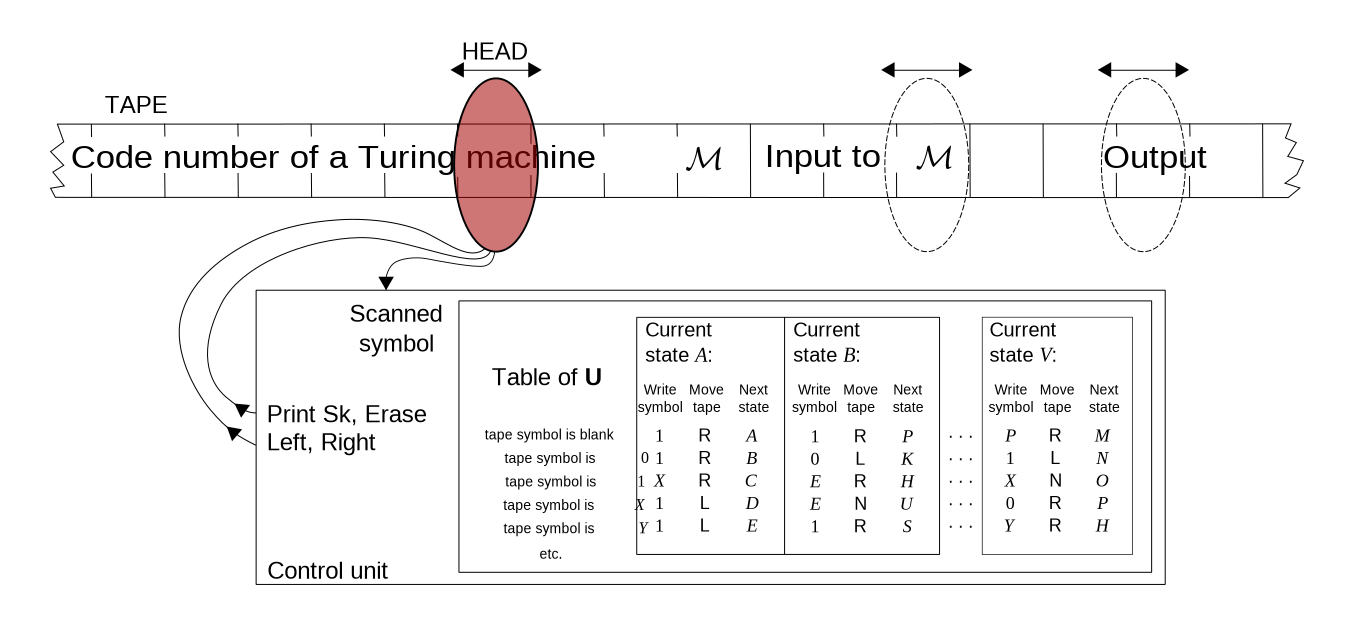
a tape, a head, a finite list of rules.
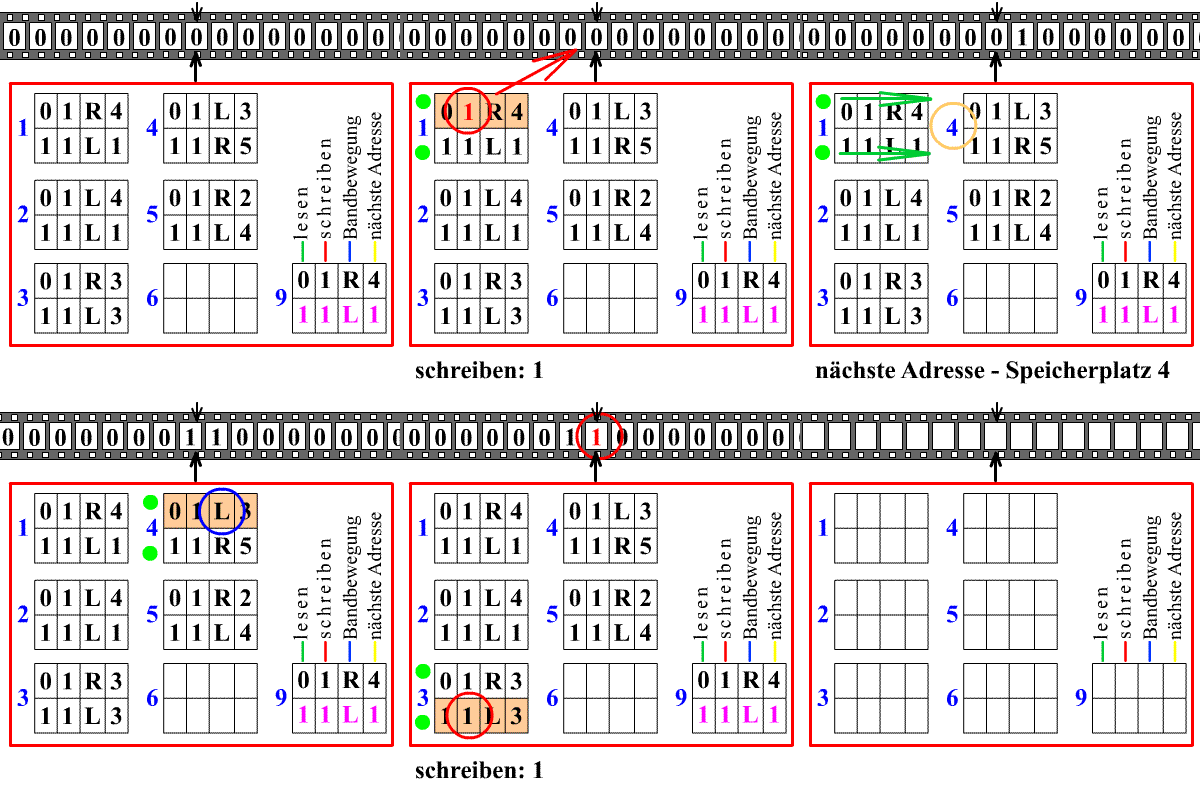
Look again at the rule table of our Turing machine — the one from the Alan session — and write the state as a bit: CARRY = 1, HALT = 0.state creads bwritesnext state...
In pairs. Two roles. TAPE: write six cells on paper, e.g. 0 1 0 1 1 1, and cover all but the cell under the head with your hand. MACHINE: you have only a rule card (the table of...
The tape holds a binary number: 1 0 1 1. The head stands on the rightmost digit. State: CARRY.
CARRY reads 1 → write 0, move left, stay in CARRY
CARRY reads 0 or blank → write 1, STOP
Run it with pencil and paper. What is on the tape when it stops? Now try 1 1 1.
It adds one: 1011 → 1100, 111 → 1000. Three rules, no understanding.
Anything you would call an algorithm can be written as such a table (Church–Turing thesis).
What is computation ? https://giphy.com/explore/turing-machines
Counting from 0 to 31 on the fingers of one hand is a Turing machine at work. Here is its anatomy:
Tape — your five fingers: thumb = rightmost cell, little finger = leftmost. Symbols — 1 finger up, 0 finger down.
Head — the finger you are looking at; it starts on the thumb. States — CARRY (start) and HALT.
Transition rulesCARRY reads 1 → write 0 (fold it down), move left, stay in CARRYCARRY reads 0 → write 1 (raise it), HALT
One run = one count. Take 7 → 8: tape 0 0 1 1 1. Thumb 1→0, index 1→0, middle 1→0, ring 0→1, halt: 0 1 0 0 0.
Counting to 31 means starting the machine 31 times (57 steps in all). Same two rules every time; nothing in it “knows” what a number is. Adding two numbers on two hands is the same idea with a bigger rule table.
Now count up from 31: the head falls off the left end. Turing's tape is infinite; your hand is not. Borrow your other hand — or paper — and keep going.
A universal machine reads the rules of another machine from its tape and behaves like it.
Program = data. Your laptop is such a machine; an app is just a long tape.
And a program that treats programs as data can also change them. Hold on to this for the learning machines.
Suppose a program H(p, x) always answers correctly: “p halts on x” or “p loops forever”.
Build D(p): ask H(p, p). If it says halts, loop forever. If it says loops, stop.
Run D on itself. Halts if and only if it loops.
Contradiction: H cannot exist. Some questions about programs no program can answer.
Turn to your neighbour. Two minutes.
What would a machine have to do for you to say “yes, it thinks”?
Write the criterion down.
We will test it at the end of the session.
17th January Question of the day: Can machines think ? Topic: Hommage to A.M.T. Hero of the day: Alan Matthison Turing
your definitions dictionary definition philosopher's definition What do You think?
Turing machine: what can be computed — defined by what a procedure does, not what it is made of.
Turing test: what we will call intelligent — defined by how it behaves toward us.
The question moves from “what is it?” to “what does it do with us?”
Next: Claude, Marvin, John &c. — from information theory to Dartmouth.
In which the reader is made acquainted with a young gentleman of Michigan who, observing that the wires of a telephone exchange could be made to reason, taught the whole world t...
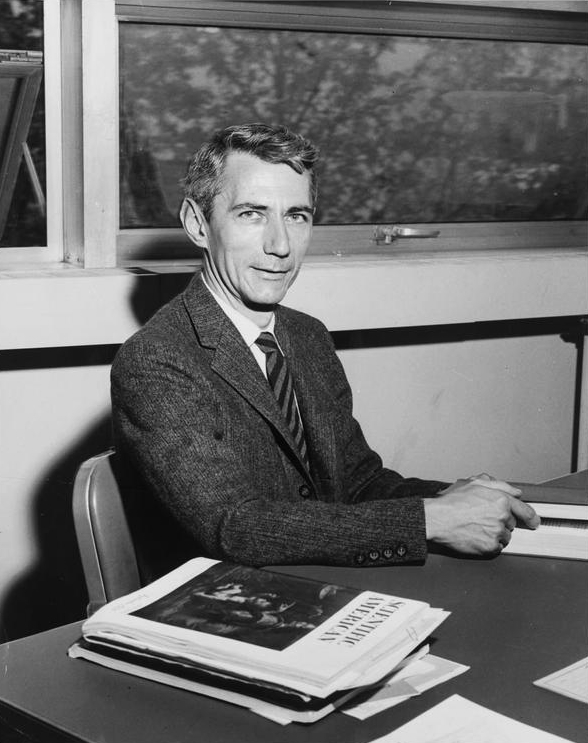
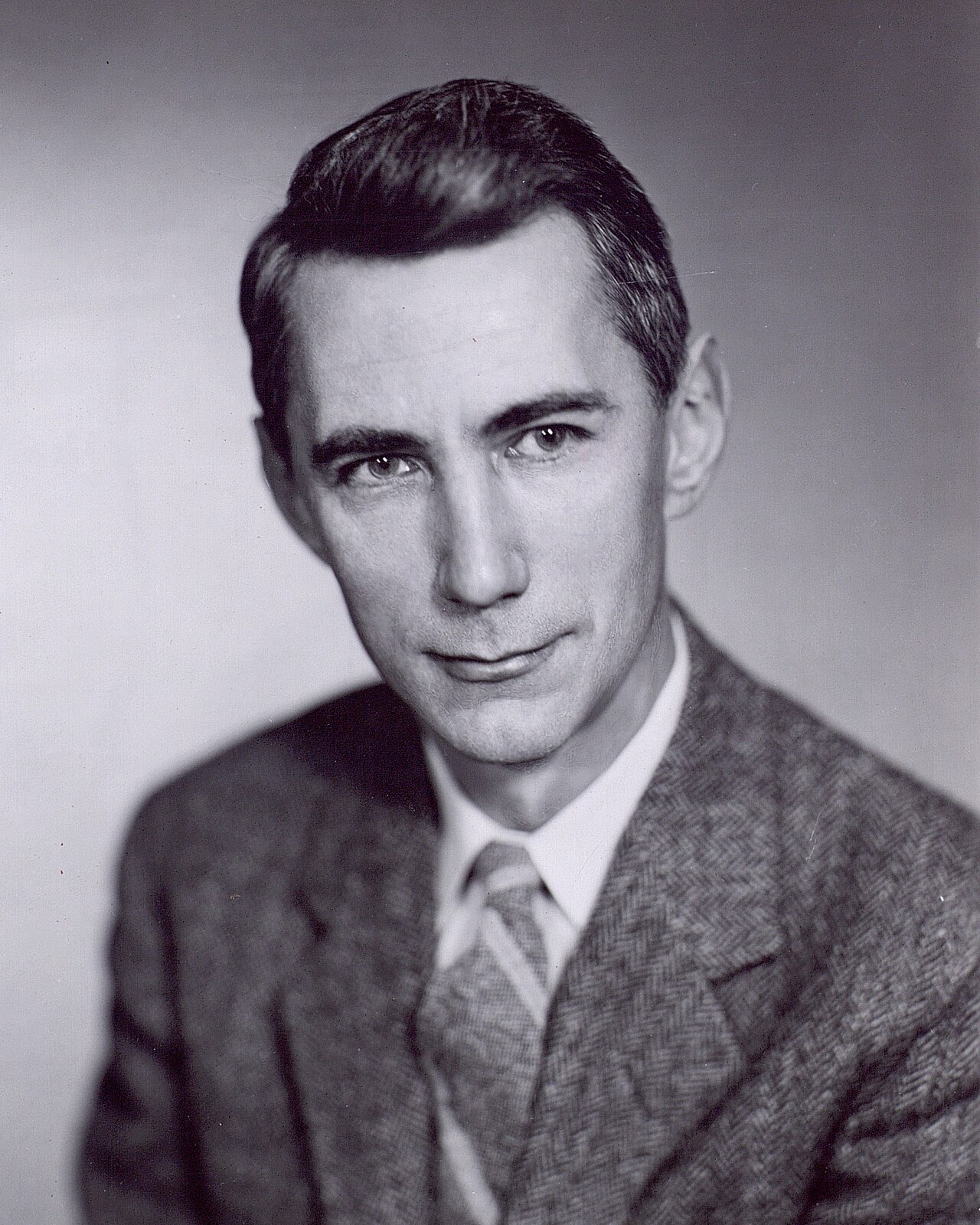
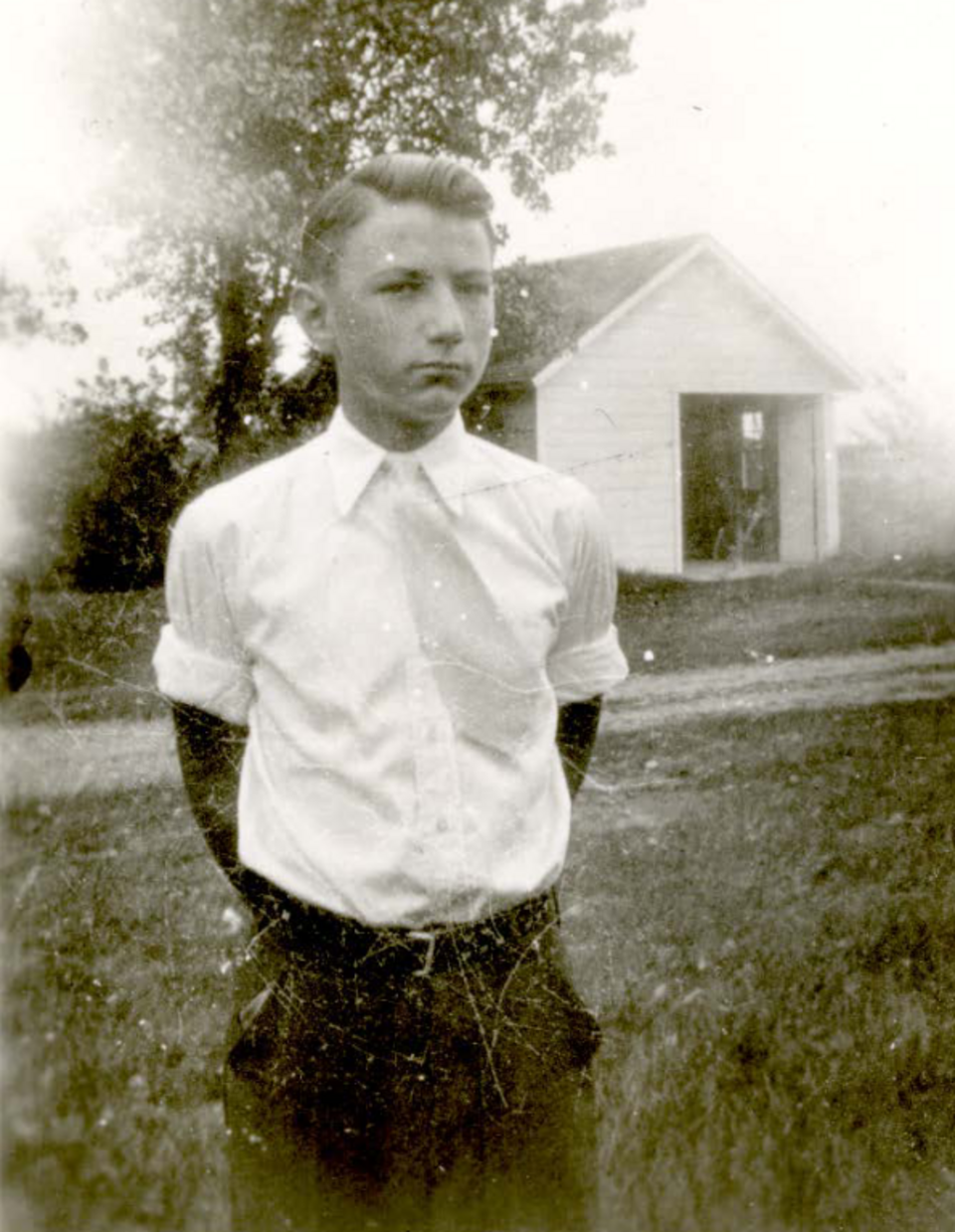
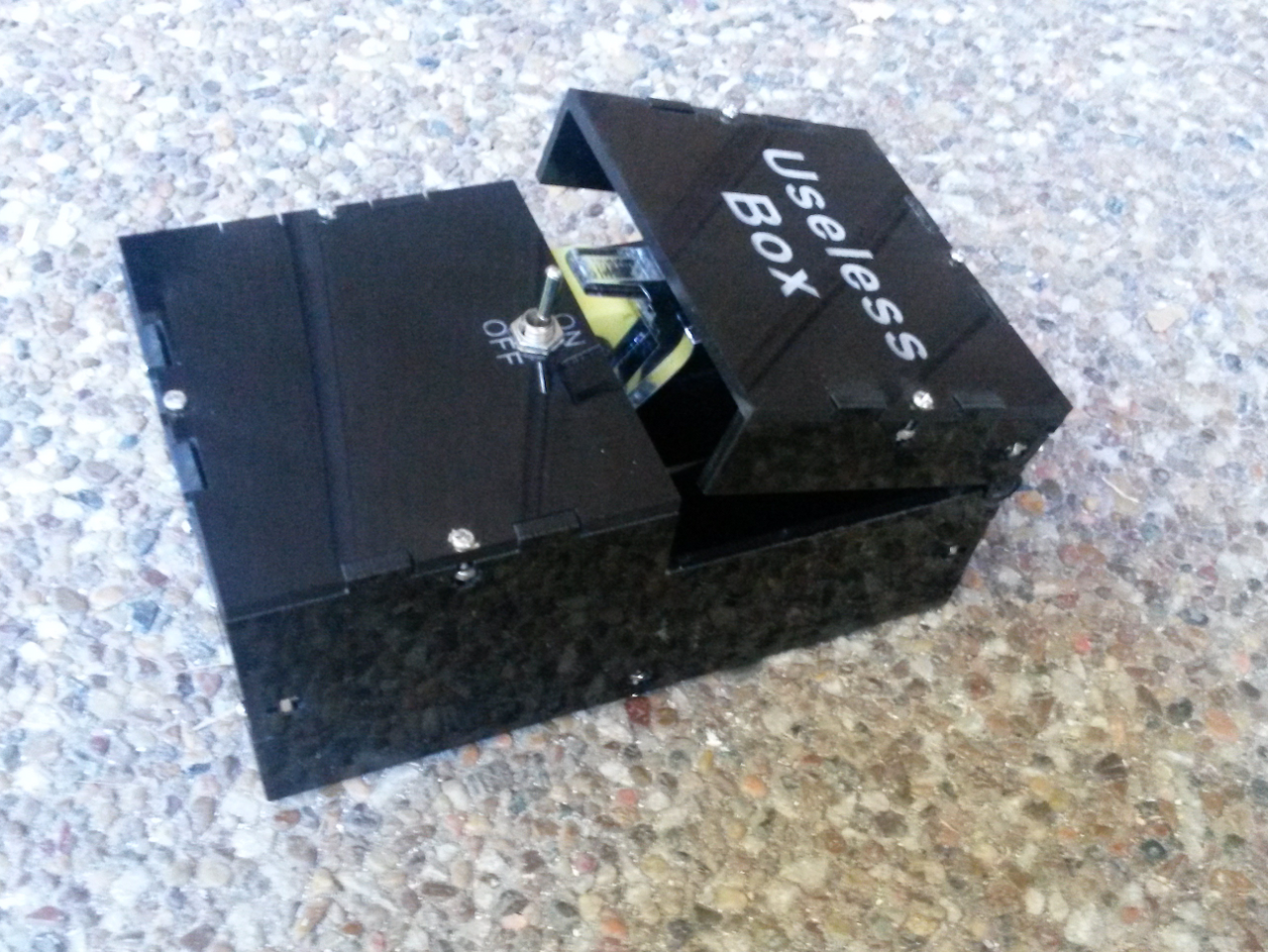
In which the reader is made acquainted with a young gentleman of Michigan who, observing that the wires of a telephone exchange could be made to reason, taught the whole world to count in Bits; who rode a unicycle through the corridors of the Laboratory, juggled upon it, and built a Machine whose sole purpose was to switch itself off.
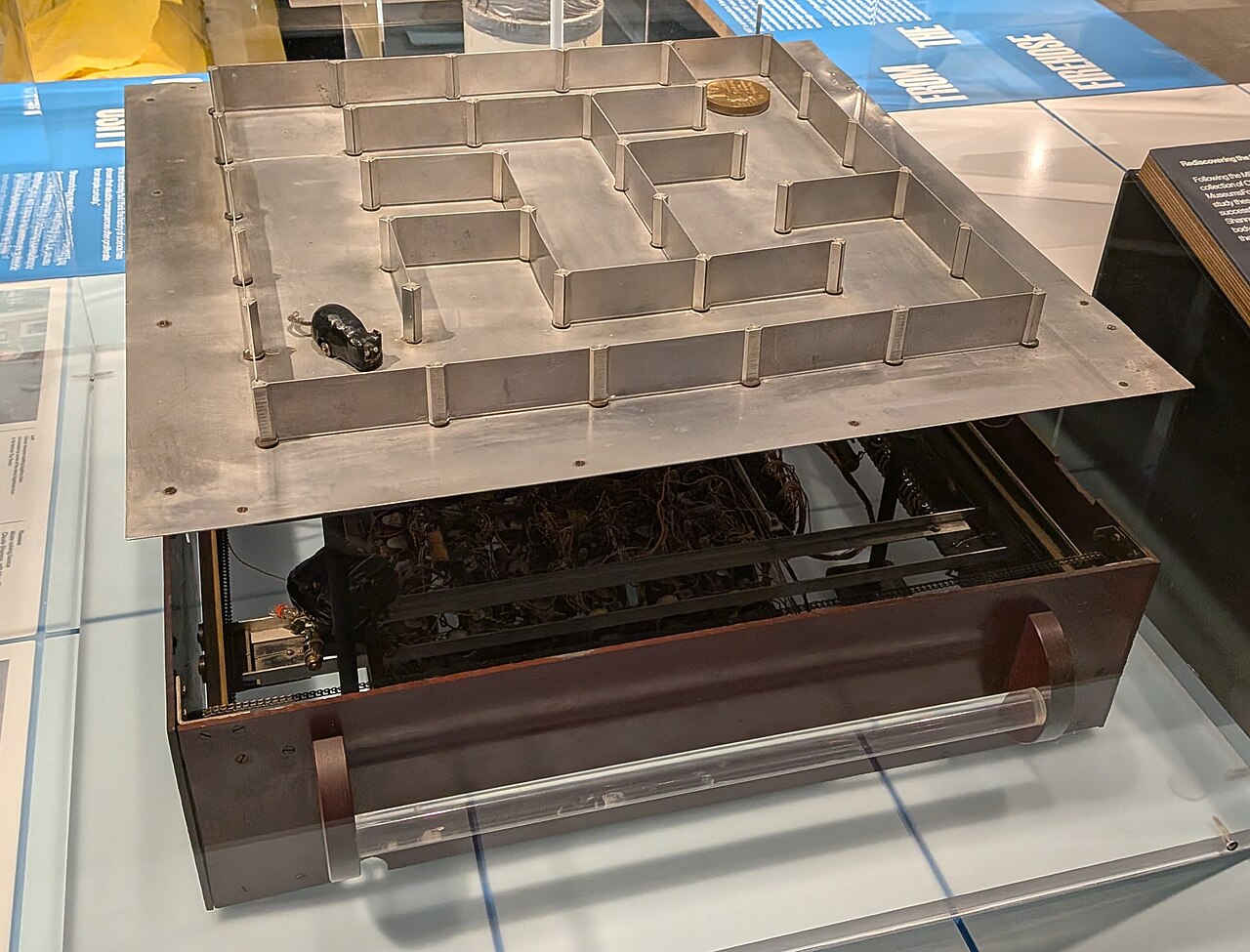
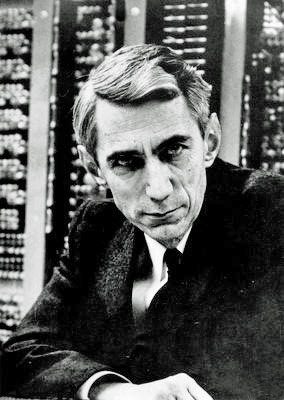
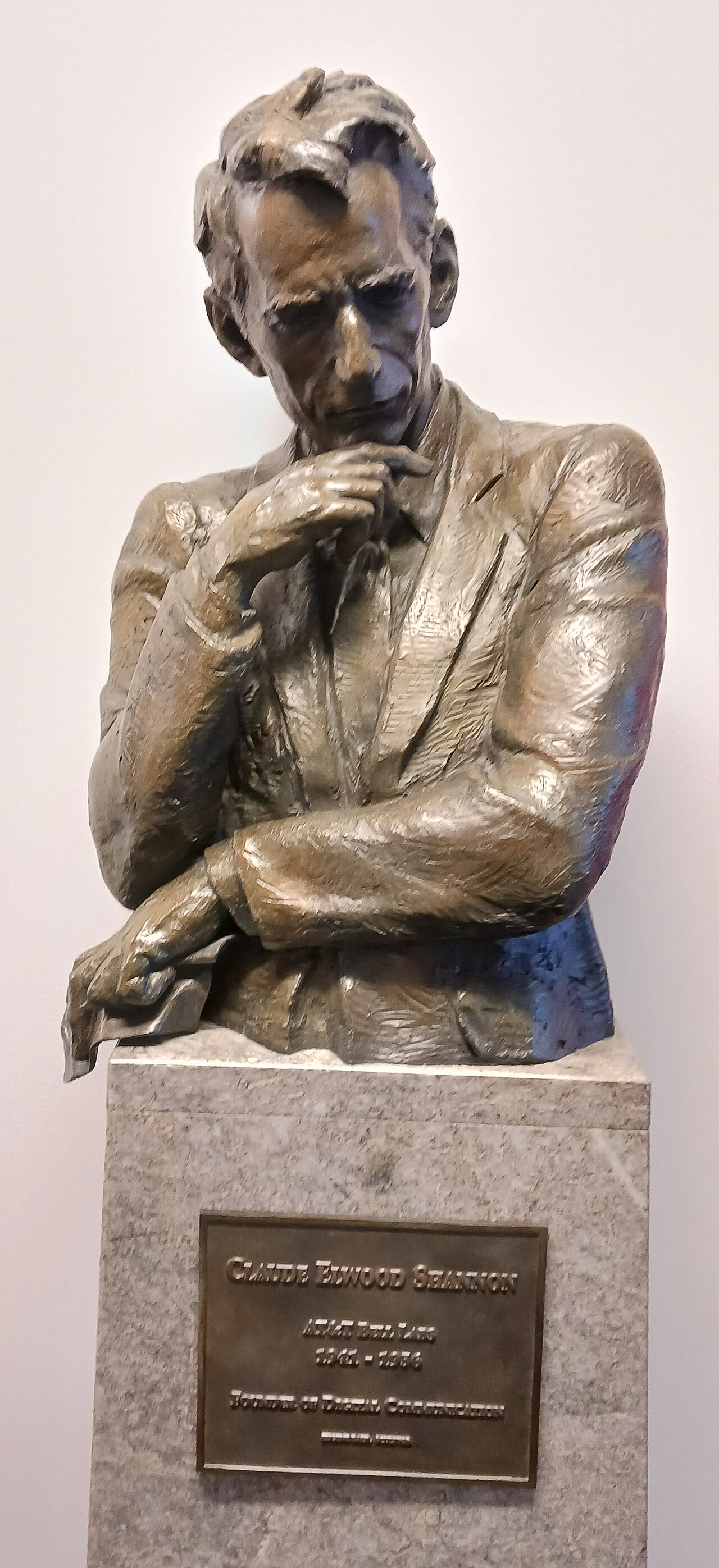
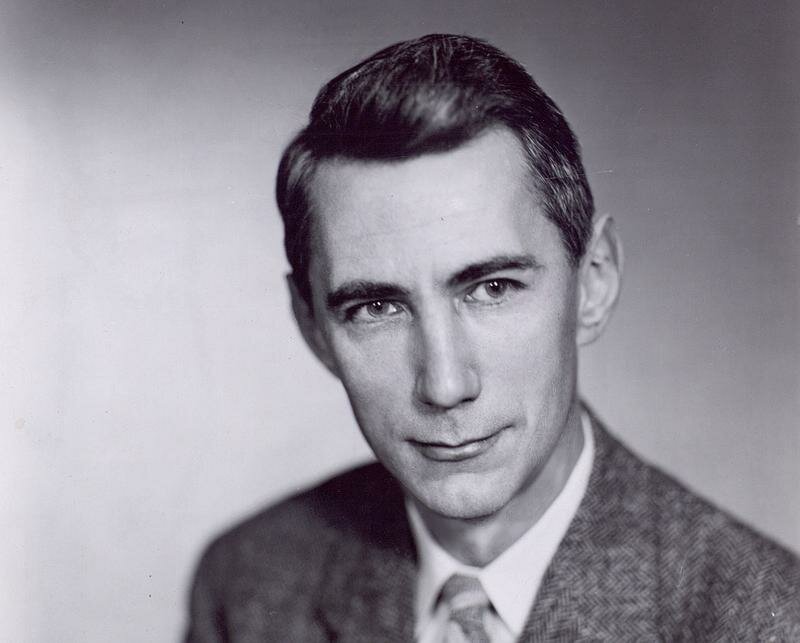
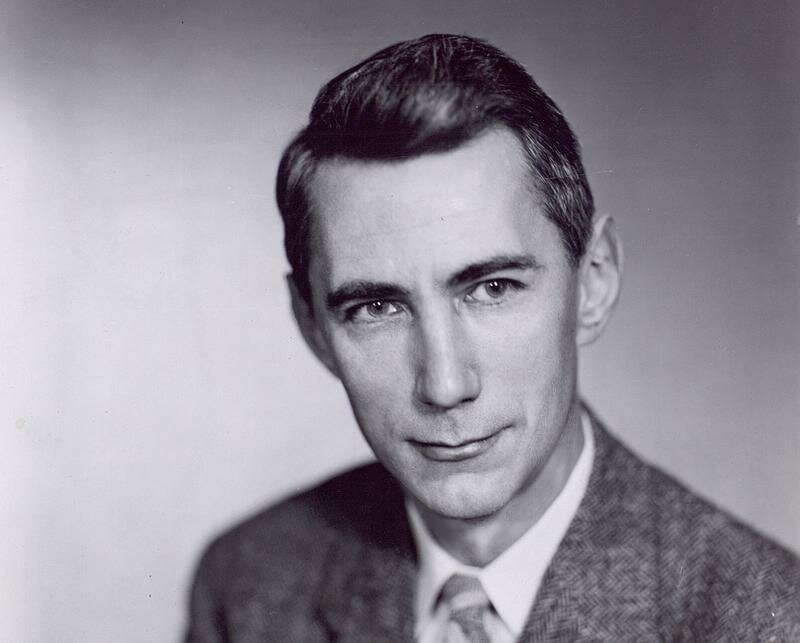
Being a narrative of Mr. Claude Elwood Shannon (1916–2001): of his Thesis and the marriage of Logic with Electricity; of the Great War and its Secret Telephony; of the Transistor, that most remarkable event of the Christmas of 1947; of the Mathematical Theory of Communication; of a Mouse that Learned its Way; and of a Summer at Dartmouth, in which Artificial Intelligence received its name.
Wherein it is humbly submitted that the first Claude was not a language model at all.
Turing machine: what can be computed — defined by what a procedure does, not what it is made of.Turing test: what we will call intelligent — defined by how it behave...
1916–1936. A tinkerer who happened to study both electrical engineering and mathematics.
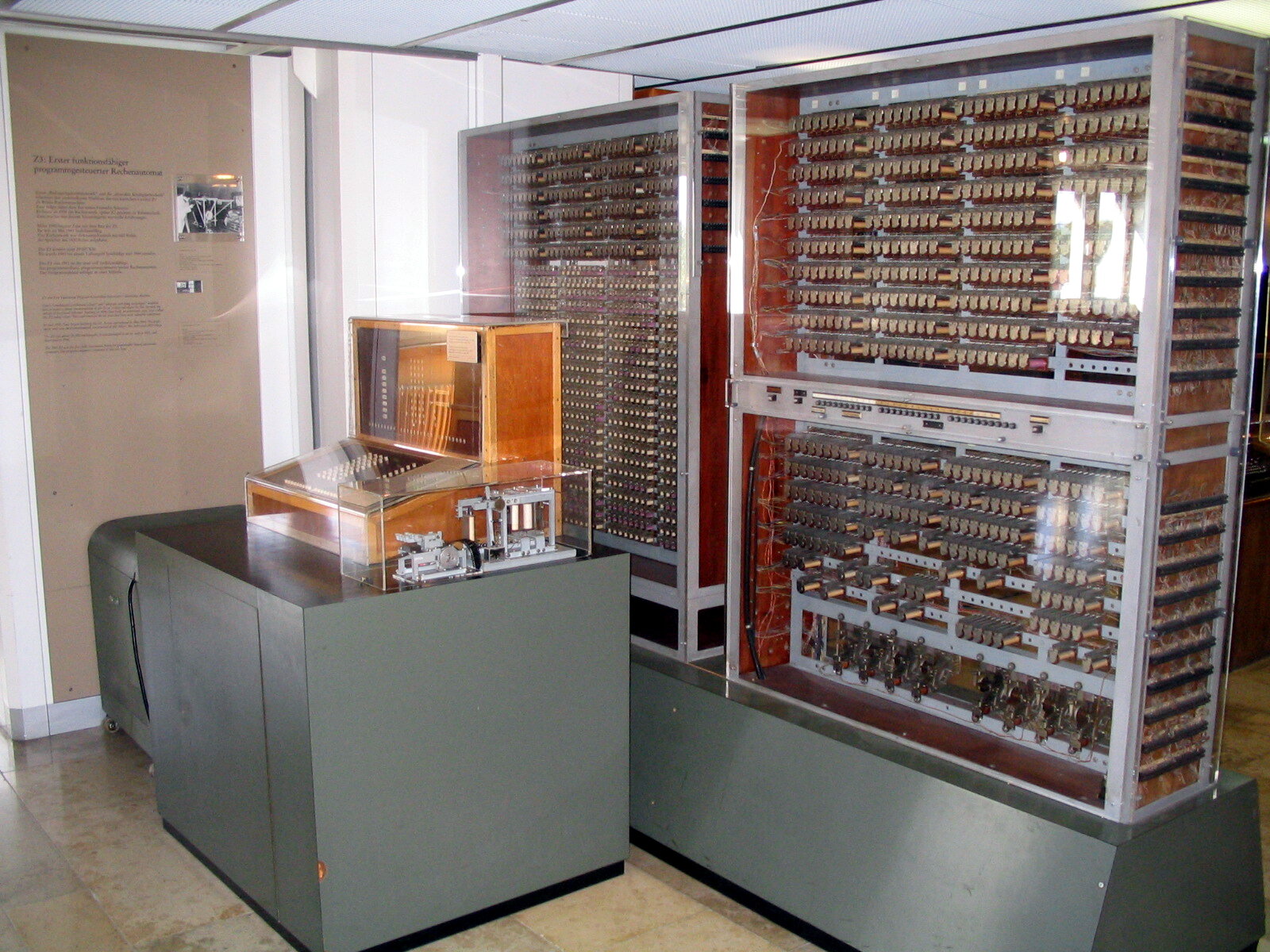
“A Symbolic Analysis of Relay and Switching Circuits” — the moment when logic and electricity were found to be the same thing.
1937: Claude Shannon, 21, writes his master’s thesis at MIT: A Symbolic Analysis of Relay and Switching Circuits.His discovery: electrical switches obey Boole’s alge...
| Circuit | Algebra |
|---|---|
| switch open / closed | 0 / 1 |
| two switches in series | AND (A·B) |
| two switches in parallel | OR (A+B) |
| normally-closed contact | NOT (A′) |
In which the reader is made acquainted with a most singular Algebra, wherein there are but two numbers, and the sum of one and one is nothing at all.Being an account of Mr. Bool...
Why is it called algebra? Because the operations behave like arithmetic on 0 and 1:AND is multiplication: a · b. NOT is 1 − a.XOR is addition — but one that f...
1937: Claude Shannon, 21, writes his master’s thesis at MIT: A Symbolic Analysis of Relay and Switching Circuits.His discovery: electrical switches obey Boole’s alge...
One gate is enough to build all the others: NAND (NOT(a AND b)), Sheffer 1913.NOT a = a NAND aa AND b = NOT (a NAND b) — i.e. a NAND followed by a NAND with itself.a OR b ...
A lamp at the top of a staircase, a switch at the bottom, a switch at the top: either switch should toggle the lamp.
XOR (exclusive or): true if the two inputs differ — one thumb up, not both.aba XOR b000011101110Note the last row: 1 XOR 1 = 0. Remember it — it will carry the whole...
In everyday speech “or” is ambiguous. Logic must not be.sentencereading“Soup or salad?” (the menu)XOR — not both (unless you pay extra)“Smoke...
1940–1945. Mathematics in the service of secrets.
The story of Alan Matthison Turing, his machine(s) and his test(s)
XOR (exclusive or): true if the two inputs differ — one thumb up, not both.aba XOR b000011101110Note the last row: 1 XOR 1 = 0. Remember it — it will carry the whole...
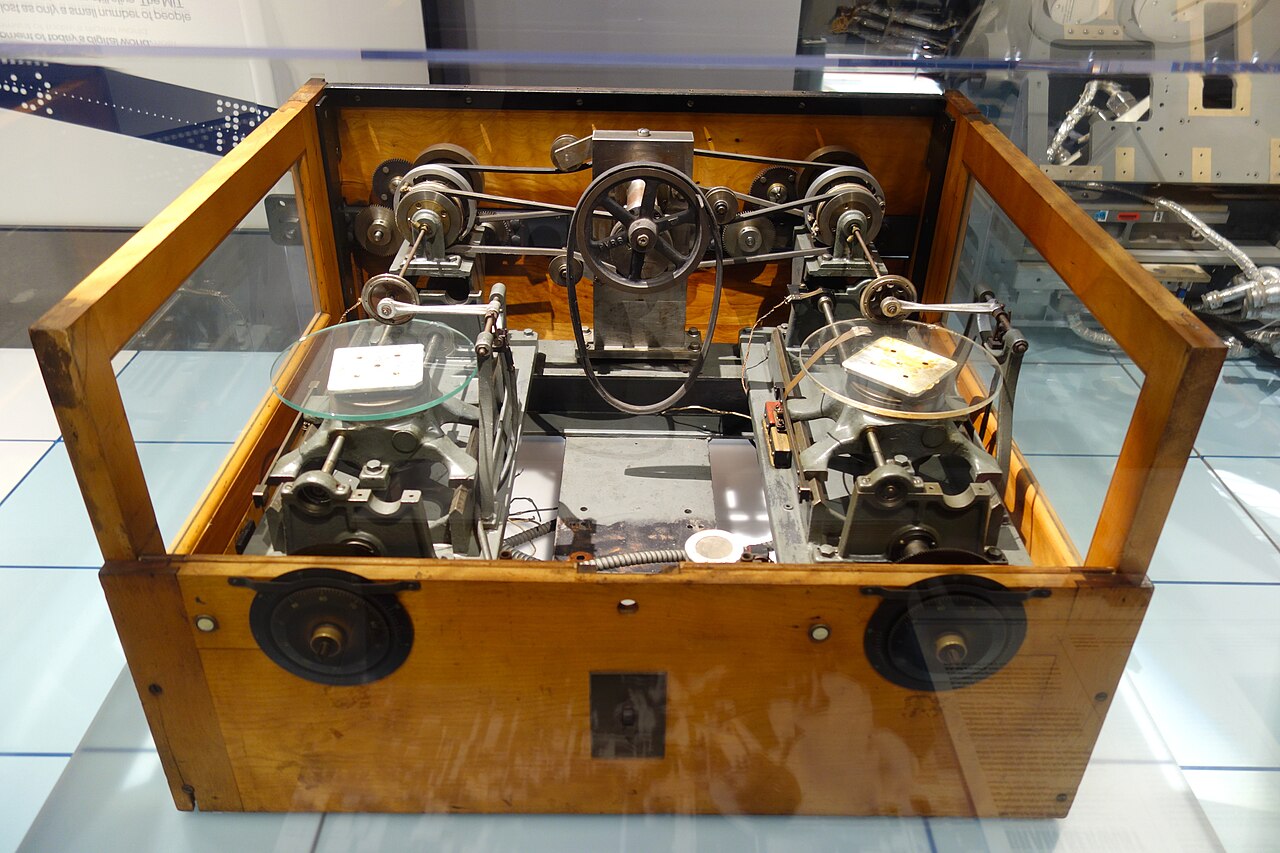
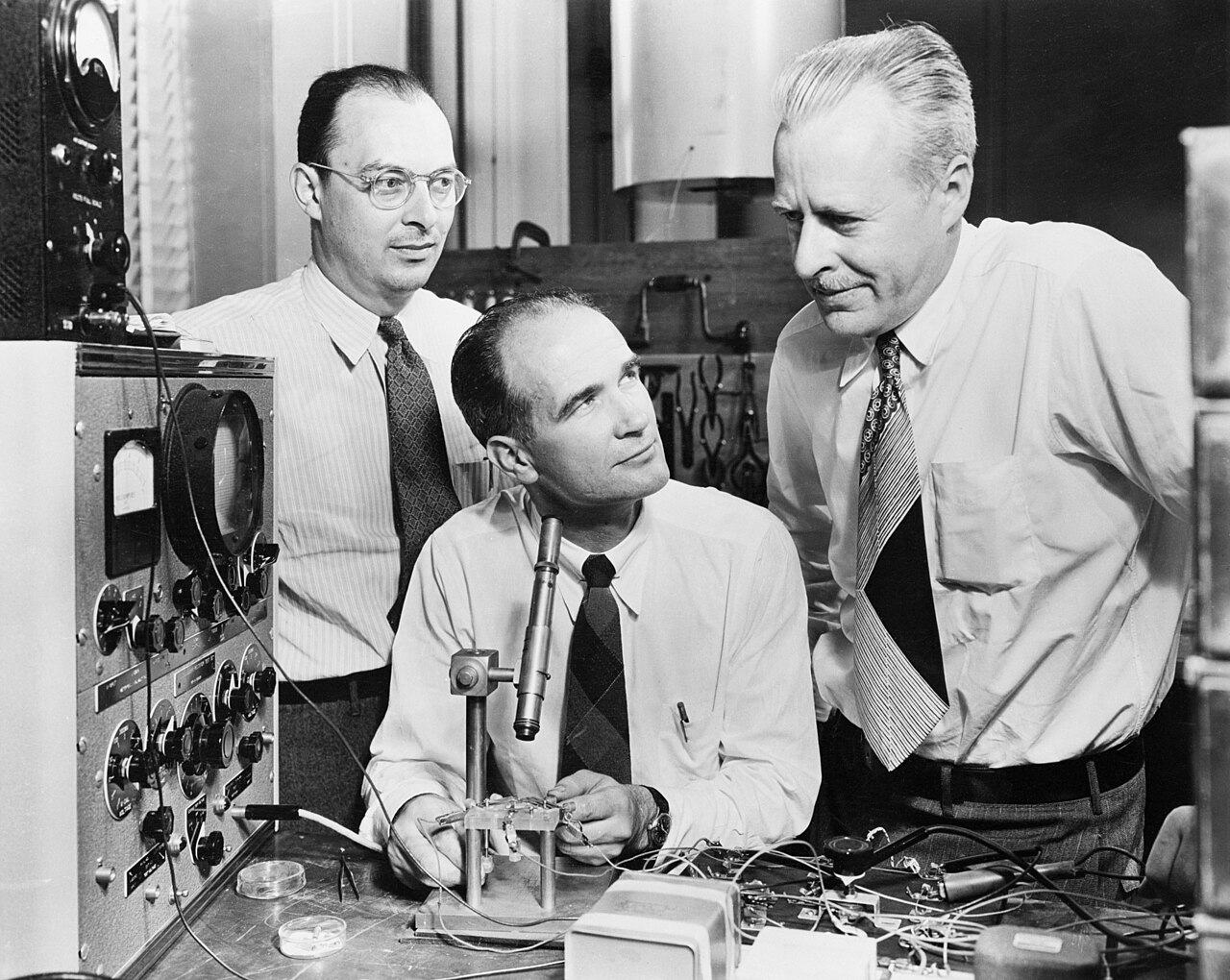
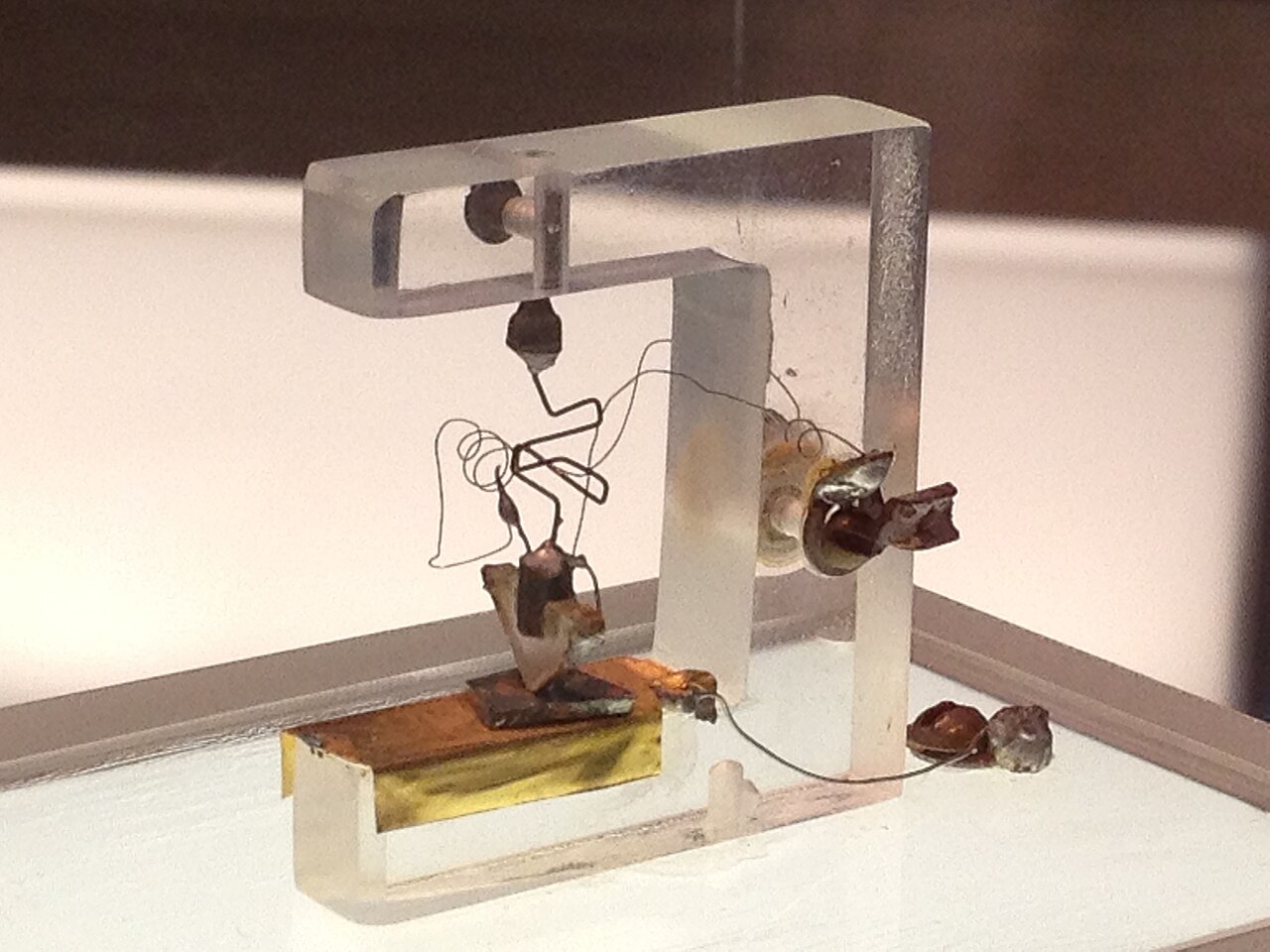
In the same building where Shannon worked, a switch without moving parts was demonstrated for the first time.
| Switch | Principle | Speed |
|---|---|---|
| Relay | coil moves a metal contact | milliseconds |
| Vacuum tube | hot filament, electrons in vacuum | microseconds |
| Transistor | crystal, no moving parts | nanoseconds and below |
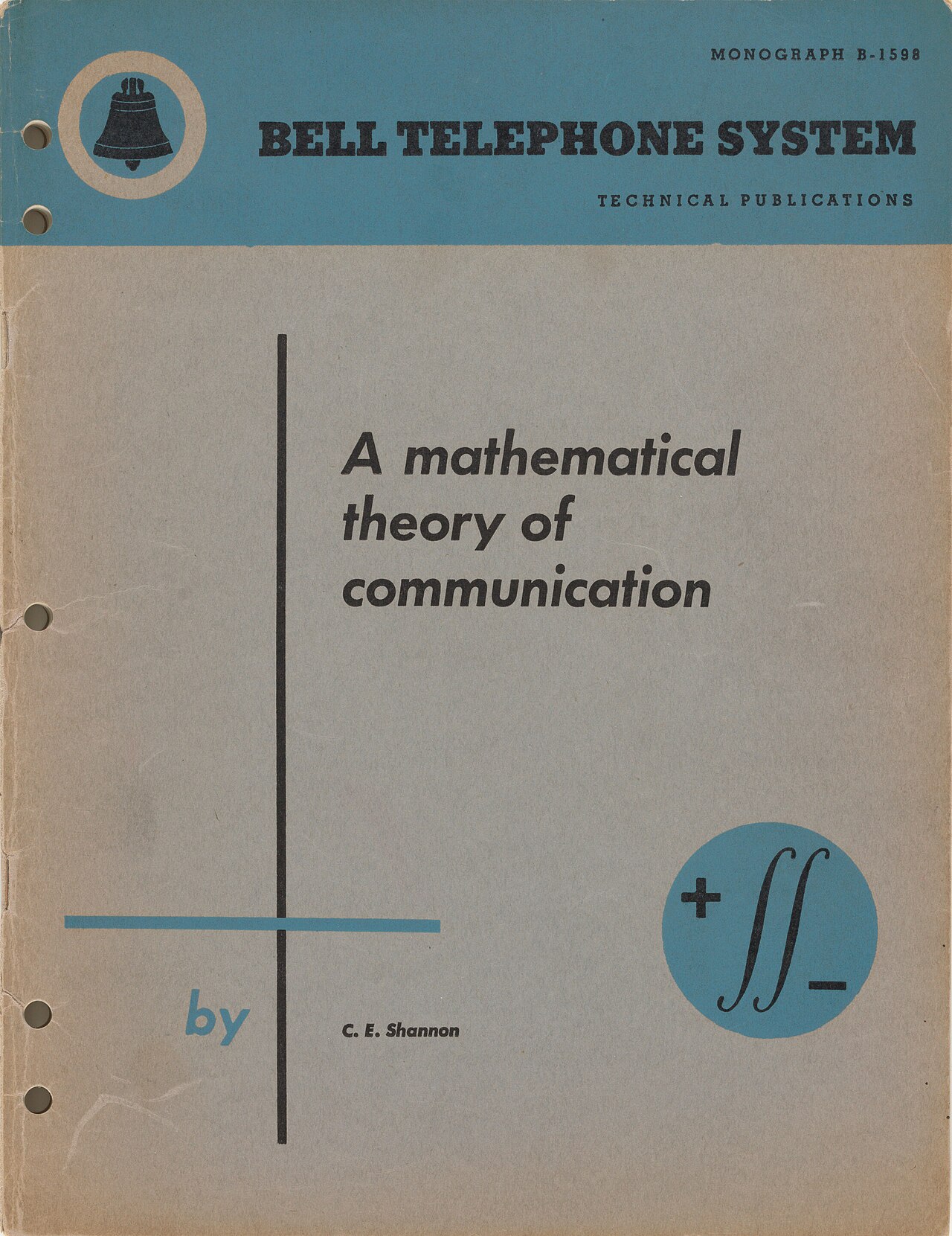
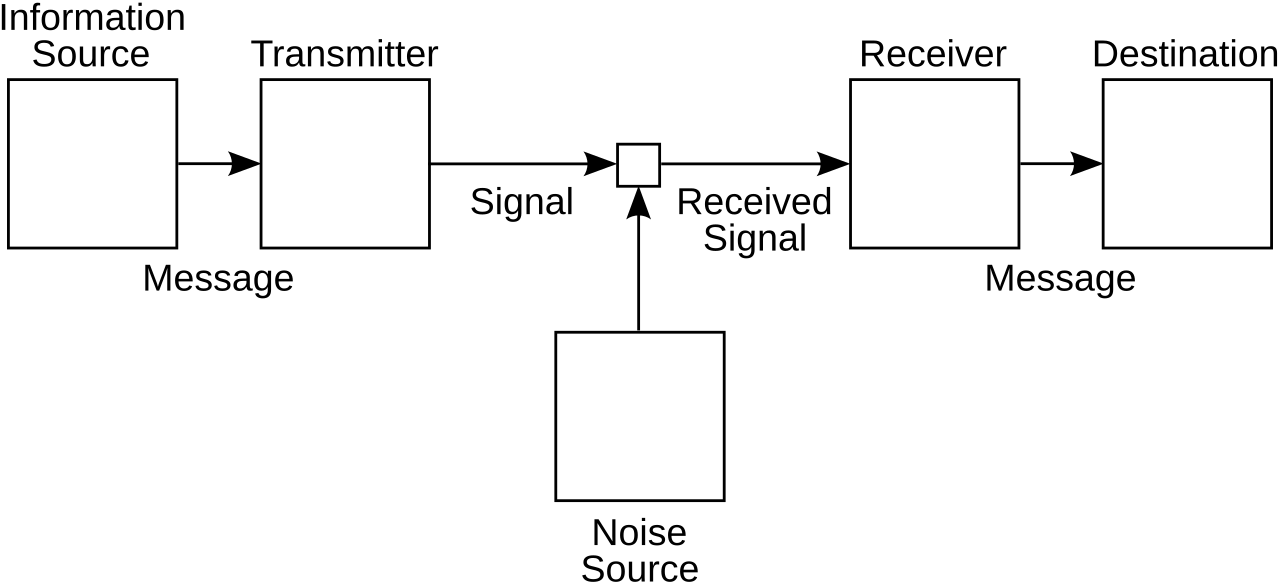
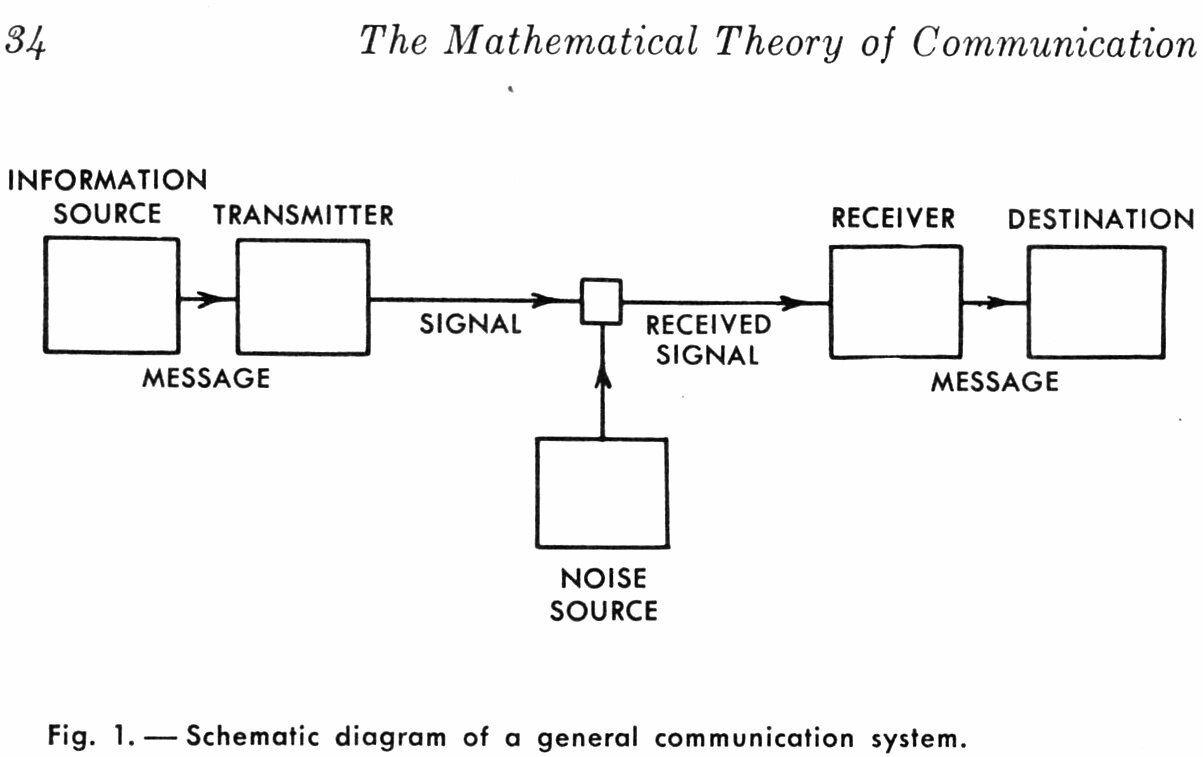
Bell System Technical Journal, July and October 1948. “The fundamental problem of communication is that of reproducing at one point either exactly or approximately a message selected at another point.”
In couples. One partner thinks of a number between 1 and 1000, the other asks only yes/no questions.
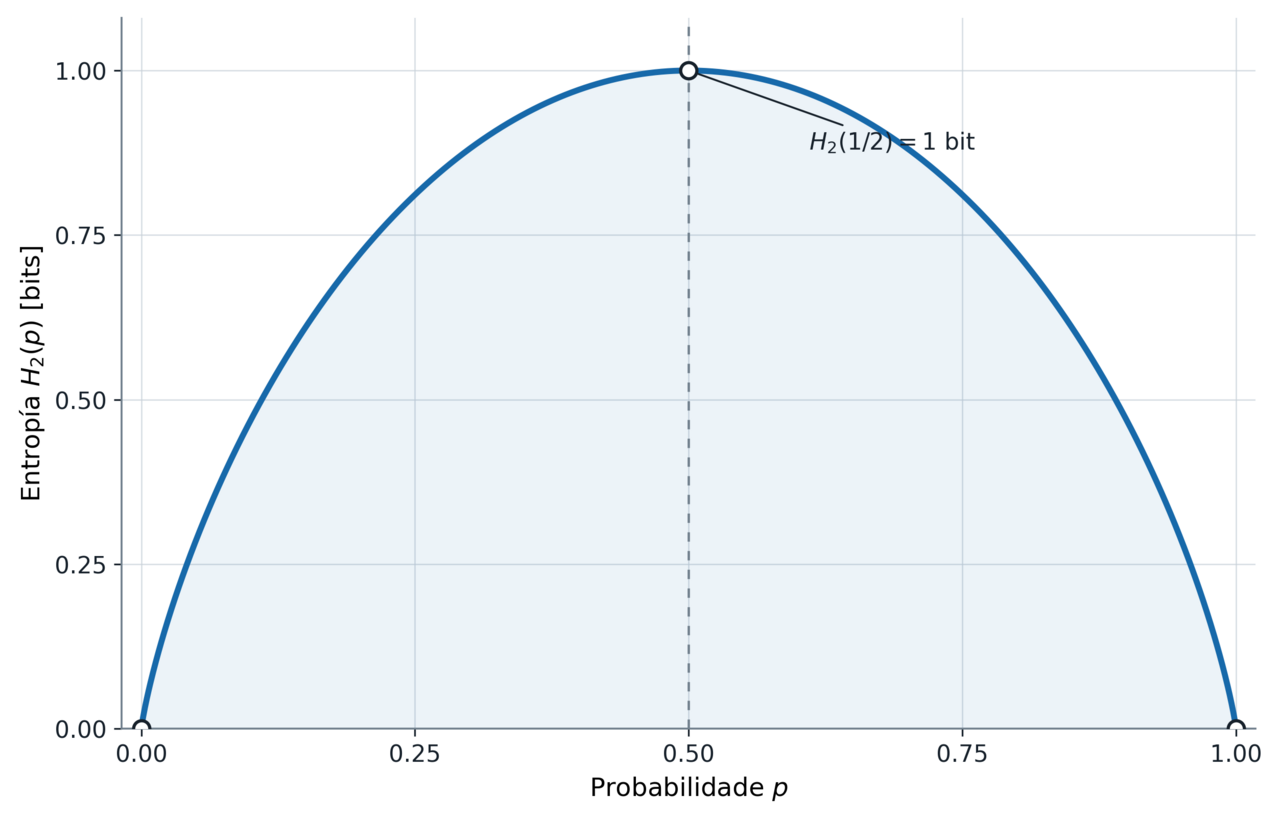
H = − Σ pi · log2 pi
Approximating English by chains of words, 1948. Second-order word approximation from the paper:
“THE HEAD AND IN FRONTAL ATTACK ON AN ENGLISH WRITER THAT THE CHARACTER OF THIS POINT IS THEREFORE ANOTHER METHOD FOR THE LETTERS THAT THE TIME OF WHO EVER TOLD THE PROBLEM FOR AN UNEXPECTED”
Large & Small Language Models
In couples. Shannon’s own experiment of 1951.
1950–1952. Shannon turns the theory into contraptions.
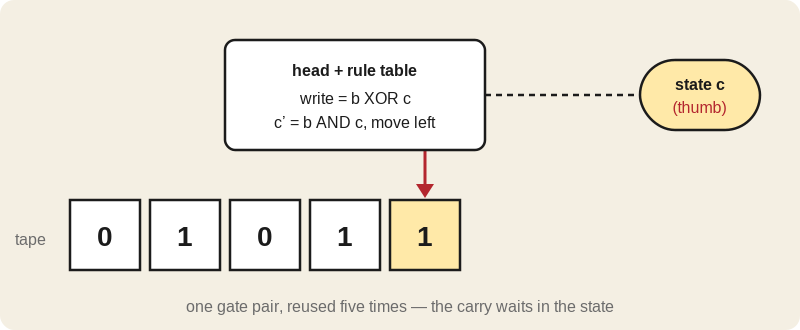
Now the other idea. Do not build five adders. Build one and walk it along the number.Each step it reads one bit from a tape, computes XOR and AND, writes the result, and moves o...
Look again at the rule table of our Turing machine — the one from the Alan session — and write the state as a bit: CARRY = 1, HALT = 0.state creads bwritesnext state...
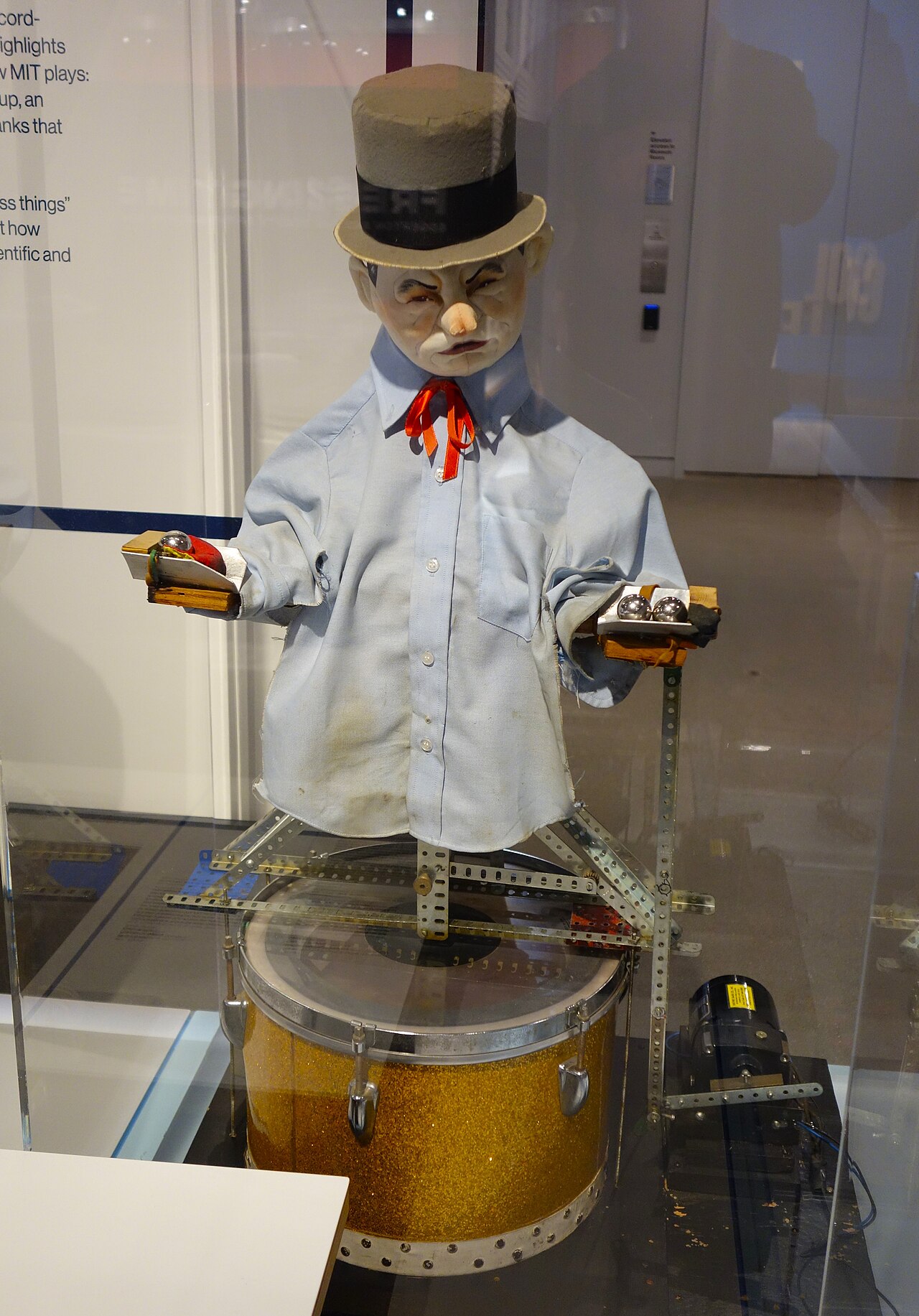
Shannon built things because they were fun. Some of them are philosophy in disguise.
The summer of the naming: where “artificial intelligence” became a field.
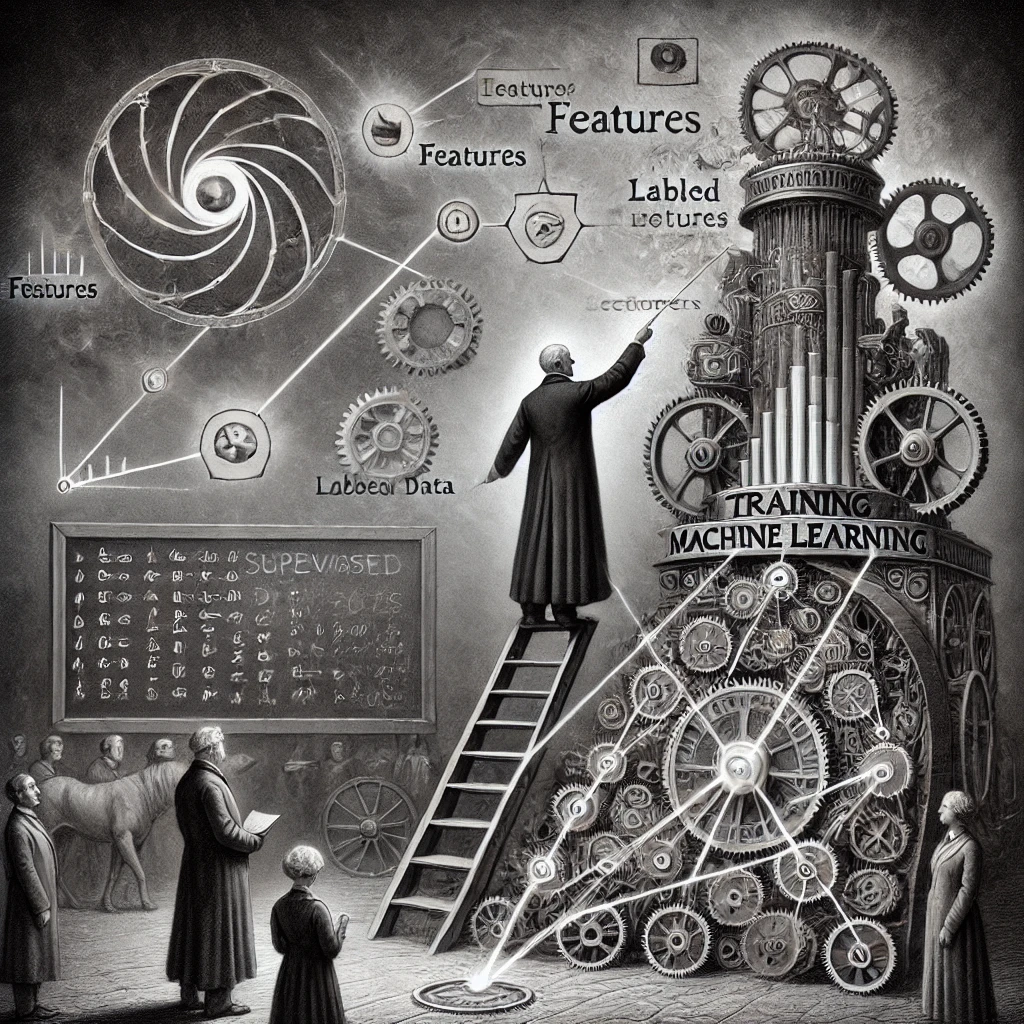
Features, Classifiers, Decision Trees, Random Forests, Training & Testing,
1956–2001. From the Laboratory to the University — and to silence.
Features, Classifiers, Decision Trees, Random Forests, Training & Testing,
Large & Small Language Models
Shannon and McCarthy edited Automata Studies (1956). McCarthy was disappointed: few papers dealt with machine intelligence.Hence a new name for the new proposal.Shannon was repo...
Relay switching → logic gates → bits → learning mouse → next-token prediction.The language models of today minimise cross-entropy — a quantity Shannon ...


Zero emerges independently more than once: among the Maya of Mesoamerica, and in India, where the mathematician Brahmagupta (7th century CE) is the first to give it formal rules...
i=0;
while (true) {
i=i+1;
print i;
}
Zero emerges independently more than once: among the Maya of Mesoamerica, and in India, where the mathematician Brahmagupta (7th century CE) is the first to give it formal rules...


Here is the thread we will follow: a number can be written down in many different ways — and the way you write it changes what you can do with it.That was true for Roman n...


The tape holds a binary number: 1 0 1 1. The head stands on the rightmost digit. State: CARRY.CARRY reads 1 → write 0, move left, stay in CARRYCARRY reads 0 or blank →...


Approximating English by chains of words, 1948. Second-order word approximation from the paper:“THE HEAD AND IN FRONTAL ATTACK ON AN ENGLISH WRITER THAT THE CHARACTER OF T...
Relay switching → logic gates → bits → learning mouse → next-token prediction.The language models of today minimise cross-entropy — a quantity Shannon ...
Some Open Educational Resources (OERs) pertaining to topic of general / digital / AI / cognitive literacy created in context of diverse courses of Daniel D. Hromada, t...
Greek mythology gives us an extraordinary laboratory of artificial beings.Athena represents intelligent making.Hephaestus represents the workshop in which artifacts begin to act.
With Hephaestus, myth moves from intelligent making toward artificial agency.His workshop contains self-moving devices and artificial attendants.The question changes:Can we make...
Argo: speaking Dodonian timber embedded in Athena's ship.Talos: bronze guardian of Crete.Pygmalion: desired artificial human brought to life.Golem: artificial human animated thr...
Pygmalion loathing their lascivious life, Abhorr'd all womankind, but most a wife: So single chose to live, and shunn'd to wed, Well pleas'd to want a consort of his bed. Yet fearing idleness, the nurse of ill, In sculpture exercis'd his happy skill; And carv'd in iv'ry such a maid, so fair, As Nature could not with his art compare ...
Artificial beings are not merely tools.They become surfaces onto which humans project desire, identity and self-understanding.

The artificial human is also a duplicate.A second body.A copy that may become difficult to distinguish from an original.The double turns technology into an identity problem:How ...

Artificial beings are not merely tools.They become surfaces onto which humans project desire, identity and self-understanding.

We first imagined machines as versions of ourselves.Then we built machines that extended parts of ourselves.Eventually we built machines capable of modifying themselves through ...

Pygmalion creates an ideal human form and falls in love with his creation.Venus / Aphrodite grants the statue life.The question is not merely:Can we reproduce a human?but:Can we...
The Goddess, present at the match she made, So bless'd the bed, such fruitfulness convey'd, That ere ten months had sharpen'd either horn, To crown their bliss, a lovely boy was born; Paphos his name, who grown to manhood, wall'd The city Paphos, from the founder call'd.
We first imagined machines as versions of ourselves.Then we built machines that extended parts of ourselves.Eventually we built machines capable of modifying themselves through ...
“All is number.” (πάντα αριθμός) — attributed to Pythagoras, 6th century BCE.For Pythagoras and his fol...

and then said creators: faciamus hominem ad imaginem et similitudinem nostram
and then said humans: faciamus machinam ad imaginem et similitudinem nostram
Machine as a projection of the human selfFaciamus machinam ad imaginem et similitudinem nostram.Let us make the machine in our image and likeness.
Greek μηχανή — mēkhanē: instrument, device, contrivance, means.Latin machina: machine, engine, apparatus, contrivance.Middle French machine → English machine.The semantic field ...
A machine can do more than move.It can contain knowledge unavailable to its operators.The mythical Argo gives us an extraordinary example.
Before machines became motors, engines and computers, the word already meant something broader:an ingenious means by which something becomes possible.


"When King Solomon stepped upon the throne, a mechanism was set in motion. As soon as he stepped upon the first step, the golden ox and the golden lion each stretched out one foot to support him and help him rise to the next step. On each side, the animals helped the King up until he was comfortably seated upon the throne. No sooner was he seated than a golden eagle brought the great crown and held it just above King Solomon's brow, so that it should not weigh heavily on his head."
We'll discuss the Persian & Arab traditions next week.

Rome counted like this: I, V, X, L, C, D, M.No zero. No place value — the position of a symbol barely matters, only which symbols appear and in what combination.Try multip...
Muhammad ibn Musa al-Khwarizmi, a 9th-century Persian scholar working in Baghdad's House of Wisdom, wrote a treatise on systematic methods for solving equations.His name, Latini...
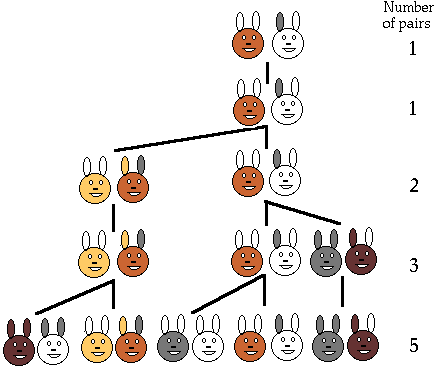
"Suppose a newly-born pair of rabbits, one male, one female, are put in a field. Rabbits are able to mate at the age of one month so that at the end of its second month a female can produce another pair of rabbits. Suppose that our rabbits never die and that the female always produces one new pair (one male, one female) every month from the second month on.
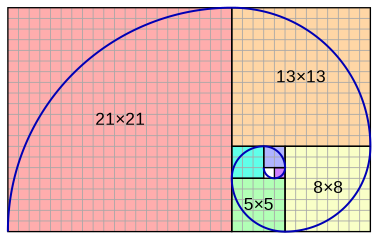
"Oh emperor, my wishes are simple. I only wish for this. Give me one grain of rice for the first square of the chessboard, two grains for the next square, four for the next, eight for the next and so on for all 64 squares, with each square having double the number of grains as the square before."
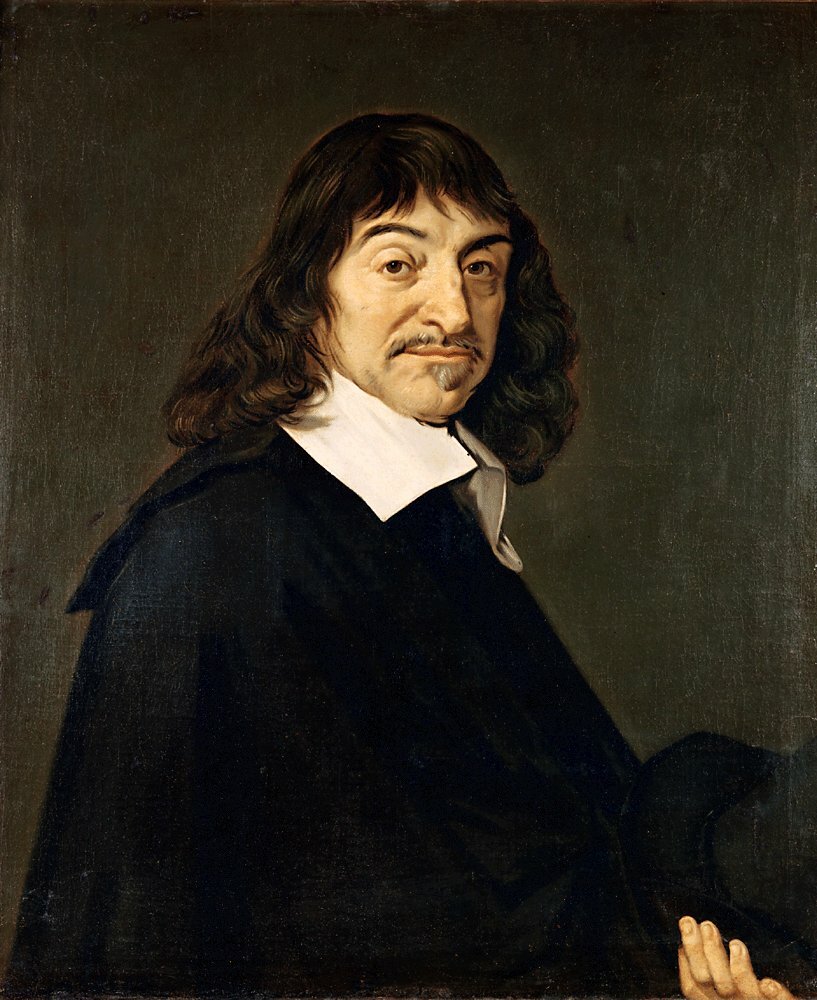
"I should like you to consider that these functions (including passion, memory, and imagination) follow from the mere arrangement of the machine’s organs every bit as naturally as the movements of a clock or other automaton follow from the arrangement of its counter-weights and wheels." (Descartes, Treatise on Man, p.108)
Machine as a projection of the human selfFaciamus machinam ad imaginem et similitudinem nostram.Let us make the machine in our image and likeness.
Rewind two centuries. Long before Babbage, long before steam, the same ancient appetite for mechanizing the mind was already stirring — in the Baroque.In 1642, at nineteen...
Gottfried Wilhelm Leibniz takes positional notation somewhere further: in 1703, he formally describes arithmetic in base 2 — binary.He was reportedly delighted to find the...
Rewind two centuries. Long before Babbage, long before steam, the same ancient appetite for mechanizing the mind was already stirring — in the Baroque.In 1642, at nineteen...
1854: George Boole, professor at Queen’s College Cork, publishes An Investigation of the Laws of Thought.His claim: reasoning itself can be calculated — like algebra...
"... it is beneath the dignity of excellent men to waste their time in calculation when any peasant could do the work just as accurately with the aid of a machine." (G.W.L, 1673)
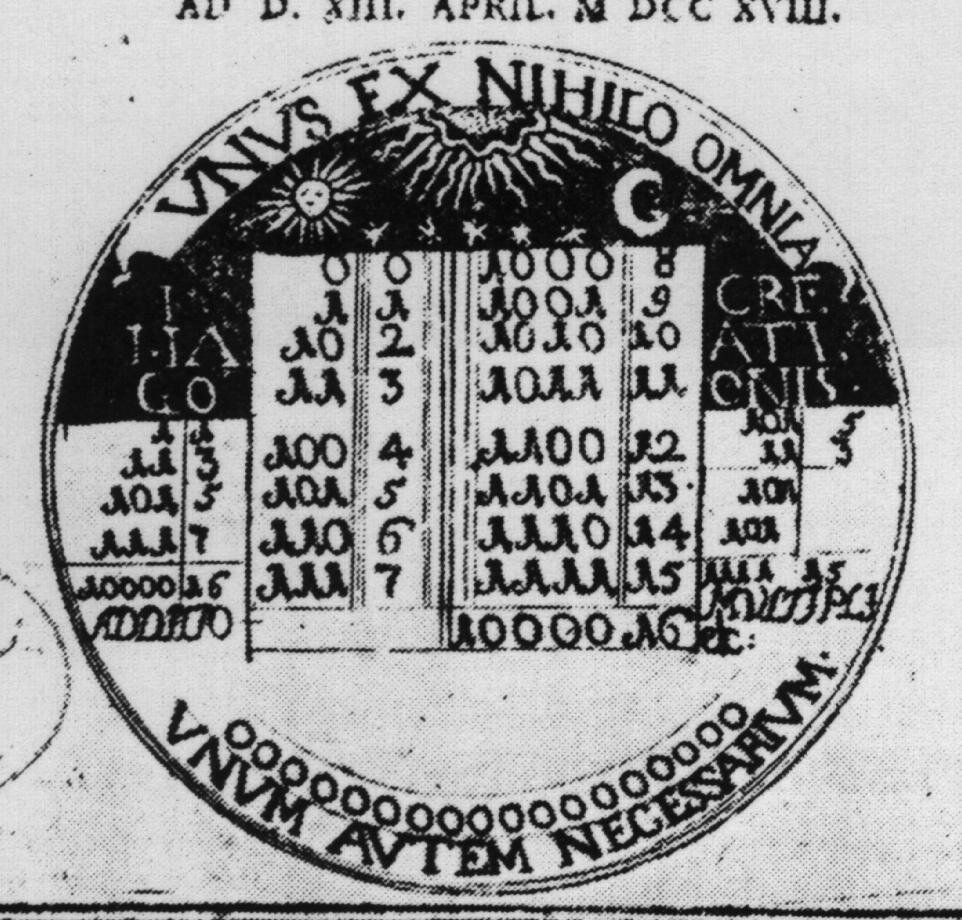
Gottfried Wilhelm Leibniz takes positional notation somewhere further: in 1703, he formally describes arithmetic in base 2 — binary.He was reportedly delighted to find the...
Rewind two centuries. Long before Babbage, long before steam, the same ancient appetite for mechanizing the mind was already stirring — in the Baroque.In 1642, at nineteen...
Please read :: http://bildung.digital.udk-berlin.de/prolegomena/handouts/Leibniz.pdf
Question of the day: why does counting in binary work — and what is a machine doing when it counts?You already know how: fold every 1 down, carry to the left, raise the fi...
In pairs. One of you counts in binary on one hand, from 0 up to 11. The other watches and says “stop!” at the first mistake.Swap. Then count from 0 1 1 1 (7) —...
Here is the thread we will follow: a number can be written down in many different ways — and the way you write it changes what you can do with it.That was true for Roman n...
By the early 1800s, the Industrial Revolution had already proven something remarkable: steam and gearwork could replace human muscle at scale.Joseph-Marie Jacquard's loom (1801)...
Charles Babbage (1791–1871) — mathematician, philosopher, mechanical engineer, and by most accounts a thoroughly restless Victorian gentleman.His Difference Engine w...
Augusta Ada King, Countess of Lovelace (1815–1852), daughter of Lord Byron, was trained rigorously in mathematics from childhood — and became Babbage's closest intel...
Note A, p. 694 :: Again, it [the Analytical Engine] might act upon other things besides number, were objects found whose mutual fundamental relations could be expressed by those of the abstract science of operations, and which should be also susceptible of adaptations to the action of the operating notation and mechanism of the engine . . . Supposing, for instance, that the fundamental relations of pitched sounds in the science of harmony and of musical composition were susceptible of such expression and adaptations, the engine might compose elaborate and scientific pieces of music of any degree of complexity or extent.
The distinctive characteristic of the Analytical Engine, and that which has rendered it possible to endow mechanism with such extensive faculties as bid fair to make this engine the executive right-hand of abstract algebra, is the introduction into it of the principle which Jacquard devised for regulating, by means of punched cards, the most complicated patterns in the fabrication of brocaded stuffs...We may say most aptly that the Analytical Engine weaves algebraical patterns just as the Jacquard-loom weaves flowers and leaves.
One more figure worth knowing, even briefly: George Boole (1815–1864), who in 1854 published The Laws of Thought — reducing logical reasoning itself to a kind of alg...
In which the reader is made acquainted with a most singular Algebra, wherein there are but two numbers, and the sum of one and one is nothing at all.Being an account of Mr. Bool...
1854: George Boole, professor at Queen’s College Cork, publishes An Investigation of the Laws of Thought.His claim: reasoning itself can be calculated — like algebra...
Boole discovered that these operations obey laws, like numbers do:lawin wordsa AND 1 = aAND with 1 changes nothinga AND 0 = 0AND with 0 kills everythinga OR 0 = aOR with 0 chang...

NOT flips: NOT 1 = 0, NOT 0 = 1.AND: true only if both are true (both thumbs up).OR: true if at least one is true.aba AND ba OR b0000010110011111
XOR (exclusive or): true if the two inputs differ — one thumb up, not both.aba XOR b000011101110Note the last row: 1 XOR 1 = 0. Remember it — it will carry the whole...
Note: rod logic (shall be used in nano-computers) operates in the same way
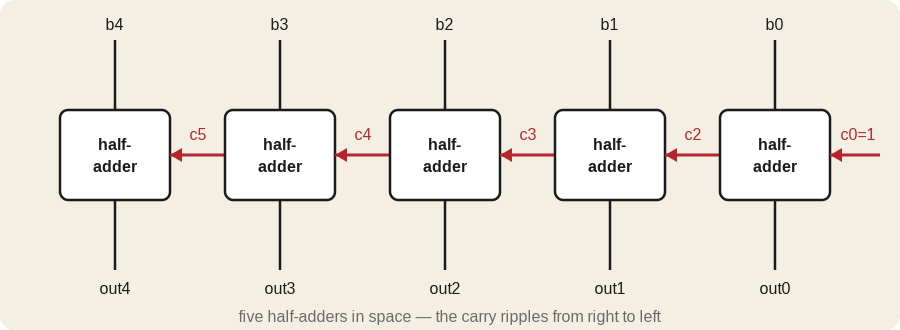
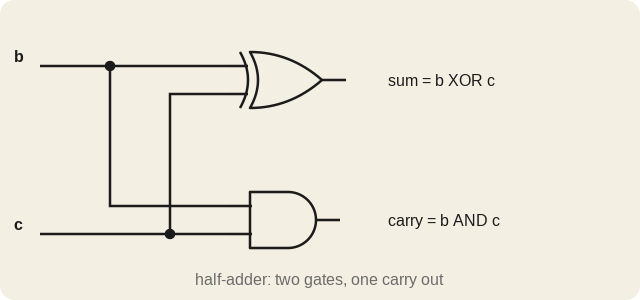
Our algorithm increment is not a special case: to add 1, put a carry of 1 into the lowest position, then let every position run a half-adder.c0 = 1 (that is the “+1”...
| Rule | Input R | Input L | Input Carry | Output | Output Carry |
|---|---|---|---|---|---|
| 0 | 0 | 0 | 0 | 0 | 0 |
| 1 | 1 | 0 | 0 | 1 | 0 |
| 2 | 0 | 1 | 0 | 1 | 0 |
| 3 | 1 | 1 | 0 | 0 | 1 |
| 4 | 0 | 0 | 1 | 1 | 0 |
| 5 | 1 | 0 | 1 | 0 | 1 |
| 6 | 0 | 1 | 1 | 0 | 1 |
| 7 | 1 | 1 | 1 | 1 | 1 |
In which the reader is made acquainted with a most singular Algebra, wherein there are but two numbers, and the sum of one and one is nothing at all.Being an account of Mr. Bool...
Alone, then compare. Right hand = tape (thumb is the lowest bit). Left thumb = the state c.Raise your left thumb: you are adding 1. Now walk along the right hand, thumb to littl...
In pairs. Two roles. TAPE: write six cells on paper, e.g. 0 1 0 1 1 1, and cover all but the cell under the head with your hand. MACHINE: you have only a rule card (the table of...
Our algorithm increment is not a special case: to add 1, put a carry of 1 into the lowest position, then let every position run a half-adder.c0 = 1 (that is the “+1”...

Turn to your neighbour. Two minutes.What would a machine have to do for you to say “yes, it thinks”?Write the criterion down.We will test it at the end of the session.
early 14c., "to train or instruct in some specific subject," from Old French informer, enformer "instruct, teach" (13c.) and directly from Latin informare "to shape, give form to, delineate," figuratively "train, instruct, educate," from in- "into" (from PIE root *en "in") + formare "to form, shape," from forma "form". Sense of "communicate facts or news" first recorded late 14c.
Source: https://www.etymonline.com/word/inform
In which the reader is made acquainted with a most singular Algebra, wherein there are but two numbers, and the sum of one and one is nothing at all.Being an account of Mr. Bool...
1937: Claude Shannon, 21, writes his master’s thesis at MIT: A Symbolic Analysis of Relay and Switching Circuits.His discovery: electrical switches obey Boole’s alge...

Howard Gardner :: Frames of Mind / The Theory of Multiple Intelligences
David Goleman :: Emotional Intelligence : Why it can matter more than IQ
Singer et al. :: A Piaget Primer: How a Child Thinks
Murray & Herrnstein :: The Bell Curve: Intelligence and Class Structure in American Life (Achtung! Controversy)
Nick Bostrom :: Superintelligenz
Carlo M. Cipolla: The Basic Laws of Human Stupidity
Referat(s) welcome, Hausarbeit (5 SWS) possible. Note: Lecture of one of these books is mandatory for all those whose attendance will be between 1/2 and 2/3.who am I
who are You
is this a course for You ?
credits (2 ECTS for >75% attendance, +1 for referat/experiment)
Hausarbeit possible
need help ? (tutor: a.terzieva@udk-berlin.de)
Leistungsnachweis
signature-related issues
Smartphone & Feedback box
Greek muses
fostering of intelligence
evaluation of intelligence
Flynn effect
stupidity
Born in London, 23 June 1912. Mathematician: Cambridge, then Princeton.1936, aged 23: On Computable Numbers — the paper that defines the computer before any computer exist...
Learning and Adaptation
Reasoning & Problem Solving
Memory & Knowledge
Perception
Emotional Intelligence
Creativity
It's important to note that intelligence is still a topic of debate among psychologists and neuroscientists. Traditionally, intelligence was often measured using IQ (intelligence quotient) tests, but many experts now believe that IQ tests capture only a narrow slice of what constitutes human intelligence. Moreover, various cultures might emphasize different abilities or qualities when defining or valuing intelligence, so the concept can be both culturally and contextually relative.
Turn to your neighbour. Two minutes.What would a machine have to do for you to say “yes, it thinks”?Write the criterion down.We will test it at the end of the session.
Born in London, 23 June 1912. Mathematician: Cambridge, then Princeton.1936, aged 23: On Computable Numbers — the paper that defines the computer before any computer exist...
Look again at the rule table of our Turing machine — the one from the Alan session — and write the state as a bit: CARRY = 1, HALT = 0.state creads bwritesnext state...
In pairs. Two roles. TAPE: write six cells on paper, e.g. 0 1 0 1 1 1, and cover all but the cell under the head with your hand. MACHINE: you have only a rule card (the table of...
The tape holds a binary number: 1 0 1 1. The head stands on the rightmost digit. State: CARRY.CARRY reads 1 → write 0, move left, stay in CARRYCARRY reads 0 or blank →...
Look again at the rule table of our Turing machine — the one from the Alan session — and write the state as a bit: CARRY = 1, HALT = 0.state creads bwritesnext state...
A universal machine reads the rules of another machine from its tape and behaves like it.Program = data. Your laptop is such a machine; an app is just a long tape.And a program ...

"A TT is a way how to address the question "Can machines think?" in a scientifically plausible ye deeply empathic way. More concretely, Turing (1950) proposes that the performance of an AA under question shall be evaluated by a human judge J whose objective is to determine which among two entities - with whom J is in real-time interaction - is of human and which is of artificial nature." (Hromada, 2012)
You are going to hear two pieces of music. One is composed and performed by humans, another is composed and generated by an artificial system. You are going to hear both pieces twice. Subsequently, You are going to write down which piece (first or second) was composed and performed by human beings.
ELIZA (Weizenbaum, 1966): a few pattern rules, and some users confided in it anyway.The Chinese Room (Searle, 1980): symbols shuffled correctly, nothing understood.Recent contro...
Alan is a Matrix bot (@alan:udk.ai) running on our own server. You will chat with “Alan” — but behind him may be an AI persona or another student. Alan relays ...
https://www.eleceng.adelaide.edu.au/students/wiki/projects/images/9/95/Basic_Schematic.png


1994: Yahoo, Amazon founded; the first banner ad; first e-commerce transaction
1997: google.stanford.edu — the research project that would become Google
1999: cyberspace.cz
2001: Wikipedia launches; kyberia.sk
2003: Total Information Awareness program revealed
2004: Facebook founded
2006: "just setting up my twttr"; Google acquires YouTube; WikiLeaks founded
2009: the first Bitcoin block is mined
2010: Stuxnet discovered
2013: Edward Snowden reveals PRISM
2018: Cambridge Analytica data scandal; GDPR enters into force
How do You observe ?
By what sense do You prefer to observe ?
What do You observe ?
members of G1 move to the left and members of G2 move to the right.
Can You think of other examples of unsupervised learning and/or clustering ?
No direct guidance :: Learner L must identify patterns or relationships from raw input on her own.
Pattern discovery :: Observation often involves recognizing and understanding patterns in the environment, which mirrors what happens in unsupervised learning.
Learning from the environment :: L derives insights from the world or data without external labels or supervision.
See → do.Macaque premotor cortex (Rizzolatti, Parma): the same neurons fire when the monkey grasps and when it sees a grasp.A neural footprint of imitation: see → do.W...
In which the reader is made acquainted with a most singular Algebra, wherein there are but two numbers, and the sum of one and one is nothing at all.
Being an account of Mr. Boole’s Laws of Thought, set down in the year 1854 by a Professor of Queen’s College, Cork; of young Mr. Shannon’s relays, and the little gates that came of them; and of how one humble operation — the adding of One to a number — may be performed in three several fashions: by Logic, by Wire, and by the Machine of Mr. Turing.
Wherein the reader is required to lend a thumb, and to consult a partner upon sundry occasions; wherein it is demonstrated that the Carry may very conveniently be kept upon the thumb of the other hand; and wherein, at the last, Logic, Circuit and Machine are discovered to be one and the same contrivance in three different coats.
another Victorian gentleman at 17 years of age "a thought struck him suddenly, which became the foundation of all his future discoveries" author of "Laws of Thou...
RuleInput RInput LInput CarryOutputOutput Carry 000000 110010 201010 311001 400110 510101 601101 711111
mathematician, electrical engineer, cryptographer, juggler & unicycler "father of information theory" (1937) A Symbolic Analysis of Relay and Switching Circuits ...
CircuitAlgebraswitch open / closed0 / 1two switches in seriesAND (A·B)two switches in parallelOR (A+B)normally-closed contactNOT (A′)A structure-preserving map (a m...
It is misleading then to talk of thinking as of a “mental activity”. We may say that thinking is essentially the activity of operating with signs. This activity is performed by the hand, when we think by writing; by the mouth and larynx, when we think by speaking; and, if we think by imagining signs or pictures I can give you no agent that thinks.
If then you say that in such cases the mind thinks, I would only draw your attention to the fact that you are using a metaphor, that here the mind is an agent in a different sense from that in which the hand can be said to be the agent in writing.
If again we talk about the locality where thinking takes place we have a right to say that this locality is the paper on which we write; or the mouth which speaks.
— Ludwig Wittgenstein, The Blue Book (1933–1934)
Keep this in mind today: in our exercises, whose hand does the thinking, and where is the carry kept?
Question of the day: why does counting in binary work — and what is a machine doing when it counts?
You already know how: fold every 1 down, carry to the left, raise the first 0. You did it with a hand and with a Turing machine.
Today we ask why. One algorithm — add 1 — seen in three languages: Logic (Boole), Wire (Shannon), Machine (Turing).
Bring a thumb. Bring a partner. Both will be needed.
In pairs. One of you counts in binary on one hand, from 0 up to 11. The other watches and says “stop!” at the first mistake.
Swap. Then count from 0 1 1 1 (7) — what happens, and who remembers the carry while the fingers fold down?
Keep that question. The rest of the session is its answer.
1854: George Boole, professor at Queen’s College Cork, publishes An Investigation of the Laws of Thought.
His claim: reasoning itself can be calculated — like algebra — if every statement is reduced to just two values: 1 (true) and 0 (false).
Leibniz’s old dream (calculemus!), now with rules.
A thumb is a perfect Boolean variable: up = 1, down = 0.
one of the last big polymaths advanced disciplines of philosophy (monadology, theodicea, why is there something rather than nothing?), mathematics (probability theory,...
another Victorian gentleman at 17 years of age "a thought struck him suddenly, which became the foundation of all his future discoveries" author of "Laws of Thou...
united algebra and logic replaced propositional form of Aristotle's logic to equation-like formulae and introduced "laws" which can solve them logical formulae ...
NOT flips: NOT 1 = 0, NOT 0 = 1.
AND: true only if both are true (both thumbs up).
OR: true if at least one is true.
| a | b | a AND b | a OR b |
|---|---|---|---|
| 0 | 0 | 0 | 0 |
| 0 | 1 | 0 | 1 |
| 1 | 0 | 0 | 1 |
| 1 | 1 | 1 | 1 |
XOR (exclusive or): true if the two inputs differ — one thumb up, not both.
| a | b | a XOR b |
|---|---|---|
| 0 | 0 | 0 |
| 0 | 1 | 1 |
| 1 | 0 | 1 |
| 1 | 1 | 0 |
Note the last row: 1 XOR 1 = 0. Remember it — it will carry the whole session.
A lamp at the top of a staircase, a switch at the bottom, a switch at the top: either switch should toggle the lamp.Truth table: lamp = 1 exactly when the two switches differ. W...
Written 1945 as a classified report, published 1949, a year after the great paper on communication.Proof: the one-time pad is perfectly secret if the key is random, as long as t...
In everyday speech “or” is ambiguous. Logic must not be.
| sentence | reading |
|---|---|
| “Soup or salad?” (the menu) | XOR — not both (unless you pay extra) |
| “Smoke or heat sets off the alarm.” | OR — and certainly if both |
| “Are you leaving today or tomorrow?” | XOR — you cannot leave twice |
| “Bring a note from your doctor or your parents.” | OR — two notes are no problem |
| “Milk or sugar in your coffee?” | unclear! Both, surely? |
Latin had two words for it: vel (inclusive: “one or the other or both”) and aut (exclusive: aut Caesar aut nihil). English has just one — and relies on you to guess.
A lamp at the top of a staircase, a switch at the bottom, a switch at the top: either switch should toggle the lamp.Truth table: lamp = 1 exactly when the two switches differ. W...
Lawyers and programmers cannot afford to guess:
Contracts write “and/or” (inclusive) and “either … or …, but not both” (exclusive), because courts have argued over a bare “or”.
Programming languages give the two meanings different symbols: a || b (or) and a ^ b (xor).
Linguists note that the exclusive reading is often not part of the word at all: we infer “not both” (“if she could say ‘and’, she would have”).
This is Boole’s move: give each meaning its own symbol, and the ambiguity disappears — for a machine, there is no “you know what I mean”.
You are in possesion of a card set. On one side there is a shape, a circle or a triangle. On the other side there is a colour, blue or yellow. There is one rule: If there is a c...
In pairs. Take turns reading these sentences aloud; your partner decides OR or XOR and defends the choice with one sentence about the situation:
• “You can pay by card or cash.” • “Students or staff may enter.” • “A fine of fifty euros or three days in jail.” • “She speaks German or French.” • “Take the lift or the stairs.”
Which ones did you disagree on? Notice what you used to decide: not the word “or”, but knowledge of the world.
Now write one real sentence of your own in which the two readings lead to different consequences — a rule, a promise, a threat. Swap, and rewrite your partner’s so it can only be read one way.
In pairs. Each of you hides a thumb behind your back (up = 1, down = 0) and shows it on three. The teacher calls the gate:
| a | b | AND | OR | XOR | NAND |
|---|---|---|---|---|---|
| 0 | 0 | 0 | 0 | 0 | 1 |
| 0 | 1 | 0 | 1 | 1 | 1 |
| 1 | 0 | 0 | 1 | 1 | 1 |
| 1 | 1 | 1 | 1 | 0 | 0 |
Show thumbs. As a pair, say the output before checking the table — then check it.
Reverse round: the teacher says gate and output (“XOR gives 1”); you show a pair of thumbs that produces it. Is the answer always unique? For which calls is there only one?
Boole discovered that these operations obey laws, like numbers do:
| law | in words |
|---|---|
a AND 1 = a | AND with 1 changes nothing |
a AND 0 = 0 | AND with 0 kills everything |
a OR 0 = a | OR with 0 changes nothing |
a AND a = a | repeating yourself adds nothing |
a AND (NOT a) = 0 | nothing is both true and false |
NOT(a AND b) = (NOT a) OR (NOT b) | De Morgan (Boole’s contemporary) |
Laws like these let you simplify circuits and programs by pure calculation — no thumbs needed.
united algebra and logic replaced propositional form of Aristotle's logic to equation-like formulae and introduced "laws" which can solve them logical formulae ...
Why is it called algebra? Because the operations behave like arithmetic on 0 and 1:
AND is multiplication: a · b. NOT is 1 − a.
XOR is addition — but one that forgets the carry (addition modulo 2): 1 + 1 = 0.
Add two single bits properly and look at the two digits of the answer:
| a + b | = carry, sum | carry | sum |
|---|---|---|---|
| 0 + 0 | 00 | 0 | 0 |
| 0 + 1 | 01 | 0 | 1 |
| 1 + 0 | 01 | 0 | 1 |
| 1 + 1 | 10 | 1 | 0 |
The sum digit is XOR. The carry digit is AND. Arithmetic is logic.
CircuitAlgebraswitch open / closed0 / 1two switches in seriesAND (A·B)two switches in parallelOR (A+B)normally-closed contactNOT (A′)A structure-preserving map (a m...
1937: Claude Shannon, 21, writes his master’s thesis at MIT: A Symbolic Analysis of Relay and Switching Circuits.
His discovery: electrical switches obey Boole’s algebra. Two switches in series = AND (current flows only if both are closed). In parallel = OR. A relay that opens when energised = NOT.
So any Boolean formula can be built out of hardware — and any circuit can be checked by algebra.
The little symbols for such components are called gates:
mathematician, electrical engineer, cryptographer, juggler & unicycler "father of information theory" (1937) A Symbolic Analysis of Relay and Switching Circuits ...
Master’s thesis at MIT, 1937; published 1938; awarded the Alfred Noble Prize (1939).Question: how to design a relay circuit systematically?Answer: write it down as Boolean...
CircuitAlgebraswitch open / closed0 / 1two switches in seriesAND (A·B)two switches in parallelOR (A+B)normally-closed contactNOT (A′)A structure-preserving map (a m...
One gate is enough to build all the others: NAND (NOT(a AND b)), Sheffer 1913.
NOT a = a NAND a
a AND b = NOT (a NAND b) — i.e. a NAND followed by a NAND with itself.
a OR b = (NOT a) NAND (NOT b) — De Morgan at work.
A NAND gate in a chip costs four transistors. Billions of them, wired by algebra, are every computer you know.
CircuitAlgebraswitch open / closed0 / 1two switches in seriesAND (A·B)two switches in parallelOR (A+B)normally-closed contactNOT (A′)A structure-preserving map (a m...
In pairs. One of you is the architect, the other the inspector.
Architect: on paper, draw XOR using only NAND gates (hint: four NANDs suffice; one of them is shared).
Inspector: feed all four input pairs through the drawing with your thumbs — one gate at a time, out loud. Compare with the XOR table.
If a row fails, find which gate lied. Then swap roles and build OR.
Put the two observations together: to add two bits b and c you need exactly two gates.
sum = b XOR c carry = b AND c
This tiny circuit is called the half-adder. All arithmetic in your phone is built from it and its relatives.
Our algorithm increment is not a special case: to add 1, put a carry of 1 into the lowest position, then let every position run a half-adder.
c0 = 1 (that is the “+1”)
for every bit bi, from right to left:outi = bi XOR cici+1 = bi AND ci
The lowest bit has it easiest: b XOR 1 = NOT b — it always flips. Every higher bit flips only if the carry reached it — and the carry survives only through a chain of 1s.
Init: Set up Your inputs. Carry is zero. Start from the rightmost position (represented by thumb). Apply the transition rule (if necessary, flip the carry to an opposi...
In pairs. Four numbers: 0101, 0111, 1011, 1111. Increment each using only the two formulas — no counting.
Split the labour like a circuit: one of you computes every XOR, the other every AND and keeps the carry. Fill in a table with columns b, c, out, c′ for each position, right to left.
Check against finger counting. Which number made the carry travel farthest? What is c after the last position of 1111?
Build the circuit literally: one half-adder per bit, the carry wired from each to its left neighbour.
It is called a ripple-carry circuit: change the input and the carry ripples through the chain like a row of dominoes.
A 64-bit number needs 64 adders. The algorithm is spread out in space.
Now the other idea. Do not build five adders. Build one and walk it along the number.
Each step it reads one bit from a tape, computes XOR and AND, writes the result, and moves one cell to the left.
But then the carry from this step must wait for the next one. Something must remember it. That memory is the machine’s state.
The memory is a state stored in relays: “in cell X, go north”.The mouse is a finite state machine whose table gets written by experience.Critics: the intelligence is...
Look again at the rule table of our Turing machine — the one from the Alan session — and write the state as a bit: CARRY = 1, HALT = 0.
| state c | reads b | writes | next state | move |
|---|---|---|---|---|
| 1 (CARRY) | 0 | 1 | 0 (HALT) | left |
| 1 (CARRY) | 1 | 0 | 1 (CARRY) | left |
| 0 (HALT) | 0 | 0 | 0 | — |
| 0 (HALT) | 1 | 1 | 0 | — |
Writes = b XOR c. Next state = b AND c. The rule table of the machine is the half-adder’s truth table.
A Turing machine is a half-adder with a memory and a moving head. The carry is the thumb of the other hand.
A "theoretical" machine consisting of tape with discrete symbols reading/writing header table of rules tape-moving mechanism Visualization of the Tur...
The memory is a state stored in relays: “in cell X, go north”.The mouse is a finite state machine whose table gets written by experience.Critics: the intelligence is...
Alone, then compare. Right hand = tape (thumb is the lowest bit). Left thumb = the state c.
Raise your left thumb: you are adding 1. Now walk along the right hand, thumb to little finger. At every finger say out loud: “out = b XOR c” (set the finger to that value) and “c = b AND c” (set your left thumb to that).
Once the left thumb is down you may stop — nothing further can change.
Count from 0 to 31 this way. Then 31 + 1: the left thumb is still up after the little finger. That is the carry that fell off the tape — overflow. Turing’s tape is infinite; your hand is not.
RuleInput RInput LInput CarryOutputOutput Carry 000000 110010 201010 311001 400110 510101 601101 711111
In pairs. Two roles. TAPE: write six cells on paper, e.g. 0 1 0 1 1 1, and cover all but the cell under the head with your hand. MACHINE: you have only a rule card (the table of the previous folio) and your left thumb as the state. You may never see the whole number.
Loop: MACHINE says “read!” — TAPE reveals the bit under the head. MACHINE looks up the row and says “write w, move left”, updating the thumb. TAPE writes and moves the head one cell left. Stop when the thumb is down.
Run 010111, 001111, 111111. Convert to decimal to check. What happens in the last run when the head falls off the tape?
Swap roles. Afterwards discuss: did either of you ever need to know what number it was? Where, physically, was the carry stored?
RuleInput RInput LInput CarryOutputOutput Carry 000000 110010 201010 311001 400110 510101 601101 711111
A "theoretical" machine consisting of tape with discrete symbols reading/writing header table of rules tape-moving mechanism Visualization of the Tur...
In pairs. First: the forgetful machine. It has no thumb: at every cell it behaves as if c = 1 (it always flips the bit and always moves on).
Run it on 0101. What should the answer be? Which inputs does the forgetful machine happen to get right, among the sixteen four-bit numbers?
Then the challenge: run it backwards. Design a rule table for subtract 1 (state BORROW) — hint: it is the increment table with the roles of 0 and 1 exchanged. Test it by counting down from 8 on your hands.
Check yourselves: BORROW reads 0 → write 1, move left, stay in BORROW; BORROW reads 1 → write 0, HALT. In algebra: out = b XOR w, w′ = (NOT b) AND w. (And the forgetful machine is right on 0111 and 1111 only.)
| Logic (Boole 1854) | Wire (Shannon 1937) | Machine (Turing 1936) | |
|---|---|---|---|
| what it is | formulas | circuit of gates | tape, head, states |
| sum digit | out = b XOR c | XOR gate | write rule |
| carry | c′ = b AND c | AND gate + wire | next state (thumb) |
| many bits | same formula for each i | a chain: space | one gate pair, repeated: time |
Same algorithm, three notations. Algebra says what, gates say with what, the machine says in what order.
And the translation between them is mechanical — which is exactly why computers can exist.
Every neural network, every language model, runs on chips made of billions of gates just like the ones you drew today — XOR, AND, NAND, wired by algebra and clocked through time.
When people say “the machine computes”, this is all it means: logic, laid out in space, unrolled in time.
Learning does not change that. It changes only which numbers sit in the tape. Next time: how those numbers came to be tuned — Claude, Marvin, John and the others.
In pairs, three minutes: explain to each other, without notes, why the sum digit is XOR and the carry is AND.
Then answer the question of the day in two sentences: why does counting in binary work, and what is a machine doing when it counts?
Write down where your thumb was needed. That is the whole difference between a calculator and a table of formulas: memory.
Is there something you like about this seminar?
Is there something you don’t like?
Is there something new and useful you learned during this seminar?