cast off

From Claude v0.0.1 to John, Marvin &c.

18.11.2026 · AE561118
In which the reader is made acquainted with a young gentleman of Michigan who, observing that the wires of a telephone exchange could be made to reason, taught the whole world to count in Bits; who rode a unicycle through the corridors of the Laboratory, juggled upon it, and built a Machine whose sole purpose was to switch itself off.Being a narrative of Mr. Claude Elwood Shannon (1916–2001): of his Thesis and the marriage of Logic with Electricity; of the Great War and its Secret Telephony; of the Transistor, that most remarkable event of the Christmas of 1947; of the Mathematical Theory of Communication; of a Mouse that Learned its Way; and of a Summer at Dartmouth, in which Artificial Intelligence received its name.Wherein it is humbly submitted that the first Claude was not a language model at all.
scan to join on your phone
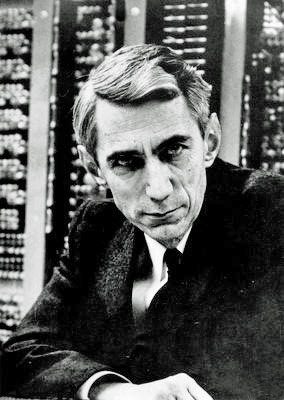
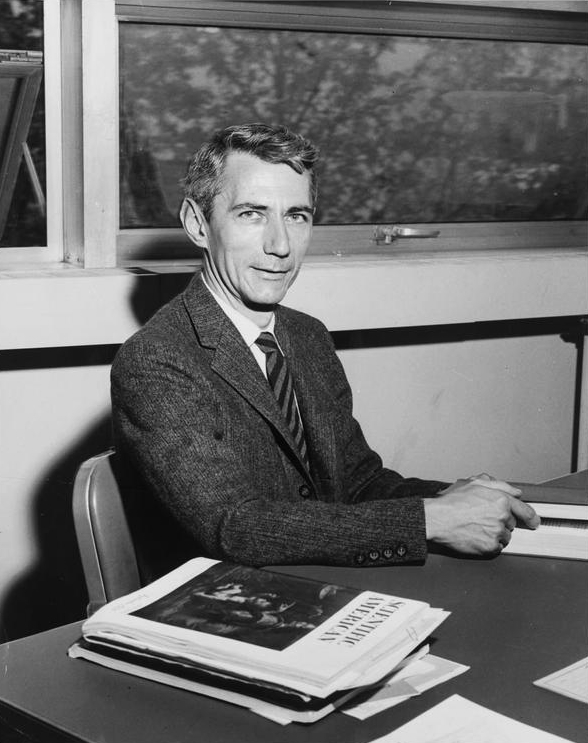
Claude Shannon at his desk, 1958 · MIT Museum / MIT Photo Service (public domain) · Wikimedia Commons
>> cross-referenced signal
  • ⇄ The enigma remains
> click / swipe / arrow keys to begin_
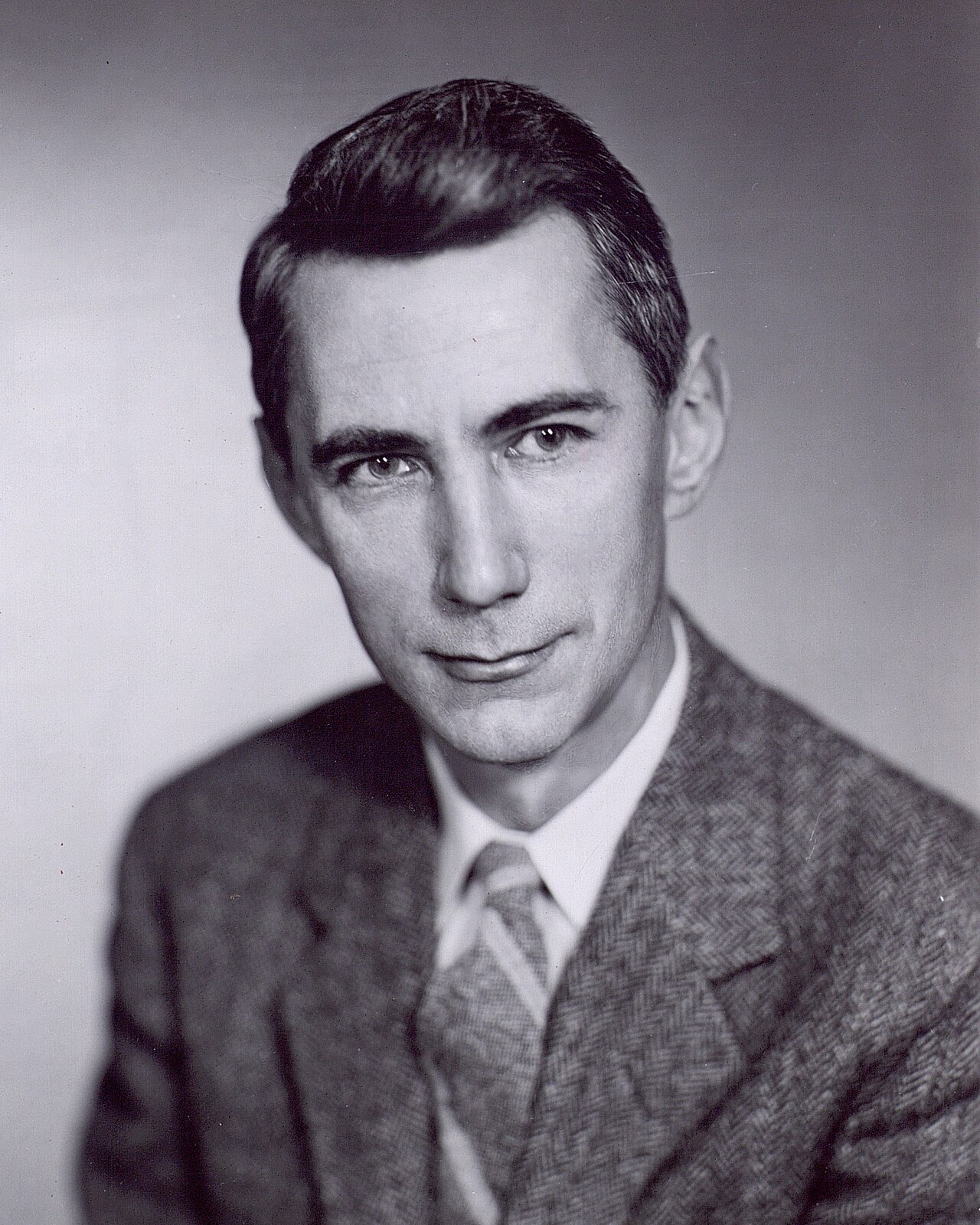
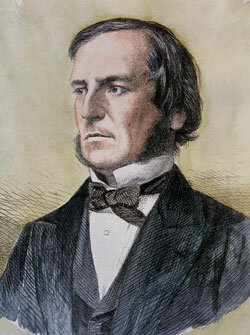
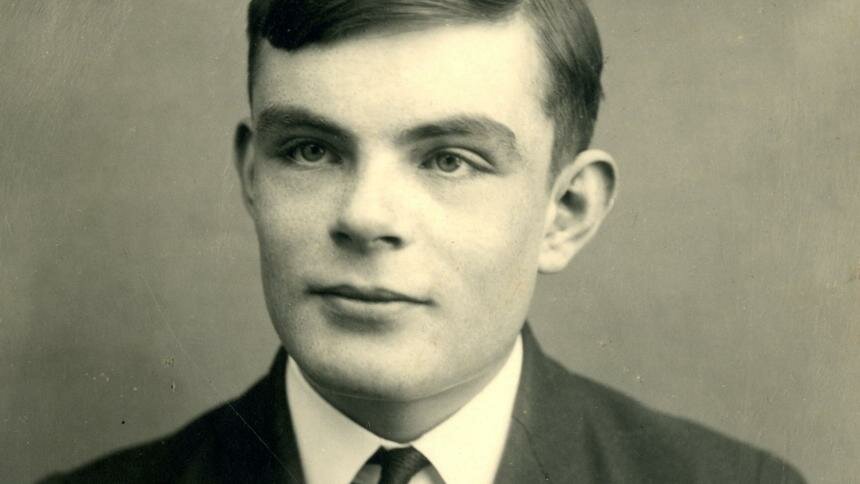
Claude Shannon, Bell Telephone Laboratories photograph · public domain · Wikimedia Commons

A Boy from Michigan

24.11.2026 · AE561124

1916–1936. A tinkerer who happened to study both electrical engineering and mathematics.

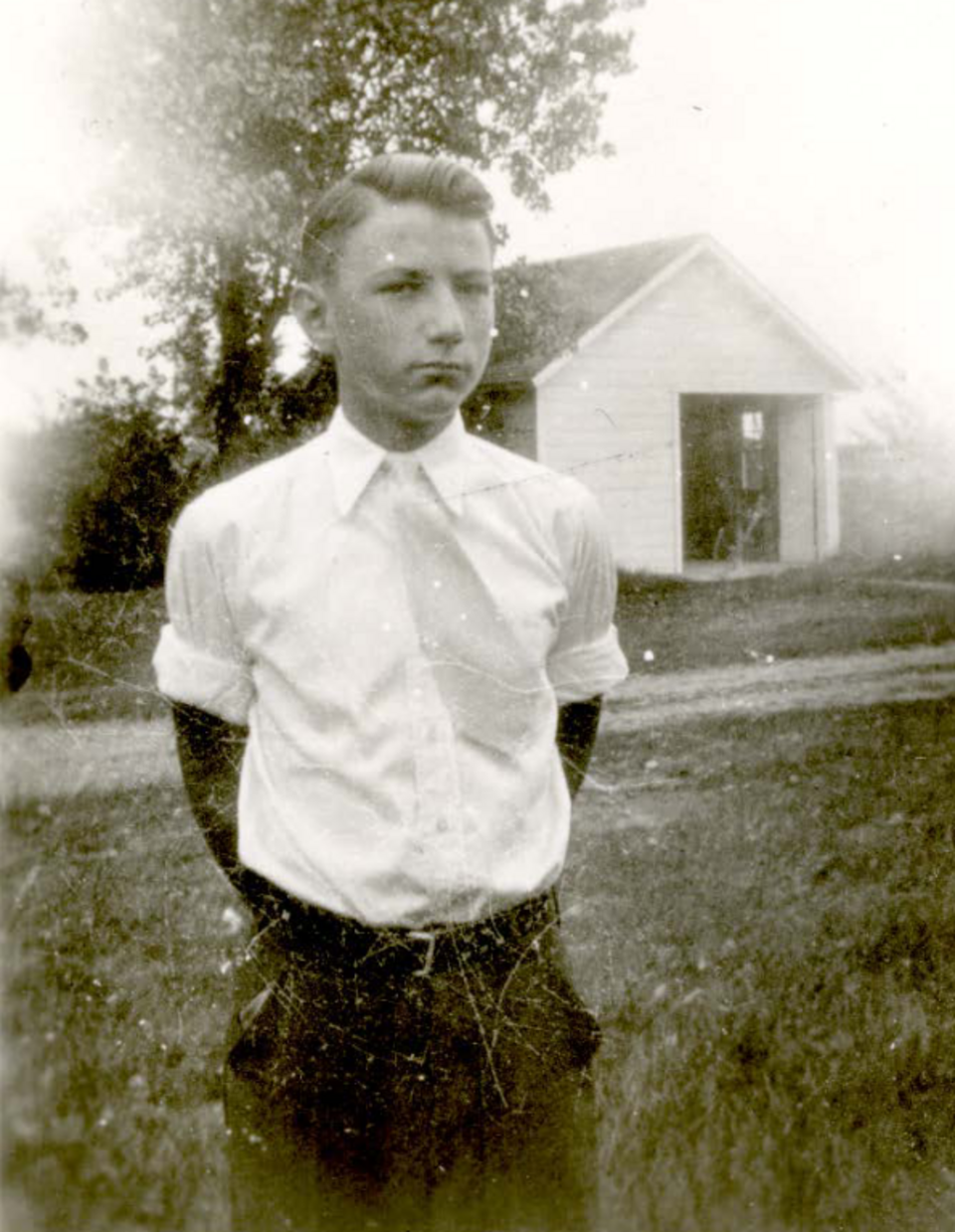
Claude Shannon as a youth, c. 1930 · public domain · Wikimedia Commons

Gaylord, Michigan

24.11.2026 · AE561124
  • Born 30 April 1916 in Petoskey, Michigan; grew up in Gaylord.
  • A boy of gadgets: model planes, a radio-controlled boat …
  • … and a telegraph to a friend’s house, run along a barbed-wire fence.
  • He admired Thomas Edison — and later learned that they were distant relatives.

Two Degrees, One Idea

24.11.2026 · AE561124
  • 1936: University of Michigan, a bachelor’s degree in both electrical engineering and mathematics.
  • In a philosophy course he met George Boole’s Laws of Thought (1854) — algebra of True and False.
  • In an engineering course he met the relay: a switch driven by a coil.
  • Nobody had yet put the two on the same table.
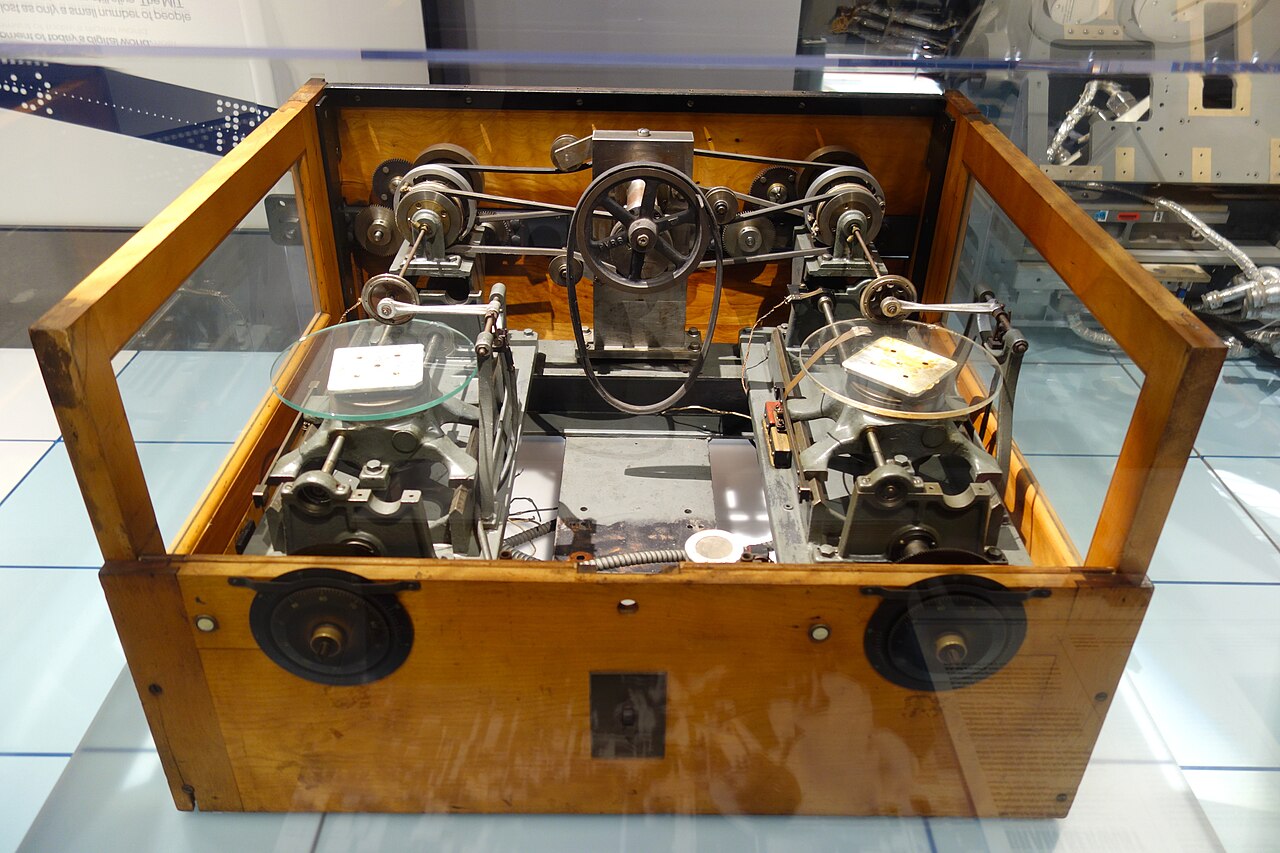
Integrator unit of the Differential Analyzer, MIT, by Daderot · CC0 · Wikimedia Commons

The Master’s Thesis (1937)

24.11.2026 · AE561124

“A Symbolic Analysis of Relay and Switching Circuits” — the moment when logic and electricity were found to be the same thing.

Integrator unit of the Differential Analyzer, MIT Museum, photo by Daderot · CC0 · Wikimedia Commons

Vannevar Bush’s Differential Analyzer

24.11.2026 · AE561124
  • 1936: Shannon goes to MIT and becomes research assistant on Vannevar Bush’s Differential Analyzer.
  • A room-sized analog computer: shafts, discs and wheels solving differential equations.
  • Its control circuits consisted of hundreds of electromechanical relays.
  • Designing them was done by trial, intuition and drawing: there was no theory.

A Symbolic Analysis of Relay and Switching Circuits

24.11.2026 · AE561124
  • Master’s thesis at MIT, 1937; published 1938; awarded the Alfred Noble Prize (1939).
  • Question: how to design a relay circuit systematically?
  • Answer: write it down as Boolean algebra, simplify the algebra, and read the circuit back off the formula.
  • The same algebra also works the other way: a circuit can calculate a logical statement.
>> cross-referenced signal
  • ⇄ A Relay Is a Logical Switch

The Morphism: Boole ↔ Wire

24.11.2026 · AE561124
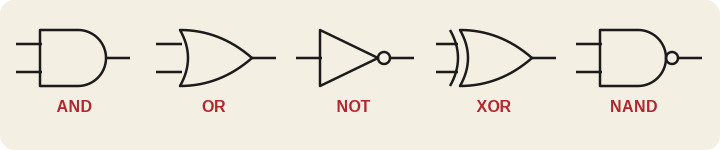
CircuitAlgebra
switch open / closed0 / 1
two switches in seriesAND (A·B)
two switches in parallelOR (A+B)
normally-closed contactNOT (A′)
  • A structure-preserving map (a morphism) between two worlds that nobody had connected.
  • Everything proven in the algebra holds for the wires — and the reverse.
  • This is the bridge crossed in the last session: logic → gates → machine.
>> cross-referenced signal
  • ⇄ Logic, Gates, Machine
  • ⇄ Algebra, Really
  • ⇄ A Relay Is a Logical Switch
  • ⇄ NAND Is Enough

Exercise · The Staircase Lamp

24.11.2026 · AE561124

A lamp at the top of a staircase, a switch at the bottom, a switch at the top: either switch should toggle the lamp.

  • Truth table: lamp = 1 exactly when the two switches differ. Which gate is that?
  • In couples: one partner is switch A, the other switch B (hand up = 1). A third person is the lamp. Prove the table.
  • Write it as a formula (A·B′ + A′·B) and draw it as series/parallel wiring.
  • Real two-way switches use a clever crossover wiring. Why is that XOR?
>> cross-referenced signal
  • ⇄ The Fourth: XOR
  • ⇄ Which “or” Do You Mean?

Most Important Thesis of the Century?

24.11.2026 · AE561124
  • Psychologist Howard Gardner called it “possibly the most important, and also the most famous, master’s thesis of the century”.
  • Computer pioneer Herman Goldstine called it one of the most important master’s theses ever written.
  • Historians add a caveat: the ideas spread gradually; engineers did not change their habits overnight.
  • Whatever the verdict: it is where digital circuit design begins.
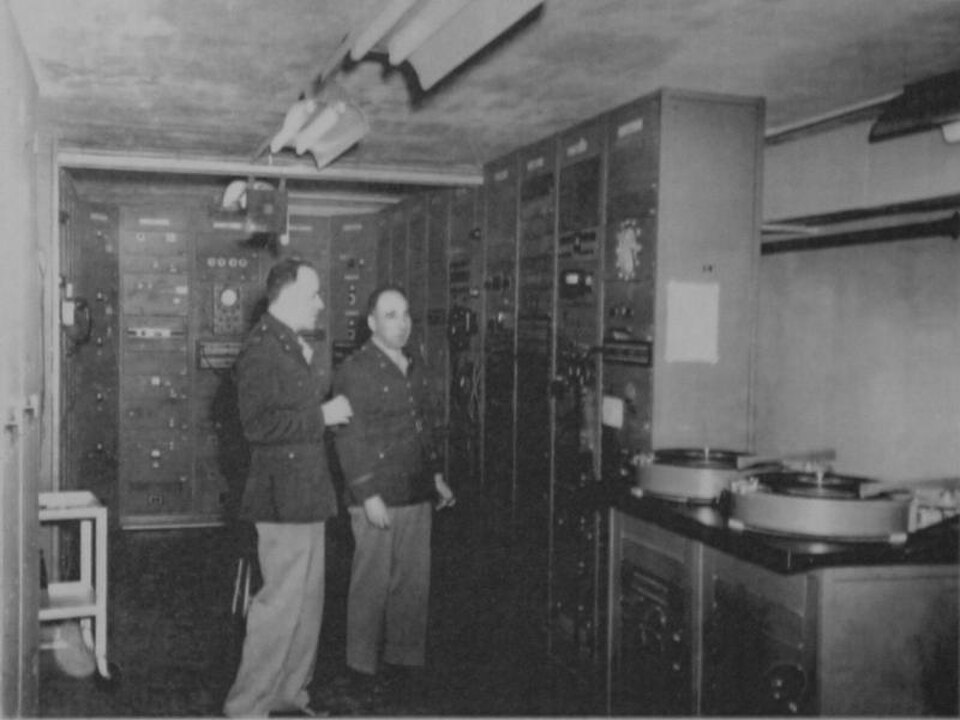
SIGSALY, 1943 (US Army Signal Corps) · public domain · Wikimedia Commons

War Years: Secrecy and Signals

24.11.2026 · AE561124

1940–1945. Mathematics in the service of secrets.

Claude Shannon, Bell Telephone Laboratories photograph · public domain · Wikimedia Commons

From Genetics to Bell Labs

24.11.2026 · AE561124
  • 1940: PhD at MIT — not on circuits, but “An Algebra for Theoretical Genetics”.
  • 1940–41: Institute for Advanced Study, Princeton (the neighbours: Einstein, Gödel, von Neumann).
  • 1941: joins Bell Telephone Laboratories, New York.
  • War work: fire-control for anti-aircraft guns and cryptography.
SIGSALY, 1943 (US Army Signal Corps) · public domain · Wikimedia Commons

SIGSALY: Encrypted Speech

24.11.2026 · AE561124
  • SIGSALY (1943): the secret telephone linking Churchill and Roosevelt.
  • Speech is sampled, quantised into levels and encrypted with a random key stored on vinyl records — one record per call.
  • In other words: digitised voice, decades before the digital age.
  • Shannon worked on secure speech and cryptography in just these years.

Turing Visits Bell Labs

24.11.2026 · AE561124
  • Early 1943: Alan Turing visits Bell Labs to inspect SIGSALY.
  • The two men meet over tea and talk about thinking machines.
  • Both had — from opposite sides — the idea of intelligence as symbol manipulation.
  • Two founders of computing, in one canteen: Turing (the machine) and Shannon (the information).
>> cross-referenced signal

Communication Theory of Secrecy Systems

24.11.2026 · AE561124
  • Written 1945 as a classified report, published 1949, a year after the great paper on communication.
  • Proof: the one-time pad is perfectly secret if the key is random, as long as the message, and never reused.
  • Encryption there is just XOR of message and key — the gate we met last session.
  • First time cryptography is placed on a mathematical basis.
>> cross-referenced signal
  • ⇄ The Fourth: XOR

Advising the Services

24.11.2026 · AE561124
  • During the war, Shannon was a consultant to the National Defense Research Committee.
  • 1951: letters between Bell Labs and the US cryptologic authorities show that his participation as a consultant was sought (von Neumann was involved).
  • Shannon himself, asked in a 1982 interview, avoided the question.
  • What is certain: the open and the secret research on communication developed side by side after 1948.
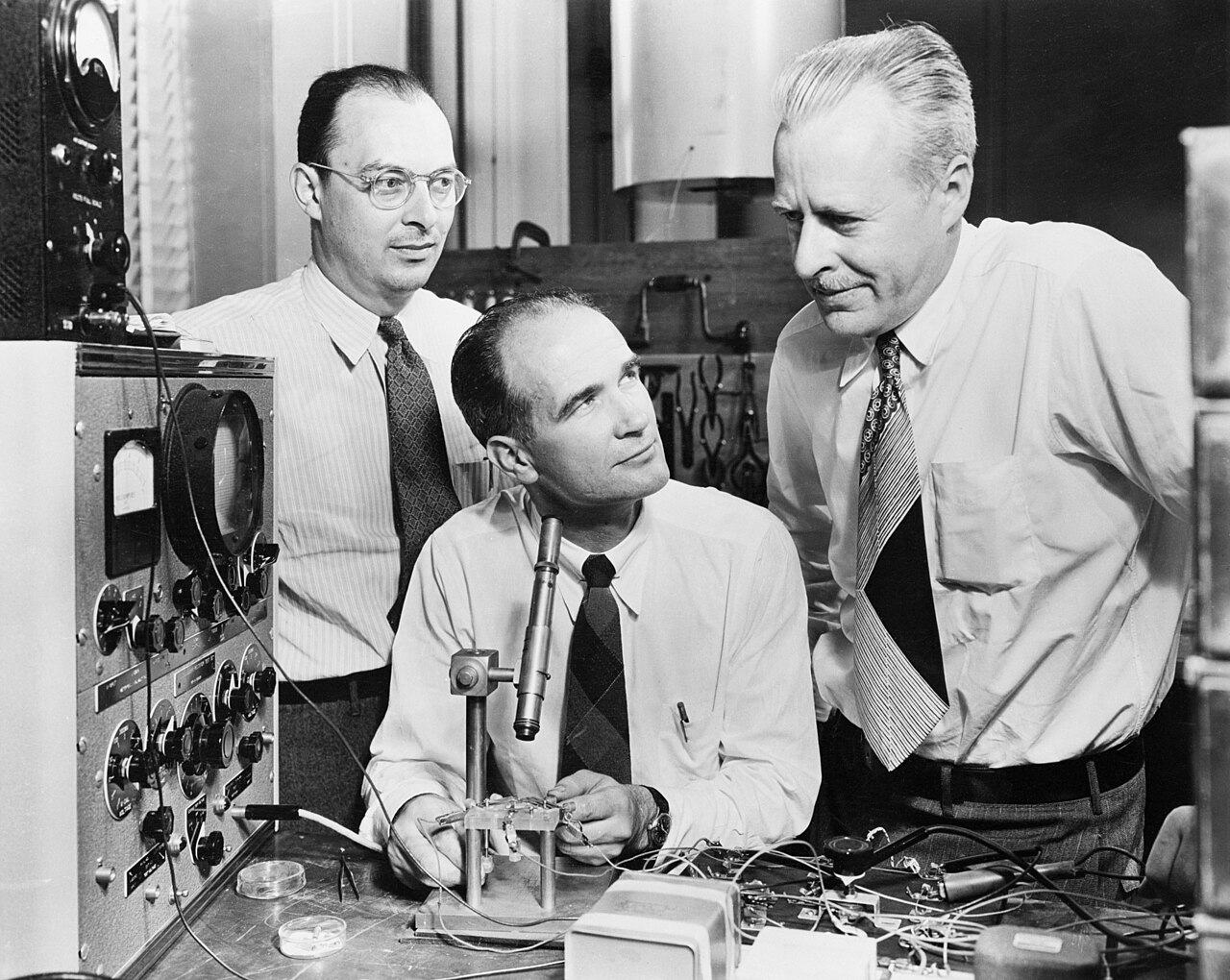
Bardeen, Shockley and Brattain at Bell Labs, 1948 · AT&T / public domain · Wikimedia Commons

Turning Point · December 1947: The Transistor

24.11.2026 · AE561124

In the same building where Shannon worked, a switch without moving parts was demonstrated for the first time.

Bardeen, Shockley and Brattain, 1948 · AT&T / public domain · Wikimedia Commons

Christmas at Bell Labs

24.11.2026 · AE561124
  • 16–23 December 1947: John Bardeen and Walter Brattain demonstrate a point-contact transistor to Bell Labs management; William Shockley leads the group.
  • Publicly announced on 30 June 1948.
  • 1956: Nobel Prize in Physics for all three.
  • Same company, same year as Shannon’s Mathematical Theory of Communication.
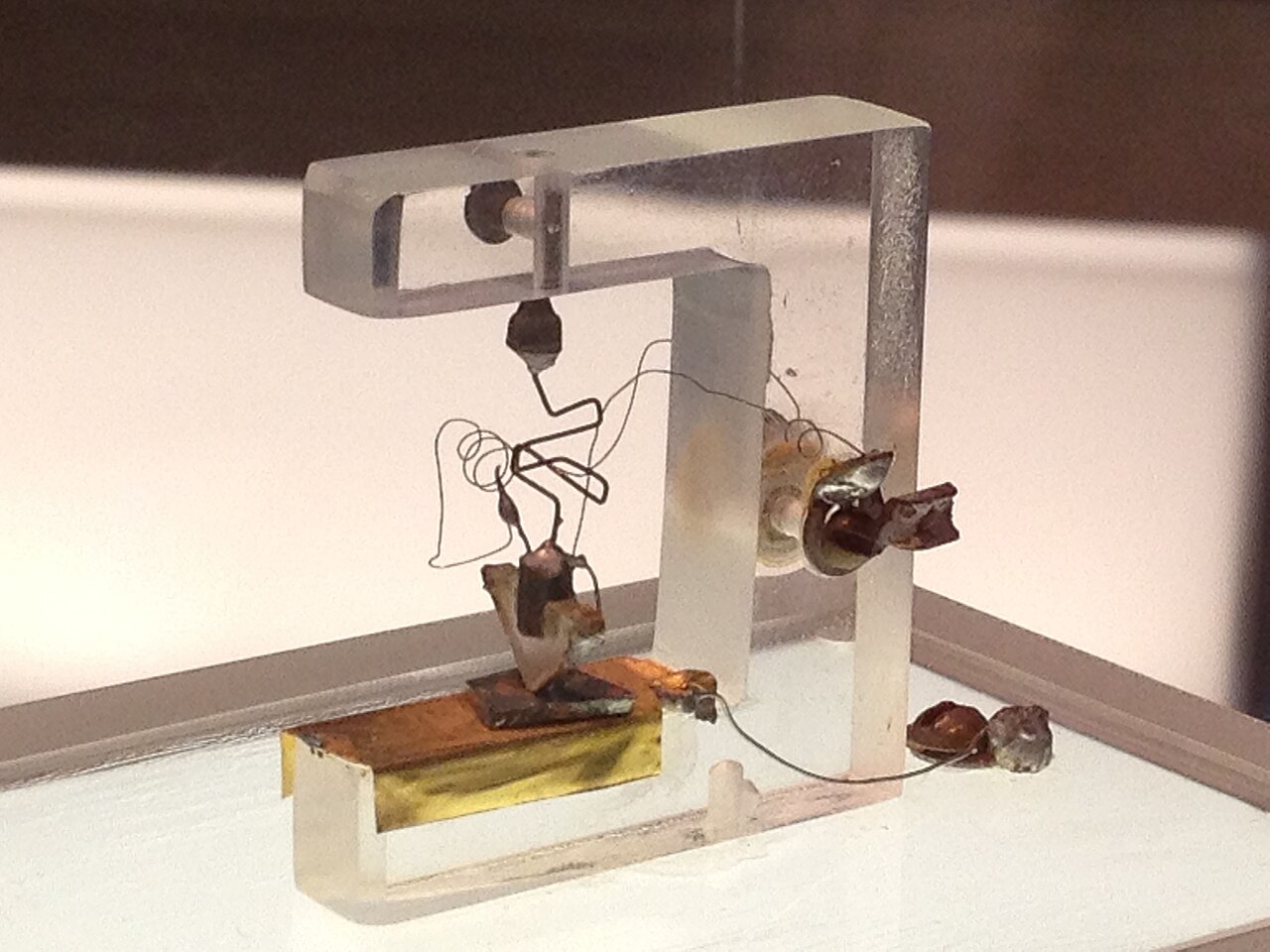
Point-contact transistor of the 1947 design, by Unitronic · CC BY-SA 3.0 · Wikimedia Commons

The First Transistor

24.11.2026 · AE561124
  • Germanium crystal, two gold contacts, a plastic wedge — a clumsy device.
  • It amplifies and, driven to extremes, switches.
  • A switch with no moving part, no glowing filament, hardly any heat.
  • The relay’s job — Shannon’s gate — can now be done by a speck of crystal.

Relay → Tube → Transistor

24.11.2026 · AE561124
SwitchPrincipleSpeed
Relaycoil moves a metal contactmilliseconds
Vacuum tubehot filament, electrons in vacuummicroseconds
Transistorcrystal, no moving partsnanoseconds and below
  • The algebra stays the same: AND, OR, NOT. Only the substrate changes.
  • This is why Shannon’s morphism scales from a few relays to billions of transistors.

When Bit Met Switch

24.11.2026 · AE561124
  • Shannon told us what a bit is and how many a message needs.
  • Shockley, Bardeen, Brattain made a bit physically cheap, fast and small.
  • Theory of the bit + hardware of the bit = the digital age.
  • Everything that follows in this session — and in this course — stands on that coincidence.
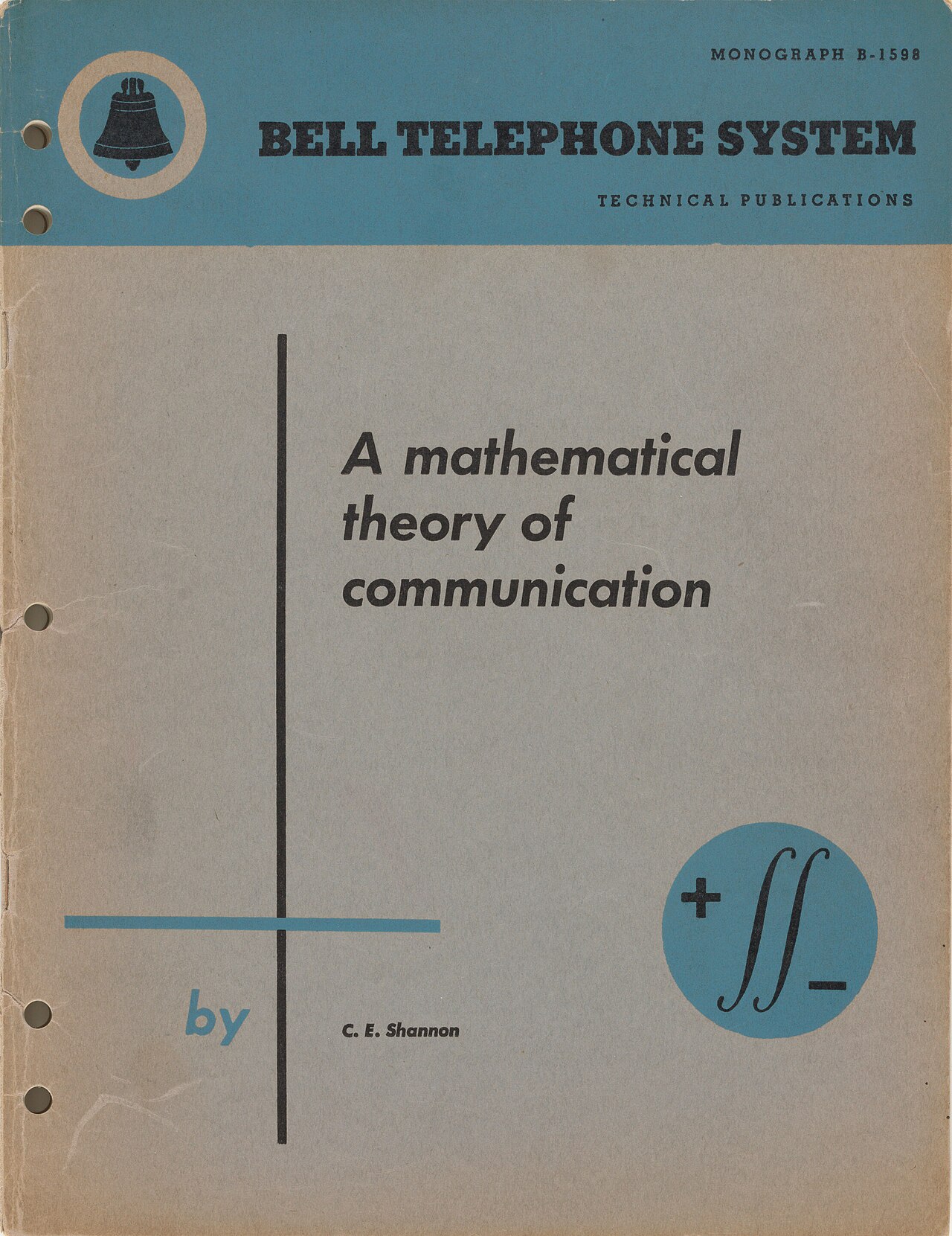
Offprint of the 1948 paper, Bell Telephone Laboratories · public domain · Wikimedia Commons

A Mathematical Theory of Communication (1948)

24.11.2026 · AE561124

Bell System Technical Journal, July and October 1948. “The fundamental problem of communication is that of reproducing at one point either exactly or approximately a message selected at another point.”

Fulltext (PDF) ↗

The Paper

24.11.2026 · AE561124
  • Published in two parts: July and October 1948, Bell System Technical Journal.
  • Later reissued as a book with Warren Weaver (1949).
  • Called the “Magna Carta of the Information Age”.
  • Founded a new science from nothing in about 80 pages.
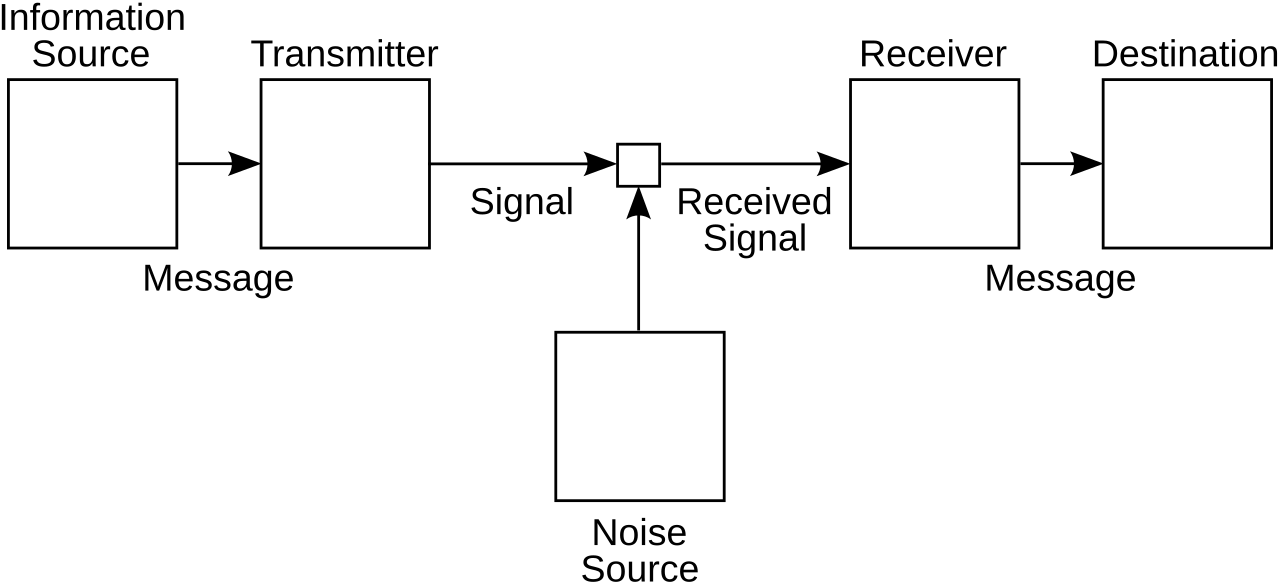
Shannon's communication system, diagram by Wanderingstan and Stannered · public domain · Wikimedia Commons

The Communication System

24.11.2026 · AE561124
  • Source → transmitter → channel (with noise) → receiver → destination.
  • The same diagram fits telegraph, telephone, radio, a conversation, DNA copying, a hard disk.
  • “The semantic aspects of communication are irrelevant to the engineering problem.” — meaning is not measured, only the choice among messages.

The Bit

24.11.2026 · AE561124
  • 1 bit = the information in a choice between two equally likely alternatives.
  • The word bit (“binary digit”) was suggested to Shannon by John W. Tukey.
  • Twenty questions: 20 yes/no answers separate 220 = 1,048,576 possibilities.
  • The amount of information is independent of what the message means.

Exercise · Twenty Questions

24.11.2026 · AE561124

In couples. One partner thinks of a number between 1 and 1000, the other asks only yes/no questions.

  • What is the best first question? (Why: it halves the possibilities.)
  • How many questions are enough for 1000 numbers? (10 — because 210 = 1024.)
  • Each good answer carries 1 bit. A question to which you already know the answer carries 0 bits.
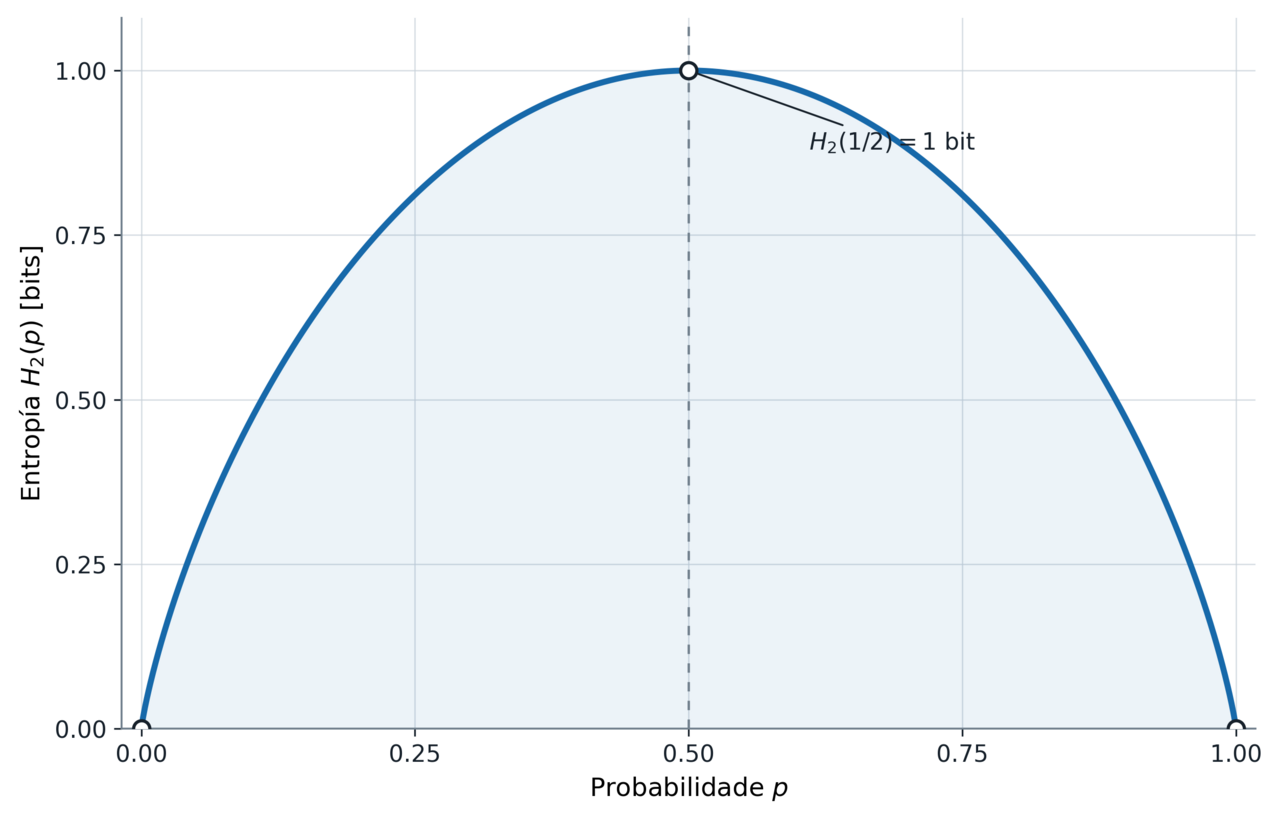
Binary entropy function, by Juanciño (labels in Portuguese) · CC BY-SA 4.0 · Wikimedia Commons

Surprise and Entropy

24.11.2026 · AE561124

H = − Σ pi · log2 pi

  • Entropy = average surprise per message, measured in bits.
  • Fair coin: 1 bit. Coin that gives heads 90% of the time: only 0.47 bit. A certain event: 0 bit.
  • Fair die: log2 6 ≈ 2.58 bits.
  • The more predictable the source, the less there is to say.

Why “Entropy”?

24.11.2026 · AE561124
  • The formula looks like the Boltzmann–Gibbs entropy of statistical mechanics.
  • A famous (and disputed) anecdote has John von Neumann advising Shannon to use the word: nobody knows what entropy really is, so in a debate he will always have the advantage.
  • Deeper reason: both measure how many microstates / messages are compatible with what we know.
  • Information and physics met here, and have not parted since.

The Two Great Theorems

24.11.2026 · AE561124
  • Source coding: a source of entropy H can be compressed to H bits per symbol — and no further. (ZIP, JPEG, MP3.)
  • Noisy-channel coding: every channel has a capacity C. Below C, communication can be made arbitrarily reliable by clever redundancy; above C, never.
  • Before 1948 engineers believed: more reliability = more power or slower speed. Shannon proved otherwise.
  • The proof was an existence proof: it took decades to build the codes (turbo, LDPC) that approach it.

Shannon’s Statistical English

24.11.2026 · AE561124

Approximating English by chains of words, 1948. Second-order word approximation from the paper:

“THE HEAD AND IN FRONTAL ATTACK ON AN ENGLISH WRITER THAT THE CHARACTER OF THIS POINT IS THEREFORE ANOTHER METHOD FOR THE LETTERS THAT THE TIME OF WHO EVER TOLD THE PROBLEM FOR AN UNEXPECTED”
  • Each word is chosen according to the word before it — a Markov chain.
  • Nonsense, but locally plausible English.
  • This is a language model — the ancestor of every GPT: predict the next token from what has come before.
  • Next-token prediction + more context + more data = the story of the last 75 years.
>> cross-referenced signal

Exercise · Guess the Next Letter

24.11.2026 · AE561124

In couples. Shannon’s own experiment of 1951.

  • Partner A chooses a sentence from a book and reveals it letter by letter, covering the rest.
  • Partner B guesses the next letter; A says “yes” or “no” until B is right.
  • Count the guesses. Early letters take many, later ones very few.
  • Result: English is highly redundant; Shannon estimated about 1 bit per letter — versus log2 27 ≈ 4.75 bits if letters were random.
Tech Icons: Claude Shannon — AT&T Tech Channel

Video · Tech Icons: Claude Shannon

24.11.2026 · AE561124
Theseus (1950) with Betty and Claude Shannon, MIT Museum, by Nickknack00 · CC BY 4.0 · Wikimedia Commons

Machines That Play and Learn

24.11.2026 · AE561124

1950–1952. Shannon turns the theory into contraptions.

Programming a Computer for Playing Chess

24.11.2026 · AE561124
  • 1950: Shannon’s paper — one of the first on computer chess, written before any machine could play it.
  • Core ideas still in use: an evaluation function for positions and minimax search of the move tree.
  • Type A programs look at all moves to fixed depth, Type B select promising lines — the human way.
  • He estimated about 10120 possible games: the Shannon number.
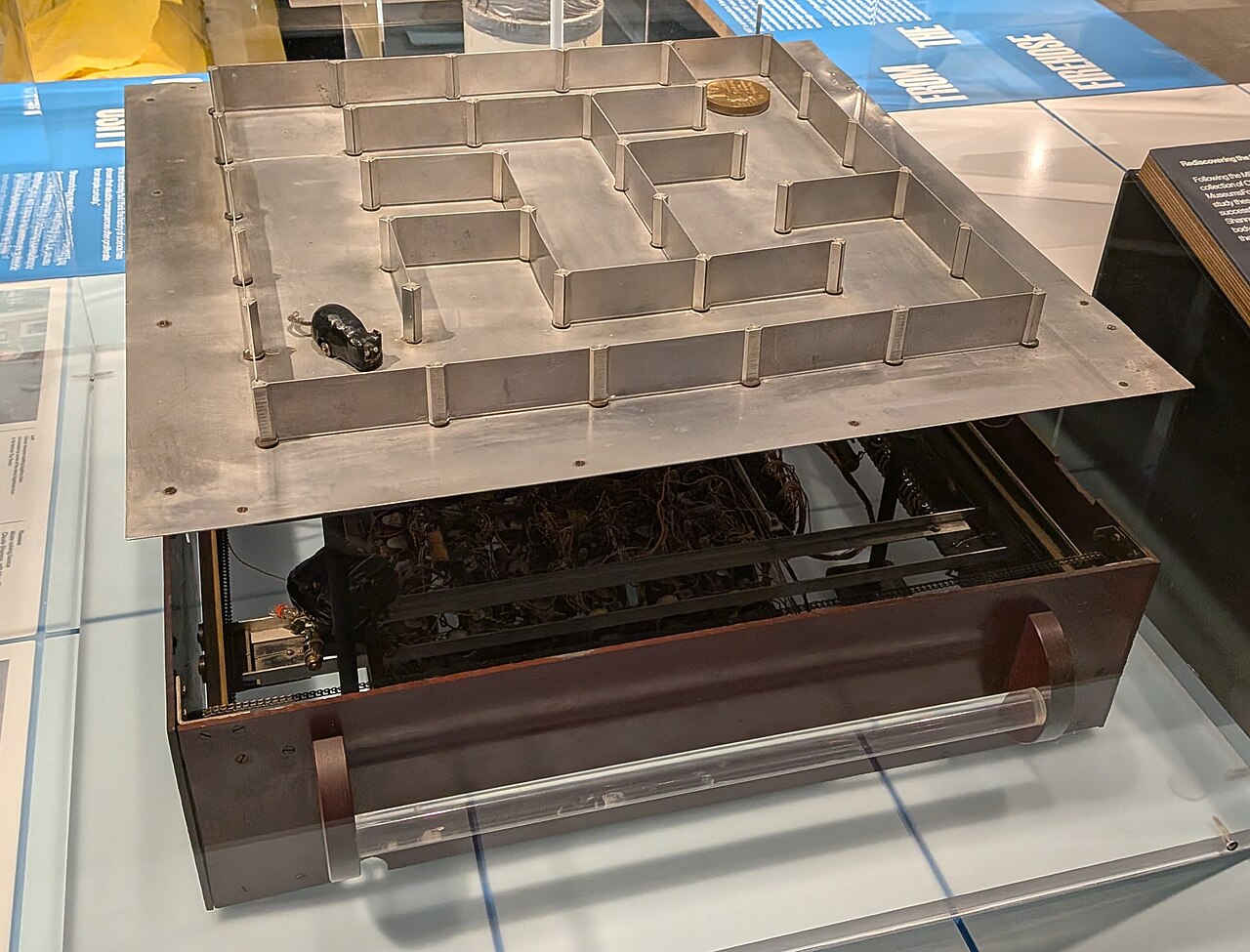
Theseus, MIT Museum, photo by Nickknack00 · CC BY 4.0 · Wikimedia Commons

Theseus, the Mouse

24.11.2026 · AE561124
  • 1950: a magnetic mouse in a maze of movable walls, steered from below by an electromagnet and a bank of telephone relays.
  • First run: trial and error, bumping into walls — and the relays remember each turn.
  • Second run: straight to the cheese, no mistakes.
  • Move the walls: it explores again and adapts.
  • Named after Theseus and the Minotaur’s labyrinth — one of the first learning machines.
Claude Shannon demonstrates machine learning (Bell Labs film, early 1950s)

Video · Theseus at Work

24.11.2026 · AE561124

What Did the Mouse Learn?

24.11.2026 · AE561124
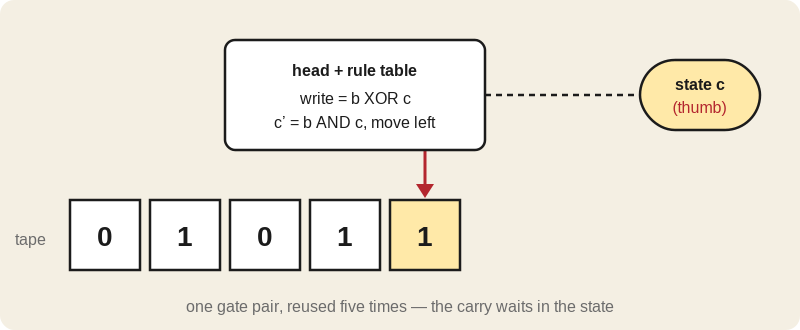
  • The memory is a state stored in relays: “in cell X, go north”.
  • The mouse is a finite state machine whose table gets written by experience.
  • Critics: the intelligence is in the maze — the mouse is a magnet, a visual gimmick; the relays just record the solution.
  • Question for discussion: is writing a solution into memory the same as learning? — Is this what a neural network does?
>> cross-referenced signal
  • ⇄ Time: One Gate Pair, Many Steps
  • ⇄ The Thumb Is the State
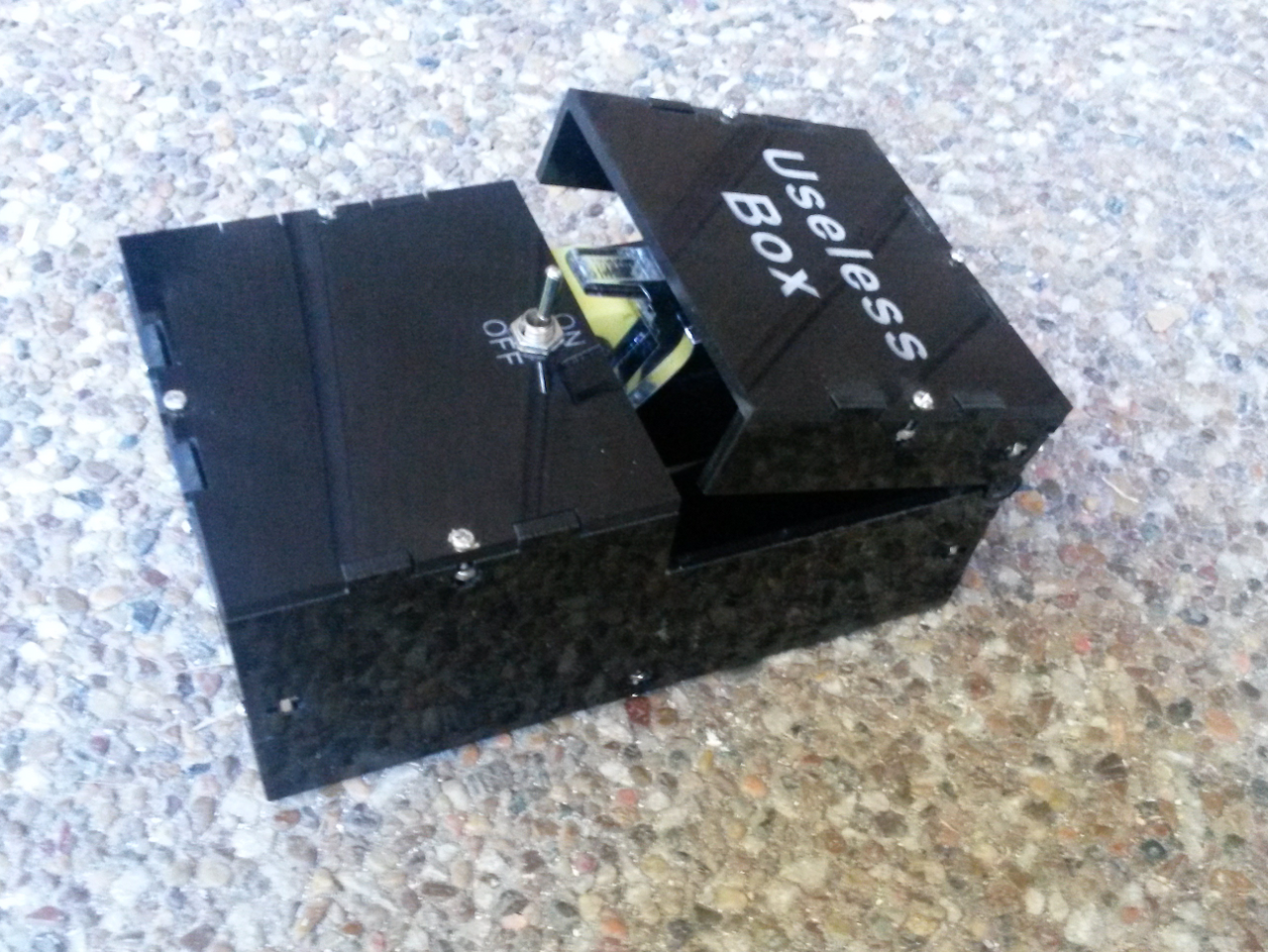
A modern “Useless Box” after Shannon’s Ultimate Machine, by Drpixie · CC BY-SA 4.0 · Wikimedia Commons

Toys, Pranks and Art

24.11.2026 · AE561124

Shannon built things because they were fun. Some of them are philosophy in disguise.

A modern “Useless Box” after Shannon’s Ultimate Machine, by Drpixie · CC BY-SA 4.0 · Wikimedia Commons

The Ultimate Machine

24.11.2026 · AE561124
  • A small box with a single switch. You flip it — the lid opens, a mechanical hand emerges, flips the switch back and disappears.
  • Idea: Marvin Minsky, Bell Labs, 1952; Shannon built it and kept one on his desk.
  • Arthur C. Clarke reportedly said: “There is something unspeakably sinister about a machine that does nothing — absolutely nothing — except switch itself off.”
  • Art? Joke? A machine whose only purpose is its own off-switch.
Shannon’s Ultimate Machine in action

Video · The Ultimate Machine

24.11.2026 · AE561124
Bounce-juggling machine by Claude Shannon, MIT Museum, photo by Daderot · CC0 · Wikimedia Commons

Juggling Machines and Juggling Theorem

24.11.2026 · AE561124
  • Shannon juggled, and rode a unicycle through the corridors of Bell Labs — sometimes juggling at the same time.
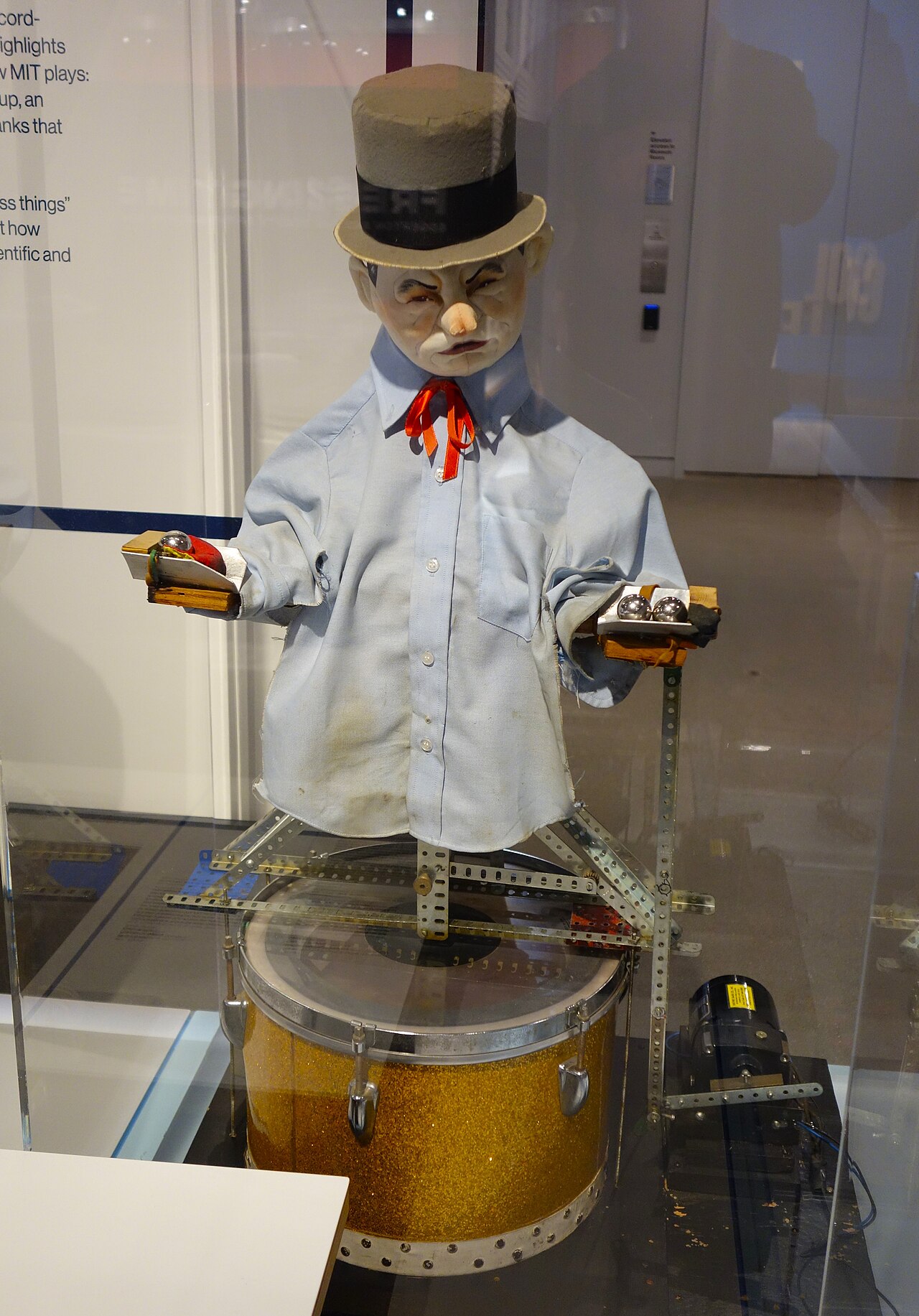
  • He built juggling robots, among them a bouncing-ball juggler in the likeness of W. C. Fields.
  • Shannon’s juggling theorem: (F + D)·H = (V + D)·N — F: flight time, D: dwell time, V: vacant time, H: hands, N: balls.
  • A mathematician who needed to see that the formula held.

THROBAC and Other Toys

24.11.2026 · AE561124
  • THROBAC (1953): the Thrifty Roman-numeral Backward-looking Computer — calculates in Roman numerals.
  • A rocket-powered frisbee, a flame-throwing trumpet.
  • Minivac 601 (1961): a relay computer kit to teach students digital logic — the educational cousin of this session.
  • 1961: with Edward Thorp, a wearable computer to beat roulette.

Play as Method

24.11.2026 · AE561124
  • Shannon at MIT famously worked on whatever amused him.
  • The thesis, the mouse, the chess paper, the Ultimate Machine: each began as a toy.
  • Is playing a method of research or its reward?
  • Discussion: which of your own toys or games taught you something serious?
Marvin Minsky, 2006, photo by Steamtalks · CC BY-SA 2.0 · Wikimedia Commons

Dartmouth, Summer 1956

24.11.2026 · AE561124

The summer of the naming: where “artificial intelligence” became a field.

Fulltext (PDF) ↗

The Proposal (1955)

24.11.2026 · AE561124
  • August 1955: A Proposal for the Dartmouth Summer Research Project on Artificial Intelligence, a funding request to the Rockefeller Foundation.
  • Authors: John McCarthy, Marvin Minsky, Nathaniel Rochester, Claude Shannon.
  • Central conjecture: “every aspect of learning or any other feature of intelligence can in principle be so precisely described that a machine can be made to simulate it.”
  • A two-month, ten-man study at Dartmouth College, New Hampshire.
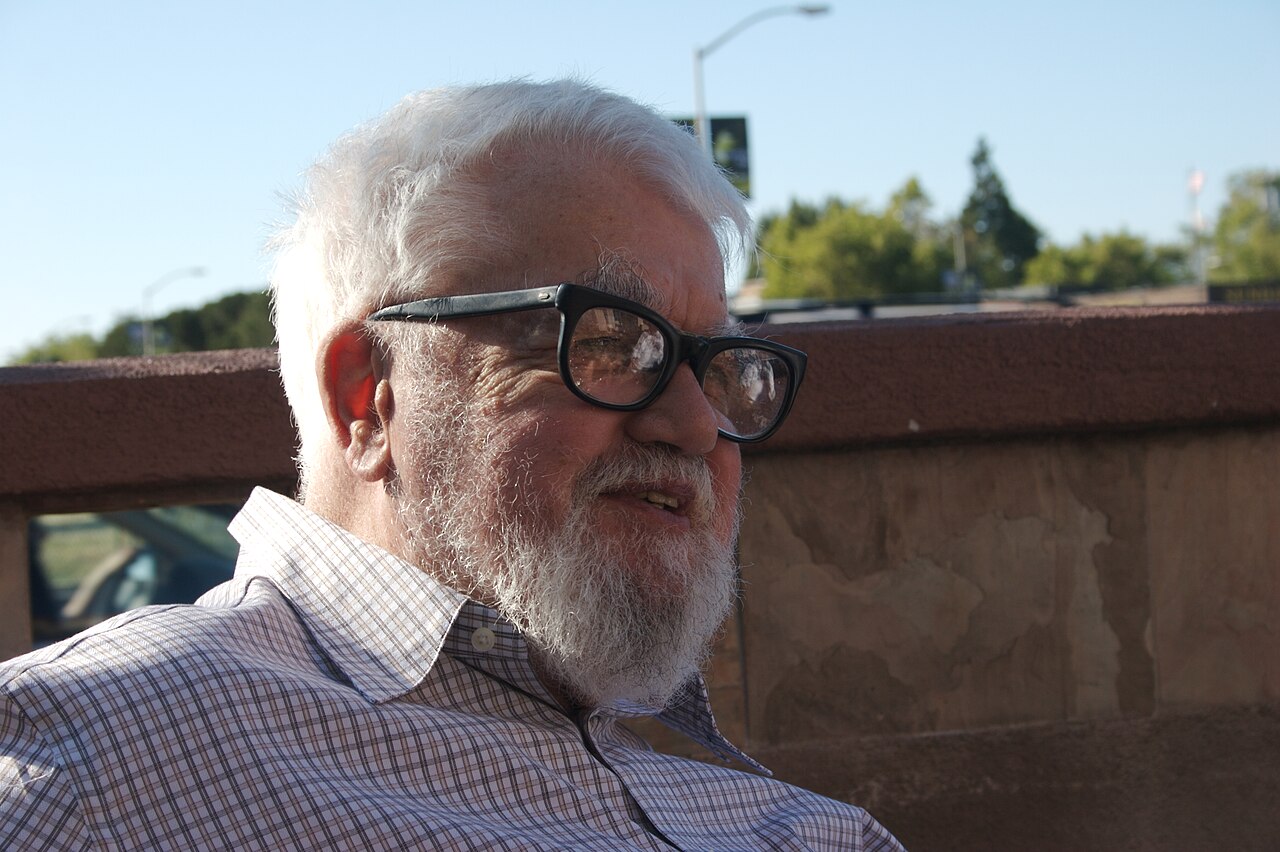
John McCarthy, Stanford 2006, by null0 · CC BY 2.0 · Wikimedia Commons

John McCarthy

24.11.2026 · AE561124
  • Dartmouth mathematician, born 1927; coined the term “artificial intelligence” for this proposal.
  • Later: Lisp (1958), time-sharing, the common-sense program.
  • Co-edited Automata Studies with Shannon (1956).
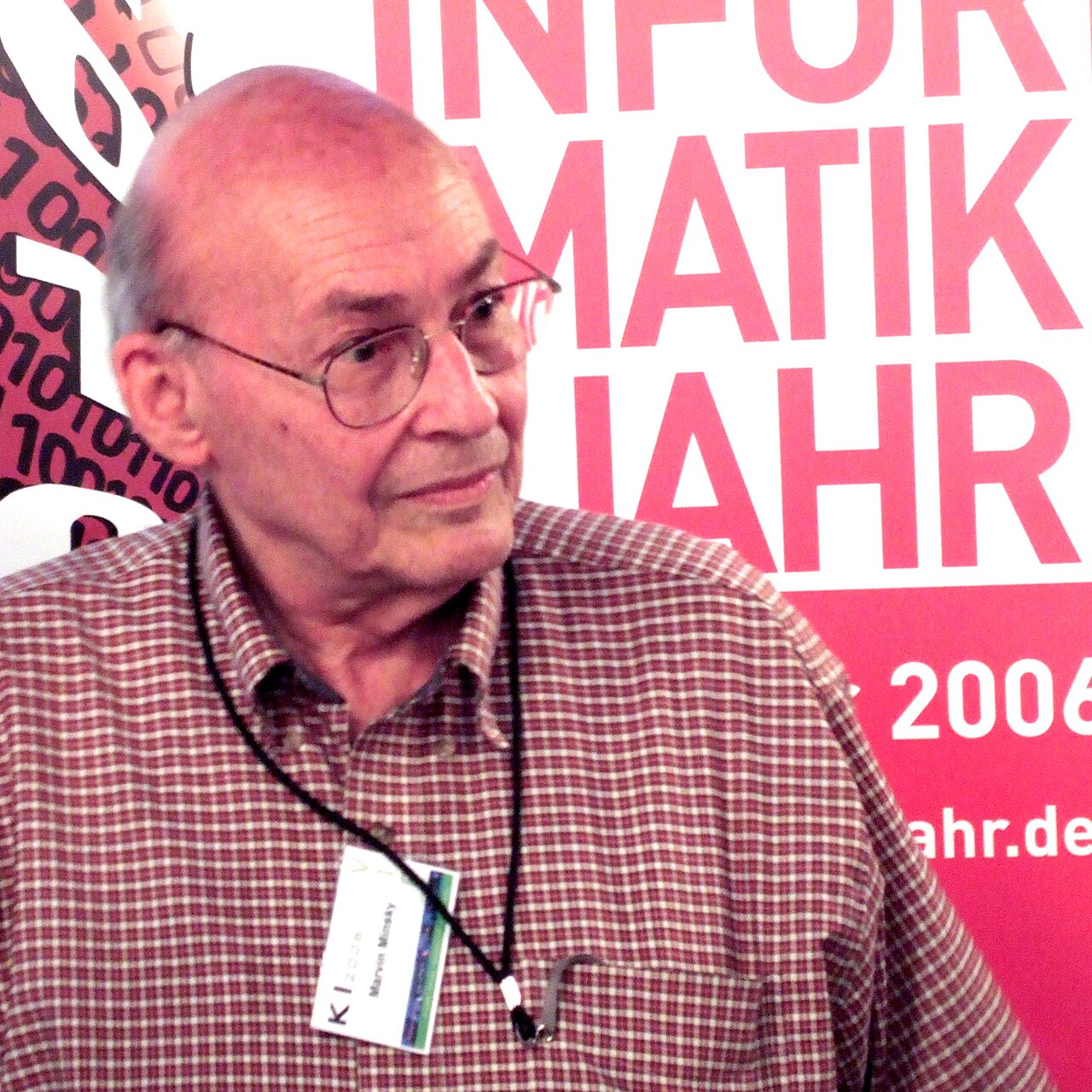
Marvin Minsky, 2006, by Steamtalks · CC BY-SA 2.0 · Wikimedia Commons

Marvin Minsky

24.11.2026 · AE561124
  • MIT, born 1927; at Dartmouth a young Junior Fellow at Harvard.
  • Co-founder of the MIT AI Lab (1959) and author of The Society of Mind.
  • The man who gave Shannon the idea of the Ultimate Machine.
Claude Shannon, Oberwolfach, by Konrad Jacobs · CC BY-SA 2.0 DE · Wikimedia Commons

Rochester and Shannon

24.11.2026 · AE561124
  • Nathaniel Rochester: IBM, designer of the IBM 701 — the hardware man.
  • Claude Shannon: Bell Labs — the theory man, with the Theseus mouse and chess paper to his credit.
  • Shannon was the senior co-signer; accounts suggest he took part only briefly.

Why “Artificial Intelligence”?

24.11.2026 · AE561124
  • Shannon and McCarthy edited Automata Studies (1956). McCarthy was disappointed: few papers dealt with machine intelligence.
  • Hence a new name for the new proposal.
  • Shannon was reportedly more at home with the word “automata” than with the label AI.
  • Names matter: it is a promise, and a marketing claim.
>> cross-referenced signal
  • ⇄ Machine Learning #0

What Happened That Summer

24.11.2026 · AE561124
  • June–August 1956: the participants came and went; only a few, McCarthy, Minsky and Ray Solomonoff, stayed throughout.
  • Highlight: Newell and Simon presented the Logic Theorist, a program proving theorems.
  • No breakthrough — but a community, a name and a research programme.
  • Another half-century to wait for learning to prevail over hand-written logic.
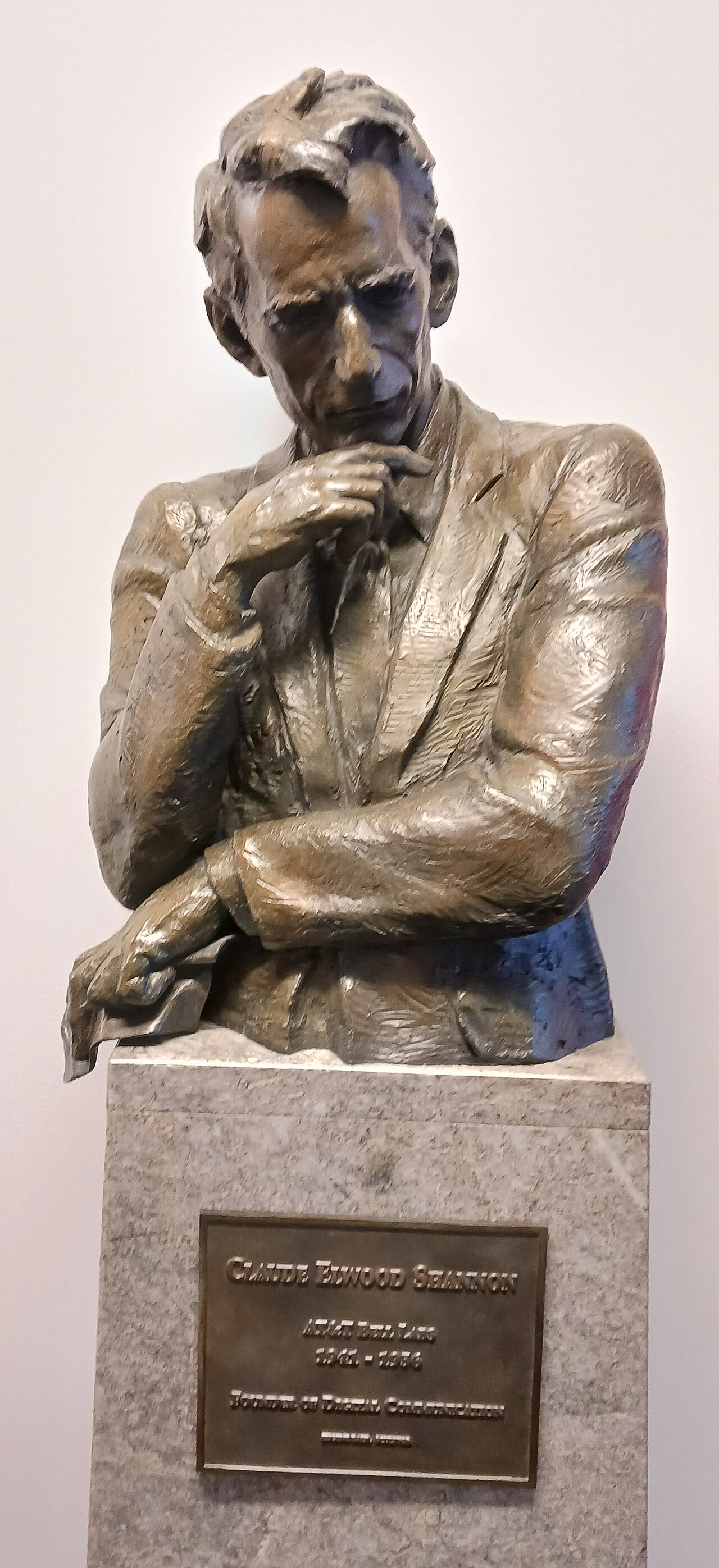
Bust of Claude Shannon, by BobTheBryan · CC BY-SA 4.0 · Wikimedia Commons

The Long Evening

24.11.2026 · AE561124

1956–2001. From the Laboratory to the University — and to silence.

Professor at MIT

24.11.2026 · AE561124
  • 1956: leaves Bell Labs, becomes a professor at MIT (until 1978).
  • Married Betty (Mary Elizabeth Moore) in 1949, a numerical analyst at Bell Labs.
  • Their house near Boston was called “Entropy House”.
  • He published little: he preferred building, juggling and tinkering.

Silence

24.11.2026 · AE561124
  • In the 1990s he developed Alzheimer’s disease.
  • Claude Shannon died on 24 February 2001, aged 84.
  • Every bit sent since is part of his legacy: telephones, internet, compression, error-correcting codes, DNA research, linguistics, language models.
Claude Shannon — Father of the Information Age (UCTV)

Video · Father of the Information Age

24.11.2026 · AE561124
Claude Shannon, Oberwolfach, by Konrad Jacobs · CC BY-SA 2.0 DE · Wikimedia Commons

The Bit Player

24.11.2026 · AE561124
  • Documentary by Mark Levinson (2018–19), made after Shannon’s centenary, with archive footage and actors reading from his interviews.
  • Official site: thebitplayer.com.
  • A portrait of a man who gave the world information and kept his childlike curiosity.

Claude v0.0.1

24.11.2026 · AE561124
  • Relay switching → logic gates → bits → learning mouse → next-token prediction.
  • The language models of today minimise cross-entropy — a quantity Shannon defined — while predicting the next token.
  • There is no direct line from Claude Shannon to Claude the language model — except that the model is trained on his loss function.
  • Next in the story: Minsky, McCarthy and the others — perceptrons, symbolic AI, winters — John, Marvin & co.
>> cross-referenced signal

open as its own page ↗