i
literacy daniel-hromada ()


literacy

Some Open Educational Resources (OERs) pertaining to topic of general / digital / AI / cognitive literacy created in context of diverse courses of Daniel D. Hromada, taught at Berlin University of the Arts between 2018 (AE48) and 2028 (AE58).

Human and arti(ficial|stic) intelligence

What is "intelligence" and how is it defined by different people and different cultures ? Is there only one "general" intelligence thanks to which humans and machines solve problems or is it more appropriate to speak about combinations of "multiple intelligences" - emotional, intepersonal, intrapersonal, spatial, visual, logical, mathematical, bodily, moral, narrative, etc. ? Can we speak about intelligence independent of cultural and socio-economical context within which its acts and is embedded ? Do organic (OI) and artificial intelligence (AI) have something in common or are they fundamentally and unreconcilably different ? In order to explore potential answers to these questions, we will look into history of cognitive (psychology, anthropology) and computer  (informatics, cybernetics)  sciences, we will read stories about "idiot savants" and children raised in wilderness and briliant minds of the past in order to ultimately ask our own AI systems to tell them something about themselves.

Sessions 0 and 1

Session 2 :: Development of intelligence

Session 3 :: Form(s) of intelligence


Session 4 :: Other (forms of) intelligence

Session 5 :: 14.12 :: Artificial intelligence

Session 6 :: 11.1 :: Examples of intelligence

Session 7 :: 25.1 :: Art of intelligence, intelligence of art

Session 8 :: 8.2 :: Futurological congress AE9202

IOPS

Initiation into Optimization & Problem-Solving

Problem & Solution

In engineering, a problem P is defined by an objective function that needs to be optimized, a vector of parameters that can be adjusted, and constraints that must be satisfied.

The solution S is the optimal set of parameter values that achieve the desired optimization while staying within the bounds of the constraints.


Constraints

Parameters & Constraints

Evaluation and beyond

Tradeoffs:::Nadir points:::Thresholds:::'There is no free lunch'-theorem

Meta-Problem in Light of Turing's Entscheidungsproblem

Meta-Problem in Light of Turing's Entscheidungsproblem

Heuristics

The term "heuristics" comes from the Greek word "heuriskein," which means "to find" or "to discover." This term reflects the idea of finding or discovering solutions through intuitive or trial-and-error methods. 

Human and Machine Learning


Homo discens

"Man is a 'homo discens,' a learning being. People learn as long as they live. Life is inseparably connected with learning." Horst Siebert

Implicit learning

Implicit learning is the process of acquiring knowledge or skills unconsciously, without intentional effort or explicit awareness of what is being learned. It typically occurs through repeated exposure to patterns, stimuli, or behaviors, allowing individuals to internalize rules or structures without being able to articulate them directly.

Experiential learning

Experiential learning is a process of learning through direct experience, where individuals engage in activities, reflect on their actions, and apply what they’ve learned to new situations. Rather than solely reading or listening, learners actively participate, often experimenting, making mistakes, and adapting.

Supervised learning

Supervised learning is a type of machine learning where a model is trained on labeled data to learn the mapping between input features and corresponding outputs. The goal is to enable the model to make accurate predictions or classifications on unseen data by minimizing the error between its predictions and the true labels. Common tasks include regression (predicting continuous values) and classification (assigning categories). Supervised learning relies on a training dataset with known inputs and outputs and evaluates performance using a separate test dataset. Examples include spam email detection, image recognition, and speech-to-text systems.

Machine Learning

Machine Learning

Reinforcement learning

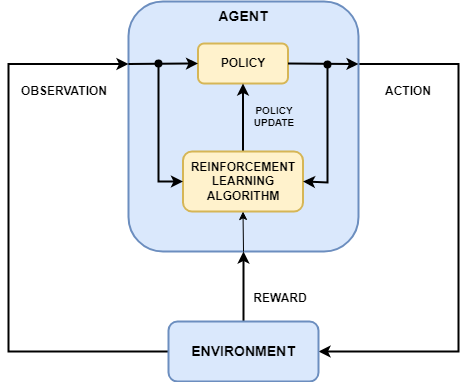
Reinforcement learning (RL) is a machine learning paradigm where an agent learns to make decisions by interacting with an environment. Instead of being told what to do, the agent takes actions and receives feedback in the form of rewards or penalties. The goal is to maximize cumulative rewards over time by discovering an optimal strategy, known as a policy. RL is inspired by trial-and-error learning in humans and animals, where behavior improves through experience. It’s particularly useful for tasks with sequential decision-making, such as robotics, game playing, and autonomous systems, where actions impact not only immediate rewards but also future outcomes.

Social learning

Social learning is "a process in which individuals learn by observing the behaviors of others, imitating them, and experiencing the consequences of these actions." (Bandura, 1977)

Peer learning

Peer learning

Four pillars of learning

Active engagement:::Attention:::Error Feedback:::Consolidation

Human-Machine Peer Learning

Human-Machine Peer Learning

Teaching, Pedagogy, Didactics

Teaching, Pedagogy, Didactics

Artificial Teacher Avatars

Artificial Teacher Avatars

Educational Systems

Educational Systems

Extended Educational Environments

Extended Educational Environments

The Congres

The Congress