i
oeb.global Daniel Hromada, Zihern Lee ()
Daniel Hromada, Zihern Lee

oeb.global

Human-Machine Peer Learning (HMPL): What and Why?:::Make Your Own Digital Primer

Human-Machine Peer Learning (HMPL): What and Why?

Can machines teach ?

Introduction

In this Boardroom Dialogue we will discuss the possibility of humans and AIs becoming "peers" in helping each other to acquire skills and competences. 

The dialogue will start with introducing the concept of Human-Machine Peer Learning (HMPL) and exploring its potential to provide a paradigm for constructing human-machine learning curricula from which both humans as well as machines benefit. 

Participants will acquire both the theoretical concept of human-machine peer learning and concrete insights into how HMPL is implemented through the illustration of two prototypical learning scenarios where HMPL is already deployed.

HMPL

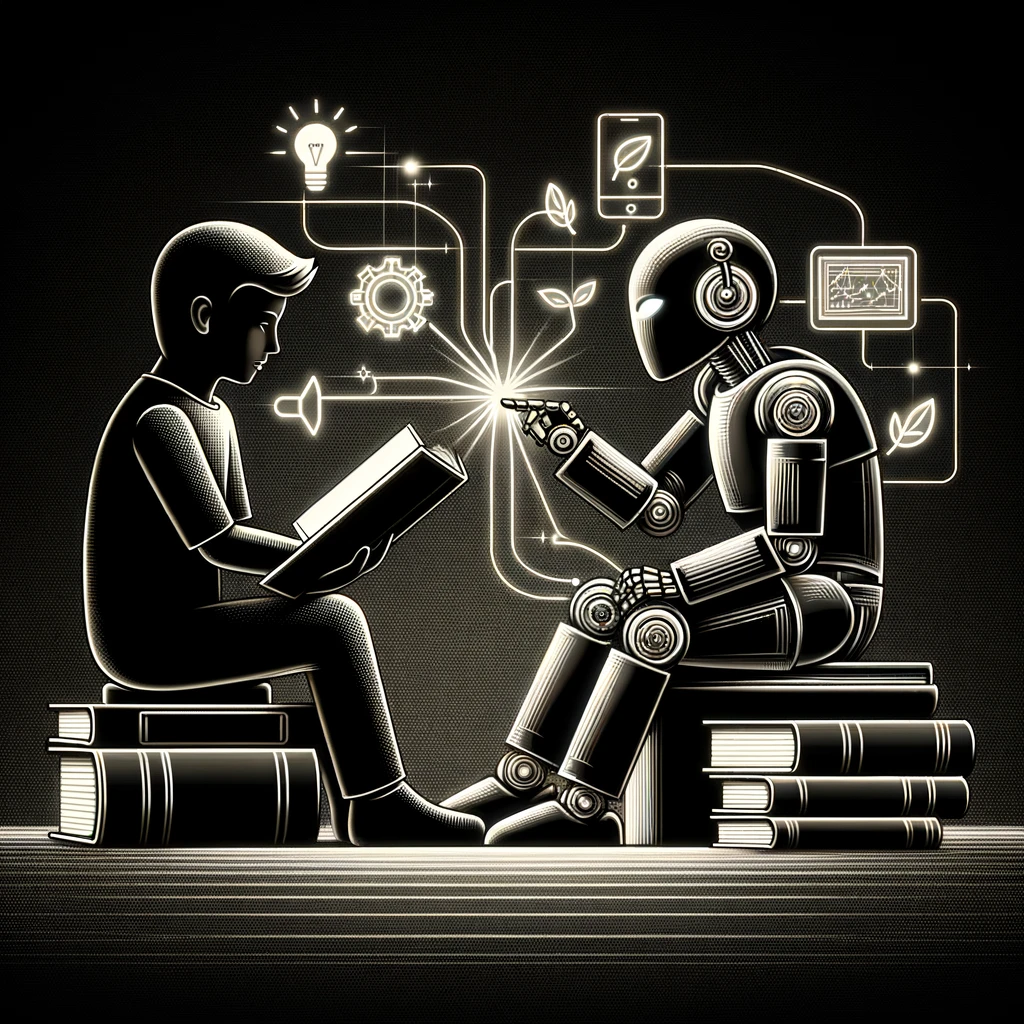
dall-e%203%3A%20%22illustration%20on%20black%20background%20of%20concept%20human-machine%20peer%20learning%20where%20machine%20learns%20from%20human%20and%20human%20learns%20from%20machine%22

dall-e 3: "illustration on black background of concept human-machine peer learning where machine learns from human and human learns from machine"

Human–Machine Peer Learning (HMPL) is a proposal that is positioned at the very frontier between educational, cognitive, and computer sciences. HMPL's core precepts which I introduced in my 2022 and 2023 papers are simple:

Humans and machines can learn together.
Humans and machines can learn from each other.

Practice

Note that HMPL is more than a theoretical concept. It is happening. Here. Now.
 
Humanity teaches the big & mighty ones (e.g. GPT4, DALL-e 3) and big & mighty ones provide educational & cognitive services in return. 
 
But what about the "small" ones, the "adaptive" ones, the "personalized" ones, the embedded (or embooked ?) ones ?

Dialogue

0. Can an entity E be considered a "peer" even if it does not have a physical body ?

1. Can AI ever be a "peer" to a human being or is it a fallacy to believe so ?

2. Should an AI communicate what it is doing (e.g. showing 👂 when listening) or what it expects the human peer to do (e.g. show 👄 when H should speak) ?

3. Can You imagine a competence X which is being simultaneously acquired by a human H and a machine M within the context of their common mutual encounter ?

4. Can You imagine a competence A transmitted from H to M during the same encounter whereby competence B is transferred from M to H ?

5. What other question concerning the human-machine education should also be asked ?

Where do we go from here ?

Someone willing to join me on a journey towards
"Encounter": a journal on human-machine education

daniel@udk-berlin.de


Make Your Own Digital Primer

This How To aims to demonstrate how anyone, including teachers, parents, and students, can create their own Personal Primer - a book-like educational instrument that combines digital education objectives.

The session will cover existing Primer prototypes and off-the-shelf components, such as Raspberry Pi Zero and e-ink display, needed to build the Primer. Participants will learn how to design and deploy personalized educational instruments that differ from smartphones and tablets.

Goal

The Goal is to accompany the learner from the original state of "not-knowing" (e.g. analphabetism) to state where she/he is able to build another copy of the Primer.

Personal Primer and Digital Primer

Education-with-digital

Education-with-digital is concerned with exploitation and integration of digital media and digital tools within the framework of generic teaching, learning, or cognition-enhancing process.

Education-about-digital

Education-with digital: increase digital competences of older students so that they are able to repair or ameliorate existing Primers or construct their new copies.

AIED

AIED

Summary video

some text here

How-To

Making:::Encounter 0