Oh no!

Template knot disallowed for unauthenticated users.

baumhaus.digital/Studium Generale/Short History of the Learning Machine/Alles ist Zahl!/Leibniz's Dream

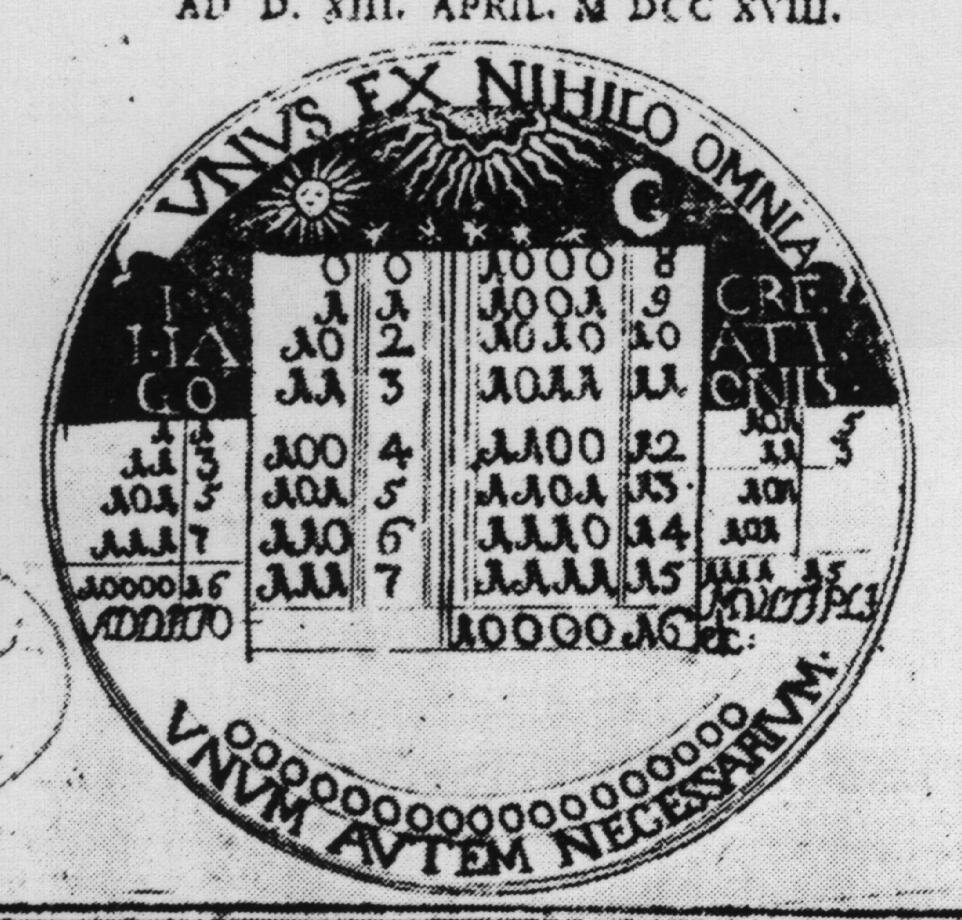
Gottfried Wilhelm Leibniz takes positional notation somewhere further: in 1703, he formally describes arithmetic in base 2 — binary.

He was reportedly delighted to find the same two-symbol logic echoed in the hexagrams of the I Ching, and saw in binary something close to a theological image: everything created from nothing (0) and unity (1).

Three centuries later, his once-mystical number system runs every computer on Earth.
7 Axones

  • ❌ this knot is_linked 🔗 baumhaus.digital/Miscellanous/Presentations/AE53/Vergangenheit, Gegenwart und Zukunft der künstlichen Intelligenz/Vergangenheit/Renaissance, Aufklärung, Neuzeit/G.W.Leibniz (*AD1646 - † AD1716) (ID: 1239 · weight 1)
  • ❌ this knot is_linked 🔗 baumhaus.digital/Studium Generale/Mythologies of possible futures: Between Science Fiction and Reality/Philip Kindred Dick (1928 - 1982)/The Man in the High Castle (1962) (ID: 2352 · weight 1)
  • ❌ this knot is_linked 🔗 baumhaus.digital/Studium Generale/Prolegomena to Educatio Digitale/Session 4 :: Between Renaissance and Age of Reason/Gottfried W. Leibniz (c. 1646 c. 1716) (ID: 3868 · weight 1)
  • ❌ this knot is_linked 🔗 (ID: · weight 1)
  • ❌ this knot is_linked 🔗 baumhaus.digital/Studium Generale/Prolegomena to Educatio Digitale/Session 4 :: Between Renaissance and Age of Reason/Stepped reckoner (ID: 3869 · weight 1)
  • ❌ this knot is_linked 🔗 baumhaus.digital/Studium Generale/Prolegomena to Educatio Digitale/Session 4 :: Between Renaissance and Age of Reason/Leibniz wheel (ID: 3870 · weight 1)
  • ❌ this knot is_linked 🔗 baumhaus.digital/Studium Generale/Mythologies of possible futures: Between Science Fiction and Reality/Cyberpunk, solarpunk and other punkz/Baroquepunk, Steampunk & co. (ID: 2172 · weight 1)