IOPS
Constraints
Heuristics
Problem & Solution
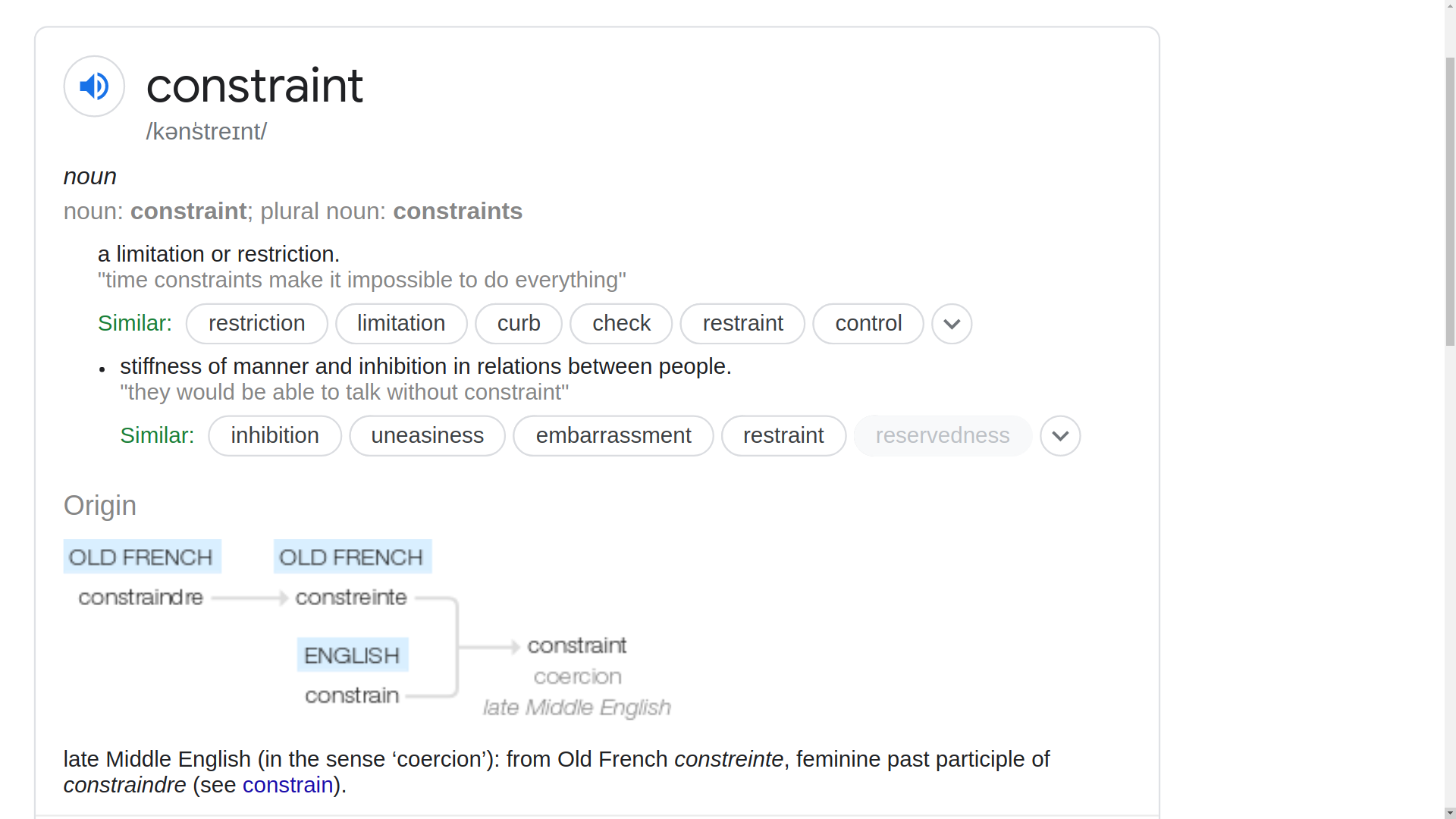
Etymology

Etymology
Meta-Problem
Mathematico-logical heuristics

problem(s)
Vector of Parameters: This is a set of variables or conditions that characterize the system or scenario. They can be input conditions, system states, or any other relevant metrics that describe the system.
Objective Function: This is a mathematical function that quantifies how far the current system's performance is from the desired performance. The goal is usually to minimize or maximize this function.
Constraints: These are the bounds or limitations within which the system operates. In engineering problems, constraints can arise from physical limitations, safety requirements, budgetary restrictions, etc. The solution must satisfy these constraints.
Reflectio: Constraint types
make a decision D
when You solve a problem P
???

Hilbert problem(s)
Mathematical Treatment of the Axioms of Physics
Rigorous Foundation of Schubert's Enumerative Calculus
Topology of Algebraic Curves and Surfaces
Analysis of Solutions of Variational Problems
Calculus
Constraint types
logic / contingency
space
time
energy
computational complexity
human resources
material resources
eco(log|nom)ical constraints
socio-political
psycho-cognitive
legal
moral
etymology of the term 'problem'
[note the etymologic similarity to word "project": from Latin projectum ‘something prominent’, neuter past participle of proicere ‘throw forth’, from pro- ‘forth’ + jacere ‘to throw’)]
Alltag problem(s)
Newton's method
Gradient descent
Millenium Problems
Birch and Swinnerton-Dyer Conjecture
Hodge Conjecture
Navier–Stokes Existence and Smoothness
P vs NP Problem
Riemann Hypothesis
Yang–Mills Existence and Mass Gap
3-SAT Problem

wicked problems
No Definitive Formulation
No Stopping Rule
Solutions Are Not True-or-False
No Immediate and No Ultimate Test
Every Solution is a 'One-Shot Operation'
No Enumerable (or Exhaustively Describable) Set of Potential Solutions
Every Wicked Problem is Essentially Unique
Every Wicked Problem Can Be Considered to Be a Symptom of Another Problem
The Existence of a Discrepancy Representing a Wicked Problem Can Be Explained in Numerous Ways
The Planner Has No Right to Be Wrong
13 teacher-proposed D&C problems
Closing the Door to Hell

Fremen Stilsuit

Central Problem of Roboethics

Young Lady's Illustrated Primer
Cracking the Voynich Manuscript

Tempelhof Biosphere
Self-optimization of communities and societies

Common Eco(log|nom)ical Protocol

Space Elevator
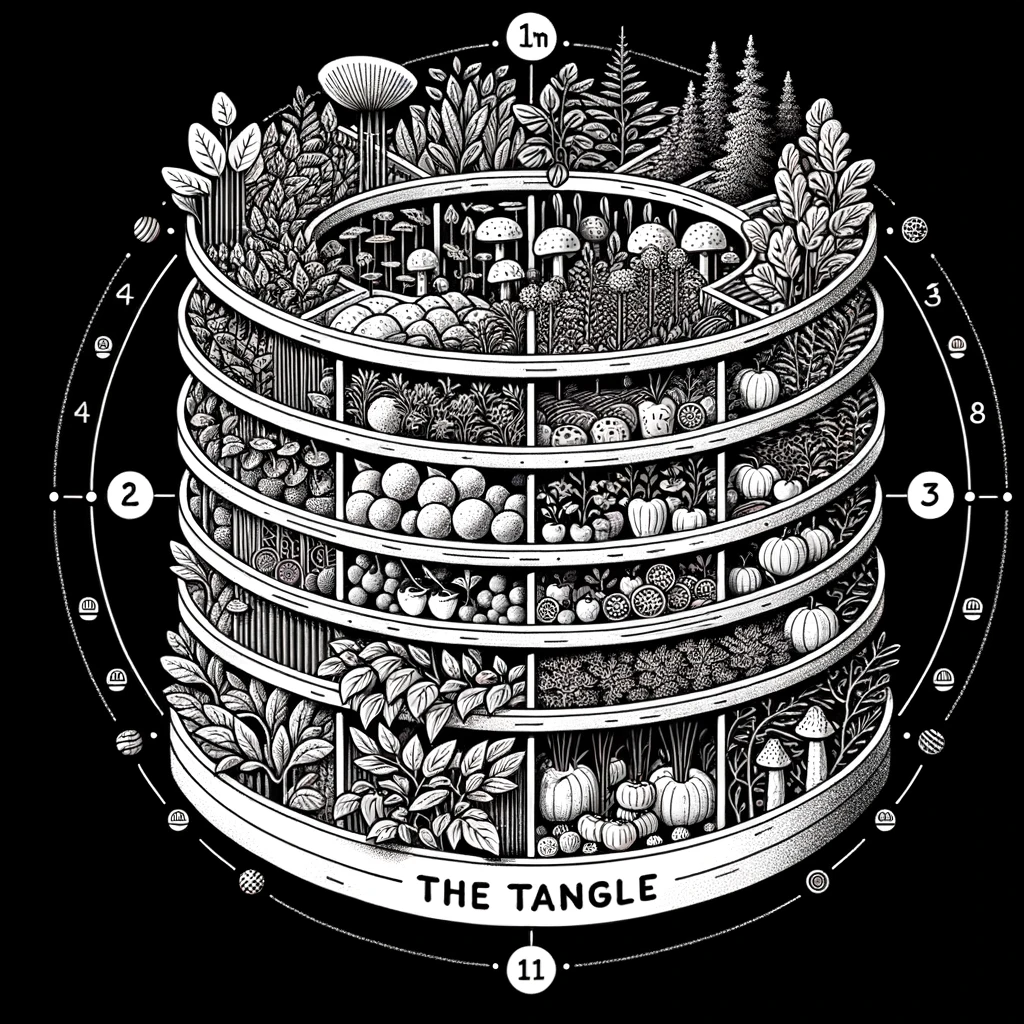
The Tangle

Elliptic Curve Discrete Logarithm Problem

The Seed

H-microfusor

10 student-proposed D&C problems
Radioactive waste disposal
Liberation from fossil fuel dependency
Language extinction
Weltverständlichmachung
Unf*cking the Wohnungsmarkt
...
...
...
...
The Clock Reform
Taxonomy of Problems

Constraint programming
Nature-inspired heuristics
.png)
Python libraries
https://github.com/python-constraint/python-constraint
https://github.com/timnon/pyschedule
Note: install the most recent fork, (e.g. pip3.10 install "pyschedule"@git+"https://github.com/ppoile/pyschedule/#subdirectory=src")
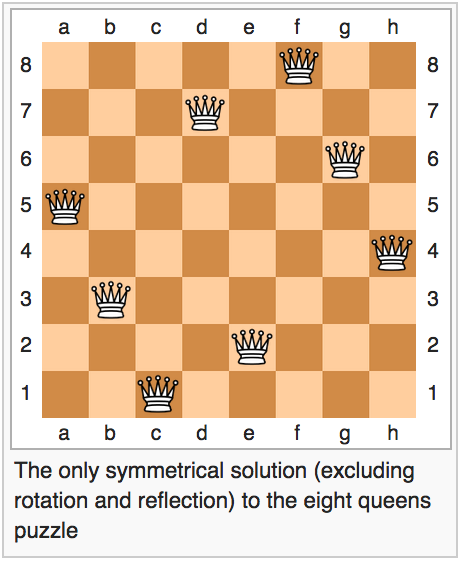
Constraint Satisfaction Problem
eight queen problems
map coloring problem
Exercise: Adam and Eve scheduling
Simulated annealing
Assignment
IOPS group: find the optimal solution using some constraint programming library (GPT4 can show You how to use it)
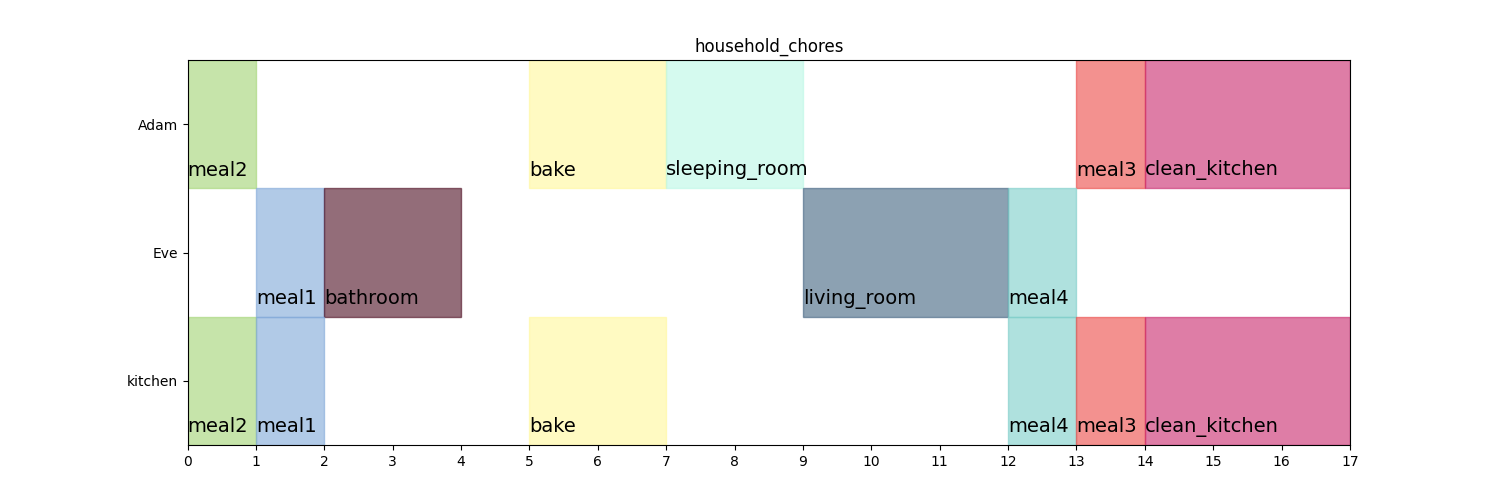
Solution
#Adam has one hour time on Monday and Wednesday, three hours time on Thursday and fours hours time on each weekend day, Eve has two hours on Tuesday, three hours on Friday and four hours on each weekend day.  Define pyschedule resources with correctly defined periods and horizons.

#Monday: Adam x 1
#Tuesday:  Eva x 2
#Wednesday: Adam x 1
#Thursday: Adam x 4
#Friday: Eva x 3
#Saturday: Both x 4
#Sunday : Both x 4

from pyschedule import Scenario, solvers, plotters, alt

# Define the scenario
S = Scenario('household_chores', horizon=15)  # Two weeks

# Define the resources, resource costs are not obligatory but it's more fun with them
adam = S.Resource('Adam',periods=[0,3,4,5,6,7,11,12,13,14])
eve = S.Resource('Eve',periods=[1,2,8,9,10,11,12,13,14])

kitchen=S.Resource('kitchen')

# Define the tasks and their durations
task_costs = {
    "meal1": {"length":1,"delay_cost":1},                # 1 hour, schedule towards beginning of the week
    "meal2": {"length":1,"delay_cost":1},
    "meal3": {"length":1,"delay_cost":-1},
    "meal4": {"length":1,"delay_cost":-1},               # 1 hour, schedule towards end of the week
    "bake": {"length":2,"delay_cost":0},                  # 2 hours (1 cake)
    "sleeping_room": {"length":2,"delay_cost":0},  # it seems there is a bug for tasks longer >1
    #"CSR1": {"length":1,"delay_cost":0},          # one way how to address the bug is to split long tasks into sub-tasks coupled by tight preference constraints
    #"CSR2": {"length":1,"delay_cost":0},          #
    "bathroom": {"length":2,"delay_cost":0},       # 2 hours
    "living_room": {"length":3,"delay_cost":0},    # 3 hours
    "clean_kitchen": {"length":3,"delay_cost":0}   # 3 hours
}

tasks={}
# Define alternative resources for each task
for task,costs in task_costs.items():
    print(task,costs)
    tasks[task] = S.Task(task,length=costs['length'],delay_cost=costs["delay_cost"])      #create new task
    tasks[task] += adam | eve               #assign resources to newly created task

#additional task-resource attributions
tasks["clean_kitchen"]+=kitchen
tasks["meal1"]+=kitchen
tasks["meal2"]+=kitchen
tasks["meal3"]+=kitchen
tasks["meal4"]+=kitchen
tasks["bake"]+=kitchen

#tight precedence constraints
#S += tasks['CSR1'] <= tasks['CSR2']

#optional tasks
#tasks['playground'] = S.Task('playground',length=2,schedule_cost=-1)
#tasks['playground'] += alt(adam,eve)

#additional constraints
S += tasks['meal1'] < tasks['clean_kitchen']
S += tasks['meal2'] < tasks['clean_kitchen']
S += tasks['meal3'] < tasks['clean_kitchen']
S += tasks['meal4'] < tasks['clean_kitchen']
S += tasks['bake'] < tasks['clean_kitchen']

# Solve the scenario
solvers.mip.solve(S,msg=1,kind='GUROBI')

print(S)
print(S.solution())
print(adam.periods)
# Plot the schedule
plotters.matplotlib.plot(S)
Ant colony optimization

unsolved
solvable
unsolvable

fatal
Evolutionary optimization
Genetic Algorithm
Selection
Variation
Replication
Selection operators
elitism: select N most fit individuals and copy them to next generation
roulette-wheel: probability of survival into next generation is proportional to indvididual's fitness
tournament...
Individual|Genotype|Chromosome
Population
Mutation
for numeric genes: additive mutation, multiplicative mutation, complex (imaginary) mutation
for symbolic ones: removal, addition or replacement of a symbol; metathesis (e.g. MORF -> FORM)
NOTE: Mutation rates often fall in the range of 0.5% to 1% per gene. This rate is low enough to prevent excessive random search (which can disrupt good solutions) and high enough to introduce diversity and enable the algorithm to explore new areas of the solution space.

Crossover
Fitness function

Genetic programming

Grammatical evolution

Caching
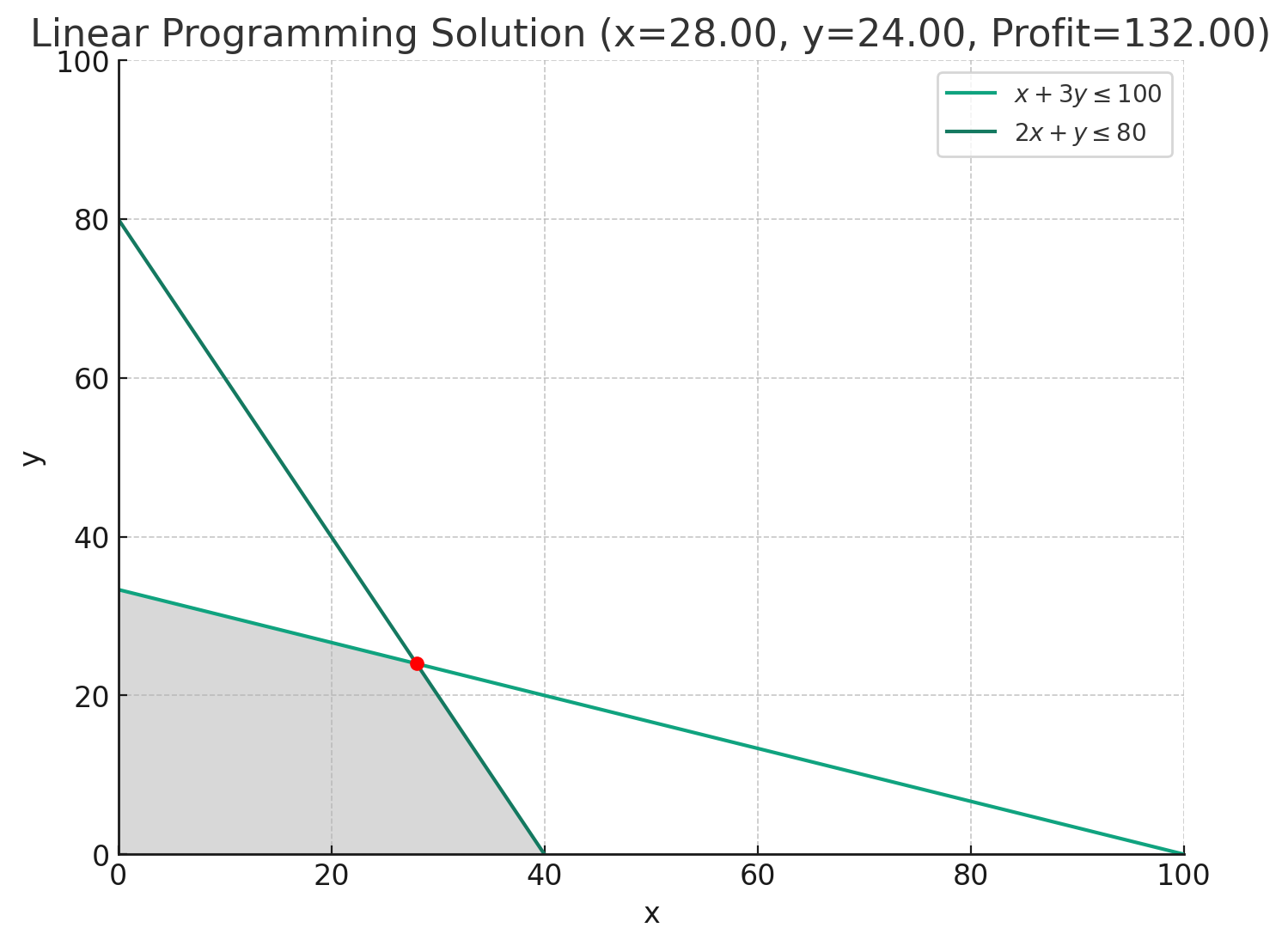
Linear Programming
solution(s)

Human heuristics
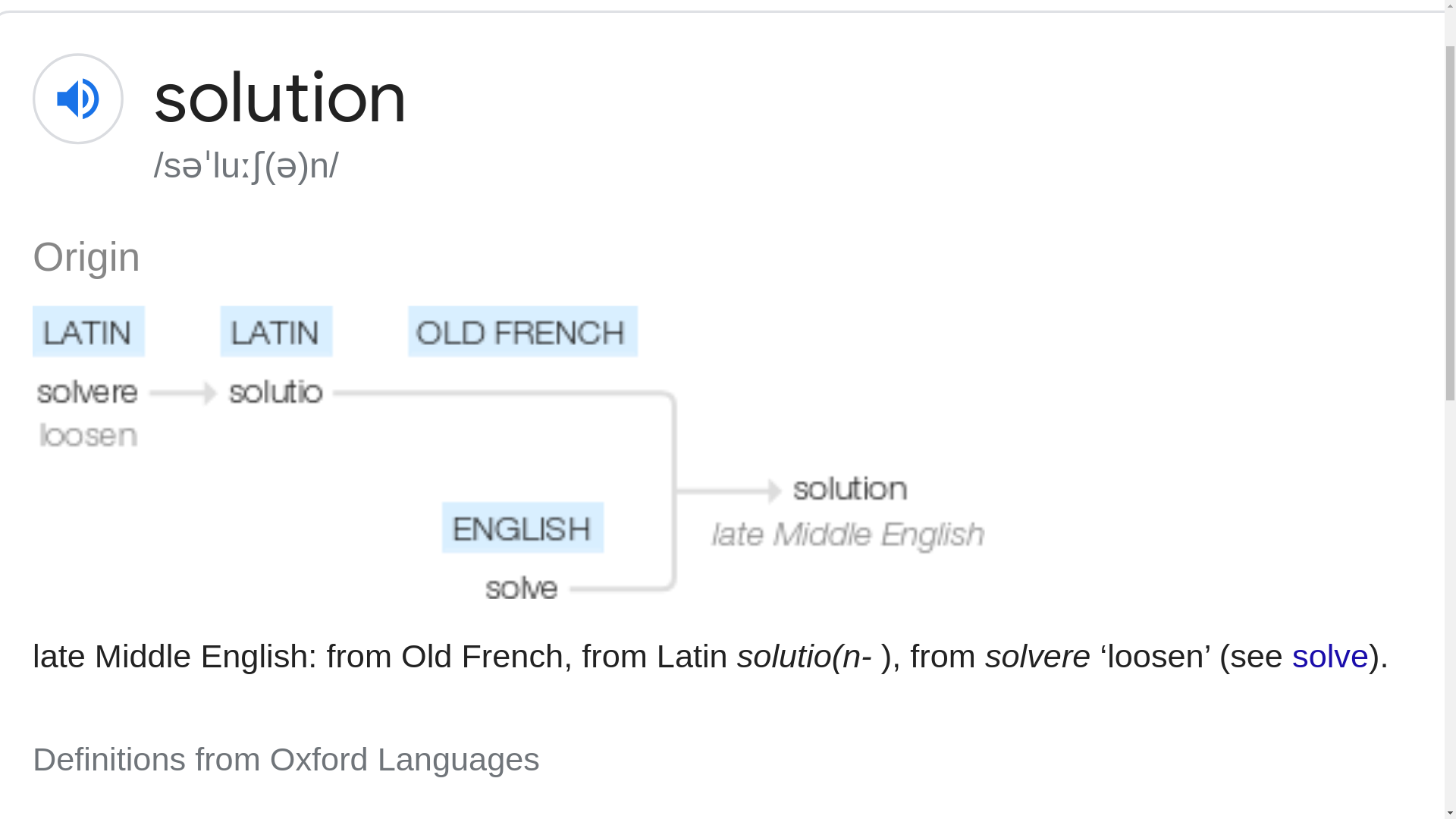
etymology of the term 'solution'
- Latin "solutio": Meaning a loosening or unbinding. This comes from the verb “solvere,” which means to loosen, untie, or dissolve.
- Latin "solvēre": This is a compound of “sol-,” a variant of “se-” (apart), and “luere” (to wash or to loosen).
Advice 0
Engineer's solution

Simplex Algorithm
In technical terms, it deals with equations representing constraints (like the rules of each path) and a goal (like reaching the treasure in the shortest time). The algorithm iteratively explores vertices on a multidimensional shape (the map), checking at each step if it's closer to the best solution. It's like checking each intersection on a map to see if you're closer to the treasure. This continues until it finds the most efficient route, giving you the best solution to your problem.
Fossil-Free Frontier
Summary
Focus: LP deals specifically with linear equations and inequalities. This means it works with problems where relationships are represented as straight lines (hence 'linear').
Objective: It always aims to find the maximum or minimum value of a linear equation, known as the objective function. For example, maximizing profit or minimizing cost.
Method: LP uses specific mathematical methods, like the Simplex algorithm, to find the best solution.
Constraints: All constraints in LP are linear (straight-line relationships). For instance, you can't spend more than a certain budget, or you need at least a certain amount of some ingredient.
Solutions: Solutions in LP are often numerical and can include fractions or decimals.
Trial and Error
Memory
Imitation
Swarm intelligence
Repetition
Tangle v0.0.1 Optimization
Game & Playfulness
Curiosity
Intuition

Diet Problem
Constraint Programming Summary
Focus: CP is more general and can handle a wide variety of constraints, not just linear ones. It can deal with logical conditions, like "either-or" situations, and can include non-linear relationships.
Objective: CP doesn't necessarily have an objective function to optimize. Instead, it focuses on finding solutions that satisfy all the given constraints.
Method: It uses different algorithms than LP, often based on search techniques, like backtracking or heuristics.
Constraints: Constraints in CP can be diverse - linear, non-linear, logical conditions, etc. For example, a constraint could be that a certain task must be done before another can start.
Solutions: Solutions in CP are often discrete (like whole numbers) and can involve deciding between different options or scenarios.
