i
Sanskrit DDH ()


Sanskrit

The Sanscrit language, whatever be its antiquity, is of a wonderful structure; more perfect than the Greek, more copious than the Latin, and more exquisitely refined than either, yet bearing to both of them a stronger affinity, both in the roots of verbs and the forms of grammar, than could possibly have been produced by accident; so strong indeed, that no philologer could examine them all three, without believing them to have sprung from some common source, which, perhaps, no longer exists; there is a similar reason, though not quite so forcible, for supposing that both the Gothic and the Celtic, though blended with a very different idiom, had the same origin with the Sanscrit; and the old Persian might be added to the same family.

(Third discourse of Wiliam Jones before the Asiatic Society, 1786)

पाणि

Pāṇini (Devanagari: पाणिनि, pronounced [paːɳɪnɪ]) was a Sanskrit philologist, grammarian, and revered scholar in ancient India variously dated between the 6th and 4th century BCE. Since the discovery and publication of his work Aṣṭādhyāyī by European scholars in the nineteenth century, Pāṇini has been considered the "first descriptive linguist", and even labelled as “the father of linguistics”.

Eat this: पाणिनि's brain encoded Mind whose grammar-induction faculties preceded faculties of all other minds which followed in upcoming 2500 years.


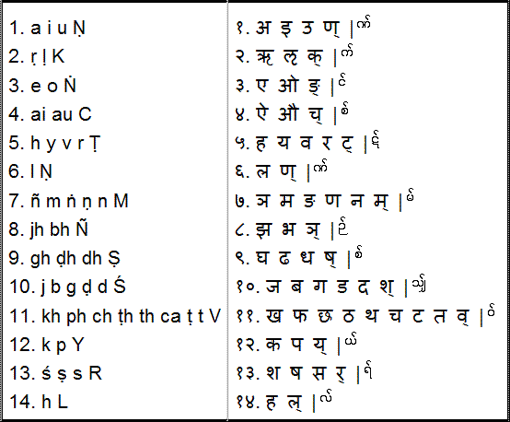
Shiva sutra

Shiva sutras contain potentially the most concise, easily learnable definition  of basic morphophonologically-relevant equivalence classes (e.g. aL -> class of all sounds; aC -> class of all vowels) of vedic sanskrit.