Kastalia Knowledge Management System · Glasperlenspiel template · knot 462
Introduction to linguistics: From पाणिनि to Čepeto
The seminar will start with a question "What is language and how can You define it ?". Subsequently, we will see how men and women of past and present answered that question - from grammarians of ancient India all the way to most modern theories of phonetics, phonology, morphosyntax, semantics and pragmatics. Special focus will be put on theories of language acquisition, that is, on discussion the process by means of which maternal language is acquired by human children. All this to be able to end the seminar with an answer to the question: "Could artificial intelligences like GPT-X be ever able to understand the meaning of the word meaning ?"
Ancestors (1 superordinated path)
root/
baumhaus.digital/
Art, Cognition, Education/
Introduction to linguistics: From पाणिनि to Čepeto
Descendants (at least 83 branches originate here)
-
Introduction to linguistics: From पाणिनि to Čepeto
The seminar will start with a question "What is language and how can You define it ?". Subsequently, we will see how men and women of past and present answered-
is_parent 0. Initiation
-
is_parent Why & what
What is linguistics ?:::What is language ?:::Why language ?:::Why linguistics ?-
is_parent What is linguistics ? ·
Linguistics is a scientific discipline whose object of study is language. -
is_parent What is language ? ·
You have five minutes to discuss / brainstorm in Your group potential answers to questions "What is language ?" and/or "What is NOT language ?". Make sure that -
is_parent Why language ? ·
because Wuman = ZOON LOGON ECHON because language can provide You the key to human heart(s) because words are source of misunderstanding "Die Grenzen meiner Spr -
is_parent Why linguistics ? ·
Γνῶθι σεαυτόν -> GNOTHI SEAUTON -> know Yourself
-
-
is_parent How
by observation:::by study:::by practice:::by reflection-
is_parent by observation ·
Observe the sounds which surround You and observe how they associate with surrounding meanings and intentions of those who speak. -
is_parent by study ·
Learn about theories and discoveries made by those who dedicated their lives to study of language.In this seminar, we will focus on works of पाणिनि, deSaussure, -
is_parent by practice ·
Be like a child discovering new horizons and try to absorb as many foreign languages as You can! (If You are not afraid of making mistakes it gets more easy as -
is_parent by reflection ·
Γνῶθι σεαυτόν
-
-
contains Formalities ·
who am I who are You is this a course for You ? credits (2 ECTS for >75% attendance, +1 for referat/experiment) Hausarbeit possible need help ? (tutor: a.terzi -
contains Session structure ·
Each session will start with at least 30-min repetition / reactivation of already acquired knowledge. At each session there will be at least: 1 main question 1 -
contains Sub-disciplines
-
is_parent
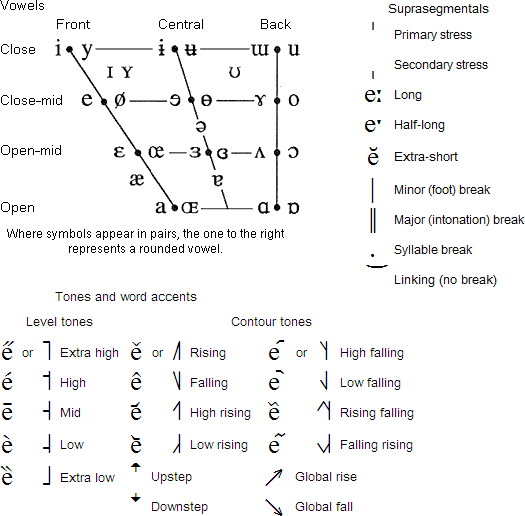 Phonetics & phonology
·
Phonetics & phonology
·
-
is_parent Morphology, Lexicology and Terminology ·
-
is_parent Grammar and Syntax ·
-
is_parent Developmental linguistics ·
-
is_parent Semantics, pragmatics, memetics ·
-
is_parent
Phonetics & phonology
·
-
is_parent Morphology, Lexicology and Terminology ·
-
is_parent Grammar and Syntax ·
-
is_parent Developmental linguistics ·
-
is_parent Semantics, pragmatics, memetics ·
-
-
contains Precursors
-
is_parent पाणि
Pāṇini (Devanagari: पाणिनि, pronounced [paːɳɪnɪ]) was a Sanskrit philologist, grammarian, and revered scholar in ancient India variously dated between the 6th a-
is_parent
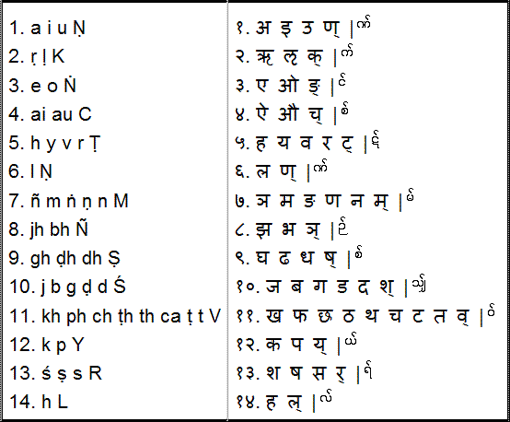 Shiva sutra
🔊
·
Shiva sutras contain potentially the most concise, easily learnable definition of basic morphophonologically-relevant equivalence classes (e.g. aL -> class of a
Shiva sutra
🔊
·
Shiva sutras contain potentially the most concise, easily learnable definition of basic morphophonologically-relevant equivalence classes (e.g. aL -> class of a -
is_parent
Shiva sutra
🔊
·
Shiva sutras contain potentially the most concise, easily learnable definition of basic morphophonologically-relevant equivalence classes (e.g. aL -> class of a -
is_parent
Shiva sutra
🔊
·
Shiva sutras contain potentially the most concise, easily learnable definition of basic morphophonologically-relevant equivalence classes (e.g. aL -> class of a
-
-
is_parent
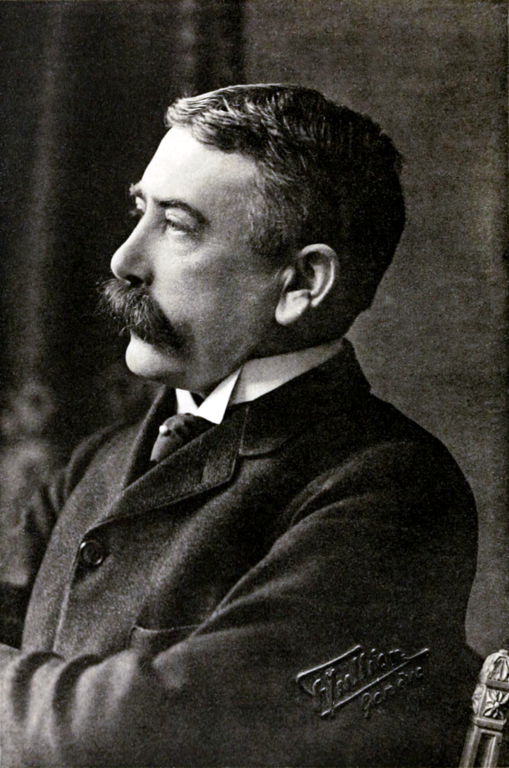 [fɛʁdinɑ̃ də sosyʁ]
·
Ferdinand de Saussure (26 November 1857 – 22 February 1913) was a Swiss linguist, semiotician and philosopher. His ideas laid a foundation for many significant
[fɛʁdinɑ̃ də sosyʁ]
·
Ferdinand de Saussure (26 November 1857 – 22 February 1913) was a Swiss linguist, semiotician and philosopher. His ideas laid a foundation for many significant -
is_parent Noam Chomsky ·
Chomsky -
is_parent Leonard Bloomfield ·
Bloomfield -
is_parent Michael Tomasello ·
Tomasello -
is_parent पाणि
Pāṇini (Devanagari: पाणिनि, pronounced [paːɳɪnɪ]) was a Sanskrit philologist, grammarian, and revered scholar in ancient India variously dated between the 6th a-
is_parent
Shiva sutra
🔊
·
Shiva sutras contain potentially the most concise, easily learnable definition of basic morphophonologically-relevant equivalence classes (e.g. aL -> class of a -
is_parent
Shiva sutra
🔊
·
Shiva sutras contain potentially the most concise, easily learnable definition of basic morphophonologically-relevant equivalence classes (e.g. aL -> class of a -
is_parent
Shiva sutra
🔊
·
Shiva sutras contain potentially the most concise, easily learnable definition of basic morphophonologically-relevant equivalence classes (e.g. aL -> class of a
-
-
is_parent
[fɛʁdinɑ̃ də sosyʁ]
·
Ferdinand de Saussure (26 November 1857 – 22 February 1913) was a Swiss linguist, semiotician and philosopher. His ideas laid a foundation for many significant -
is_parent Noam Chomsky ·
Chomsky -
is_parent Leonard Bloomfield ·
Bloomfield -
is_parent Michael Tomasello ·
Tomasello
-
-
contains Links ·
Open Educational Resource (OER): knowledge unit "Art, Cognition, Education" of https://baumhaus.digital repository Matrix room: #edu-linguistics:m3x.baum -
contains Bye & thanks for all the fish ·
see You in #edu-linguistics or in 2 weeks (same time, same place)daniel@udk-berlin.de / Sprechstunden Wednesday 13:00 - 14:00 R313 Medienhaus
-
-
is_parent 1. Sound
-
is_parent Repetitio ·
-
is_parent Questio :: What is speech ?
Speech is intention-encoding sound produced by human vocal tract or its artificial Ersatz.-
is_parent
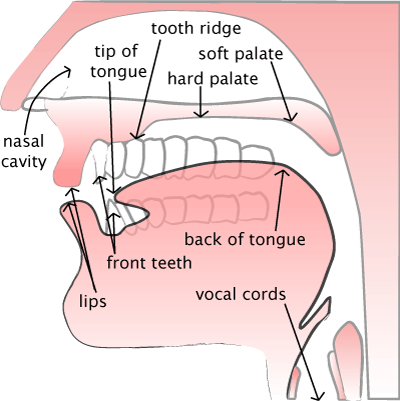 Anatomy of human vocal tract
·
Anatomy of human vocal tract
·
-
-
is_parent Exercicio :: Sound production ·
Look into mirror (or use https://udk.ai/facemesh/ ) and ... pronounce continuous AAAA , EEEE , IIII and OOOO waves put a finger in front of Your lips; start voi -
is_parent International Phonetic Alphabet ·
-
is_parent Sanskrit
The Sanscrit language, whatever be its antiquity, is of a wonderful structure; more perfect than the Greek, more copious than the Latin, and more exquisitely re-
is_parent पाणि
Pāṇini (Devanagari: पाणिनि, pronounced [paːɳɪnɪ]) was a Sanskrit philologist, grammarian, and revered scholar in ancient India variously dated between the 6th a-
is_parent
Shiva sutra
🔊
·
Shiva sutras contain potentially the most concise, easily learnable definition of basic morphophonologically-relevant equivalence classes (e.g. aL -> class of a -
is_parent
Shiva sutra
🔊
·
Shiva sutras contain potentially the most concise, easily learnable definition of basic morphophonologically-relevant equivalence classes (e.g. aL -> class of a -
is_parent
Shiva sutra
🔊
·
Shiva sutras contain potentially the most concise, easily learnable definition of basic morphophonologically-relevant equivalence classes (e.g. aL -> class of a
-
-
-
is_parent Phone vs. Phoneme
One of the most fundamental dichotomy in linguistics is the phone / phoneme dichotomy: a phone is any distinct speech sound regardless of whether the exact soun-
is_parent Minimal pairs ·
Minimal pairs are pairs of words or phrases in a particular language, spoken or signed, that differ in only one phonological element. word 1 word 2 IPA 1 IPA 2
-
-
-
is_parent 2. Sign
-
is_parent
[fɛʁdinɑ̃ də sosyʁ]
·
Ferdinand de Saussure (26 November 1857 – 22 February 1913) was a Swiss linguist, semiotician and philosopher. His ideas laid a foundation for many significant -
is_parent Repetitio ·
-
is_parent Saussure's theory of sign ·
--Ferdinand de Saussure, from Course in General Linguistics The Nature of the Linguistic Sign Sign, Signified, Signifier Some people regard language, when redu -
is_parent Saussure's dichotomies
-
is_parent signified ·
Signifier: directly perceptible material form term Signified: abstract needs to be "activated" by the signifier idea concept -
is_parent parole ·
Langue ("language"): abstract, systematic rules and conventions of a signifying system independent of the individual user involves the principles of language, w -
is_parent synchrony ·
A synchronic approach (from Ancient Greek: συν- "together" and χρόνος "time") considers a language at a moment in time without taking its history into account.
-
-
is_parent Sinn & Bedeutung ·
In the philosophy of language, the distinction between sense and reference was an idea of the German philosopher and mathematician Gottlob Frege in 1892 (in his -
is_parent Lectio :: Mind's new science ·
-
-
is_parent 3. From morphemes to sentences
-
is_parent Repetitio ·
-
is_parent Morpheme ·
basic (atomic) unit of expressed meaning (sense) -
is_parent Grammar
In linguistics, the grammar of a natural language is its set of structural constraints on speakers' or writers' composition of clauses, phrases, and words.-
is_parent Parts-of-speech ·
Some parts of speech (PoS, sometimes also called "word classes" or "syntactic classes") often present in different languages are: nouns (N) adjectives (Adj) pro -
is_parent Syntax ·
What follows what, what impacts what.Note :: in some languages, sequential order is more strict, in some, it is more relaxed
-
-
is_parent Formal Language Theory ·
In the classic formalization of generative grammars first proposed by Noam Chomsky in the 1950s,[ grammar G consists of the following components: A finite set N
-
-
is_parent 4. Language Acquisition
-
is_parent Repetitio ·
-
-
is_parent 5. As a large language model ...
-
is_parent The turning point
With the advent of the Epoch, humanity mastered the art of quantifying the "meaning of the Word".-
is_parent Geometrization of meaning ·
Even entities like "word meanings" or "concepts" can be geometrically represented, either as points, vectors or sub-spaces of the enveloping vector space S. One
-
-
is_parent Distributional Hypothesis
"The DISTRIBUTION of an element is the total of all environments in which it occurs, i.e. the sum of all the (different) positions (or occurrences) of an elemen-
is_parent
 Word embeddings
·
word context: wings context: engine context: sky bee 3 0 2 eagle 3 0 3 goose 2 0 4 helicopter 0 2 4 drone 0 3 3 rocket 0 4 2 jet 1 1 1
Word embeddings
·
word context: wings context: engine context: sky bee 3 0 2 eagle 3 0 3 goose 2 0 4 helicopter 0 2 4 drone 0 3 3 rocket 0 4 2 jet 1 1 1
-
-
is_parent Questio: What features characterize word X ?
Let's have a sentence: "Harfa, gitara a piano sú excelentné hudobné inštrumenty."What can the slovak word "hudobné" mean ? Wh-
is_parent
.png) Features
·
Features of a word can be: phoneticalphonologicalprosodicsemanticcontextualsyntactic
Features
·
Features of a word can be: phoneticalphonologicalprosodicsemanticcontextualsyntactic
-
-
-
contains Session structure ·
Each session will start with at least 30-min repetition / reactivation of already acquired knowledge. At each session there will be at least: 1 main question 1 -
contains Sub-disciplines
-
is_parent
Phonetics & phonology
·
-
is_parent Morphology, Lexicology and Terminology ·
-
is_parent Grammar and Syntax ·
-
is_parent Developmental linguistics ·
-
is_parent Semantics, pragmatics, memetics ·
-
is_parent
Phonetics & phonology
·
-
is_parent Morphology, Lexicology and Terminology ·
-
is_parent Grammar and Syntax ·
-
is_parent Developmental linguistics ·
-
is_parent Semantics, pragmatics, memetics ·
-
-
contains Precursors
-
is_parent पाणि
Pāṇini (Devanagari: पाणिनि, pronounced [paːɳɪnɪ]) was a Sanskrit philologist, grammarian, and revered scholar in ancient India variously dated between the 6th a-
is_parent
Shiva sutra
🔊
·
Shiva sutras contain potentially the most concise, easily learnable definition of basic morphophonologically-relevant equivalence classes (e.g. aL -> class of a -
is_parent
Shiva sutra
🔊
·
Shiva sutras contain potentially the most concise, easily learnable definition of basic morphophonologically-relevant equivalence classes (e.g. aL -> class of a -
is_parent
Shiva sutra
🔊
·
Shiva sutras contain potentially the most concise, easily learnable definition of basic morphophonologically-relevant equivalence classes (e.g. aL -> class of a
-
-
is_parent
[fɛʁdinɑ̃ də sosyʁ]
·
Ferdinand de Saussure (26 November 1857 – 22 February 1913) was a Swiss linguist, semiotician and philosopher. His ideas laid a foundation for many significant -
is_parent Noam Chomsky ·
Chomsky -
is_parent Leonard Bloomfield ·
Bloomfield -
is_parent Michael Tomasello ·
Tomasello -
is_parent पाणि
Pāṇini (Devanagari: पाणिनि, pronounced [paːɳɪnɪ]) was a Sanskrit philologist, grammarian, and revered scholar in ancient India variously dated between the 6th a-
is_parent
Shiva sutra
🔊
·
Shiva sutras contain potentially the most concise, easily learnable definition of basic morphophonologically-relevant equivalence classes (e.g. aL -> class of a -
is_parent
Shiva sutra
🔊
·
Shiva sutras contain potentially the most concise, easily learnable definition of basic morphophonologically-relevant equivalence classes (e.g. aL -> class of a -
is_parent
Shiva sutra
🔊
·
Shiva sutras contain potentially the most concise, easily learnable definition of basic morphophonologically-relevant equivalence classes (e.g. aL -> class of a
-
-
is_parent
[fɛʁdinɑ̃ də sosyʁ]
·
Ferdinand de Saussure (26 November 1857 – 22 February 1913) was a Swiss linguist, semiotician and philosopher. His ideas laid a foundation for many significant -
is_parent Noam Chomsky ·
Chomsky -
is_parent Leonard Bloomfield ·
Bloomfield -
is_parent Michael Tomasello ·
Tomasello
-
-
contains Links ·
Open Educational Resource (OER): knowledge unit "Art, Cognition, Education" of https://baumhaus.digital repository Matrix room: #edu-linguistics:m3x.baum
-