cast off

A Mathematical Theory of Communication (1948)

24.11.2026 · AE561124
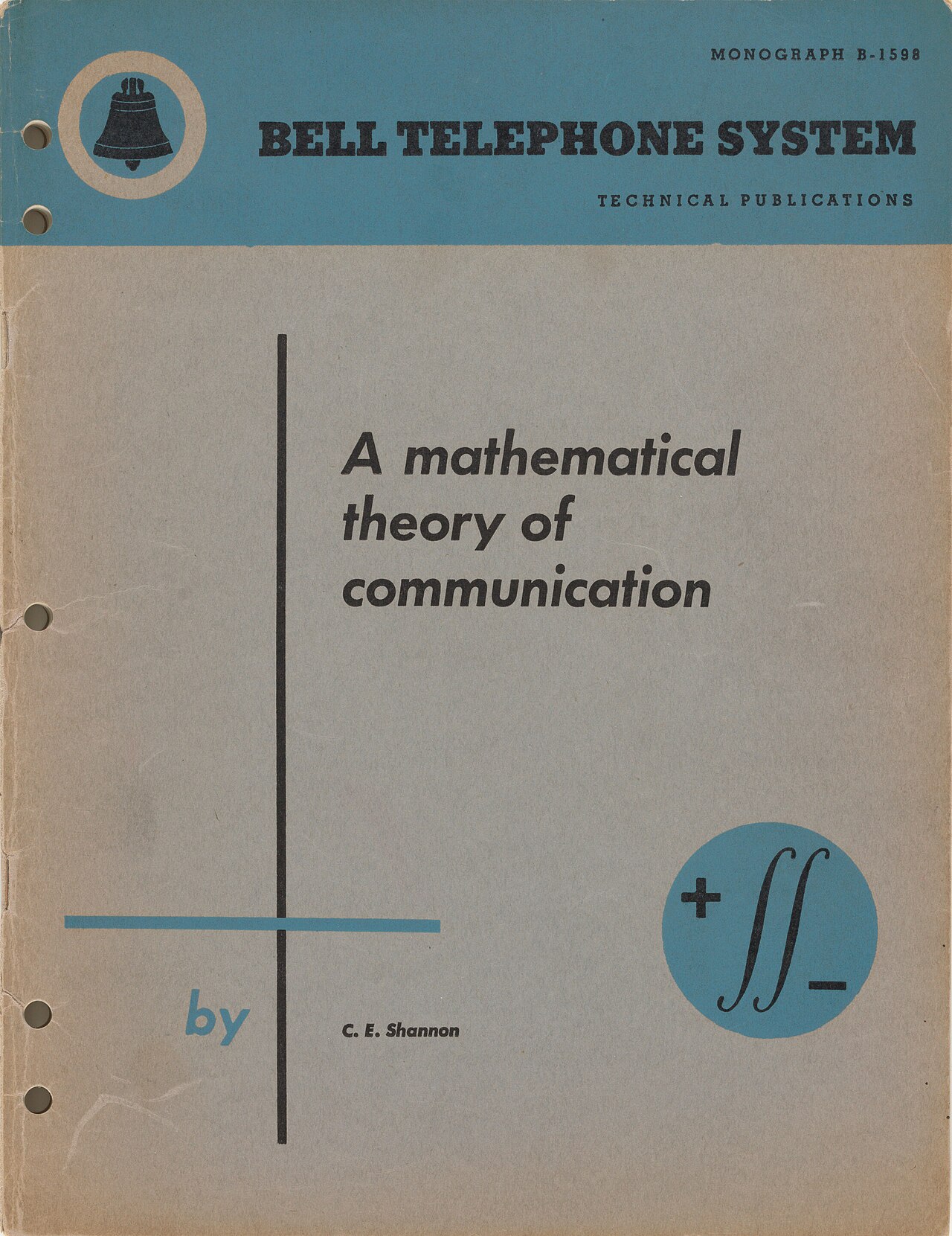
Bell System Technical Journal, July and October 1948. “The fundamental problem of communication is that of reproducing at one point either exactly or approximately a message selected at another point.”
scan to join on your phone
Offprint of the 1948 paper, Bell Telephone Laboratories · public domain · Wikimedia Commons
> click / swipe / arrow keys to begin_
Fulltext (PDF) ↗

The Paper

24.11.2026 · AE561124
  • Published in two parts: July and October 1948, Bell System Technical Journal.
  • Later reissued as a book with Warren Weaver (1949).
  • Called the “Magna Carta of the Information Age”.
  • Founded a new science from nothing in about 80 pages.
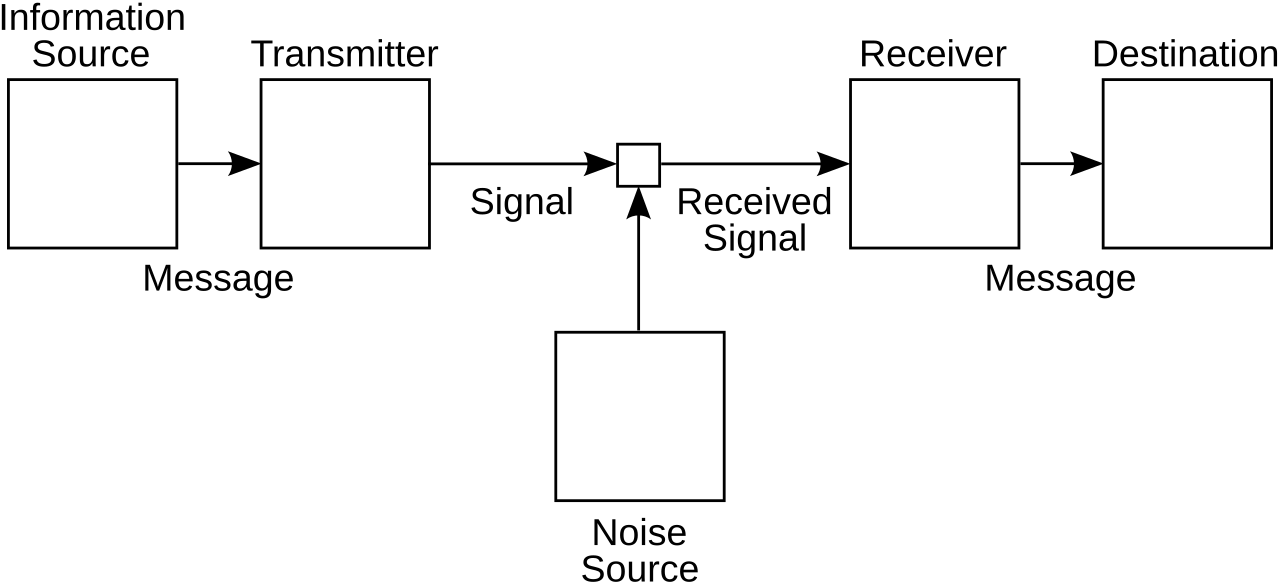
Shannon's communication system, diagram by Wanderingstan and Stannered · public domain · Wikimedia Commons

The Communication System

24.11.2026 · AE561124
  • Source → transmitter → channel (with noise) → receiver → destination.
  • The same diagram fits telegraph, telephone, radio, a conversation, DNA copying, a hard disk.
  • “The semantic aspects of communication are irrelevant to the engineering problem.” — meaning is not measured, only the choice among messages.

The Bit

24.11.2026 · AE561124
  • 1 bit = the information in a choice between two equally likely alternatives.
  • The word bit (“binary digit”) was suggested to Shannon by John W. Tukey.
  • Twenty questions: 20 yes/no answers separate 220 = 1,048,576 possibilities.
  • The amount of information is independent of what the message means.

Exercise · Twenty Questions

24.11.2026 · AE561124

In couples. One partner thinks of a number between 1 and 1000, the other asks only yes/no questions.

  • What is the best first question? (Why: it halves the possibilities.)
  • How many questions are enough for 1000 numbers? (10 — because 210 = 1024.)
  • Each good answer carries 1 bit. A question to which you already know the answer carries 0 bits.
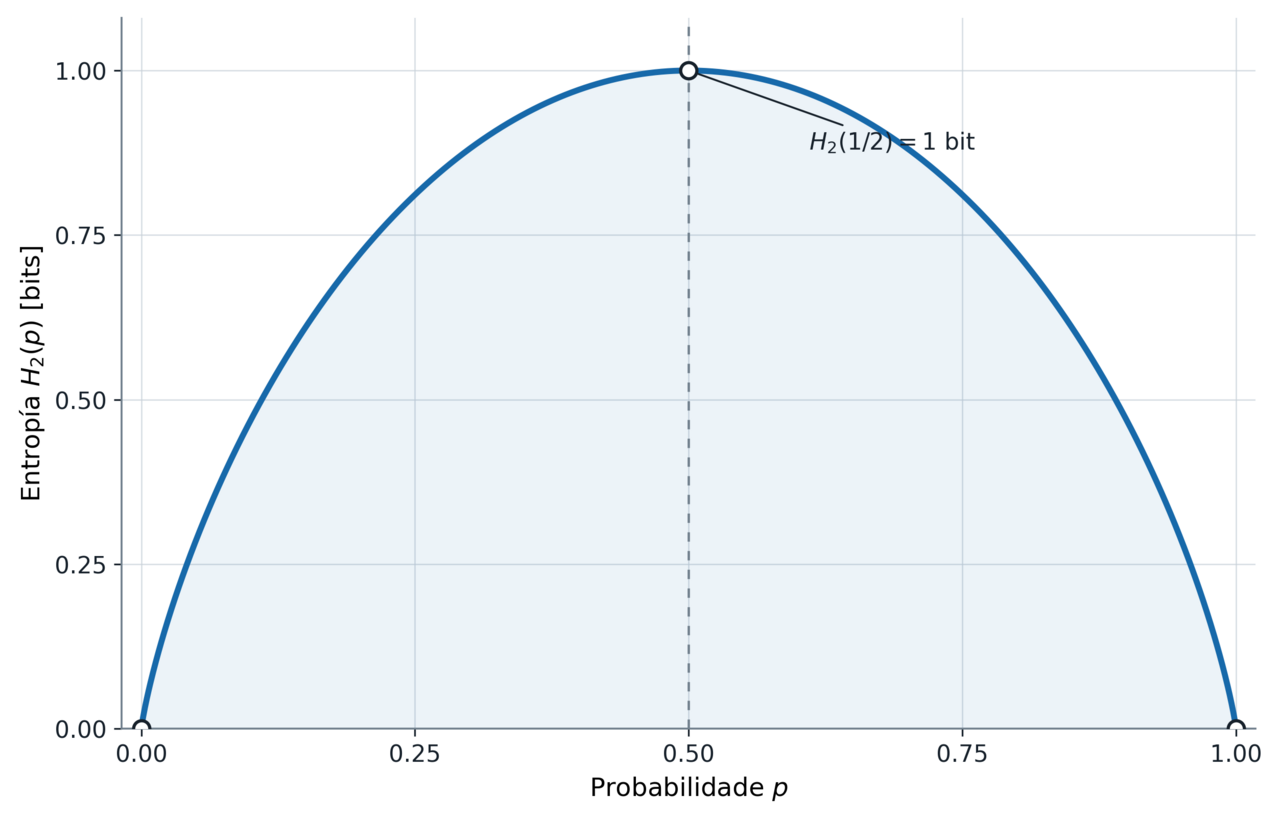
Binary entropy function, by Juanciño (labels in Portuguese) · CC BY-SA 4.0 · Wikimedia Commons

Surprise and Entropy

24.11.2026 · AE561124

H = − Σ pi · log2 pi

  • Entropy = average surprise per message, measured in bits.
  • Fair coin: 1 bit. Coin that gives heads 90% of the time: only 0.47 bit. A certain event: 0 bit.
  • Fair die: log2 6 ≈ 2.58 bits.
  • The more predictable the source, the less there is to say.

Why “Entropy”?

24.11.2026 · AE561124
  • The formula looks like the Boltzmann–Gibbs entropy of statistical mechanics.
  • A famous (and disputed) anecdote has John von Neumann advising Shannon to use the word: nobody knows what entropy really is, so in a debate he will always have the advantage.
  • Deeper reason: both measure how many microstates / messages are compatible with what we know.
  • Information and physics met here, and have not parted since.

The Two Great Theorems

24.11.2026 · AE561124
  • Source coding: a source of entropy H can be compressed to H bits per symbol — and no further. (ZIP, JPEG, MP3.)
  • Noisy-channel coding: every channel has a capacity C. Below C, communication can be made arbitrarily reliable by clever redundancy; above C, never.
  • Before 1948 engineers believed: more reliability = more power or slower speed. Shannon proved otherwise.
  • The proof was an existence proof: it took decades to build the codes (turbo, LDPC) that approach it.

Shannon’s Statistical English

24.11.2026 · AE561124

Approximating English by chains of words, 1948. Second-order word approximation from the paper:

“THE HEAD AND IN FRONTAL ATTACK ON AN ENGLISH WRITER THAT THE CHARACTER OF THIS POINT IS THEREFORE ANOTHER METHOD FOR THE LETTERS THAT THE TIME OF WHO EVER TOLD THE PROBLEM FOR AN UNEXPECTED”
  • Each word is chosen according to the word before it — a Markov chain.
  • Nonsense, but locally plausible English.
  • This is a language model — the ancestor of every GPT: predict the next token from what has come before.
  • Next-token prediction + more context + more data = the story of the last 75 years.
>> cross-referenced signal

Exercise · Guess the Next Letter

24.11.2026 · AE561124

In couples. Shannon’s own experiment of 1951.

  • Partner A chooses a sentence from a book and reveals it letter by letter, covering the rest.
  • Partner B guesses the next letter; A says “yes” or “no” until B is right.
  • Count the guesses. Early letters take many, later ones very few.
  • Result: English is highly redundant; Shannon estimated about 1 bit per letter — versus log2 27 ≈ 4.75 bits if letters were random.
Tech Icons: Claude Shannon — AT&T Tech Channel

Video · Tech Icons: Claude Shannon

24.11.2026 · AE561124

open as its own page ↗