Turning Point · December 1947: The Transistor
24.11.2026 · AE561124
In the same building where Shannon worked, a switch without moving parts was demonstrated for the first time.
scan to join on your phone
> click / swipe / arrow keys to begin_
Christmas at Bell Labs
24.11.2026 · AE561124
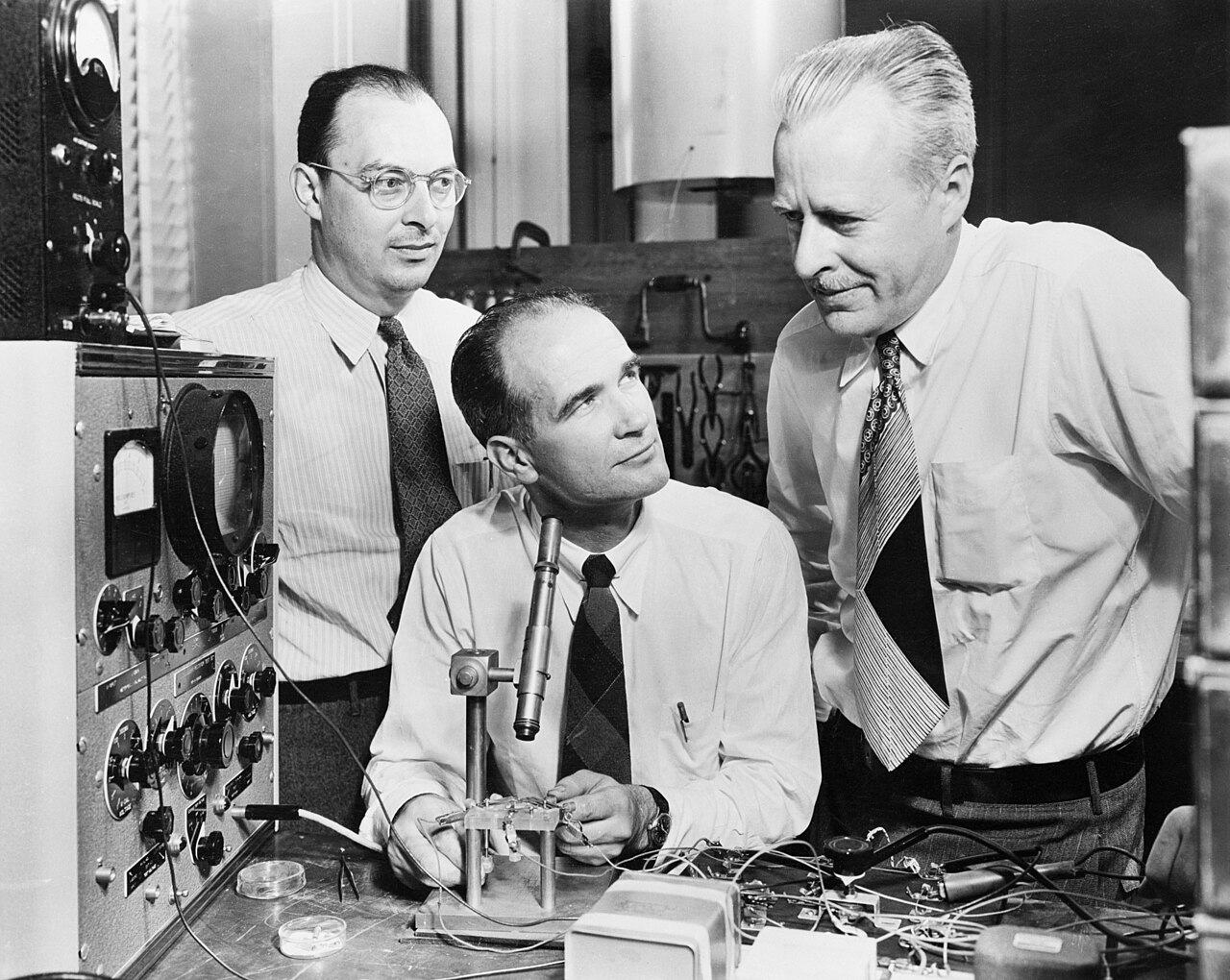
- 16–23 December 1947: John Bardeen and Walter Brattain demonstrate a point-contact transistor to Bell Labs management; William Shockley leads the group.
- Publicly announced on 30 June 1948.
- 1956: Nobel Prize in Physics for all three.
- Same company, same year as Shannon’s Mathematical Theory of Communication.
The First Transistor
24.11.2026 · AE561124
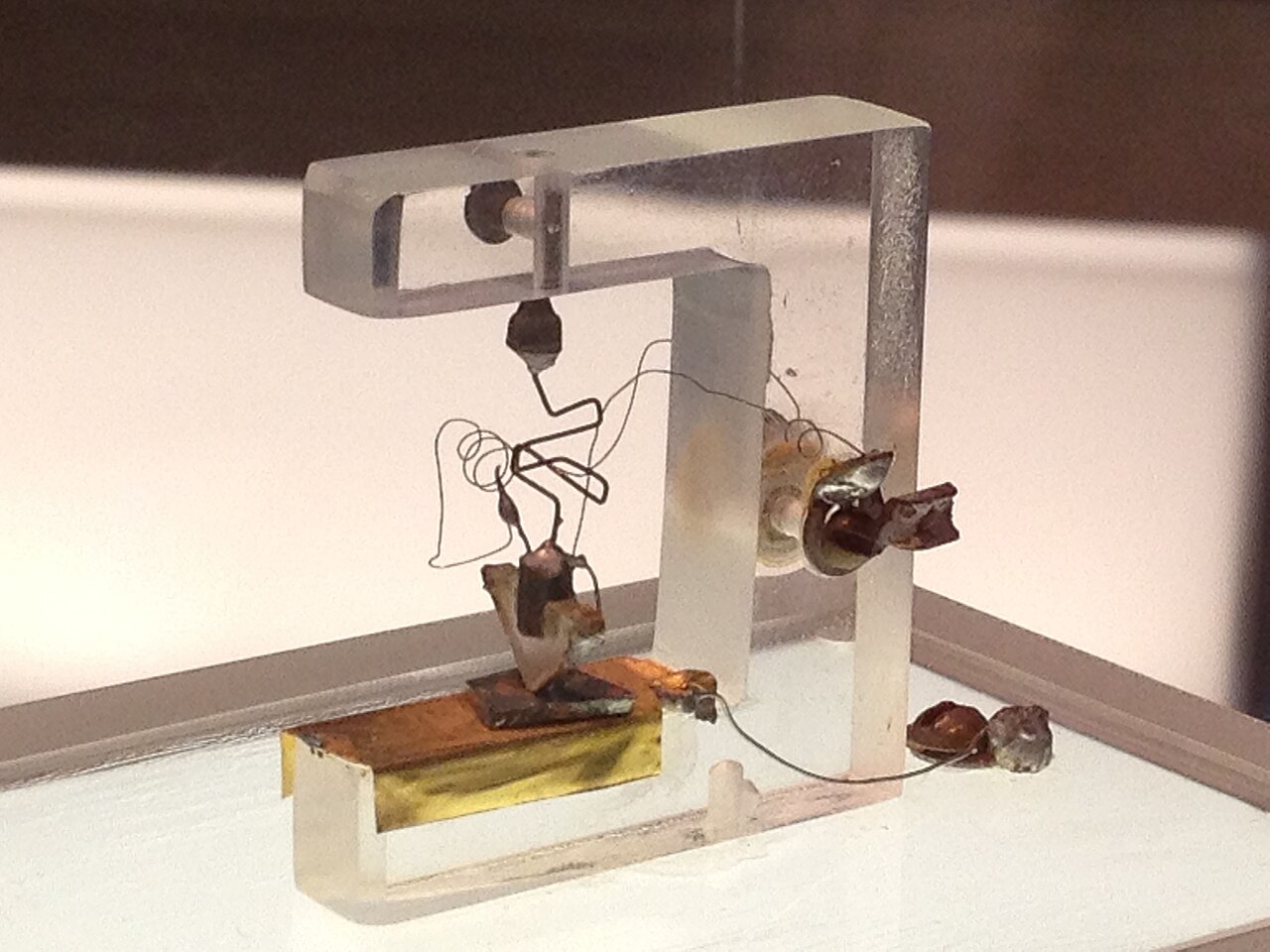
- Germanium crystal, two gold contacts, a plastic wedge — a clumsy device.
- It amplifies and, driven to extremes, switches.
- A switch with no moving part, no glowing filament, hardly any heat.
- The relay’s job — Shannon’s gate — can now be done by a speck of crystal.
Relay → Tube → Transistor
24.11.2026 · AE561124
| Switch | Principle | Speed |
|---|---|---|
| Relay | coil moves a metal contact | milliseconds |
| Vacuum tube | hot filament, electrons in vacuum | microseconds |
| Transistor | crystal, no moving parts | nanoseconds and below |
- The algebra stays the same: AND, OR, NOT. Only the substrate changes.
- This is why Shannon’s morphism scales from a few relays to billions of transistors.
When Bit Met Switch
24.11.2026 · AE561124
- Shannon told us what a bit is and how many a message needs.
- Shockley, Bardeen, Brattain made a bit physically cheap, fast and small.
- Theory of the bit + hardware of the bit = the digital age.
- Everything that follows in this session — and in this course — stands on that coincidence.
