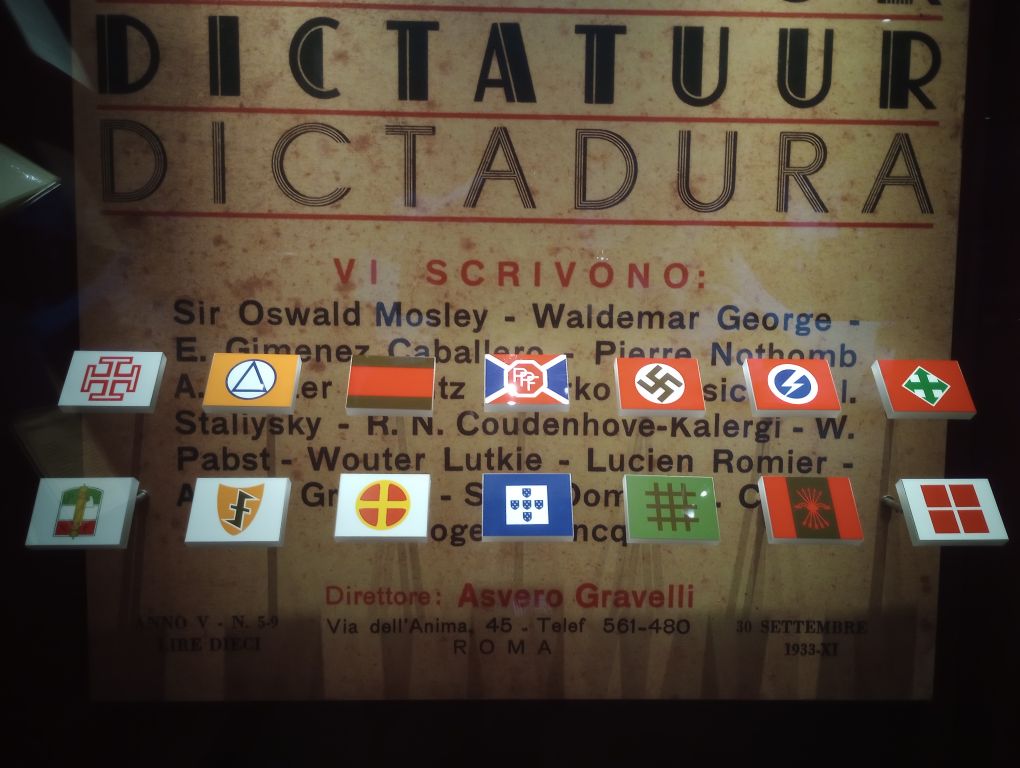
Straight lines. Right angles. Nothing soft.
The Nazi swastika: four equal arms bent at 90°, tilted on its tip. The SS runes: two sharp lightning zigzags. The Hungarian Arrow...
Sounds have shapes. Shapes have moods.
Köhler (1929, 1947) and Ramachandran & Hubbard (2001): almost everyone calls the round form maluma / bouba, the spiky one takete ...
One module. Repeated until the individual disappears.
The swastika turns: four-fold rotational symmetry, a built-in motion. The fasces is a vertical bundle of identical rods.
Ma...
Three colours. Maximum contrast.
Red field, white disc, black sign: readable from far away, on cloth, on stone, in a photograph. A target shape: the eye is pulled to the centre....
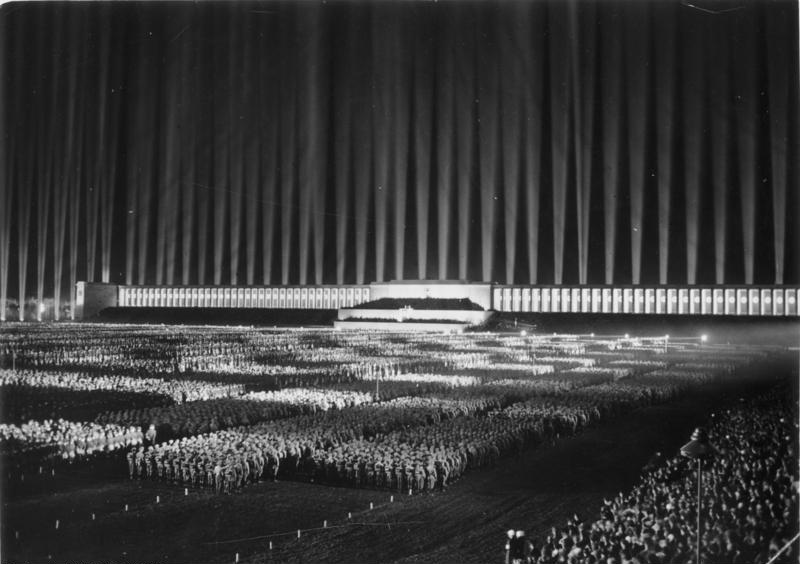
Walter Benjamin, 1935: fascism gives the masses not rights, but a chance to express themselves.
Politics as spectacle: flags, uniforms, torches, light, visible body movements.
A...