Diese Präsentation ist für die Ansicht im Querformat gestaltet.

A symbol is a meme small enough to fit on an armband.
Look first not at what the signs mean, but at how they are made.
Form is not guilt: the swastika is thousands of years older than the Nazis. But form is what lets a sign be copied, massed and obeyed.
Straight lines. Right angles. Nothing soft.
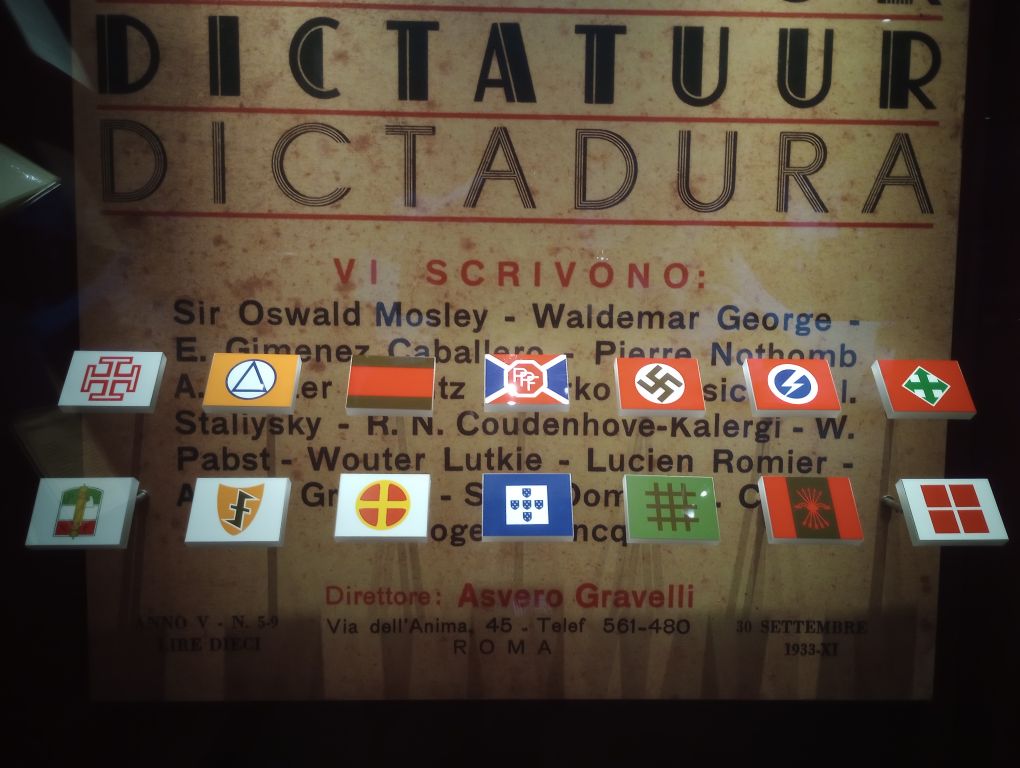
The Nazi swastika: four equal arms bent at 90°, tilted on its tip. The SS runes: two sharp lightning zigzags. The Hungarian Arrow Cross: an equal-armed cross ending in points.
Reduced to a few strokes, a sign can be drawn by anyone, in seconds, on any wall. Copyability is fitness.
Scan. Choose. Don’t think.
Which one is maluma?
Sounds have shapes. Shapes have moods.
Köhler (1929, 1947) and Ramachandran & Hubbard (2001): almost everyone calls the round form maluma / bouba, the spiky one takete / kiki.
Bar & Neta (2006): people prefer curved objects over sharp-angled ones — sharp contours read as threat.
Fascist forms use the spike on purpose: hard edges signal power before any word is read.
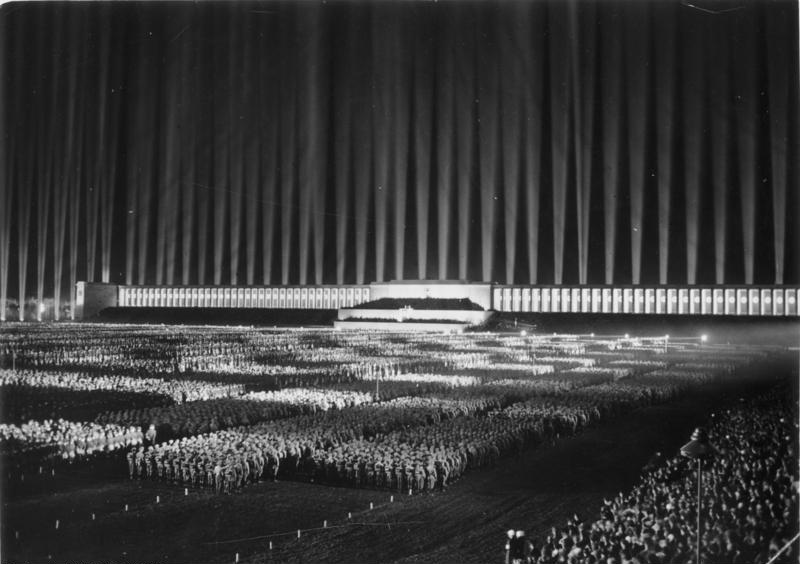
Reichsparteitag Nuremberg, Lichtdom. Bundesarchiv Bild 183-1982-1130-502, CC BY-SA 3.0 de
One module. Repeated until the individual disappears.
The swastika turns: four-fold rotational symmetry, a built-in motion. The fasces is a vertical bundle of identical rods.
Mass ornament: ranks of identical bodies, rows of banners, and at Nuremberg a hall of vertical searchlight beams. The crowd becomes the pattern.
Three colours. Maximum contrast.
Red field, white disc, black sign: readable from far away, on cloth, on stone, in a photograph. A target shape: the eye is pulled to the centre.
Hitler himself explained each colour as a message — the design was a deliberate piece of propaganda.
Walter Benjamin, 1935: fascism gives the masses not rights, but a chance to express themselves.
Politics as spectacle: flags, uniforms, torches, light, visible body movements.
Ask: when you feel the pull of an image, what is it asking you to do?