Session 8b :: Alan Turing
Order of the day
- Narratio :: The imitation game
- Repetitio :: Introduction to information theory
- Questio :: Can machines think ?
- Lectio ::
- Turing machine
- Turing test
- Exercitio :: Turing test.
The imitation game
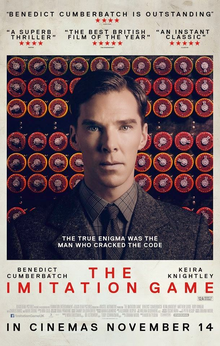
- a 2014 movie adaptation of the book Alan Turing: The Enigma (1983)
- 8 Oscar nominations, one Oscar for Best Adapted Screenplay
- story about life, work and death of Alan Matthison Turing (A.M.T.)
-
⇄ Alan Matthison Turing (1912–1954)
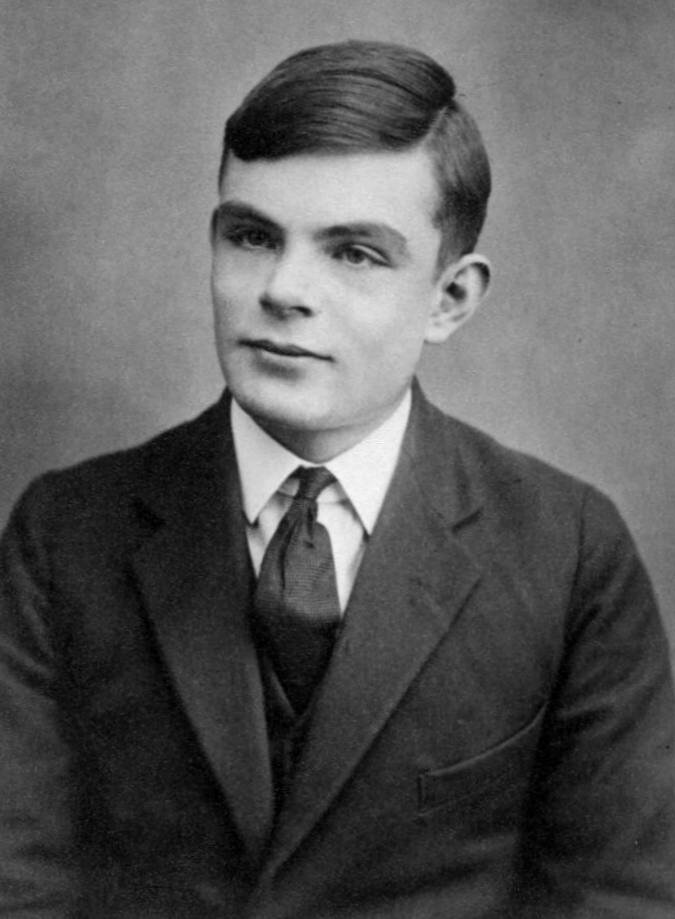 Alan Matthison Turing (1912–1954)
Born in London, 23 June 1912. Mathematician: Cambridge, then Princeton.1936, aged 23: On Computable Numbers — the paper that defines the computer before any computer exist...
Question of the day
What does it mean "to think" ?
- your definitions
- dictionary definition
- philosopher's definition
What do You think?
-
⇄ Question of the Day · Can machines think?
Question of the Day · Can machines think?
Turn to your neighbour. Two minutes.What would a machine have to do for you to say “yes, it thinks”?Write the criterion down.We will test it at the end of the session.
philosopher's definition of "thinking"
Descartes
- an English mathematician, computer scientist, logician, cryptanalyst, philosopher and theoretical biologist
- father of theoretical computer science (1936) and artificial intelligence (1948-1950)
- pivotal role in the project Ultra
- convicted for "gross indecency" in 1952, put on hormonal treatment, develops gynaecomastia
- death by cyanide; half-bitten apple by the bedside
- Queen's "pardon" on 24.12.2013
-
⇄ Alan Matthison Turing (1912–1954)
Alan Matthison Turing (1912–1954)
Born in London, 23 June 1912. Mathematician: Cambridge, then Princeton.1936, aged 23: On Computable Numbers — the paper that defines the computer before any computer exist...
Halting Problem
- halting problem is the problem of determining, from a description of an arbitrary computer program and an input, whether the program will finish running (i.e., halt) or continue to run forever
- Turing proved that a general algorithm to solve the halting problem for all possible program-input pairs cannot exist
- to prove this, he described a paradox involving a concept now known as "Turing machine"
a Turing machine #1
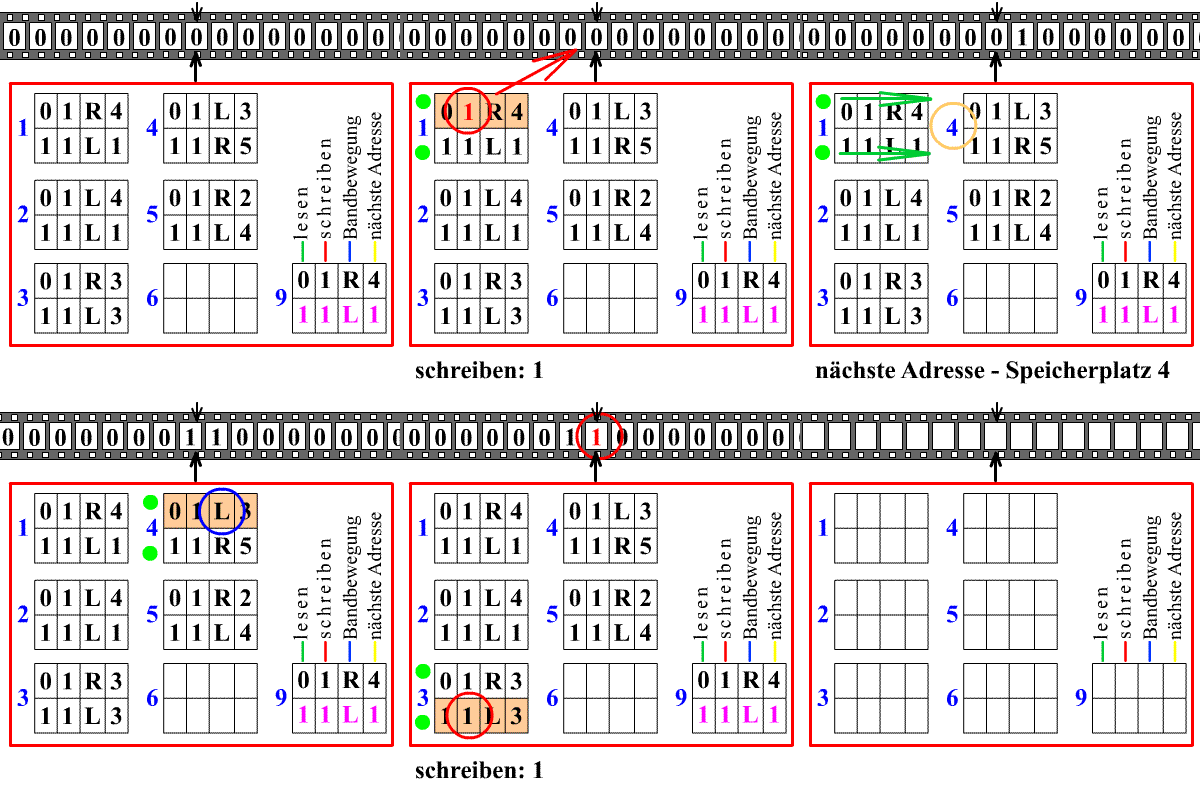
- tape with discrete symbols
- reading/writing header
- table of rules
- tape-moving mechanism
-
⇄ The Thumb Is the State
The Thumb Is the State
Look again at the rule table of our Turing machine — the one from the Alan session — and write the state as a bit: CARRY = 1, HALT = 0.state creads bwritesnext state...
-
⇄ Exercise · Human Turing Machine
Exercise · Human Turing Machine
In pairs. Two roles. TAPE: write six cells on paper, e.g. 0 1 0 1 1 1, and cover all but the cell under the head with your hand. MACHINE: you have only a rule card (the table of...
a Turing machine #2
-
⇄ Exercise · Be the machine
Exercise · Be the machine
The tape holds a binary number: 1 0 1 1. The head stands on the rightmost digit. State: CARRY.CARRY reads 1 → write 0, move left, stay in CARRYCARRY reads 0 or blank →...
-
⇄ The Thumb Is the State
The Thumb Is the State
Look again at the rule table of our Turing machine — the one from the Alan session — and write the state as a bit: CARRY = 1, HALT = 0.state creads bwritesnext state...
Universal Turing machine
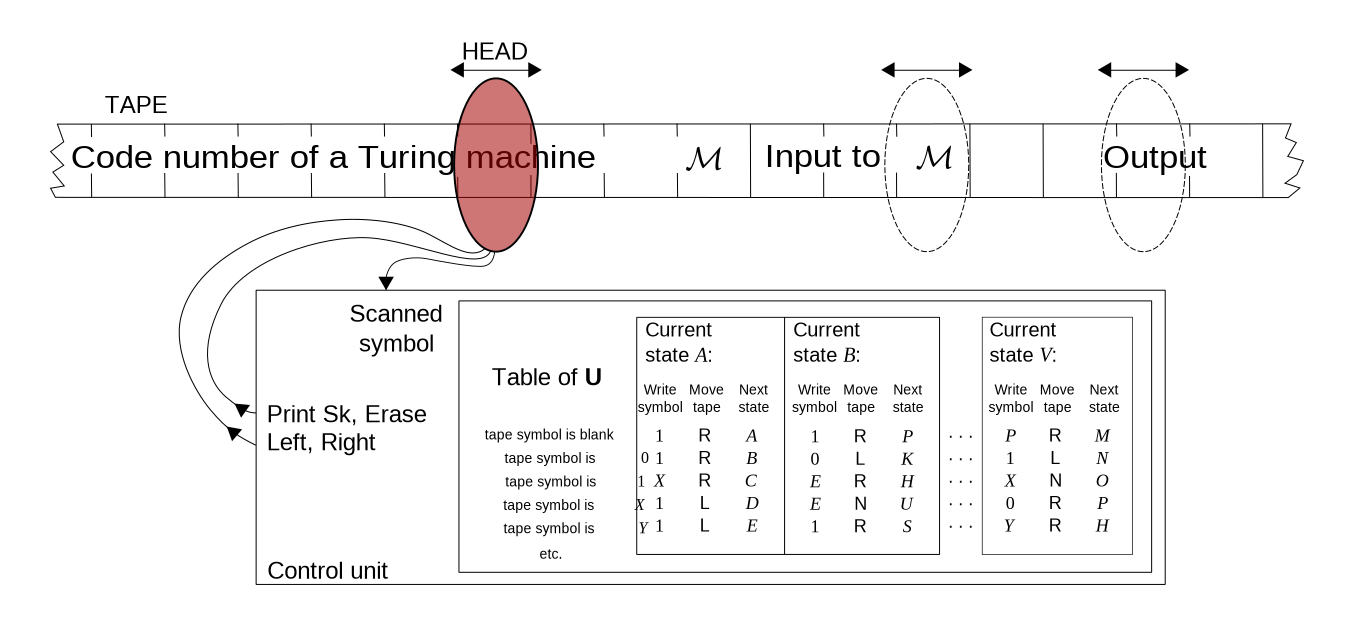
Universal Turing Machine2
-
⇄ The tape can hold a machine
The tape can hold a machine
A universal machine reads the rules of another machine from its tape and behaves like it.Program = data. Your laptop is such a machine; an app is just a long tape.And a program ...
Turing test
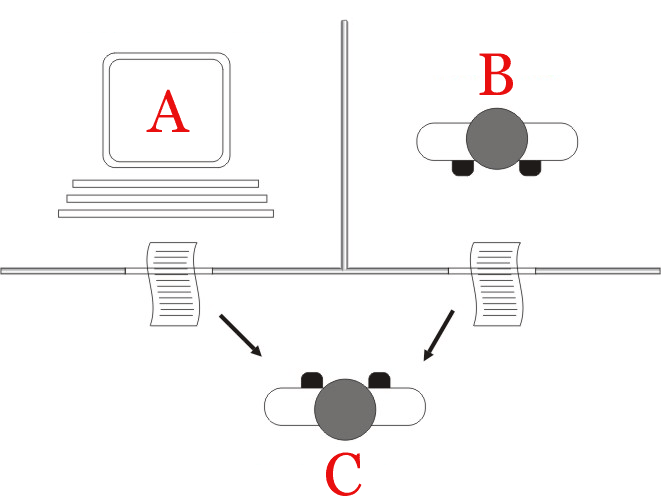
"A TT is a way how to address the question "Can machines think?" in a scientifically plausible ye deeply empathic way. More concretely, Turing (1950) proposes that the performance of an AA under question shall be evaluated by a human judge J whose objective is to determine which among two entities - with whom J is in real-time interaction - is of human and which is of artificial nature." (Hromada, 2012)
The imitation game
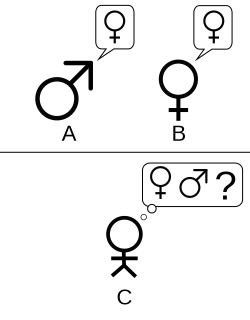
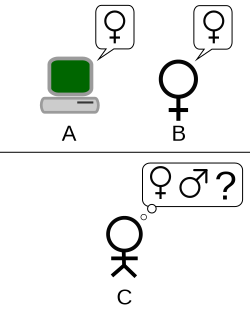
Computational machinery and intelligence (1950)
Exercicio :: Musical Turing Test
You are going to hear two pieces of music. One is composed and performed by humans, another is composed and generated by an artificial system. You are going to hear both pieces twice. Subsequently, You are going to write down which piece (first or second) was composed and performed by human beings.
-
⇄ Does the test still work?
Does the test still work?
ELIZA (Weizenbaum, 1966): a few pattern rules, and some users confided in it anyway.The Chinese Room (Searle, 1980): symbols shuffled correctly, nothing understood.Recent contro...
-
⇄ Exercise · Meet Alan
Exercise · Meet Alan
Alan is a Matrix bot (@alan:udk.ai) running on our own server. You will chat with “Alan” — but behind him may be an AI persona or another student. Alan relays ...
