i
Session 3 :: Between Antiquity and Renaissance daniel-hromada ()


Session 3 :: Between Antiquity and Renaissance

Order of the day

  1. Repetitio :: Antiquity
  2. Narratio :: L'histoire de fille mecanique
  3. Questio :: What is a digit ?

  4. Lectio :: Dark ages
    • al-Khwarizmi
    • Fibonacci

  5. Exercitio :: Abacus II.
  6. Disputatio :: Your feedback

Question of the day

What is a digit ?

Etymology of the word "digit"

  • digit (n.)
    in English since late 14c., "numeral below 10," from Latin digitus (french: "doigt") "finger or toe" (also with secondary meanings relating to counting and numerals), considered to be related to Proto-Indo-European root *deik- "to show"

Mariam-Webster dict. definition of a "digit"

    • any of the Arabic numerals 1 to 9 and usually the symbol 0
    • one of the elements that combine to form numbers in a system other than the decimal system
    • digits , slang : the digits of a telephone number
  1. any of the divisions in which the limbs of most vertebrates terminate, which are typically five in number but may be reduced (as in the horse), and which typically have a series of phalanges bearing a nail, claw, or hoof at the tip

Our definition "digit"

  • a symbol denoting/representing a natural number ("a numeral")
  • we'll work with four systems of numerals
    1. roman: I, V, X, L, C, D, M
    2. decimal: 0, 1, 2, 3, 4, 5, 6, 7, 8, 9
    3. binary: 0, 1
    4. hexadecimal: 0, 1, 2, 3, 4, 5, 6, 7, 8, 9, a, b, c, d, e, f
  • other systems of numerals are also possible (e.g. base64)

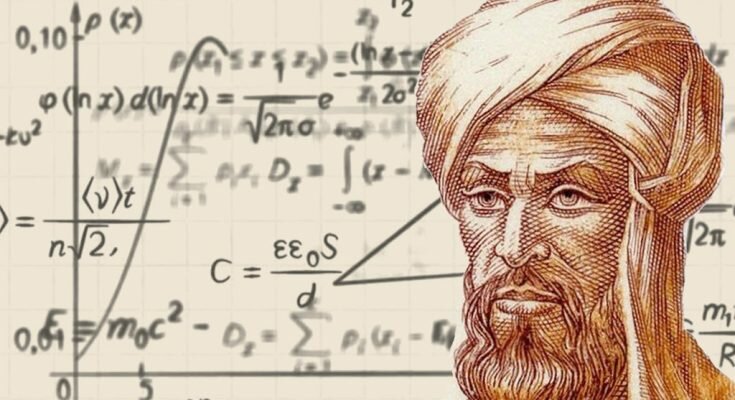
Muhammad ibn Musa al-Khwarizmi (c. 780 - 850 A.D.)

  • persian scholar from golden-age of islamic science
  • his name Latinized as "Algorithmi" (Port. "guarismo" and Spanish "algarismo" mean digit)
  • since 820 A.D. the astronomer and head of the House of Wisdom in Baghdad
  • contributions to Algebra, Arithmetic, Astronomy, Trigonometry, Geography

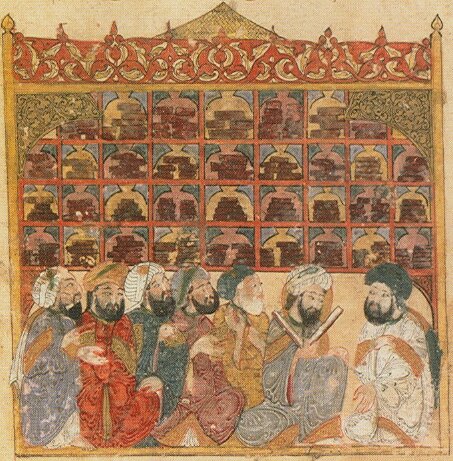
House of Wisdom of Baghdad

  • 8th century - 12th century :: golden-age of islamic science
  • integration of Persian and Arabic into one cultural realm
  • translation of Greek and Roman works into arabic
  • extension of antique knowledge, e.g. Brothers Musa
  • more practical than Greek stuff

Liber Algebræ et Almucabola

  • book about solving quadratic equations
  • principial mathematical text-book of European Universities until 16th century
  • al-ğabr ("forcing", "restoring") operation :: moving a deficient quantity from one side of the equation to the other side
  • al-Muqabala ("balancing" or "corresponding") operation :: subtraction of the same positive quantity from both sides
  • presented in ordinary text
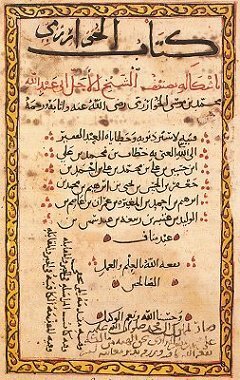
    Al-kitāb al-mukhtaṣar fī ḥisāb al-ğabr wa’l-muqābala, The Compendious Book on Calculation by Completion and Balancing

"an algorithm" to solve quadratic equation

If some one says: "You divide ten into two parts: multiply the one by itself; it will be equal to the other taken eighty-one times."
Computation: You say, ten less a thing, multiplied by itself, is a hundred plus a square less twenty things, and this is equal to eighty-one things. Separate the twenty things from a hundred and a square, and add them to eighty-one. It will then be a hundred plus a square, which is equal to a hundred and one roots. Halve the roots; the moiety is fifty and a half. Multiply this by itself, it is two thousand five hundred and fifty and a quarter. Subtract from this one hundred; the remainder is two thousand four hundred and fifty and a quarter. Extract the root from this; it is forty-nine and a half. Subtract this from the moiety of the roots, which is fifty and a half. There remains one, and this is one of the two parts.
(1831 English Translation)

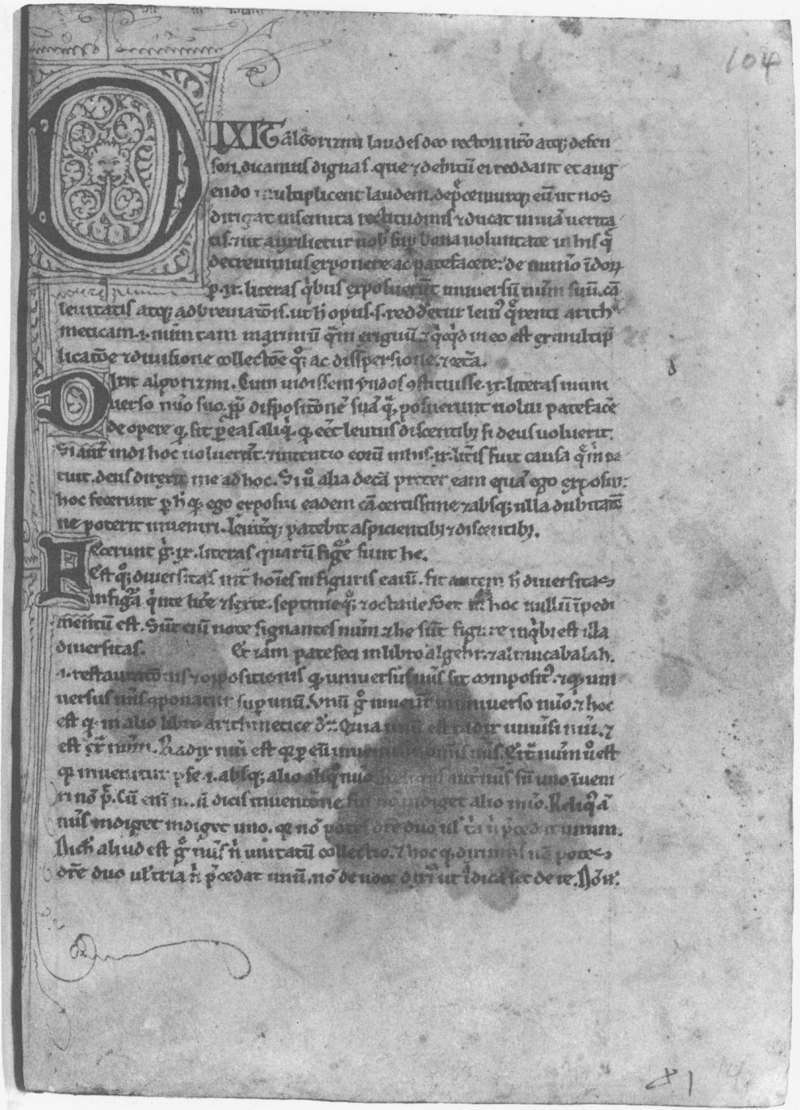
Arithmetics: Dixit algorizmi...

  • Kitāb al-Jam‘ wat-Tafrīq bi-Ḥisāb al-Hi("The Book of Addition and Subtraction According to the Hindu Calculation")
  • Arabic original of the book has been lost
  • 12th century translation by Adelard of Bath (starting with "so said alKhwarizmi") introduced Hindu numerals in the west
  • Hindu numerals: position-based and including 0

Leonardo Fibonacci of Pisa (c. 1175 c. 1250)

  • "the most talented Western mathematician of the Middle Ages"
  • his book Liber Abaci (1202) popularized the Hindu-Arabic numeral systems in Europe
  • travelled extensively around the Mediterranean coast, meeting with many merchants and learning about their systems of doing arithmetic
  • first one to describe Fibonacci sequence

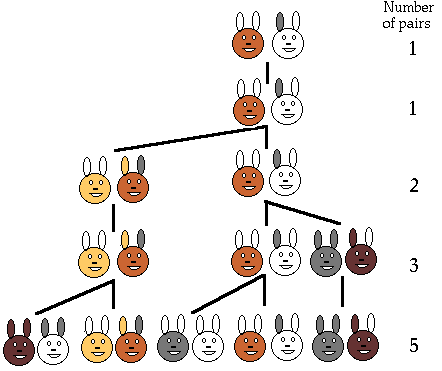
Fibonacci's sequence :: Rabbits

"Suppose a newly-born pair of rabbits, one male, one female, are put in a field. Rabbits are able to mate at the age of one month so that at the end of its second month a female can produce another pair of rabbits. Suppose that our rabbits never die and that the female always produces one new pair (one male, one female) every month from the second month on.
How many pairs will there be in one year?"
http://www.maths.surrey.ac.uk/hosted-sites/R.Knott/Fibonacci/fibnat.html

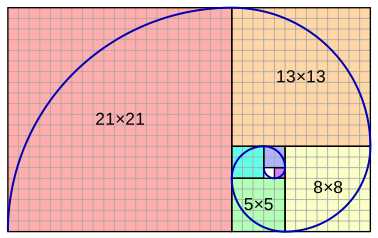
Fibonacci's sequence :: Spiral

modus Indorum :: the method of Indians

"The nine Indian figures are:
9 8 7 6 5 4 3 2 1
With these nine figures, and with the sign 0 which the Arabs call zephir any number whatsoever is written...
"

Leonardo Fibonacci of Pisa :: Liber Abaci :: The Book of the Abacus

Feedback 0 :: 3 questions

  • What do I like about the course?
  • What I do not like?
  • What are my wishes?