Diese Präsentation ist für die Ansicht im Querformat gestaltet.

Let us now temporarily leave theory behind.
Look at ordinary life as a landscape of things passing from person to person.
We will move from the smallest and fastest patterns...
...toward increasingly complex cultural structures.
😮 yawning
😂 laughter
👏 applause
👀 looking where everybody else is looking
🌊 the stadium wave
These are useful starting examples because copying is immediately visible.
But some may be biological contagion rather than memes in Blackmore's strict sense.
One person suddenly looks intensely at the ceiling.
How many people look too?
Did information pass?
Was anything learned?
Would you call it a meme?
🤝 handshake
✋ high five
👊 fist bump
✌ peace sign
🫶 hand-heart
finger hearts
air quotes
A tiny movement can carry socially learned meaning.
The physical movement alone is not enough.
A raised thumb means something because other people already know how to interpret it.
The same movement can mean different things in different cultures.
A meme therefore often contains both performance and interpretation.
🎂 birthday cake + candles + song + wish
🥂 touching glasses before drinking
🎆 counting down at New Year
🪵 knocking on wood
🤞 crossing fingers
💰 throwing a coin into a fountain
Memes can become coordinated social scripts.
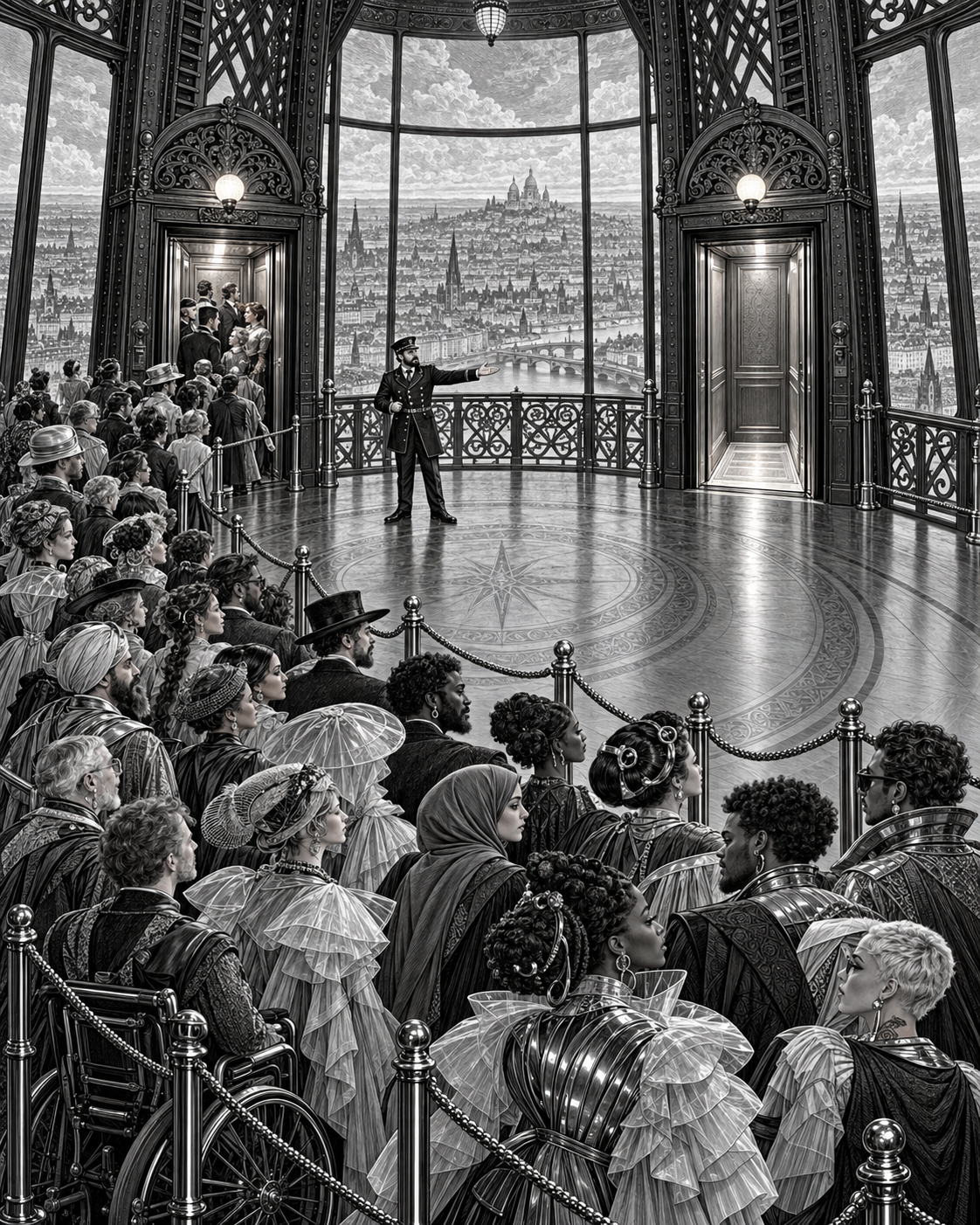
At the highest floor of the Eiffel Tower, there are two elevators facing each other.
If human beings were fully rational beings, two equally long queues should have formed, each unfolding in its own direction.
But again and again, only one queue appears.
A long line of visitors patiently waits for one elevator...
...while the other elevator stays empty and available.
People tend to infer their own action not from the total situation, but from the behavior of the people already in front of them.
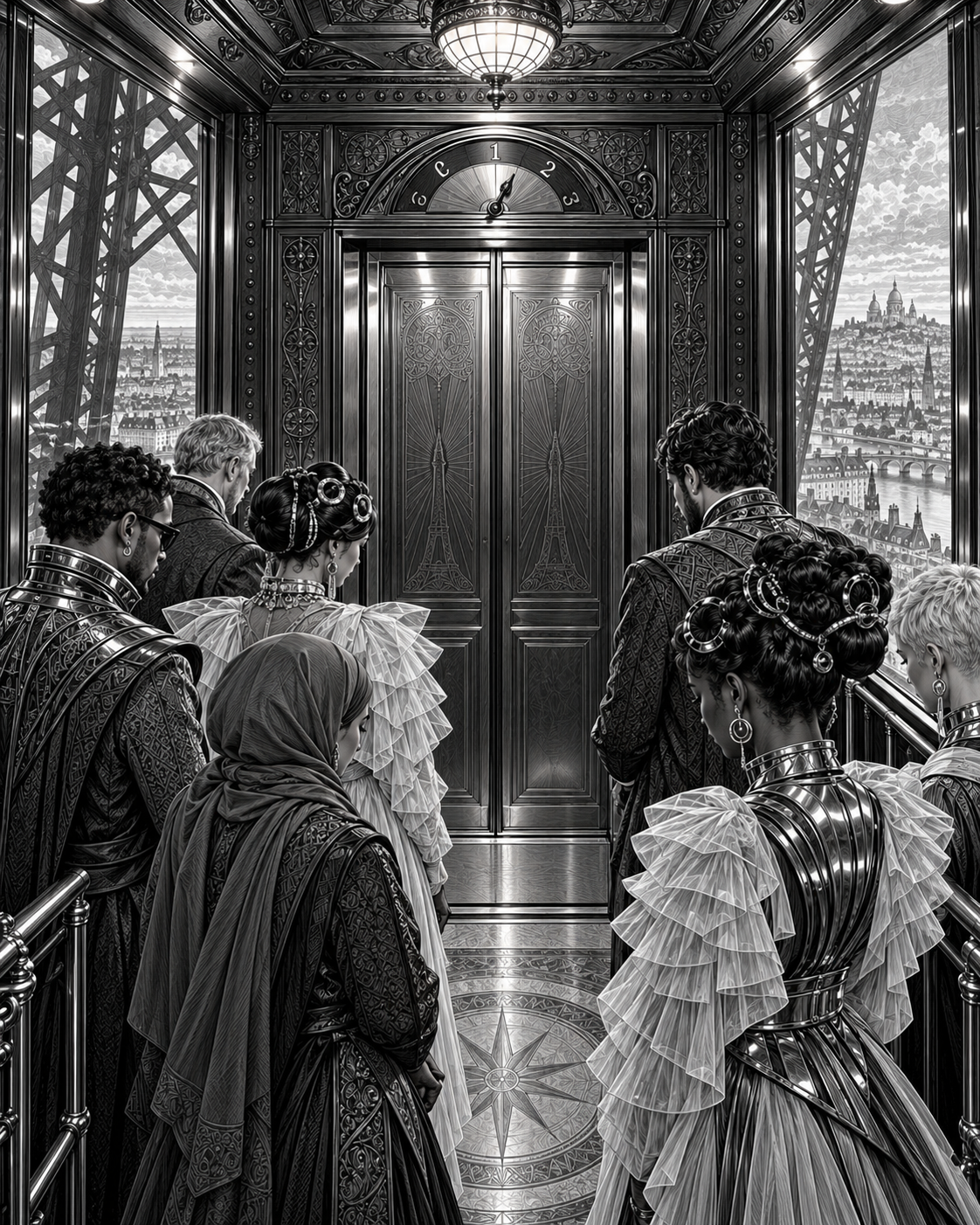
Enter.
Turn around.
Face the door.
Avoid prolonged eye contact.
Become strangely silent.
Who taught us this?
Many everyday conventions are acquired without an explicit teacher.
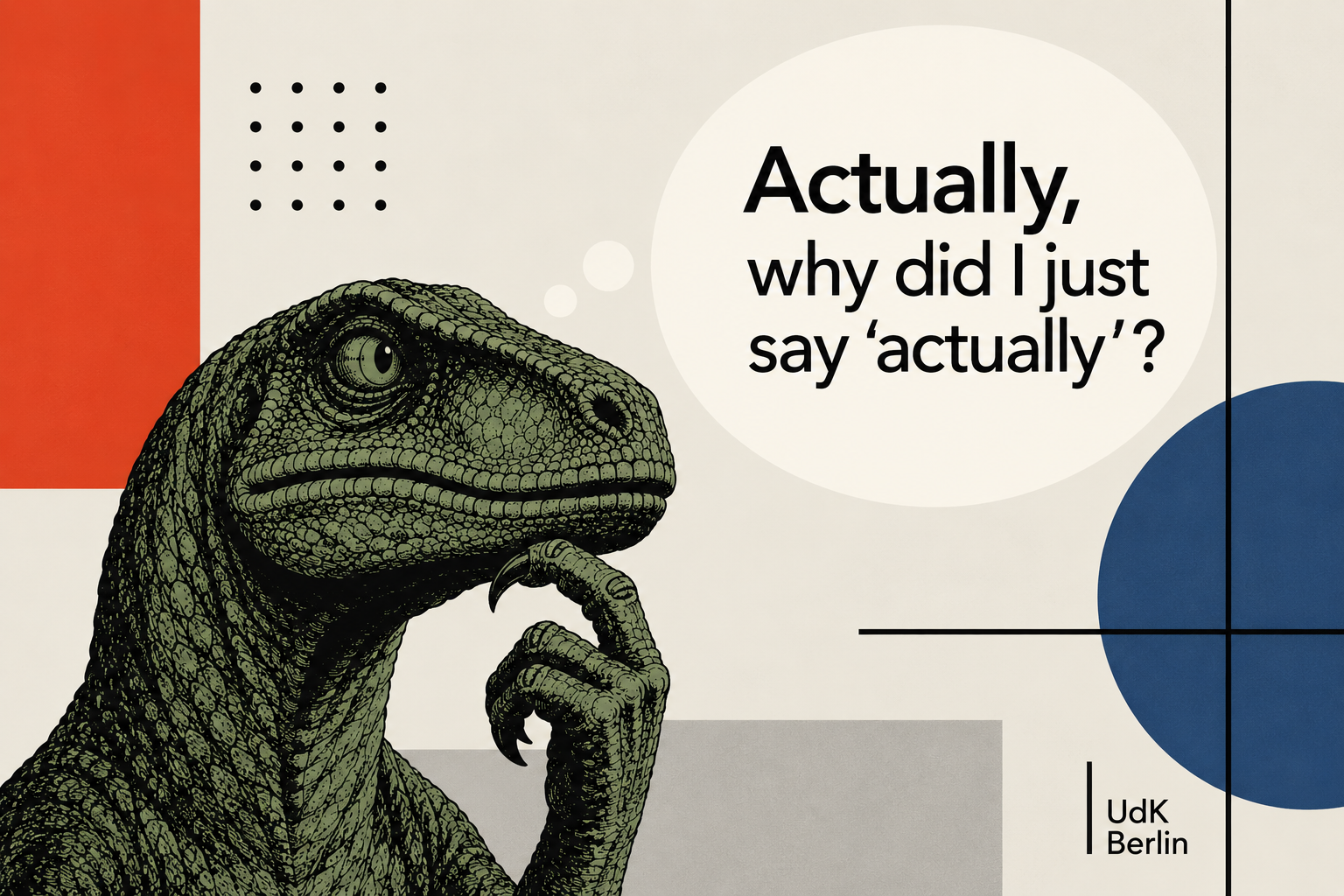
“Actually...”
“However...”
“You know?”
“At the end of the day...”
euh… [øː] , bah oui
блядь, f*ck, vole ...
Language is full of units which seem to "live their own life".
A phrase can detach itself from its original situation.
It becomes reusable.
People recognize it.
They repeat it because others recognize it.
Recognition itself can increase its probability of further replication.
Familiarity can become its own selection advantage.
A melody enters through the ears.
Hours later it is still playing internally.
You hum it.
Somebody else hears it.
Now it may inhabit another mind.
An earworm is almost a cartoonishly clear memetic lifecycle.
nursery rhymes
football chants
advertising jingles
melodies with changing lyrics
TikTok audio fragments detached from their original context
The carrier can change while the recognizable pattern survives.
♥ a heart that looks nothing like an anatomical heart
★ a five-pointed star
☀ a circle with rays
🏠 a square house with a triangular roof
💡 a light bulb meaning “idea”
We learn visual conventions by repeatedly encountering them.
Who knows how to draw the “Cool S”?
Who taught you?
Where did you first see it?
Do you know who invented it?
Why did generations of schoolchildren reproduce it?
A near-perfect classroom specimen of anonymous cultural transmission.
💾 floppy disk = save
🔍 magnifying glass = search
⚙ gear = settings
🗑 bin = delete
♥ heart = like
☰ three lines = menu
The original object can disappear while its symbolic descendant survives.
Many people click a floppy disk icon without ever having saved a file onto a floppy disk.
The symbol has become detached from the technology that produced it.
Its survival depends on continued copying inside interface culture.
Cultural ancestry can remain visible after functional ancestry has vanished.
ripped jeans
mullets
moustaches
Crocs
rolling trouser legs
particular sneaker styles
black clothing in particular creative milieus
Bodies become media.
Someone adopts a style.
Others notice it.
Some imitate it.
Some exaggerate it.
Some reject it.
Some revive an older version thirty years later.
Replication produces variation; variation produces selection.
family recipes
sourdough starters
cutting sandwiches diagonally
particular ways of folding pizza
“five-second rule”
putting a wet phone into rice
Useful, useless and questionable practices can all be culturally transmitted.
A meme does not have to be true to spread.
It does not have to be useful.
It does not have to benefit its host.
It merely needs properties that allow further transmission.
This is one of the most important—and most uncomfortable—ideas in memetics.
the elevator pitch
brainstorming with Post-its
the agenda slide
the TED-style talk
“three things I learned...”
the Venn diagram
the iceberg diagram
Sometimes the meme is not the content but the format.
image macros
reaction GIFs
“POV:”
“starter pack”
“nobody: / absolutely nobody:”
“tell me X without telling me X”
“how it started / how it's going”
The Internet did not invent memes. It created an extraordinarily fast memetic environment.
Internet memes make one property especially visible:
a stable template + many mutations.
Distracted Boyfriend.
Drake Hotline Bling.
Woman Yelling at a Cat.
The image remains recognizable while captions and meanings mutate.
Variation is not failure of copying. It is part of the evolutionary process.
urban legends
schoolyard rumours
ghost stories
“a friend of a friend once...”
life hacks
folk explanations
Stories are compressed, reconstructed and altered every time they move.
superstitions
stereotypes
ideas about success
ideas about beauty
ideas about what a “proper career” looks like
ideas about how families, schools or workplaces should function
At this scale, memes begin to shape perception itself.