The Second Replicator
Before Darwin
For most of human history, the diversity of life was explained by one simple idea: species are fixed, created once, unchanging.
A rabbit begets a rabbit. An oak begets an oak. World without end.
Even naturalists who classified thousands of species rarely asked: where did all this variety come from?
Darwin's Insight
In 1859, Charles Darwin proposed something radical: species are not fixed.
They change, slowly, over generations — new species arise from old ones through an entirely natural, unplanned process.
He called it natural selection.
No designer. No goal. Just a mechanism.
The Engine of Evolution
Replication + Variation + Selection = Evolution
Darwin never used these three words this way — but this is the abstract engine hiding inside his argument.
Three ingredients. Run them together, over and over, and something astonishing happens: design without a designer.
Replication
Something must be copied from one generation to the next.
Offspring resemble parents — not perfectly, but closely enough that traits persist.
Darwin did not know about DNA. He only needed: like tends to produce like.
Variation
No copy is perfect.
Within any population, individuals differ — in size, colour, behaviour, shape.
Some of this variation is heritable: it gets passed on, imperfections and all.
Without variation, there is nothing for selection to act upon.
Selection
Not every variant survives. Not every survivor reproduces equally.
Resources are limited; environments are demanding.
Whatever traits make an individual slightly better at surviving and reproducing become, on average, more common in the next generation.
Nobody chooses. The environment simply… filters.
Darwin's Finches
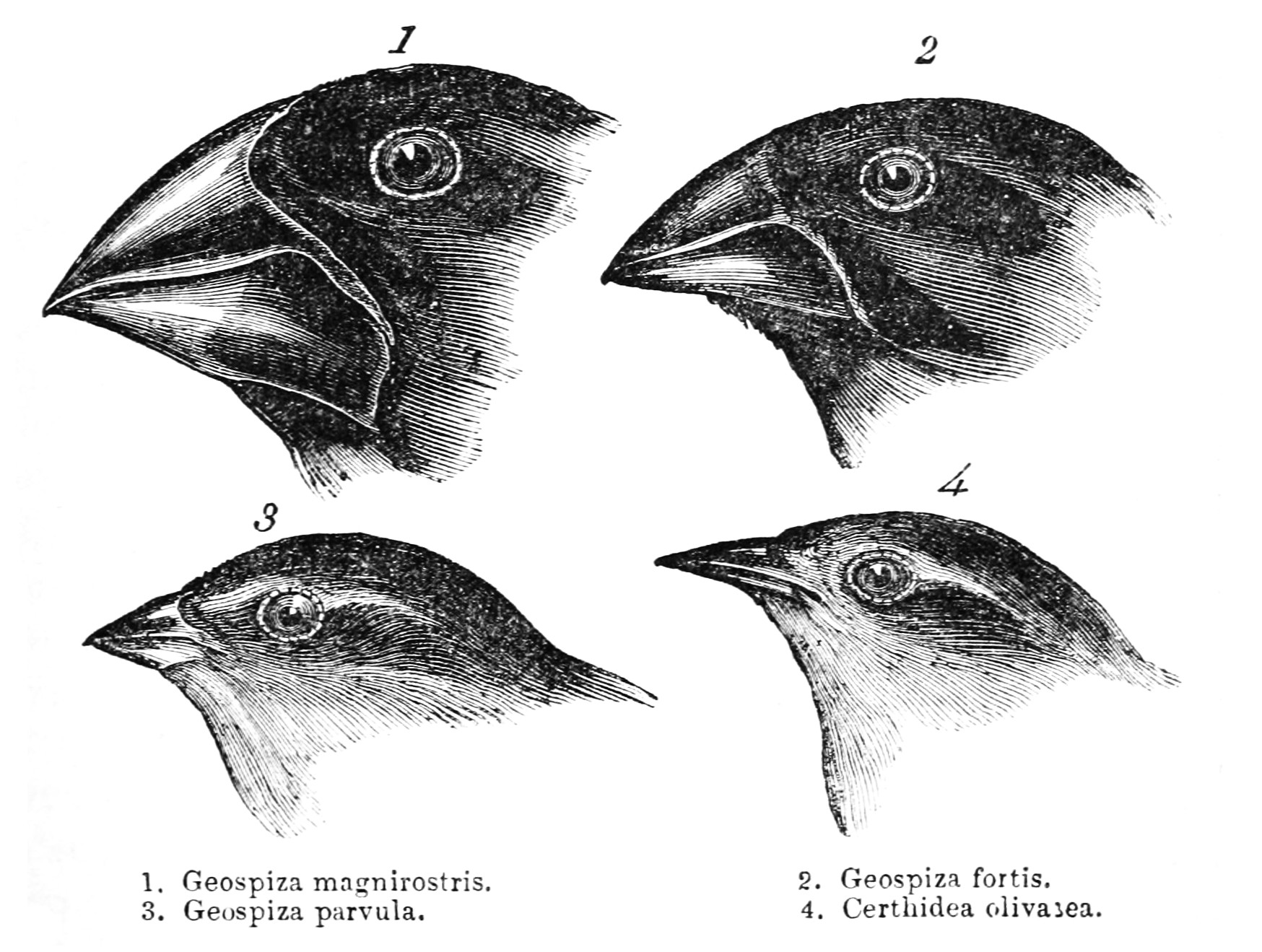
In 1835, Darwin collected small birds across the Galápagos Islands — a few hundred kilometres off the coast of Ecuador.
Back in London, ornithologist John Gould identified them: not varieties of one species, but more than a dozen distinct species of finch — found nowhere else on Earth.
Each island's finches had a differently shaped beak: thick and crushing, thin and probing, long and curved.
One Ancestor, Many Beaks
The beaks matched the food available on each island: hard seeds, soft fruit, insects, nectar.
Darwin's explanation: all the finches descended from a single ancestral species that reached the islands long ago.
On each island: beak-shape variation + a different food source + generations of selection → a different finch.
One ancestor. One mechanism. Many birds.
Why Finches Matter
The finches are not proof of evolution by themselves — but they are an unusually clean illustration of the engine in action, isolated on real islands, at a scale a visitor could actually observe.
Replication (finches breed finches), variation (beak shapes differ), selection (local food decides who thrives) — nothing more was needed.
So here is a strange question. Does this engine only run on carbon?
Universal Darwinism
Darwin described biological evolution. But notice: nothing in the three-step engine mentions DNA, cells, or carbon chemistry.
It only requires: entities that are copied, imperfectly, and then differentially filtered.
Richard Dawkins called this generalized claim Universal Darwinism: wherever you find replication + variation + selection, you will find evolution — in biology or anywhere else.
Beyond Carbon
The pattern shows up again and again, once you know to look for it:
your immune system selects among antibody variants for the ones that bind an intruder;
computer scientists breed populations of candidate solutions in “genetic algorithms”;
markets select among competing products and firms.
Could the same be true of ideas themselves?
Dawkins' Reframing
In 1976, Richard Dawkins published The Selfish Gene — and reframed the whole story.
It is not organisms that are the true unit of selection, he argued. It is the gene.
“We are survival machines — robot vehicles blindly programmed to preserve the selfish molecules known as genes.”
The Altruism Puzzle
Nature is full of altruism — vervet monkeys shout alarm calls that draw a predator's attention to themselves, worker bees die defending the hive, parents starve so their young can eat.
Selection should ruthlessly punish that. An organism that sacrifices its own survival to help another should leave fewer copies of itself behind — so how does self-sacrifice survive selection at all?
Dawkins' answer: look one level down. Kin selection (W.D. Hamilton) — a gene for helping relatives can spread if it helps enough copies of itself in their bodies, discounted by relatedness. Reciprocal altruism (Robert Trivers) — helping a non-relative who is likely to help you back.
The organism can be generous because the gene is not — it is simply exploiting every available route to more copies of itself, kinship and reciprocity included.
Replicators and Vehicles
Two roles, easy to confuse:
Replicator — the thing that gets copied. The gene.
Vehicle — the thing that is built, survives, and reproduces, carrying replicators inside it. The organism's body.
Selection acts on vehicles — but its lasting effect is on which replicators get copied into the next generation.
A Question Dawkins Asked
If the gene is just one possible kind of replicator…
…could there be others? Things that are copied, vary, and are selected — but are made of neither DNA nor protein?
Dawkins proposed there could. He needed just one more word.
The Second Replicator
“I think that a new kind of replicator has recently emerged on this very planet… I shall call it a meme.”
— Richard Dawkins, The Selfish Gene, 1976
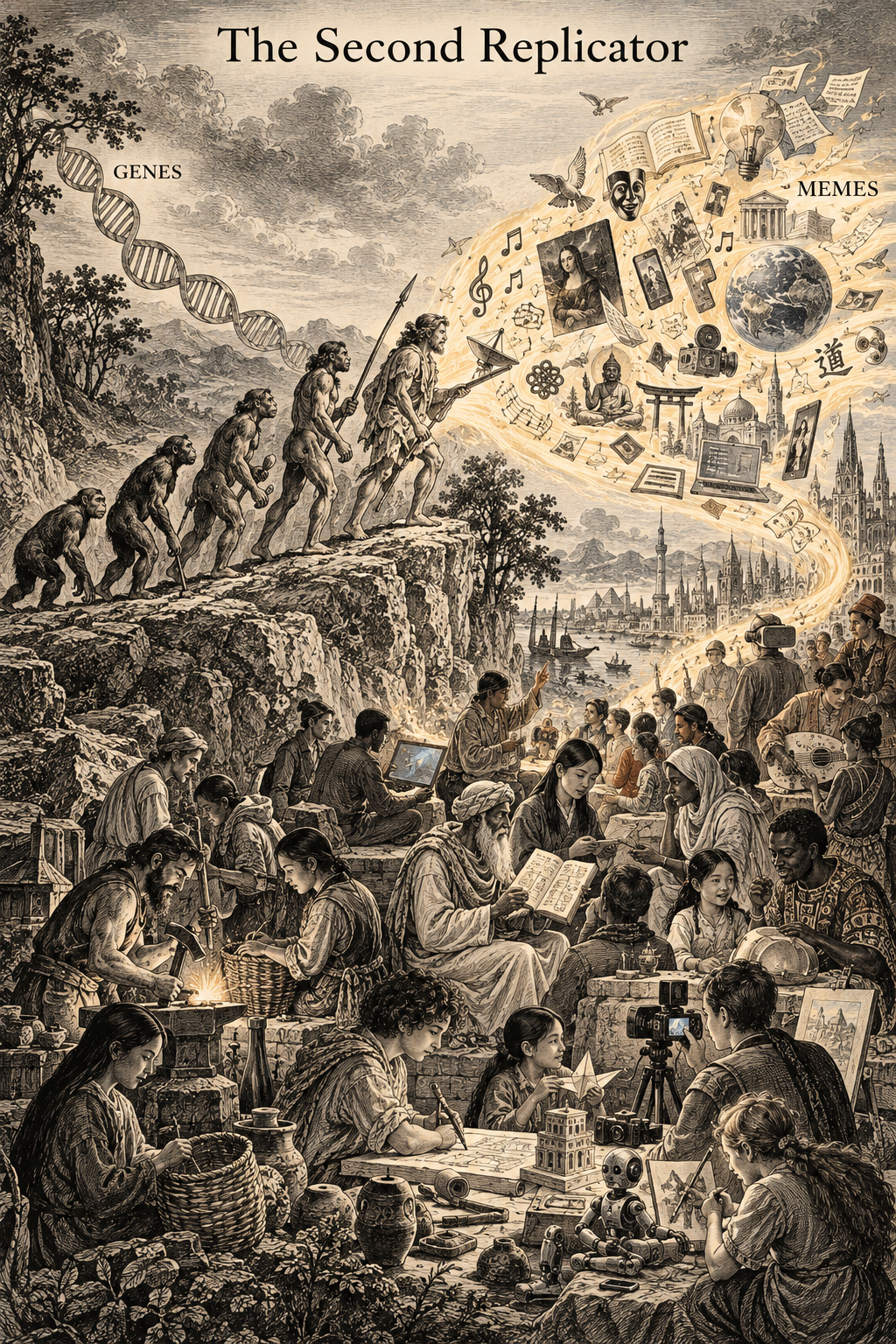
Tunes, catch-phrases, fashions, ways of making pots or building arches — copied from mind to mind, by imitation.
Genes and Memes Compared
Gene — replicated via reproduction; vehicle: the body; variation: mutation; selection: survival & reproduction.
Meme — replicated via imitation; vehicle: brains, books, screens; variation: mis-copying, reinterpretation; selection: attention, memorability, usefulness.
Same three-step engine. A completely different substrate.
Ideas in Motion
We began with finches on volcanic islands and ended with an idea that may be living, right now, inside each of you.
If memes are real replicators, then minds are their islands — and culture is the ongoing experiment.
In the sessions ahead, we will look much closer at how exactly this second replicator moves: through imitation, through everyday life, through law, politics, and the machines we now build.
