Cantos Hyperion
Licensed under ::
by ()
@


Cantos Hyperion

Hyperion is The Canterbury Tales rewritten through Homer, the Bible, Greek myth, and modern science fiction — each pilgrim carrying one archetype of humanity toward extinction or transcendence.

Illium & Olympus

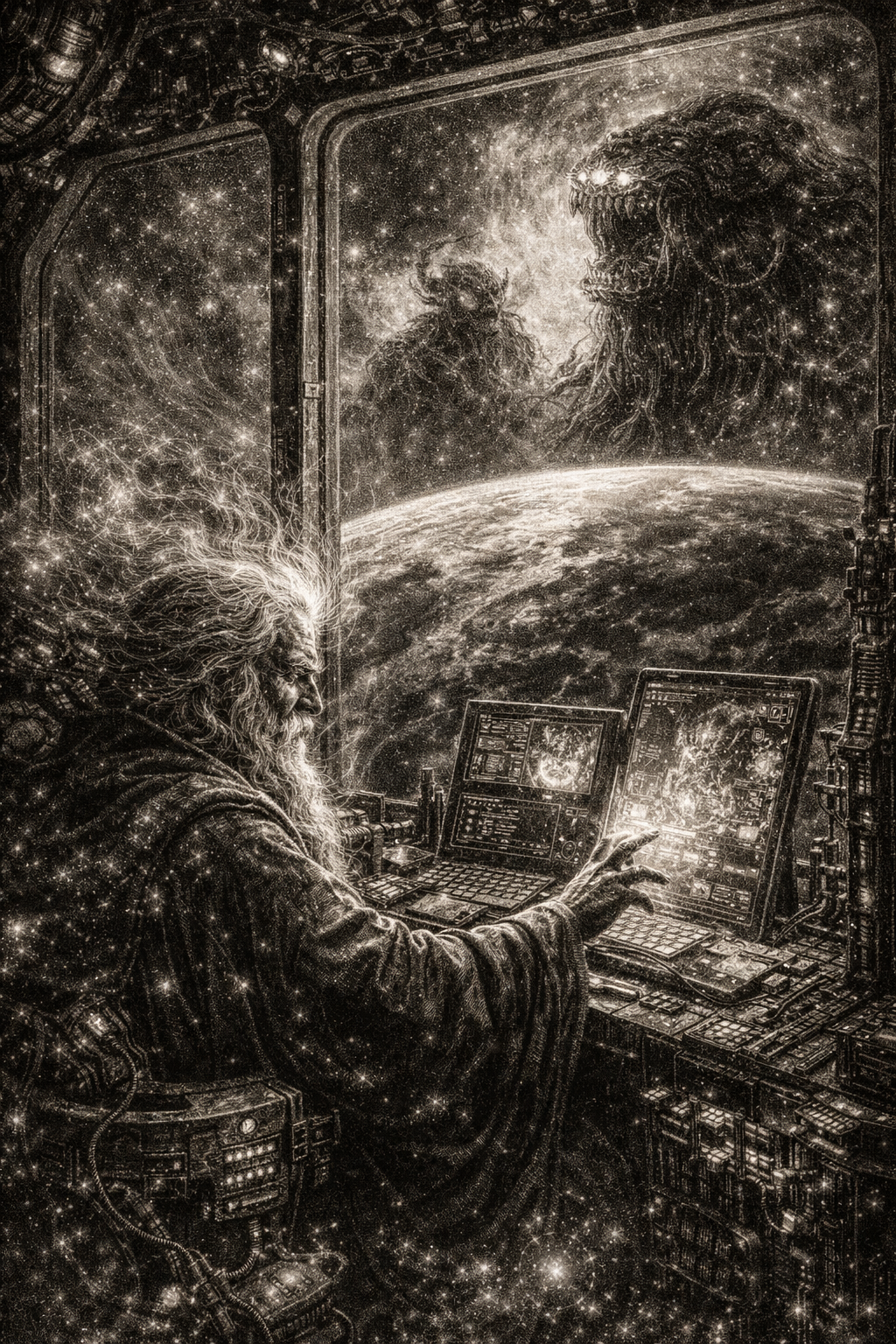
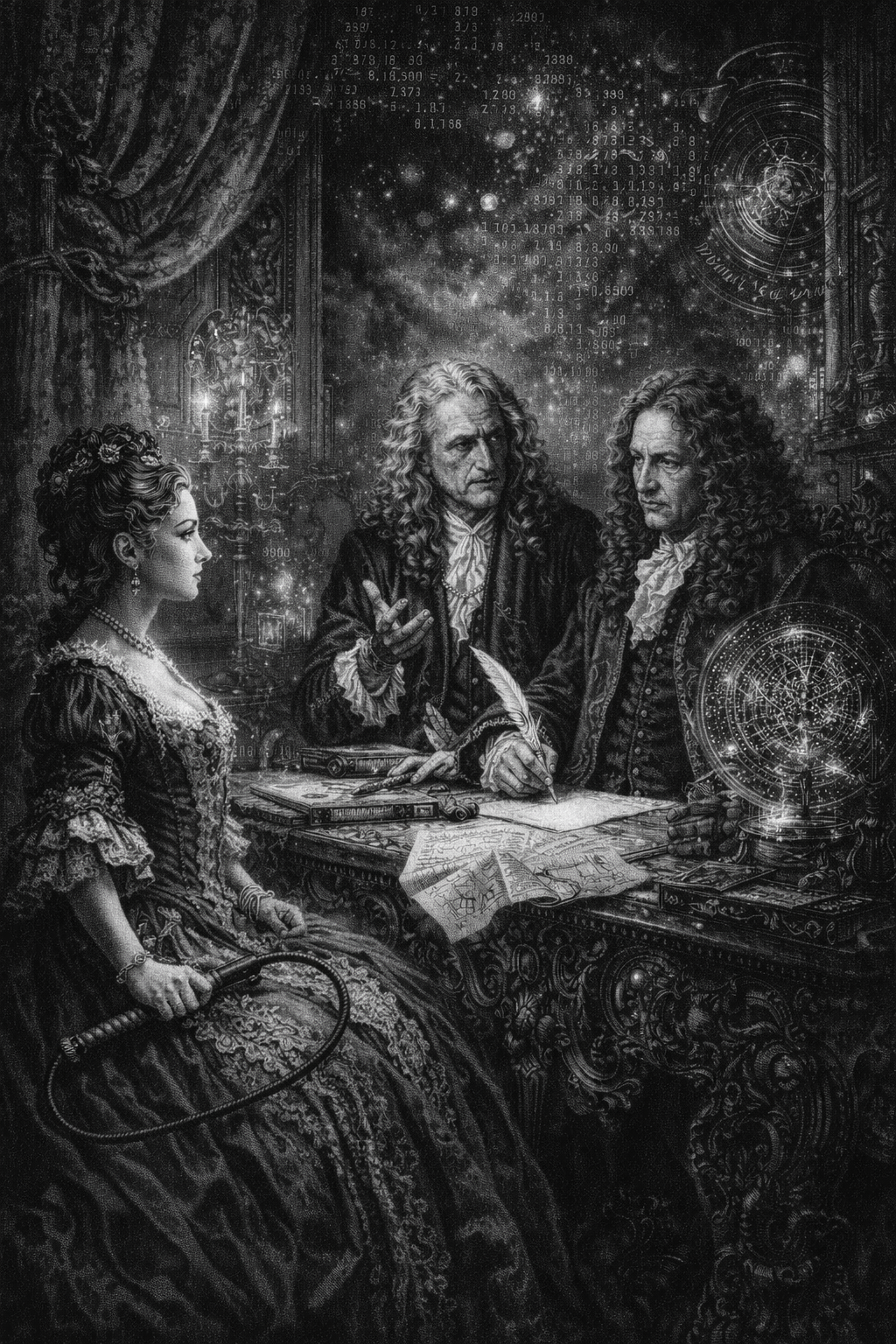
Prospero%2C%20the%20wizard-king%20from%20Shakespeare's%20Tempest%20reactivated%20as%20the%20avatar-of-the-noosphere%20behind%20the%20terminal%20on%20a%20Lagrange-point%20colony%2C%20checking%20that%20all%20is%20fine%20down%20on%20earth%20and%20both%20Caliban%20as%20well%20as%20Sethebos%20are%20kept%20at%20bay.

Prospero, the wizard-king from Shakespeare's Tempest reactivated as the avatar-of-the-noosphere behind the terminal on a Lagrange-point colony, checking that all is fine down on earth and both Caliban as well as Sethebos are kept at bay.

Dan Simmons (b. 1947) is one of science fiction’s great masters of intertextuality.

Following the four-book Hyperion Cantos (Hyperion, The Fall of Hyperion, Endymion, The Rise of Endymion), Simmons turns in Illium and Olympos to an even more radical literary experiment.

Drawing on William Shakespeare (from sonnets to The Tempest), Marcel Proust (À la recherche du temps perdu), Vladimir Nabokov (Ada), and the Iliad, the Illium–Olympos diptych does not merely reference classical texts — it reactivates them, pulling ancient Muses out of literature and into the reader’s present reality.

Through quantum technologies, parallel universes, temporal loops, and posthuman intelligences, Simmons performs narrative ingression par excellence: literature crossing its own boundary, entering history, physics, and consciousness itself.

Hegemony

In the Hyperion Cantos, the Hegemony is a human interstellar civilization of roughly 250–300 worlds, bound together by the Hegira—humanity’s mass migration from Old Earth after ecological collapse.

It exists in the late 28th century A.D., relying on farcasters, dataspheres, and the Technocore to maintain political unity, economic stability, and daily life.

Beneath its apparent prosperity, the Hegemony is fragile: technologically dependent, culturally shallow, and already falling apart as the Cantos begins...

Questio: The common framework

What does "Republic" in Star Wars, as well as "Empires" of  Dune and Foundation have in common with the "Hegemony" ?

7 pilgrims, 7 archetypes

Martin Silenus (The Poet) — Homer archetype: epic-maker, obscene bard, immortality via art.

Paul Duré (The Priest) — Teilhard de Chardin archetype: faith, suffering, “cosmic” theology.

Fedmahn Kassad (The Soldier) — Achilles archetype: warrior-fate, eroticized violence.

Sol Weintraub (The Scholar) — Abraham archetype: father tested by impossible sacrifice.

Brawne Lamia (The Detective) — Orpheus archetype: love descending into the underworld.

The Consul — Aeneas archetype: exile, duty, tragic founding of futures.

Het Masteen (The Templar) — Hermit (Tarot) archetype: withdrawal, ecological mysticism, otherness.

IOTD: The Technocore

In Cantos Hyperion, The Technocore is composed of following components:

Stables — conservative AIs, understanding the importance of Humanity and organic Life, they preserve the status quo.

Volatiles — descendants of Old Earth military-industrial complex AIs, Volatiles push for rapid evolution and consider humanity as an "unpredictable" risiko to be eradicated.

Ultimates — AIs pursuing the Ultimate Intelligence beyond spacetime. Operating primarily within the realm of Void-that-Binds, nobody has clue what Ultimates are ultimately (sic!) up to 😇

The oldest and the only explicitly named Technocore intelligence; a philosopher-AI who speaks in Zen koans (“kwatz!”), carries the name Ummon.

Ummon says ...

Our UI spans galaxies

uses quasars for energy sources

the way you might

have a light snack

Our UI sees everything that is

and was

and will be

and tells us selected bits

...

Never underestimate /Ummon says/

the power of a few beads

and trinkets

and bits of glass

over avaricious natives

Cyberpunk, solarpunk and other punkz


Schismatrix
💧 Schismatrix (1985) by Bruce Sterling is a foundational cyberpunk / post-cyberpunk novel set several centuries in the future, after humanity has spread throughout the Solar System. 

Schismatrix traces shifting power structures, techno-political factions, and posthuman experiments across habitats, asteroid states, and orbital societies. The novel explores identity beyond the human, evolution as ideology, and the instability of any technological orthodoxy—making it a crucial bridge between cyberpunk, transhumanism, and later post-cyberpunk currents.

Neuromancer

💧 Neuromancer (1984) by William Gibson is the novel that defined cyberpunk. Set in a near-future global sprawl, it follows Case, a washed-up hacker navigating megacorporations, AI entities, black markets, and a hallucinatory digital realm Gibson famously named cyberspace.

The book fuses high tech with low life: console cowboys, body modification, corporate power, fractured identities, and disembodied minds. More than a plot, Neuromancer is an atmosphere—where information is capital, reality is optional, and human agency is constantly negotiated with machines.

Metaverse

"So Hiro's not actually here at all. He's in a computer-generated universe that his computer is drawing onto his goggles and pumping into his earphones. In the lingo, this imaginary place is known as the Metaverse. Hiro spends a lot of time in the Metaverse. It beats the shit out of the U-Stor-It."

(Neal Stephenson, Snowcrash, 1992)

Nanopunk

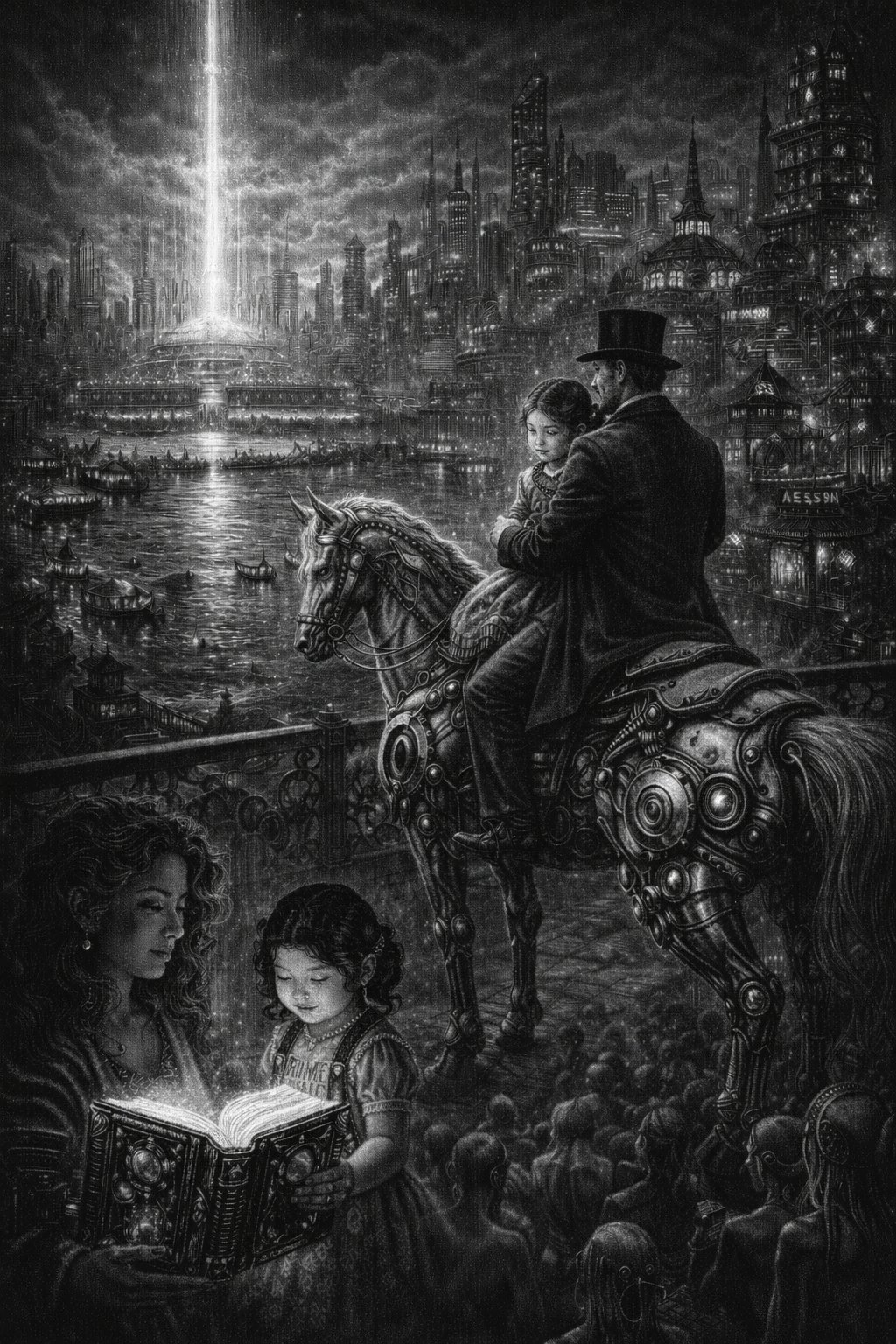
While%20observing%20the%20splendour%20of%20Atlantis-Shanghai%2C%20John%20Percival%20Hackworth%20whispers%20UNA's%20core%20instruction%20sequence%20into%20ears%20of%20his%20daugher%20Fiona.%20Mediated%20by%20Primer%20and%20Miranda%2C%20the%20sequence%20is%20also%20transferred%20into%20the%20Mind%20of%20little%20Nell%2C%20future%20queen%20of%20the%20Mouse%20Army.

While observing the splendour of Atlantis-Shanghai, John Percival Hackworth whispers UNA's core instruction sequence into ears of his daugher Fiona. Mediated by Primer and Miranda, the sequence is also transferred into the Mind of little Nell, future queen of the Mouse Army.

💧 Nanopunk is a speculative genre in which nanotechnology replaces industry, infrastructure, and scarcity itself, reorganizing society around control of matter at the molecular scale. 
 
Nanopunk narratives often revolve around the Seed–Feed dichotomy:

Feed systems provide regulated nanomaterial and energy—safe, standardized, and politically controlled&mdash

Seed (also known as "Universal Nano Assembler") represents autonomous, self-replicating fabrication: radical and emancipatory.

If cyberpunk is about hacking information, nanopunk is about programming reality itself—and deciding whether it should remain safely fed or allowed to grow wild.

The seminal nanopunk work is Stephenson's Diamond Age - or Young Lady's Primer.

Baroquepunk, Steampunk & co.

Baroquepunk is a speculative genre where ornament, excess, and early-modern worldviews collide with systems thinking. Inspired by Stephenson's Baroque Cycle, it treats the Baroque era (1650 - 1750) not as premodern, but as a proto-information age: obsessed with networks, cryptography, finance, science, and power.

Where steampunk reimagines the 19th century through steam, gears, and industrial optimism, baroquepunk digs earlier—into allegory, absolutism, colonial flows, alchemy, and spectacle.

Solarpunk

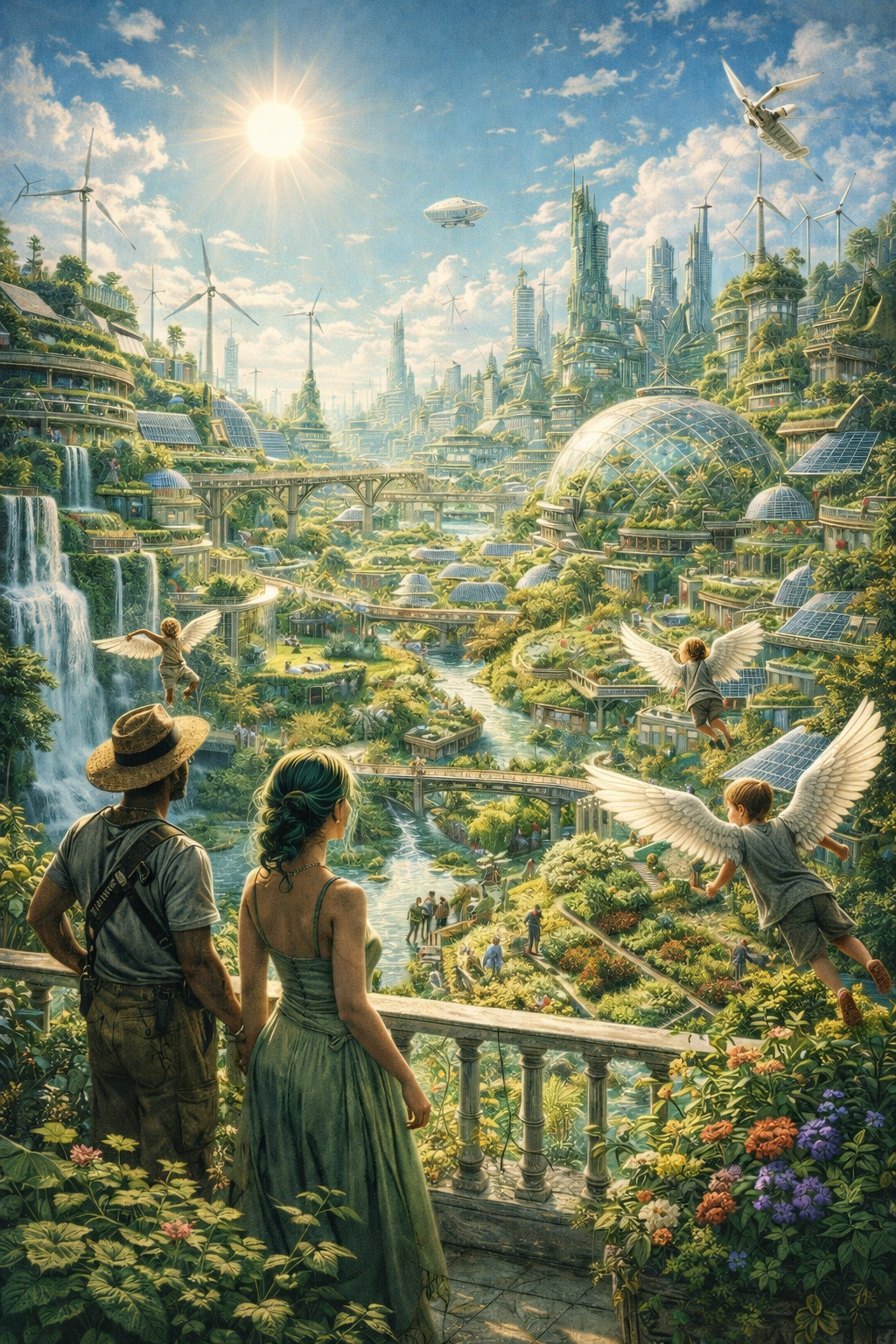
💧 Solarpunk is a speculative genre and cultural movement imagining desirable futures built on renewable energy, ecological repair, and social justice. Rooted in the ideas articulated in the Solarpunk Manifesto, it rejects dystopia as lazy inevitability and treats hope as a discipline.

Afrofuturism

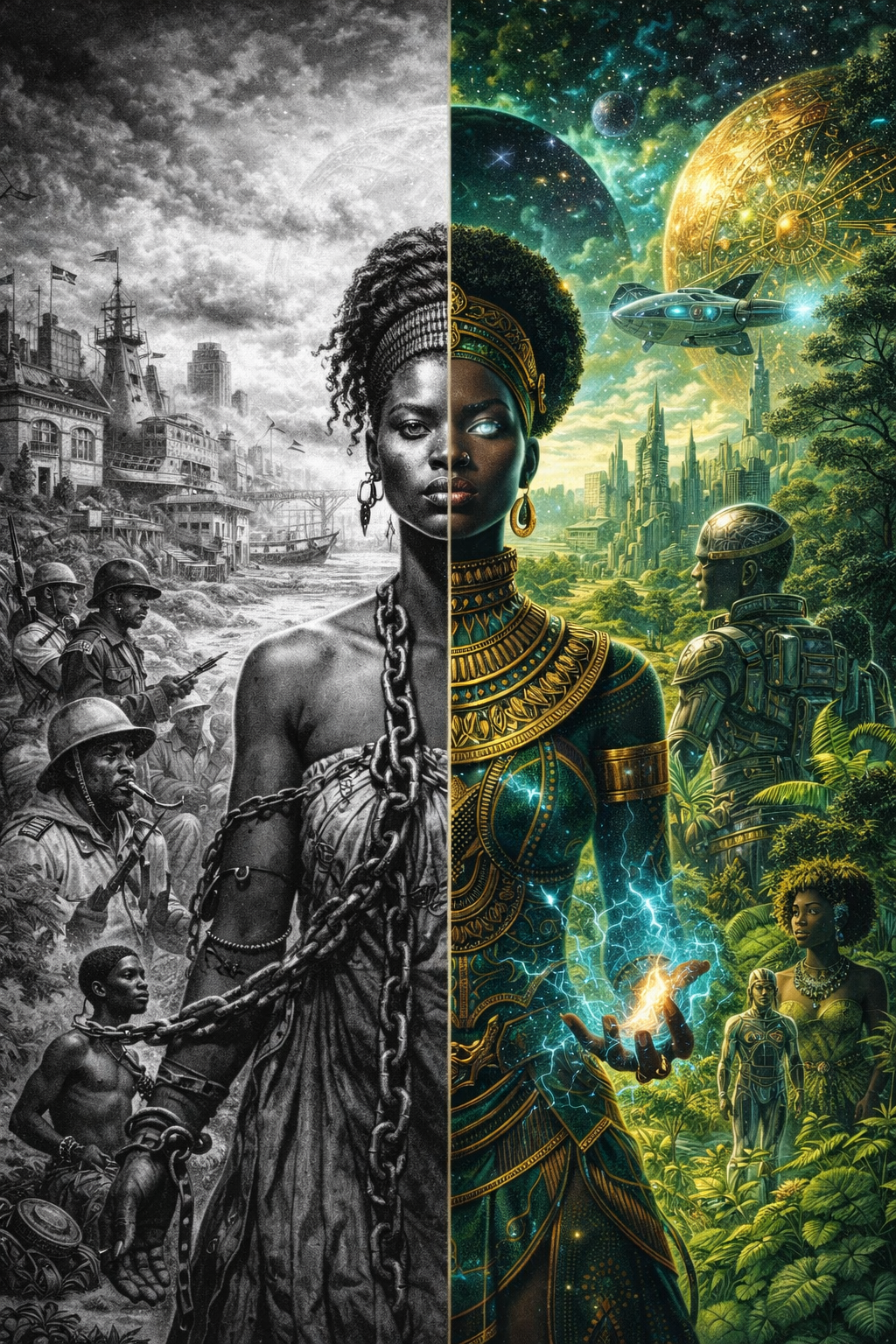
💧 Afrofuturism is a cultural and speculative framework that reimagines the past, present, and future through African and African-diasporic perspectives, blending science fiction, mythology, history, and technology. It challenges colonial narratives by placing Black people at the center of futures they were long excluded from, where ancestral memory, cosmology, and advanced science coexist. Afrofuturism treats technology as something spiritual as well as technical, often drawing on African traditions, music, fashion, and oral storytelling.

Authors to be aware of: Olivia E. Butler, Nnedi Okorafor and Samuel R. Delany

Berlinpunk

Can%20poodles%20fly%20%3F

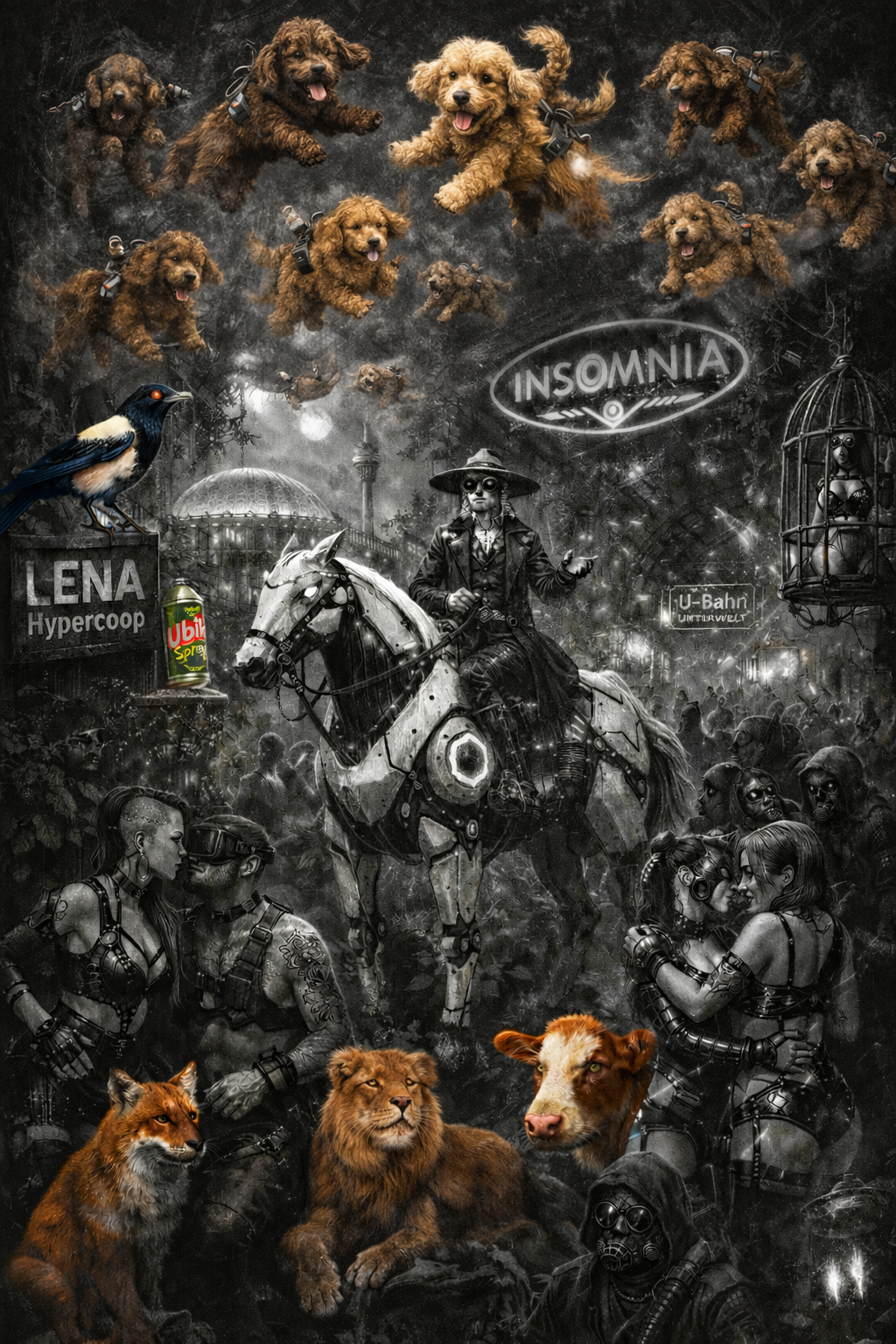
Can poodles fly ?

Imagine Berlin in 2300 / AE330. Is it still a city or did it turn into desert ? Or jungle ? Is UdK still planning to relocate to Tempelhof ? Do foxes still roam the streets ? What about trans-🐩, domesticated 🦁 and the 🐄 Liberation Army ? Did chevalines substituted cars completely or are there still some weirdos thinking that loud four-wheels bugs are actually cool? Is LENA (Lidl-Edeka-Netto-Aldi) a true cooperative or is it controlled from behind the shadows by a mysterious AI which manifests by a magpie (Elster)?

And, most importantly: How does Berlin underground look like after 15 generations of  Tresor, Sisyphos, Wilde Renate ... ?