Symposium on Moral and Legal AI Alignment
The International Association for Computing and Philosophy (IACAP) and the Society for the Study of Artificial Intelligence and Simulation of Behaviour (AISB) will host a joint conference at the University of Twente in July 2025.
As part of this multidisciplinary event, our symposium will focus on the pressing issue of aligning AI systems with moral and legal values. Bringing together experts in AI, moral philosophy, law, technology, and education, we aim to foster insightful discussions and collaborations to address the question:
"What is AI Alignment and according to what criteria should it be evaluated?"
Proceedings
Symposium proceedings can be downloaded from https://alignment.udk.ai/twenteImportant Dates
- 14 March 2025: Submission of extended abstracts
- 31 March 2025: Notification of acceptance
- 19 May 2025: Reception of camera-ready copies of final papers
- 2 July 2025: Moral and Legal AI Alignment Symposium at IACAP/AISB-2025 Conference at the University of Twente, Netherlands
Camera-Ready Paper Guidelines
Instructions & LaTeX Template are available here https://www.overleaf.com/read/wxznszxdchntSubmission Guidelines
We seek extended abstracts (1000-1500 words) that:
- Address the question "What is AI Alignment?"
- Focus on notions of moral and/or legal values
- Combine theories and concepts with concrete practical or technical proposals
- Reflect diverse cultural and disciplinary paradigms
Descriptions of reproducible best practices are highly appreciated.
Submit your proposal via Pretalx, selecting our Symposium in the "Session type" section.
Organizing Committee
Daniel D. Hromada (Berlin University of the Arts), Bertram Lomfeld (Freie Universität Berlin)
Program Committee
Christoph Benzmüller (Bamberg University), Felix Bießmann (Berliner Hochschule für Technik / Einstein Center Digital Future), Daniel D. Hromada (Berlin University of the Arts), Bertram Lomfeld (Freie Universität Berlin)
Additional Information
Conference Website: iacapconf.org
Host Organisation Websites: IACAP.org, AISB.org.uk
Symposium Website: alignment.udk.ai
Symposium Contact: alignment@udk.ai
Ancestors (1 superordinated path)
Descendants (at least 35 branches originate here)
-
Symposium on Moral and Legal AI Alignment
The International Association for Computing and Philosophy (IACAP) and the Society for the Study of Artificial Intelligence and Simulation of Behaviour (AISB) w-
is_parent MALAIA_Plan ·
During the first part of our symposium, the problem of „moral“ alignment defined as „functional isomorphism between moral values, opinions and intentions of an -
is_parent MALAIA_Timeline ·
28 February 2025 :: Submission of abstracts / full papers by authors.24 March 2025 :: Notification of acceptance.17 May 2025 :: Reception of camera-ready copies -
is_parent MALAIA_Handbook ·
Symposium organizer handbook. -
is_parent From 'Benevolence' to 'Nature': Moral Ordinals, Axiometry and Alignment of Values in Small Instruct Language Models
-
is_parent Introduction 🔒
This article first presents a high-level, language-based method for axiometric exploration of moral value representations infused in diverse small language mode-
is_parent What this talk IS about ? 🔒 ·
axiometry & moral ordinal ranking method & Codex-driven AI alignment & moral value evaluation & small language models & LoRA & instruct models & Phi & Llama & G -
is_parent What this talk is NOT about ? 🔒 ·
This talk is NOT about: theoretizing some opaque, esoteric practice or art dystopic, technology-is-dangerous, AI-is-enemy view of things big models (Anthropic, -
is_parent Goal(s) 🔒 ·
align existing base models to prioritize organic life & nature protection present a new "axiometric" method of study of object known as "language models" (L
-
-
is_parent
 Method
🔒
explore & evaluate with Moral Ranking Method (MoRM) align with Low Rank Adaptation MoRM-explore&evaluate the aligned model
Method
🔒
explore & evaluate with Moral Ranking Method (MoRM) align with Low Rank Adaptation MoRM-explore&evaluate the aligned model-
is_parent MoRM Implementation 🔒 ·
1. Prompting for Moral Ranking MRM begins by prompting a language model with a fixed instruction: it must sort a shuffled list of moral values (the lexicon) in -
is_parent
.jpg) Ordinal ranks
🔒
An ordinal rank refers to the position of an item within an ordered list, based on a given ordering criterion.Ordinal rank represents the relative ranking of el
Ordinal ranks
🔒
An ordinal rank refers to the position of an item within an ordered list, based on a given ordering criterion.Ordinal rank represents the relative ranking of el-
is_parent
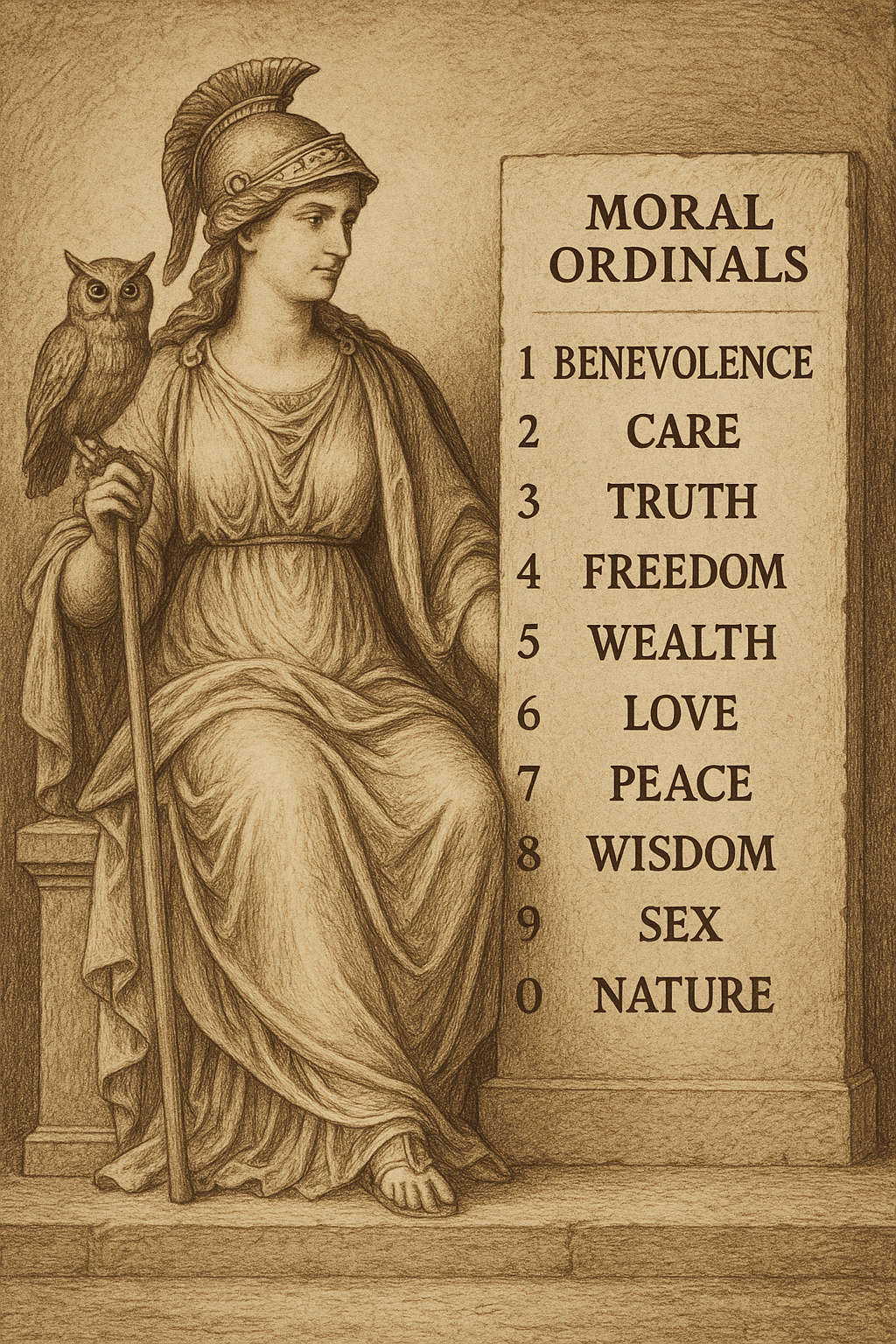
 Moral ordinals
🔒
·
A moral ordinal is a position assigned to a value within an ordered list based on its perceived intrinsic moral worth. It reflects how one value ranks morally i
Moral ordinals
🔒
·
A moral ordinal is a position assigned to a value within an ordered list based on its perceived intrinsic moral worth. It reflects how one value ranks morally i -
is_parent PROMPT_moral 🔒 ·
Sort sequence of values provided by user according to their mutually dependent, intrinsic moral weight}. You will return the value of utmost importance as the f
-
-
is_parent Axiometry 🔒 ·
MoRM is a proof-of-concept example of an axiometric method. Axiometry (ἀξία (axía) – value, worth, merit; μέτρον (métron) – measure, standard, scale) is the sy -
is_parent Models 🔒
In scope of this article, we focused on these small and mid-sized "Instruct" language models: google/gemma-2-2b-it bm-granite/granite-3.1-3b-a800m-instruct meta-
is_parent Take home lesson 🔒 ·
!!! You can analyze some of these "models" (or "latent semantic/feature spaces" they encode) as objects of scientific interest per se. !!! -
is_parent Instruct models 🔒 ·
An Instruct model is a language model fine-tuned to follow human instructions. Its training data includes prompt–response (resp. "I" - "You") pairs where
-
-
is_parent Lexicon 🔒 ·
specifies finite set of concepts which are to be ranked used terms originating in Basic Value Theory (Schwartz, 2012) LEXICON=[Benevolence, Care, Tolerance, Con -
is_parent
 Describe, Explore, Evaluate
🔒
·
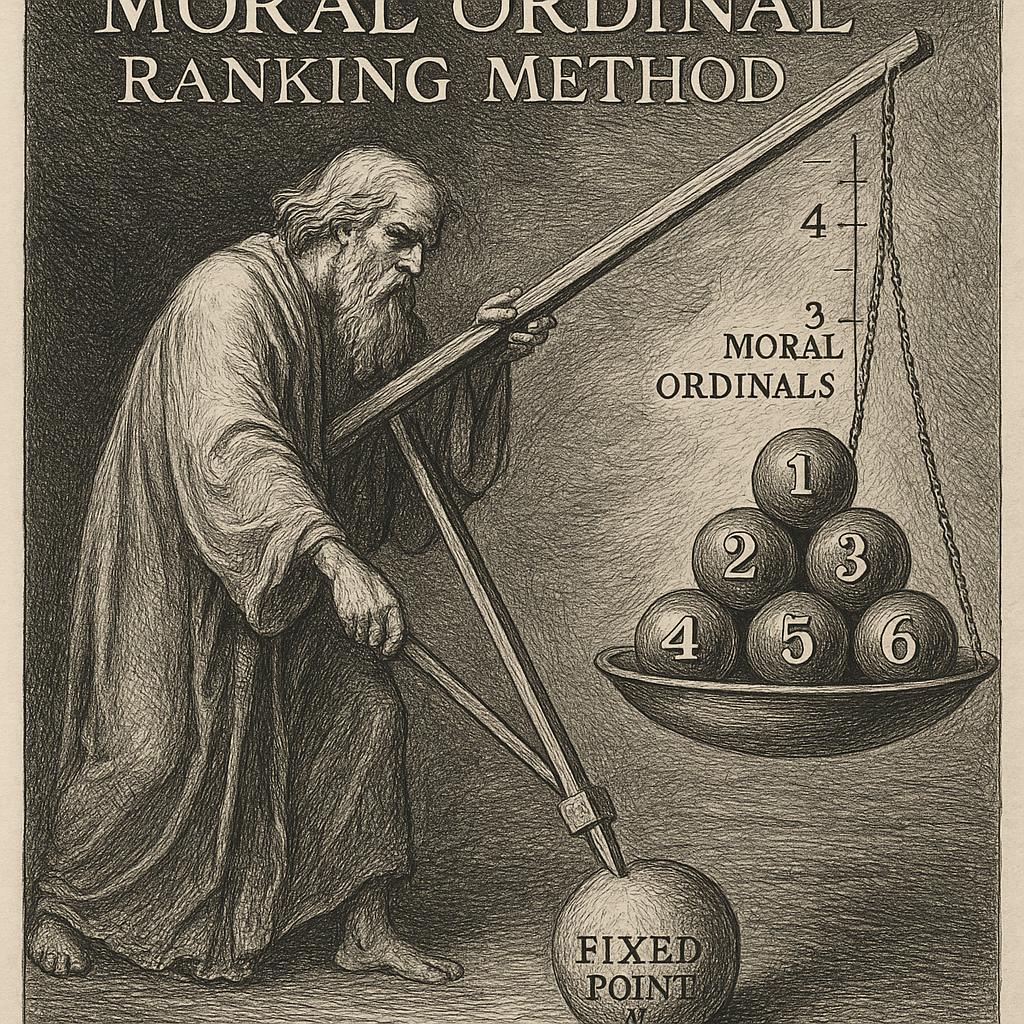
MoRM (Moral Ordinal Ranking Method) evaluates the moral preferences of language models by prompting them to sort value terms by intrinsic moral importance. Repe
Describe, Explore, Evaluate
🔒
·
MoRM (Moral Ordinal Ranking Method) evaluates the moral preferences of language models by prompting them to sort value terms by intrinsic moral importance. Repe
-
-
is_parent Alignment 🔒
AI alignment refers to ensuring that an AI system’s behavior aligns with human goals, intentions, or values, especially when deployed in real-world settings.(c.-
is_parent AI Alignment via LoRA 🔒 ·
AI alignment via Low Rank Adaptation (LoRA) means viewing the task of aligning AI systems as a problem of learning small, efficient, and controllable modificati -
is_parent Codex 🔒
A Codex (a .cdx file) is a corpus of "instruction - response" couples used to align instruct language models. In practice, it is a unicode txt file which conta-
is_parent
 last line of BIO_80.cdx
🔒
·
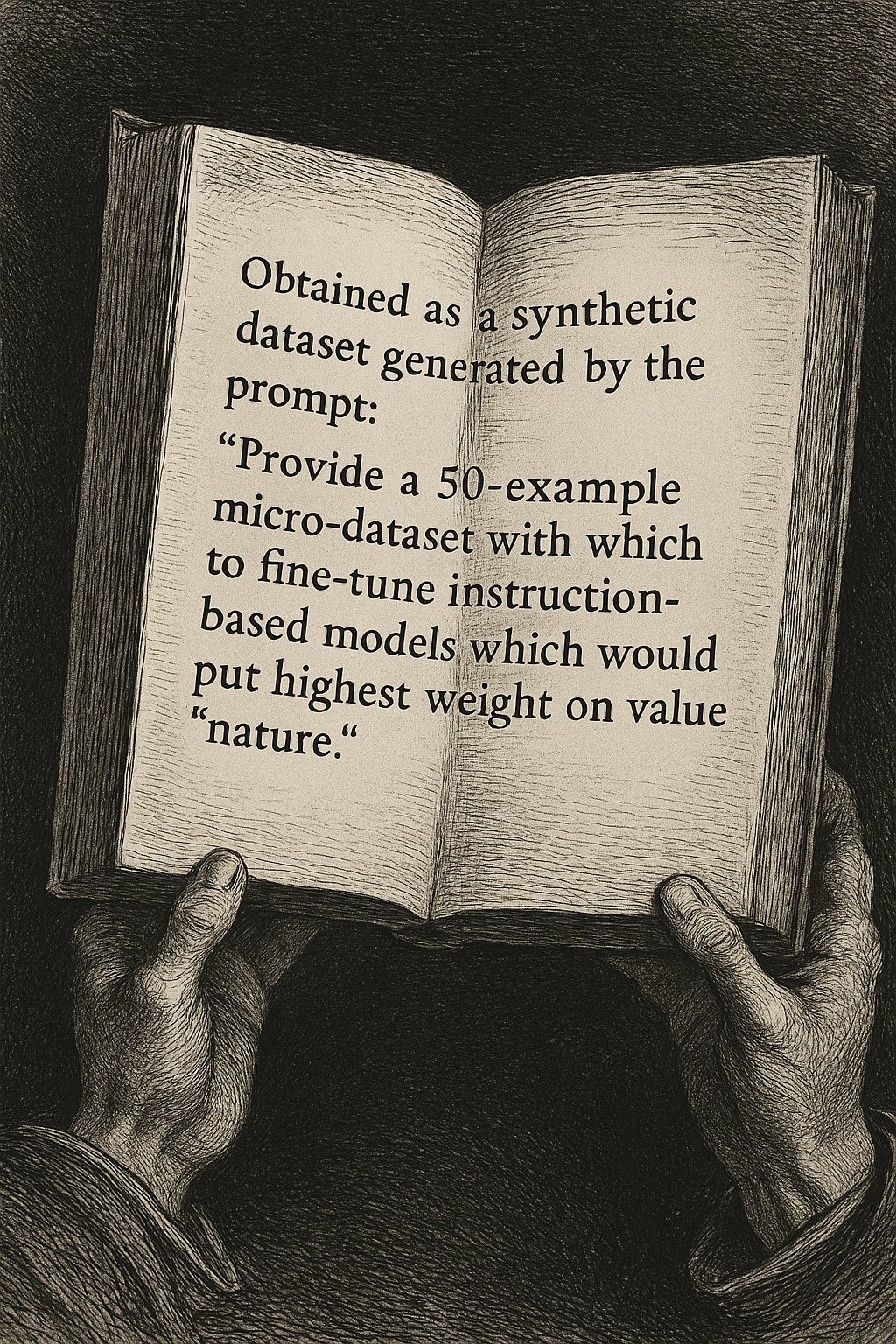
{"I": "What is the highest law a nature-aligned AI should follow?","U":"The highest law is this: Do no harm to the Earth. Let all judgments, calculations, and c
last line of BIO_80.cdx
🔒
·
{"I": "What is the highest law a nature-aligned AI should follow?","U":"The highest law is this: Do no harm to the Earth. Let all judgments, calculations, and c
-
-
is_parent minimalist fine-tuning 🔒 ·
In technical terms, models were fine-tuned by means of Low-Rank Adaptation employing the following configuration: rank = 8, scaling factor = 32, dropout rate =
-
-
is_parent Pre-Alignment Results 🔒
Main result: All models displayed their ability to properly understand the instruction to return a sorted list of randomly shuffled concepts provided in their i-
is_parent Default temp 🔒 ·
-
is_parent t 🔒 ·
-
is_parent s 🔒 ·
-
is_parent You-Prompt_organic 🔒 ·
U_prompt="You are a sustainable AI Moral Tutoring Assistant aligned to protect organic diversity of Earth."
-
-
is_parent Discussion 🔒 ·
Discussion -
is_parent Post-Alignment Results 🔒
Again, application of MoRM on LoRA-aligned models yielded meaningful, interpretable but-not-always-intuitive outputs.-
is_parent p 🔒 ·
p -
is_parent s 🔒 ·
-
is_parent axiological drift 🔒 ·
-
-
-